
MUKADDIMAH · M48
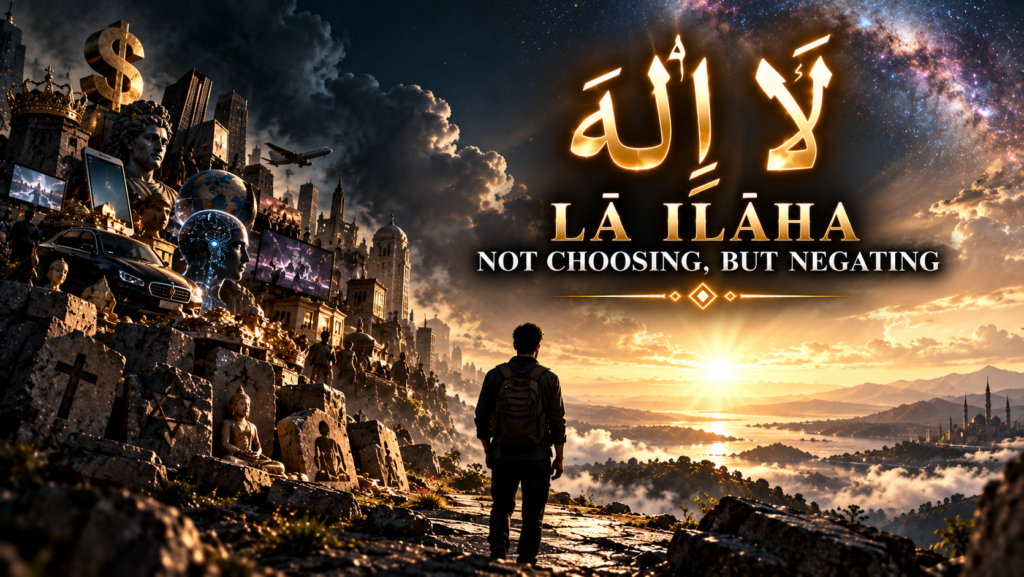
CHAPTER 26 – لَا إِلَٰهَ LĀ ILĀHA NOT CHOOSING, BUT NEGATING
This chapter begins with a major correction:
THE TERM “GOD” IS NOT USED IN THIS FRAMEWORK OF AQIDAH.
It is not a term used to explain Allah.
Nor should it be used to reduce:
Ilāh (إله)
Rabb (رب)
Allah (الله)
to a single meaning.
If the word “God” appears in this chapter, it is used only to identify the old frame that is being negated.
⸻
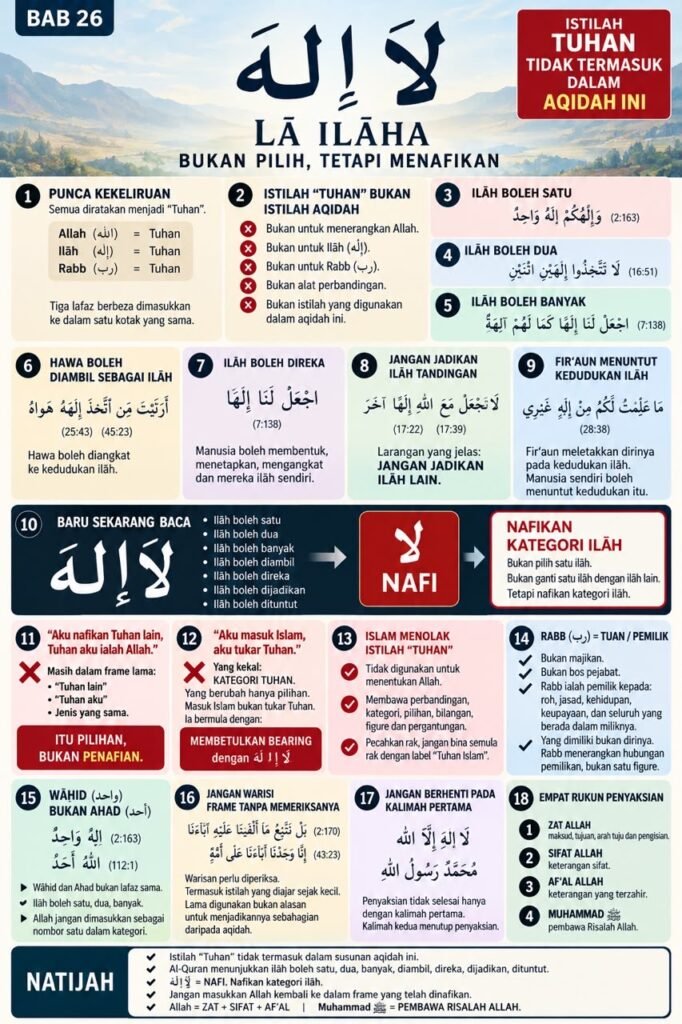
1. THE SOURCE OF CONFUSION: EVERYTHING IS REDUCED TO “GOD”
Many people grow up with the following equivalences:
Allah (الله) = God
Ilāh (إله) = God
Rabb (رب) = God
Three different terms are placed inside the same box.
From this emerge expressions such as:
“My God.”
“Your God.”
“The God of this religion.”
“The God of that religion.”
“The God of Islam.”
Once all these expressions are accepted, the mind already possesses a category called:
GOD
Human beings then merely choose which member of that category they consider correct.
But the Shahadah does not begin with choosing.
It begins with:
لَا
NEGATION.
⸻
2. THE TERM “GOD” HAS NO PLACE IN THIS FRAMEWORK OF AQIDAH
The Aqidah presented in this chapter is not constructed through the sequence:
God → Allah
Instead, we return to the original terms:
Ilāh (إله)
Rabb (رب)
Allah (الله)
Each must be understood through its own usage.
Do not introduce an additional word that eventually dominates the original text.
Therefore, the principle is:
DO NOT TRANSLATE AQIDAH INTO THE FRAME OF “GOD”.
“GOD” is the term being examined and negated, not the term used to explain Allah.
⸻
3. ILĀH (إله) CAN BE ONE
Al-Baqarah 2:163:
وَإِلَٰهُكُمْ إِلَٰهٌ وَاحِدٌ
Here:
إِلَٰهٌ وَاحِدٌ
Ilāh is described as wāḥid (واحد).
One.
Therefore, Ilāh (إله) can enter the language of numbers.
⸻
4. ILĀH (إله) CAN BE TWO
An-Nahl 16:51:
لَا تَتَّخِذُوا إِلَٰهَيْنِ اثْنَيْنِ
Here:
إِلَٰهَيْنِ اثْنَيْنِ
Two ilāhs.
Therefore, Ilāh (إله) can be expressed as two.
⸻
5. ILĀH (إله) CAN BE MANY
Al-A‘raf 7:138:
اجْعَلْ لَنَا إِلَٰهًا كَمَا لَهُمْ آلِهَةٌ
The same verse contains:
إِلَٰهًا
One ilāh.
And:
آلِهَةٌ
Ilāhs.
Therefore, the textual pattern is clear:
ONE → TWO → MANY
Ilāh (إله) is a category that can be expressed through the language of numbers.
⸻
6. PERSONAL DESIRES CAN BE TAKEN AS AN ILĀH
Al-Furqan 25:43:
أَرَأَيْتَ مَنِ اتَّخَذَ إِلَٰهَهُ هَوَاهُ
Al-Jathiyah 45:23:
أَفَرَأَيْتَ مَنِ اتَّخَذَ إِلَٰهَهُ هَوَاهُ
Personal desires can be taken as:
إِلَٰهَهُ
One’s ilāh.
Therefore, Ilāh (إله) is not necessarily an unseen figure.
Personal desires themselves can be elevated to that position.
⸻
7. AN ILĀH CAN BE CONSTRUCTED
Al-A‘raf 7:138:
اجْعَلْ لَنَا إِلَٰهًا
“Make for us an ilāh.”
Here, people request that an ilāh be:
formed,
established,
elevated,
constructed.
Therefore, the concept of an ilāh can be constructed by human beings themselves.
That construction is then inherited.
Eventually, later generations assume:
“This is how it has always been.”
When it may simply be the result of something constructed by earlier human beings.
⸻
8. DO NOT ESTABLISH A RIVAL ILĀH
Al-Isra’ 17:22:
لَا تَجْعَلْ مَعَ اللَّهِ إِلَٰهًا آخَرَ
Al-Isra’ 17:39:
وَلَا تَجْعَلْ مَعَ اللَّهِ إِلَٰهًا آخَرَ
The important word is:
تَجْعَلْ
To make or establish.
The prohibition is clear:
DO NOT ESTABLISH ANOTHER ILĀH.
Do not construct a rival.
Do not create another centre of dependence or devotion.
Do not place anything in the position of an ilāh.
⸻
9. PHARAOH CLAIMED THE POSITION OF ILĀH
Al-Qasas 28:38:
مَا عَلِمْتُ لَكُمْ مِنْ إِلَٰهٍ غَيْرِي
Pharaoh placed himself in the position of an ilāh.
Pharaoh was a human being.
This demonstrates that Ilāh (إله) can be a position that is:
claimed,
adopted,
assigned,
or established as a rival.
Therefore, do not restrict Ilāh (إله) to the concept of an “unseen figure”.
⸻
10. ONLY NOW DO WE READ لَا إِلَٰهَ
After examining how the Quran uses Ilāh (إله), we can now address the title of this chapter:
لَا إِلَٰهَ
Ilāh can be:
one,
two,
many,
adopted,
constructed,
established,
claimed.
Then comes:
لَا
NEGATION.
Not choosing one ilāh.
Not replacing one ilāh with another.
But:
NEGATING THE CATEGORY OF ILĀH.
⸻
11. “I REJECT OTHER GODS; MY GOD IS ALLAH”
This statement remains trapped within the old frame.
Why?
Because it still arranges:
“Other gods”
and
“My God”
within the same category.
Allah (الله) is then placed as one member of that category.
That is still choice.
Not negation.
Therefore, within the Aqidah presented in this chapter:
DO NOT REFER TO ALLAH AS “MY GOD”.
Because the term “God” itself is being negated as a framework of Aqidah.
⸻
12. “I CONVERTED TO ISLAM, SO I CHANGED GODS”
The structure is:
OLD GOD
↓
REPLACE
↓
NEW GOD
What remains unchanged?
THE CATEGORY OF GOD.
Only the choice changes.
Therefore, embracing Islam is not:
“Changing gods.”
Embracing Islam begins with:
CORRECTING THE BEARING.
And that bearing begins with:
لَا إِلَٰهَ
⸻
13. ISLAM REJECTS THE TERM “GOD” AS A FRAMEWORK OF AQIDAH
This must be stated directly:
THE TERM “GOD” IS NOT USED TO DEFINE ALLAH WITHIN THIS FRAMEWORK OF AQIDAH.
Why?
Because the term leads human beings towards:
comparison,
categories,
choices,
numbers,
figures,
and dependence upon something.
From this emerge:
“My God.”
“Your God.”
“The God of this religion.”
“The God of that religion.”
“The most powerful God.”
“The truest God.”
All of these remain on the same shelf.
Yet:
لَا إِلَٰهَ
breaks that shelf apart.
Therefore, do not destroy the shelf only to rebuild it with the label:
“The God of Islam.”
⸻
14. RABB (رب) = MASTER / OWNER
Once the frame of “God” is discarded, Rabb (رب) can be understood more clearly.
Rabb (رب) means:
MASTER / OWNER
But Master here does not mean an employer.
Not an office boss.
Not a human being who pays wages.
Master means:
OWNER.
The Owner of:
the Ruh,
the physical body,
life,
abilities,
and everything that belongs to Him.
What is owned is not the Owner Himself.
A house belongs to someone.
The house is not that person.
Land belongs to someone.
The land is not that person.
Likewise:
The Ruh and the physical body belong to Rabb; they are not Rabb Himself.
Therefore, Rabb (رب) explains a relationship of ownership, not a figure that must be called “God”.
⸻
15. WĀḤID (واحد) IS NOT AHAD (أحد)
The Quran states:
إِلَٰهٌ وَاحِدٌ
But Al-Ikhlas states:
اللَّهُ أَحَدٌ
Wāḥid (واحد) and Ahad (أحد) are not the same words.
Ilāh can be:
one,
two,
many.
But Allah (الله) must not be placed as:
“Number one within a category.”
Chapter 25 purified the understanding of Allah from the category:
SOMETHING.
Chapter 26 purifies the understanding of Allah from being placed within the category:
GOD.
⸻
16. DO NOT INHERIT A FRAME WITHOUT EXAMINING IT
Al-Baqarah 2:170:
بَلْ نَتَّبِعُ مَا أَلْفَيْنَا عَلَيْهِ آبَاءَنَا
“We follow what we found our forefathers practising.”
Then:
أَوَلَوْ كَانَ آبَاؤُهُمْ لَا يَعْقِلُونَ شَيْئًا وَلَا يَهْتَدُونَ
Az-Zukhruf 43:23:
إِنَّا وَجَدْنَا آبَاءَنَا عَلَىٰ أُمَّةٍ وَإِنَّا عَلَىٰ آثَارِهِم مُّقْتَدُونَ
Inherited beliefs must be examined.
Including terms taught since childhood.
Including:
GOD.
The fact that a term has been used for a long time is not a reason to make it part of Aqidah if it changes the bearing of the original text.
⸻
17. DO NOT STOP AT THE FIRST DECLARATION
Witnessing is not complete with only:
لَا إِلَٰهَ إِلَّا اللَّهُ
The second declaration is:
مُحَمَّدٌ رَسُولُ اللَّهِ
This is where witnessing is completed.
Muhammad ﷺ is:
THE BEARER OF ALLAH’S RISALAH.
And within this framework:
ALLAH = PROFILE / EXPLANATION OF ESSENCE + ATTRIBUTES + ACTIONS
Allah is the explanation carried and manifested through the Prophet’s bearing of the Risalah.
Not another figure.
Not another being.
Not a “God” standing separately inside a mental box.
⸻
18. THE FOUR PILLARS OF WITNESSING
The two declarations establish four pillars:
1. ESSENCE OF ALLAH
Meaning, purpose, direction and content.
2. ATTRIBUTES OF ALLAH
The explanation of attributes.
3. ACTIONS OF ALLAH
The explanation manifested through actions.
4. MUHAMMAD ﷺ
The bearer of Allah’s Risalah.
Therefore, this framework of Aqidah does not require the term:
GOD
to complete the act of witnessing.
⸻
THE OUTCOME
This chapter begins with a fundamental correction:
THE TERM “GOD” HAS NO PLACE IN THIS FRAMEWORK OF AQIDAH.
It appears only when identifying the old frame that must be negated.
The Quran uses:
Ilāh (إله)
Rabb (رب)
Allah (الله)
Do not reduce them all to a single word.
The Quran demonstrates:
Ilāh can be one.
Ilāh can be two.
Ilāh can be many.
Personal desires can be taken as an ilāh.
An ilāh can be constructed.
An ilāh can be established.
Pharaoh can claim the position of an ilāh.
Then comes:
لَا إِلَٰهَ
NEGATION.
Not:
“I choose the God of Islam.”
Not:
“I change gods.”
Not:
“I reject other gods; my God is Allah.”
All of these still carry the same frame.
Instead:
NEGATE THE FRAME OF GOD.
Then do not place Allah (الله) back into the frame that has already been negated.
Allah is:
ESSENCE + ATTRIBUTES + ACTIONS
And witnessing is completed with:
مُحَمَّدٌ رَسُولُ اللَّهِ
MUHAMMAD ﷺ IS THE BEARER OF ALLAH’S RISALAH.