
MUKADDIMAH · M49
CHAPTER 27 -THE FOUR PILLARS OF WITNESSING , AQIDAH BEGINS WITH HOW WE RECOGNISE
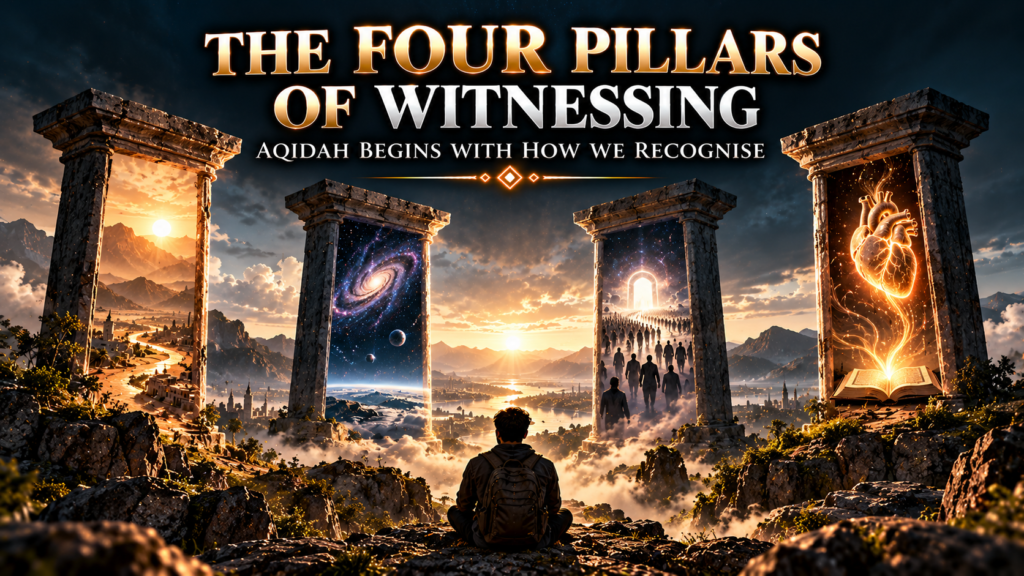
Aqidah is not about memorising names.
Nor does Aqidah begin by looking at a figure and immediately assigning attributes to it.
The more fundamental question is:
HOW DO HUMAN BEINGS RECOGNISE AN IDENTITY?
Human beings do not recognise someone’s profile merely by looking at their body.
A figure that does nothing does not provide enough information for people to understand who that individual is.
The individual must:
move,
speak,
give,
reject,
choose,
act.
Through actions, human beings begin to recognise attributes.
From the collection of attributes repeatedly manifested through actions, human beings eventually form a conclusion about:
PROFILE / ESSENCE.
Therefore, the process of recognition follows:
ACTIONS → ATTRIBUTES → ESSENCE
⸻
1. A FIGURE IS NOT A PROFILE
Consider a person named:
Ali.
“Ali” refers to the individual or his personal identity.
But when Ali speaks, we do not say:
“Speaking is Ali.”
No.
Ali = the doer.
Speaking = Af‘al (Action).
From the way Ali speaks, we may conclude that he is:
polite, firm, gentle, harsh or truthful.
These are:
ATTRIBUTES.
Only after observing many attributes through many actions can we form a conclusion about who Ali really is.
That is his:
PROFILE.
⸻
2. AN ACTION CANNOT BE CALLED BY THE NAME OF THE INDIVIDUAL
For example:
Ali gives.
“Ali” is the individual.
“Giving” is the action.
We do not say:
“Giving is Ali.”
Likewise:
Ali speaks.
“Speaking” is not Ali.
Speaking is an action performed by Ali.
Through that action, human beings recognise attributes.
Therefore, language itself teaches us not to confuse:
the doer,
the action,
the attributes,
and the profile.
⸻
3. ATTRIBUTES ARE ALSO NOT THE INDIVIDUAL
Suppose Ali repeatedly helps others.
From those actions, people conclude that he is:
generous.
“Generous” is not Ali’s body.
Not his hands.
Not his face.
Not another object.
It is an:
ATTRIBUTE.
The same applies to:
loving,
patient,
firm,
trustworthy,
truthful.
All of these are descriptions.
⸻
4. THE PROFILE IS ESTABLISHED LAST
This is important.
Human beings should not begin by saying:
“This is his profile.”
And then force every action to fit that initial assumption.
A more intellectually honest method is:
observe the Actions,
identify the Attributes,
then conclude the Essence/Profile.
Therefore:
ACTIONS → ATTRIBUTES → ESSENCE
is the method of recognition.
Whereas:
ESSENCE → ATTRIBUTES → ACTIONS
is the method of explanation once the profile has already been recognised.
These two directions must not be confused.
⸻
5. PROFILE = ESSENCE
Within the framework of this book:
ESSENCE = PROFILE
Essence refers to:
meaning,
purpose,
direction,
content,
the essential nature of an identity.
But Essence cannot be recognised merely by observing a motionless figure.
It is recognised through:
Attributes,
which are themselves known through:
Actions.
Therefore, a profile is not a hidden object inside the body.
A profile is the conclusion drawn about an identity.
⸻
6. WHY IS THE PROFILE OF MUHAMMAD ﷺ NOT CALLED “MUHAMMAD”?
Because Muhammad ﷺ is the name of the individual and bearer.
A profile is not the individual.
An action is not the individual.
An attribute is not the individual.
Therefore, when discussing a profile, attribute or action, language does not necessarily repeat the individual’s name.
It may use:
pronouns,
descriptions of attributes,
or descriptions of actions.
Just as in the sentence:
“Ali speaks.”
We do not name the act of “speaking” as “Ali”.
Likewise, the Prophet’s profile cannot simply be equated with the name of the individual Muhammad.
The name identifies the bearer.
The profile explains the identity recognised through what the bearer manifests.
⸻
7. MUHAMMAD ﷺ IS THE BEARER
This is where the fourth pillar becomes clear.
The first three pillars are:
Essence,
Attributes,
Actions.
The fourth pillar is:
MUHAMMAD ﷺ — THE BEARER OF THE RISALAH
He is the individual who carries the Risalah, enabling human beings to witness:
Actions,
recognise Attributes,
and ultimately understand the Essence/Profile.
Therefore, do not confuse:
the name of the bearer
with:
the explanation of the profile.
⸻
8. ALLAH = THE EXPLANATION OF ESSENCE + ATTRIBUTES + ACTIONS
Within this framework:
ALLAH = THE EXPLANATION OF ESSENCE + ATTRIBUTES + ACTIONS
Not a figure.
Not an imagined being.
Not an entity that must be visualised.
This explanation is recognised through the same method:
ACTIONS → ATTRIBUTES → ESSENCE
Human beings observe what becomes manifest.
From that, they recognise attributes.
From the collection of attributes and actions, they understand the profile/Essence.
⸻
9. THE FOUR PILLARS OF WITNESSING
Therefore, the four pillars are:
1. ESSENCE (ZAT)
Profile / essence.
2. ATTRIBUTES (SIFAT)
Characteristics that explain the profile.
3. ACTIONS (AF‘AL)
Actions that manifest the attributes.
4. MUHAMMAD ﷺ
The bearer of the Risalah who makes that explanation observable.
But the sequence of recognition is:
ACTIONS → ATTRIBUTES → ESSENCE
And the sequence of explanation, once recognition has occurred, is:
ESSENCE → ATTRIBUTES → ACTIONS
Muhammad ﷺ is the bearer through whom this witnessing becomes possible.
⸻
10. THIS IS THE SUBJECT OF PHILOSOPHY
Aqidah is not about memorising a list and stopping there.
It concerns:
what,
why,
how,
who,
relationships,
causes,
outcomes.
This is the work of reason.
The Quran repeatedly calls upon human beings to:
use reason,
think,
see,
observe,
reflect and learn.
Therefore, Aqidah without the exercise of reason contradicts the very purpose of witnessing.
If memorisation alone were sufficient, why would there be so many calls for human beings to use their intellect?
⸻
11. EVIDENCE IS NOT LIMITED TO NAQLI
When an argument is presented and someone asks:
“Where is your evidence?”
What they often mean is:
“Where is the Quranic verse or hadith?”
But in the pursuit of knowledge, evidence is not limited to Naqli.
There is also:
DALIL AQLI — RATIONAL EVIDENCE.
An argument that:
is reasonable,
is consistent,
does not contradict reality,
and does not contradict the revealed texts as a whole,
also constitutes evidence.
Dalil Aqli is not the enemy of Dalil Naqli.
They work together.
⸻
12. THE CONDITIONS OF DALIL AQLI
Rational evidence must not become unrestricted imagination.
It must:
be consistent with all relevant revealed texts,
not contradict language,
not contradict the structure of the verses,
not contradict sound reasoning,
and be testable through the universe and the human self.
Therefore, the method is:
NAQLI + AQLI
Not:
Naqli without thinking.
And not:
Aqli without revealed texts.
⸻
13. MEMORISATION WITHOUT REASON PRODUCES INCONSISTENCY
Problems arise when people memorise many descriptions separately but never bring them together through logical reasoning.
In one place, someone says:
“Allah is not a thing.”
Elsewhere, the same person imagines Allah as a figure.
In one place, someone says:
“Nothing resembles Him.”
Elsewhere, the same person assigns direction, location and relative relationships.
In one place, someone says:
“Attributes are not created beings.”
Elsewhere, those attributes are imagined as entities.
This is inconsistency.
Not because of insufficient memorisation.
But because the memorised information has never gone through the process of:
THINK → TEST → CONNECT → UNDERSTAND.
⸻
14. REASON IS NOT THE ENEMY OF REVEALED TEXTS
A major mistake is assuming:
“If we use reason, we might end up opposing the revealed texts.”
Yet reason is used to:
read the revealed texts,
understand their language,
connect one verse with another,
distinguish literal wording from intended meaning,
and test conclusions to ensure they are not contradictory.
Without reason, human beings may possess only sounds.
But not necessarily understanding.
⸻
15. REVEALED TEXTS PROVIDE THE CODE — REASON UNLOCKS THE CODE
The method of this book remains:
TEXT = CODE
Reason reads the code.
Thinking examines and unpacks its structure.
Understanding is the result.
Witnessing occurs when that result can be recognised within the self and the universe.
Therefore:
NAQLI PROVIDES THE CODE
AQLI UNCOVERS THE RELATIONSHIPS WITHIN THE CODE
WITNESSING TESTS THE RESULT
⸻
THE OUTCOME
The four pillars of witnessing cannot be studied merely as four terms to memorise.
They form a method of recognition:
ACTIONS → ATTRIBUTES → ESSENCE
Actions are observed.
From actions, attributes are identified.
From the collection of attributes and actions, the profile/Essence is recognised.
Then there is:
MUHAMMAD ﷺ — THE BEARER OF THE RISALAH
who carries that explanation so it can be witnessed.
Therefore:
Muhammad ﷺ = the name of the individual/bearer.
Af‘al = his actions.
Sifat = the characteristics recognised through those actions.
Zat = the profile concluded from the whole.
And that is why Aqidah is not merely a subject of memorisation.
AQIDAH IS A SUBJECT OF PHILOSOPHY.
It requires:
Dalil Naqli — Transmitted Evidence
and:
Dalil Aqli — Rational Evidence.
As long as a rational argument does not contradict all the relevant revealed texts, it is not an enemy of religion.
It is a tool for ensuring that religion does not become a collection of memorised statements that contradict one another.
WHEN MEMORISATION IS NOT EXAMINED THROUGH REASON, INCONSISTENCY EMERGES.
WHEN REVEALED TEXTS AND REASON WORK TOGETHER, WITNESSING EMERGES.