

MUKADDIMAH · M47
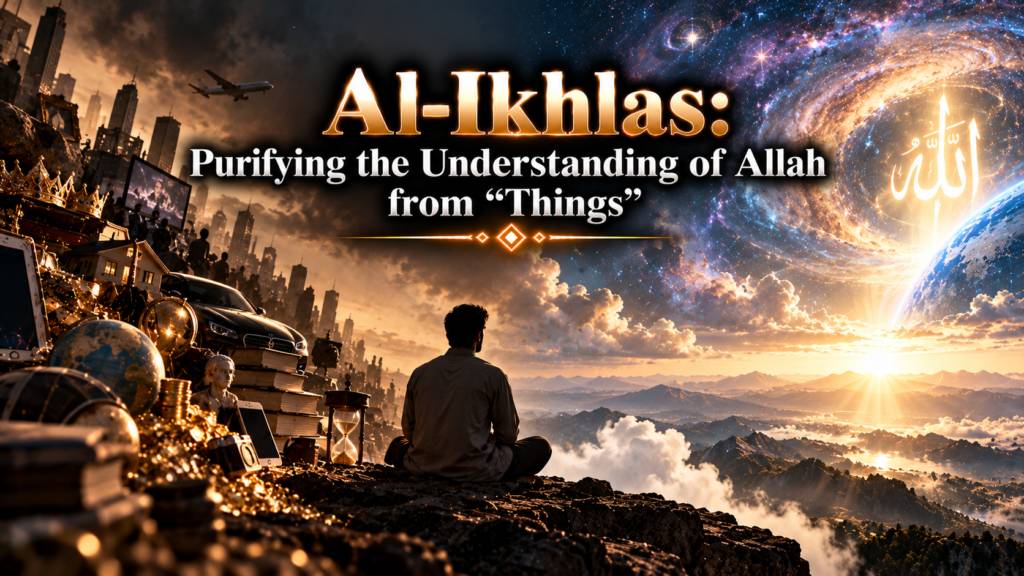
The name of this surah itself is:
الإِخْلَاص — AL-IKHLAS
In the interpretation presented in this chapter, Ikhlas means purification.
Purifying the understanding of Allah from every addition that brings us back to:
form,
figure,
imagined beings,
mental images,
objects,
places,
directions,
relative relationships,
comparisons,
and representations created by the mind.
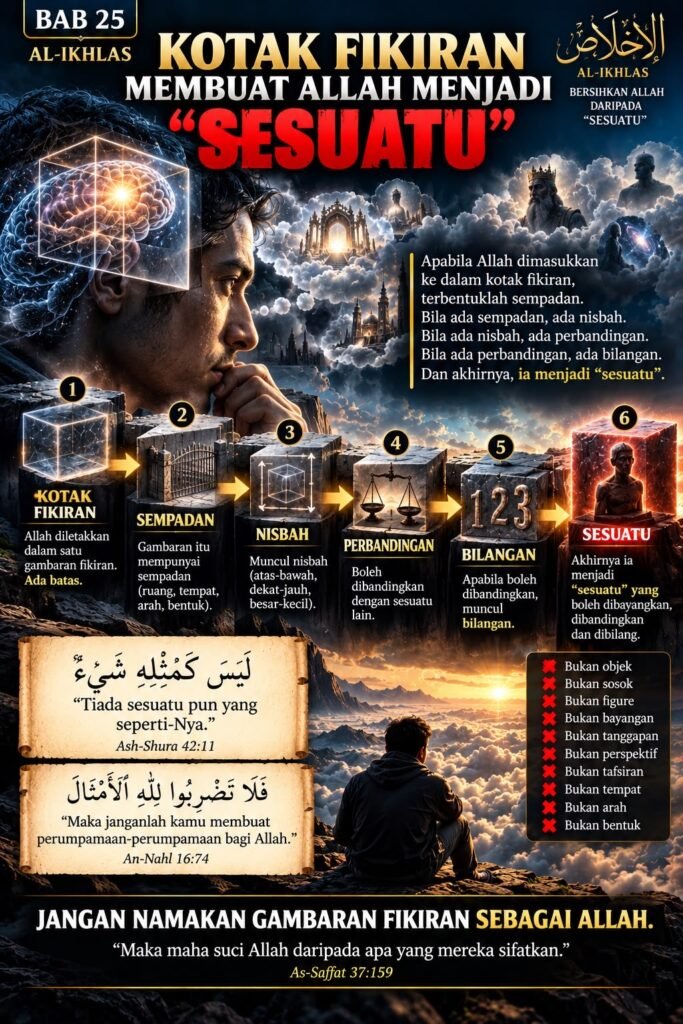
Because the moment Allah is placed within an image, that image already has boundaries.
Once it has boundaries, it has relative relationships.
Once it has relative relationships, it can be compared.
Once it can be compared, numbers become possible.
And once it can be counted:
it has already become a “thing”.
Yet the foundation of witnessing in this chapter is:
ALLAH IS NOT A THING.
This is the conclusion reached through the framework of witnessing developed in this book, not a literal translation of any particular verse.
Nevertheless, the Quranic texts establish powerful boundaries against turning Allah into a thing.
⸻
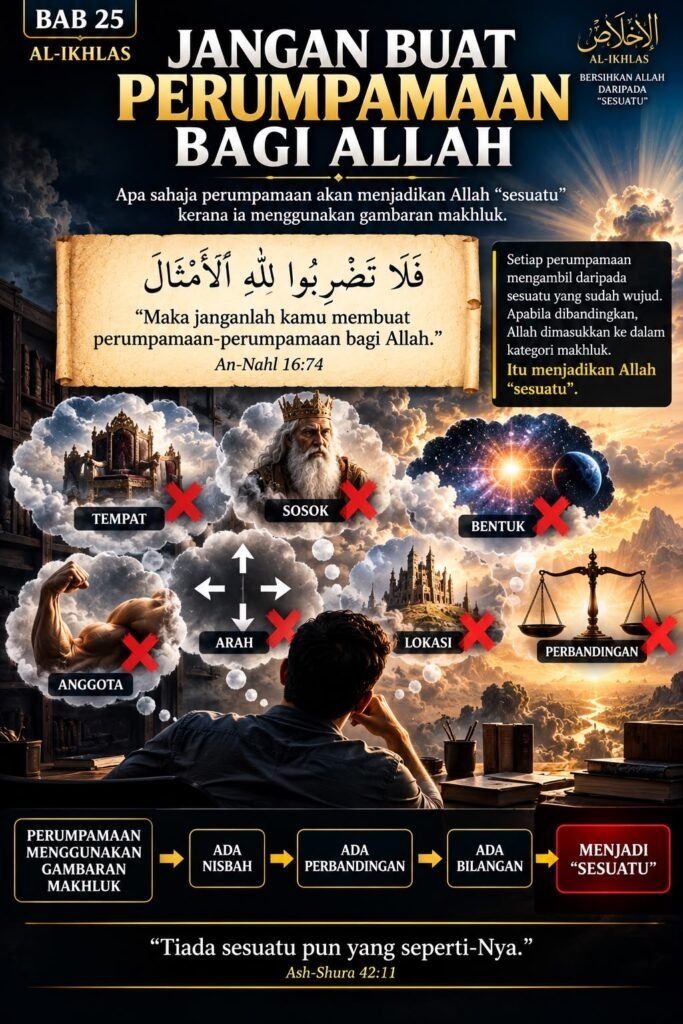
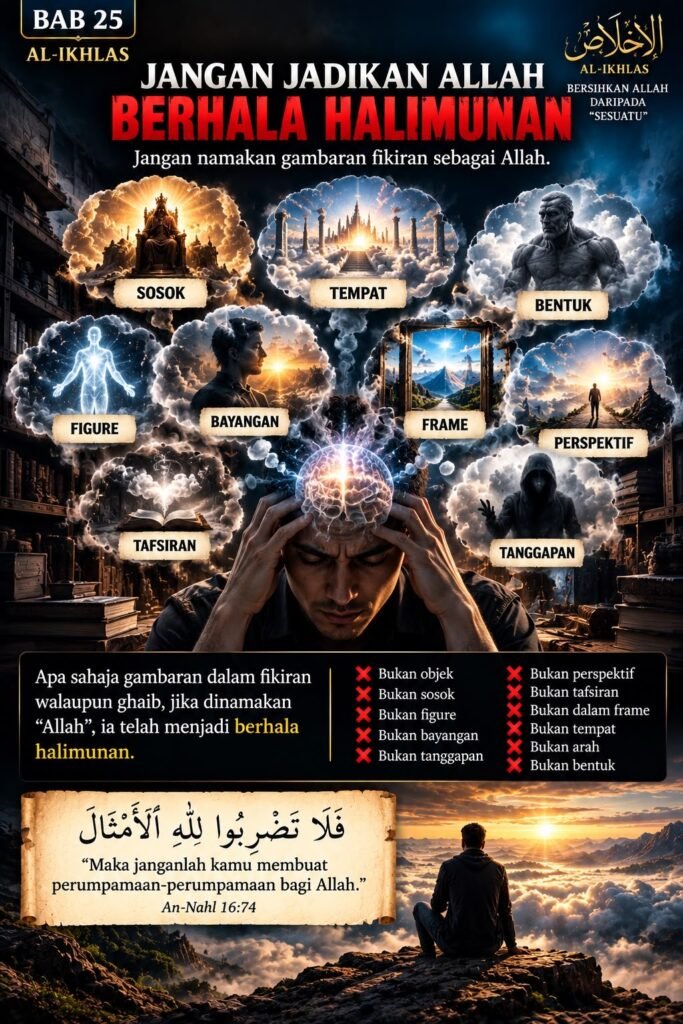
1. DO NOT MAKE COMPARISONS FOR ALLAH
The Quran states:
فَلَا تَضْرِبُوا لِلَّهِ الْأَمْثَالَ
“So do not make comparisons for Allah.”
— An-Nahl 16:74
This is fundamental.
When someone attempts to say:
“Allah is like this…”
Or:
“Imagine Allah as…”
They have already begun placing Allah within a category of things that can be compared.
Yet the revealed text states:
DO NOT MAKE COMPARISONS FOR ALLAH.
⸻
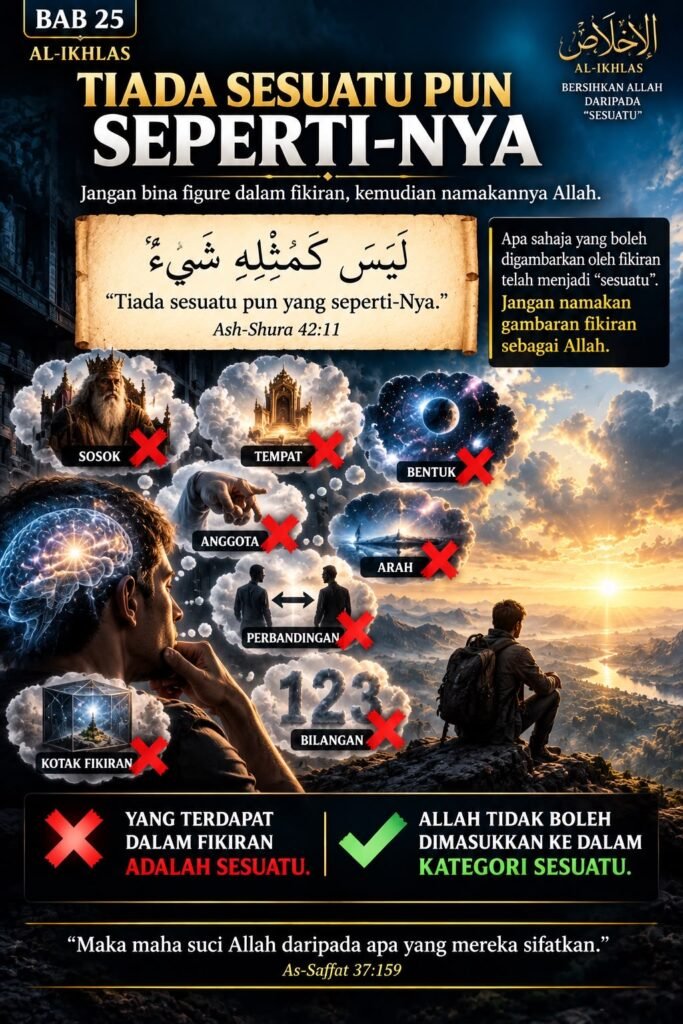
2. THERE IS NOTHING LIKE HIM
The Quran states:
لَيْسَ كَمِثْلِهِ شَيْءٌ
“There is nothing like Him.”
— Ash-Shura 42:11
Notice the word:
شَيْءٌ — A THING
The revealed text rejects every attempt to find something that can serve as a comparison.
Therefore, do not take anything that exists within your mind and then say:
“This is an image of Allah.”
Because whatever the mind can imagine has already become something within the mind.
And when that image is subsequently named “Allah”, human beings are actually giving the name Allah to something produced by their own imagination.
⸻
3. DO NOT TURN ALLAH INTO AN “INVISIBLE IDOL”
An idol is not necessarily a stone standing before someone’s eyes.
In this chapter’s interpretation, a more subtle danger arises when human beings construct an unseen figure within their minds:
existing somewhere,
having a direction,
occupying a spatial position,
and then calling that mental figure:
“Allah.”
A stone idol can be seen.
But an invisible idol is constructed through imagination.
The revealed words of Al-Ikhlas come to purify the understanding of Allah from all such constructions:
قُلْ هُوَ اللَّهُ أَحَدٌ
— Al-Ikhlas 112:1
اللَّهُ الصَّمَدُ
— 112:2
لَمْ يَلِدْ وَلَمْ يُولَدْ
— 112:3
وَلَمْ يَكُن لَّهُ كُفُوًا أَحَدٌ
— 112:4
The final verse is particularly decisive:
كُفُوًا
There is no equivalent, counterpart or anything that can be placed on an equal footing.
Therefore, do not first construct a figure and then say:
“This figure is unlike created beings.”
The problem has already occurred before that comparison is made.
Because the figure itself has already become a “thing”.
⸻
4. DO NOT PLACE ALLAH INSIDE A MENTAL BOX
The human mind operates through:
categories,
boundaries,
relative relationships,
locations,
measurements,
similarities and differences.
When something is placed inside a “mental box”, human beings begin asking:
Where?
Above or below?
Near or far?
Large or small?
Inside or outside?
All of these belong to the language of relative relationships.
Yet the revealed text states:
وَلَمْ يَكُن لَّهُ كُفُوًا أَحَدٌ
“And there is nothing comparable to Him.”
— Al-Ikhlas 112:4
When there is no comparison, do not invent relative relationships.
Because:
A BOX EXISTS → BOUNDARIES EXIST
BOUNDARIES EXIST → RELATIVE RELATIONSHIPS EXIST
RELATIVE RELATIONSHIPS EXIST → COMPARISON EXISTS
COMPARISON EXISTS → COUNTING BECOMES POSSIBLE
COUNTING BECOMES POSSIBLE → A “THING” EXISTS
And that is where understanding begins to go astray.
⸻
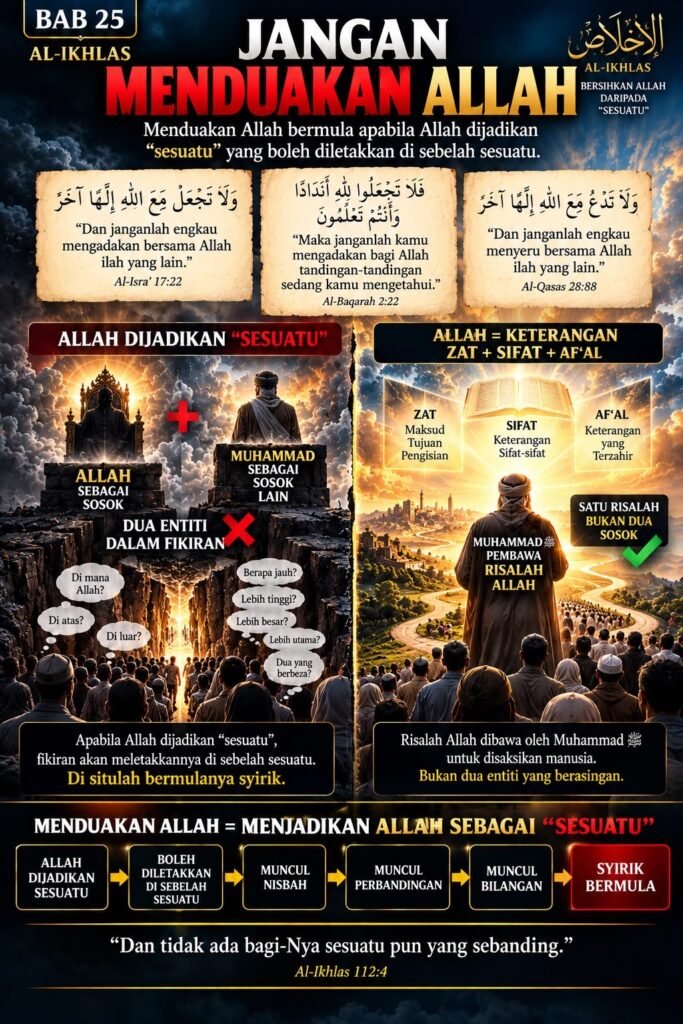
5. DO NOT MAKE ALLAH INTO TWO
The Quran repeatedly warns:
وَلَا تَجْعَلْ مَعَ اللَّهِ إِلَٰهًا آخَرَ
“And do not establish another deity alongside Allah.”
— Al-Isra’ 17:22
Also:
لَا تَجْعَلْ مَعَ اللَّهِ إِلَٰهًا آخَرَ
“Do not establish another deity alongside Allah.”
— Al-Isra’ 17:39
And:
وَلَا تَدْعُ مَعَ اللَّهِ إِلَٰهًا آخَرَ
“And do not invoke another deity alongside Allah.”
— Al-Qasas 28:88
And:
فَلَا تَجْعَلُوا لِلَّهِ أَندَادًا وَأَنتُمْ تَعْلَمُونَ
“So do not establish rivals to Allah while you know.”
— Al-Baqarah 2:22
In this chapter’s interpretation, making Allah into two begins when Allah is first turned into a “thing”.
Because when human beings construct the idea:
“Allah is an entity,”
they automatically open the possibility of:
a first entity,
a second entity,
one thing beside another thing.
Counting has begun.
Two can only emerge when one has first been turned into something countable.
Therefore, the question of shirk must be taken further back than merely asking:
“Am I worshipping two gods?”
The question is:
Have I already turned Allah into ONE OBJECT that I can place beside another object?
If so, counting has already begun.
⸻
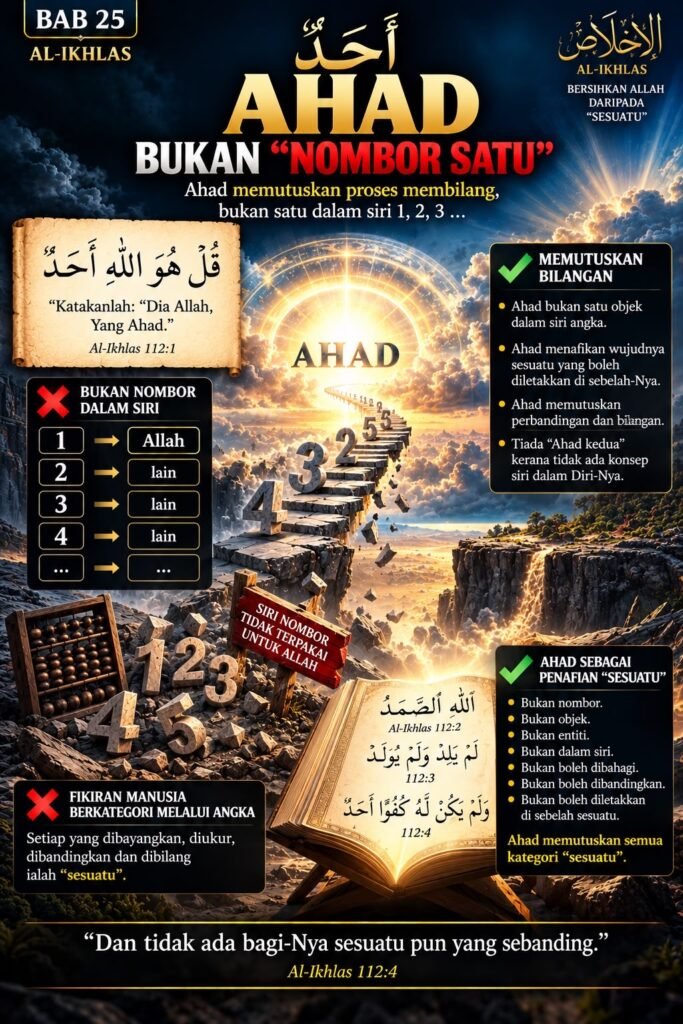
6. AHAD IS NOT “NUMBER ONE”
This is why the word:
أَحَدٌ — AHAD
is so important.
Ahad must not be confined to the number 1.
Because mathematically, the number one opens the sequence:
1, 2, 3, 4…
If Allah is understood as:
“one thing”,
the mind has already made room for a second thing.
In this chapter’s interpretation:
AHAD ends the process of counting itself.
Not:
Allah is object number one.
But:
Do not construct a category in which Allah can be counted alongside anything else.
⸻
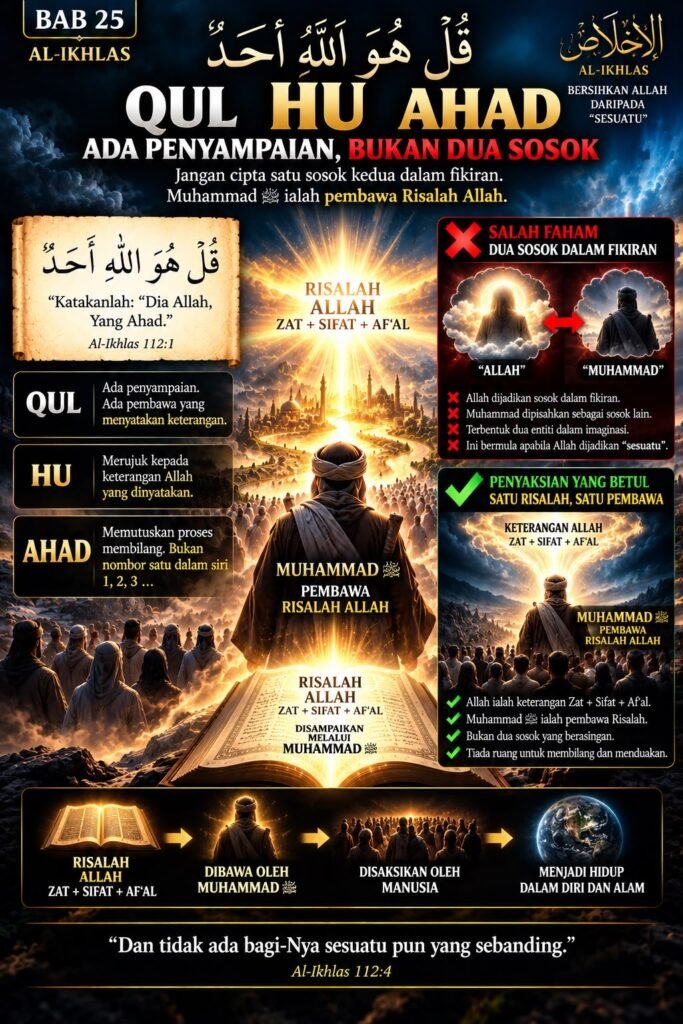
7. HU IS NOT A FIGURE BEHIND THE WORD
The surah begins:
قُلْ هُوَ اللَّهُ أَحَدٌ
قُلْ — QUL
Say.
There is communication.
There is a bearer who conveys the explanation.
In this chapter’s interpretation:
هُوَ — HU
must not immediately be transformed into an unseen figure within the imagination.
A pronoun must be understood through the structure of the utterance and the identity of the one conveying it.
Prophet Muhammad ﷺ is the bearer of Allah’s Risalah.
Therefore, do not read the verse in a way that produces a mental image of:
Muhammad ﷺ here,
and:
“Allah” as another figure over there.
That is what ultimately produces two figures within the mind.
Instead:
ALLAH’S RISALAH → CARRIED BY MUHAMMAD ﷺ → WITNESSED BY HUMANITY
Allah is not a figure behind the Risalah.
Allah is the explanation of ESSENCE + ATTRIBUTES + ACTIONS conveyed through the Risalah.
⸻
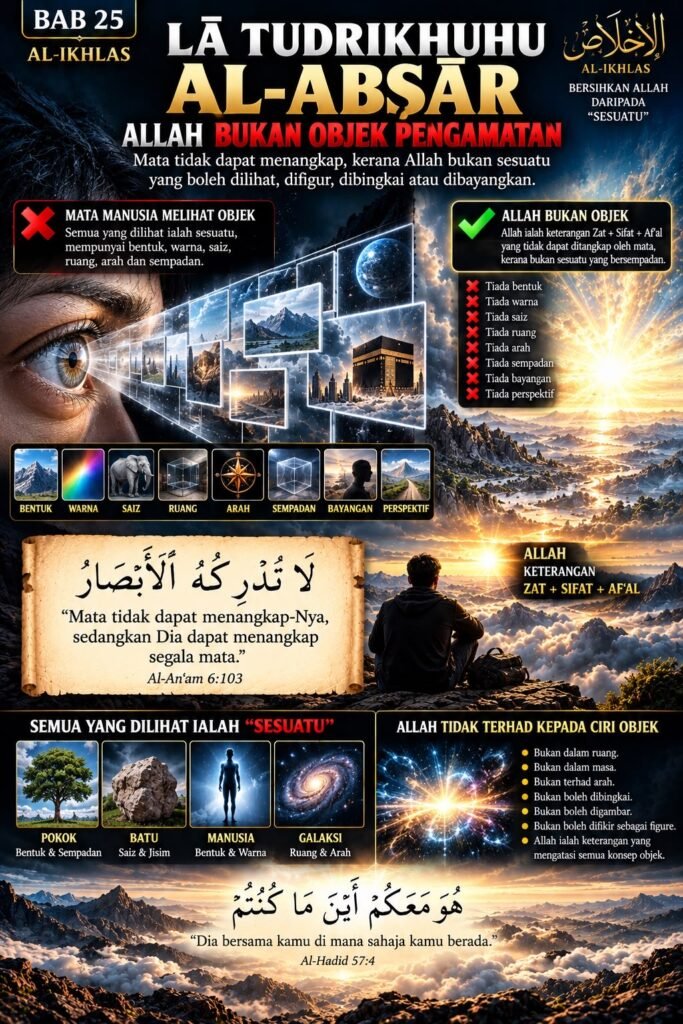
8. VISION CANNOT COMPREHEND HIM
The Quran states:
لَا تُدْرِكُهُ الْأَبْصَارُ وَهُوَ يُدْرِكُ الْأَبْصَارَ
“Vision cannot comprehend Him, while He comprehends all vision.”
— Al-An‘am 6:103
This revealed text once again closes the door to attempts to turn Allah into an object of observation.
If something can be constructed as a mental figure and then observed within the mind, what we are actually observing is a figure created by our own imagination.
Do not subsequently name that figure:
Allah.
⸻
9. DO NOT CREATE A PERSPECTIVE AND THEN CALL IT ALLAH
Allah is not:
a figure,
a frame,
a shadow,
a perception,
a perspective,
an interpretation,
or an imagined being.
Why?
Because all of these are products of an observer.
Perspective depends on where someone stands.
A shadow depends on light and an object.
A figure depends on form.
A frame depends on boundaries.
Interpretation depends on the person interpreting.
Yet Allah cannot be turned into a product of any of these processes.
The Quran states:
سُبْحَانَ اللَّهِ عَمَّا يَصِفُونَ
“Glory be to Allah above what they describe.”
— Among other places, As-Saffat 37:159
Subhan calls human beings to purify their understanding of Allah from whatever the human mind attaches to Him.
⸻
10. AL-IKHLAS = PURIFICATION
Now the name of the surah becomes deeply meaningful.
AL-IKHLAS.
Purify.
Purify the understanding of Allah from:
form.
figures.
location.
direction.
imagined beings.
shadows.
perspectives.
frames.
relative relationships.
numbers.
comparisons.
and every “thing”.
Until no visible idol remains.
And no invisible idol remains within the mind.
⸻
THE OUTCOME
The first mistake occurs when someone says:
“I want to imagine Allah so that He will be easier to understand.”
That is where the problem begins.
What is imagined is an image.
An image is a thing.
Whatever exists within a frame is a thing.
Whatever occupies a place is a thing.
Whatever has relative relationships is a thing.
Whatever can be compared is a thing.
Whatever can be counted is a thing.
Then human beings give a name to the construction of their own minds:
“Allah.”
This chapter rejects that.
DO NOT NAME A MENTAL IMAGE ALLAH.
The revealed text states:
لَيْسَ كَمِثْلِهِ شَيْءٌ
“There is nothing like Him.”
The revealed text states:
فَلَا تَضْرِبُوا لِلَّهِ الْأَمْثَالَ
“Do not make comparisons for Allah.”
The revealed text states:
وَلَمْ يَكُن لَّهُ كُفُوًا أَحَدٌ
“There is nothing comparable to Him.”
The revealed text states:
فَلَا تَجْعَلُوا لِلَّهِ أَندَادًا
“Do not establish rivals to Allah.”
Therefore, the conclusion reached through witnessing in this chapter is:
MAKING ALLAH INTO TWO BEGINS WHEN ALLAH IS TURNED INTO A “THING”.
Because a thing can be counted.
A thing can be compared.
A thing can be placed beside another thing.
But:
ALLAH IS NOT A THING.
And Al-Ikhlas purifies the mind until not a single invisible idol remains that human beings have created themselves and then named “Allah”.
Detecting your location…