
MUKADDIMAH · M46
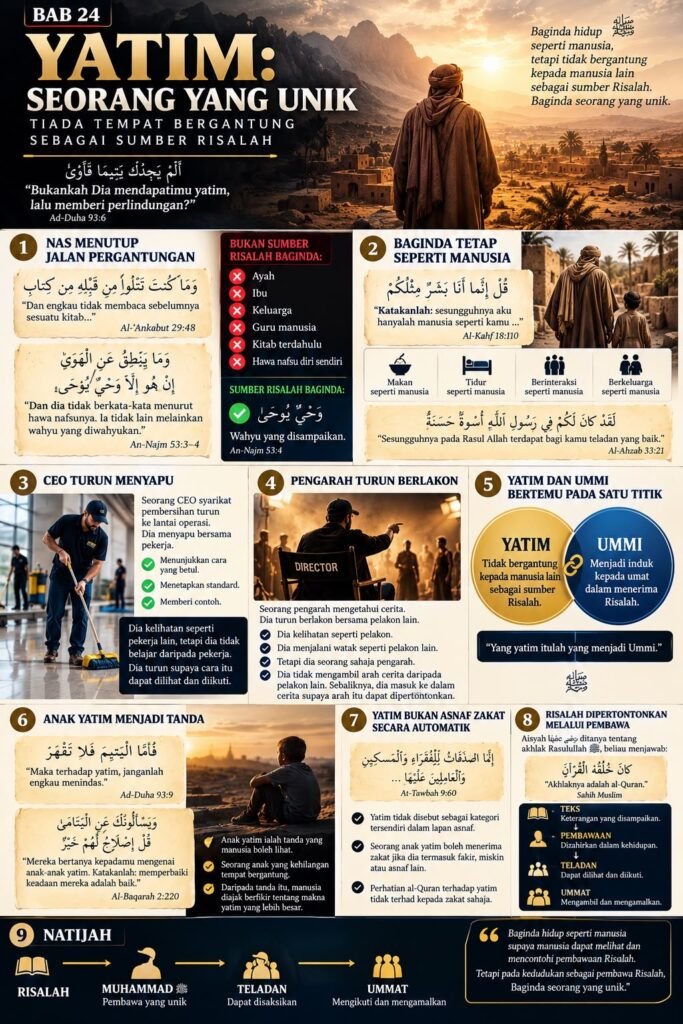
Chapter 24 — Yatim: A Unique Individual

The Quran describes Prophet Muhammad ﷺ:
أَلَمْ يَجِدْكَ يَتِيمًا فَآوَىٰ
“Did He not find you an orphan and give you shelter?”
— Ad-Duha 93:6
The word used is:
يَتِيمًا — YATIM
It is not merely a description of social circumstances, but a condition that deserves closer examination.
In this chapter, the focus is:
YATIM = HAVING NO HUMAN SOURCE TO DEPEND UPON FOR THE RISALAH
The Prophet ﷺ did not obtain the Risalah from his father, mother, family, human teachers or previous scriptures.
⸻
1. THE REVEALED TEXTS RULE OUT HUMAN DEPENDENCE
The Quran states:
وَمَا كُنتَ تَتْلُوا مِن قَبْلِهِ مِن كِتَابٍ
“And you did not previously read any scripture…”
— Al-‘Ankabut 29:48
And:
وَمَا يَنطِقُ عَنِ الْهَوَىٰ
“Nor does he speak from his own desires.”
إِنْ هُوَ إِلَّا وَحْيٌ يُوحَىٰ
“It is nothing but revelation revealed.”
— An-Najm 53:3–4
Therefore, the source of the Risalah is not:
his father,
his family,
previous scriptures,
or his own desires.
It comes as:
وَحْيٌ يُوحَىٰ
revelation that is conveyed.
⸻
2. HE REMAINED LIKE OTHER HUMAN BEINGS
The Quran states:
قُلْ إِنَّمَا أَنَا بَشَرٌ مِّثْلُكُمْ
“Say: I am only a human being like you…”
— Al-Kahf 18:110
The important word is:
مِثْلُكُمْ — LIKE YOU
The Prophet ﷺ ate, slept, had a family, walked, interacted with others and lived a life that human beings could observe.
All of this made the way he carried the Risalah something that could be witnessed and followed.
The Quran itself states:
لَّقَدْ كَانَ لَكُمْ فِى رَسُولِ ٱللَّهِ أُسْوَةٌ حَسَنَةٌ
“Indeed, in the Messenger of Allah you have an excellent example.”
— Al-Ahzab 33:21
An example must be observable.
An example must be possible to follow.
⸻
3. THE CEO WHO COMES DOWN TO SWEEP THE FLOOR
Imagine the CEO of a cleaning company.
He comes down to the operational floor and picks up a broom.
He sweeps alongside his employees.
Outwardly, he looks like any other worker.
But his purpose is not to learn from the workers how to sweep.
He comes down to:
demonstrate the method,
establish the standard,
and set an example.
He performs the task himself so that the workers can see the correct way to do it.
This is an analogy for how the Prophet ﷺ carried the Risalah.
He lived like other human beings so that humanity could observe how the Risalah was manifested in everyday life.
⸻
4. THE DIRECTOR WHO ENTERS HIS OWN FILM
A director knows the story.
Then he enters the production and acts in it himself.
On stage, he appears like the other actors.
But there is one difference:
HE ALONE IS THE DIRECTOR.
He does not obtain the direction of the story from the other actors.
Instead, the actors receive their direction from him.
This analogy connects Yatim with uniqueness.
In his position as director, he does not depend on another actor as the source of direction.
⸻
5. YATIM AND UMMĪ MEET AT THE SAME POINT
The previous chapter discussed:
النَّبِيَّ الْأُمِّيَّ
The Prophet ﷺ as Ummī.
Now the relationship becomes clearer:
YATIM
= not depending on another human being as the source of the Risalah.
UMMĪ
= becoming the Original Source for the Ummah in receiving the Risalah.
Therefore:
YATIM → NO HUMAN ORIGINAL SOURCE TO DEPEND UPON FOR THE RISALAH
UMMĪ → BECOMING THE ORIGINAL SOURCE FOR THE UMMAH
Like the director:
He has no other director within that performance, yet he becomes the director for everyone else.
⸻
6. THE RISALAH IS DEMONSTRATED THROUGH ITS BEARER
The Prophet ﷺ did not merely convey words.
He manifested the Risalah through his life.
When Aisyah رضي الله عنها was asked about the character of the Messenger of Allah ﷺ, she replied:
كَانَ خُلُقُهُ الْقُرْآنَ
“His character was the Quran.”
— Sahih Muslim
Therefore:
Risalah = explanation.
Muhammad ﷺ = the bearer who manifests that explanation.
A manual can be written.
But people still need to see how its instructions are carried out.
That is why:
TEXT → MANIFESTATION → EXAMPLE → UMMAH
⸻
7. THE ORPHAN BECOMES A VISIBLE SIGN
After describing the Prophet ﷺ as an orphan, the same surah states:
فَأَمَّا الْيَتِيمَ فَلَا تَقْهَرْ
“So as for the orphan, do not oppress him.”
— Ad-Duha 93:9
The Quran also states:
وَيَسْأَلُونَكَ عَنِ الْيَتَامَىٰ قُلْ إِصْلَاحٌ لَّهُمْ خَيْرٌ
“They ask you about orphans. Say: Improving their condition is best.”
— Al-Baqarah 2:220
An orphan is a sign that human beings can observe:
a child who has lost someone to depend upon.
From this visible sign, humanity is invited to reflect upon a greater meaning of Yatim.
⸻
8. ORPHANS ARE NOT AUTOMATICALLY ZAKAT RECIPIENTS
At-Tawbah 9:60 identifies eight categories of zakat recipients.
Orphans are not mentioned as a separate category.
Therefore:
YATIM ≠ AUTOMATICALLY ELIGIBLE FOR ZAKAT
An orphan may receive zakat if they qualify as poor, needy or belong to another eligible category.
This demonstrates that the Quran’s concern for orphans is not limited to the distribution of zakat.
Yatim has its own significance as a condition that must be cared for and contemplated.
⸻
9. “MAHA YATIM” — THE ULTIMATE YATIM
The term Maha Yatim in this chapter is used as an expression to describe the most complete state of not depending upon another human being as the source of the Risalah.
It is not one of the Names of Allah, nor is it a phrase that we claim appears in the revealed texts.
Its meaning is:
His father was not the source of the Risalah.
His mother was not the source of the Risalah.
His family was not the source of the Risalah.
Previous scriptures were not the source of the Risalah.
Human teachers were not the source of the Risalah.
He still lived like other human beings:
eating,
sleeping,
having a family,
interacting with others.
But his position in relation to the Risalah was unique.
⸻
10. THE OUTCOME
The Quran describes him as:
يَتِيمًا
And:
النَّبِيَّ الْأُمِّيَّ
These two terms meet within one arrangement:
YATIM
→ not depending upon another human being as the source of the Risalah.
UMMĪ
→ becoming the Original Source for the Ummah in carrying the Risalah.
The analogy of the director explains this.
A director enters his own production as an actor.
He appears like an actor.
He acts like an actor.
But he does not learn the direction of the story from them.
Instead, he enters the story so that its direction can be demonstrated.
The same applies to the analogy of the cleaning company’s CEO.
He comes down to sweep the floor, not because the workers are his teachers.
He sweeps so that the workers can see how the task should be performed.
Therefore, the final relationship becomes:
RISALAH → MUHAMMAD ﷺ → EXAMPLE → UMMAH
The Prophet ﷺ was like other human beings so that humanity could observe and follow how the Risalah was carried.
But in his position as the bearer of the Risalah, he was unique:
THE ONE WHO WAS YATIM BECAME THE UMMĪ.