
MUKADDIMAH · M38
Chapter 16 — Alhamdulillah: Praise, the Lord of All Realms and the Praiseworthy One
Al-Fatihah opens with:
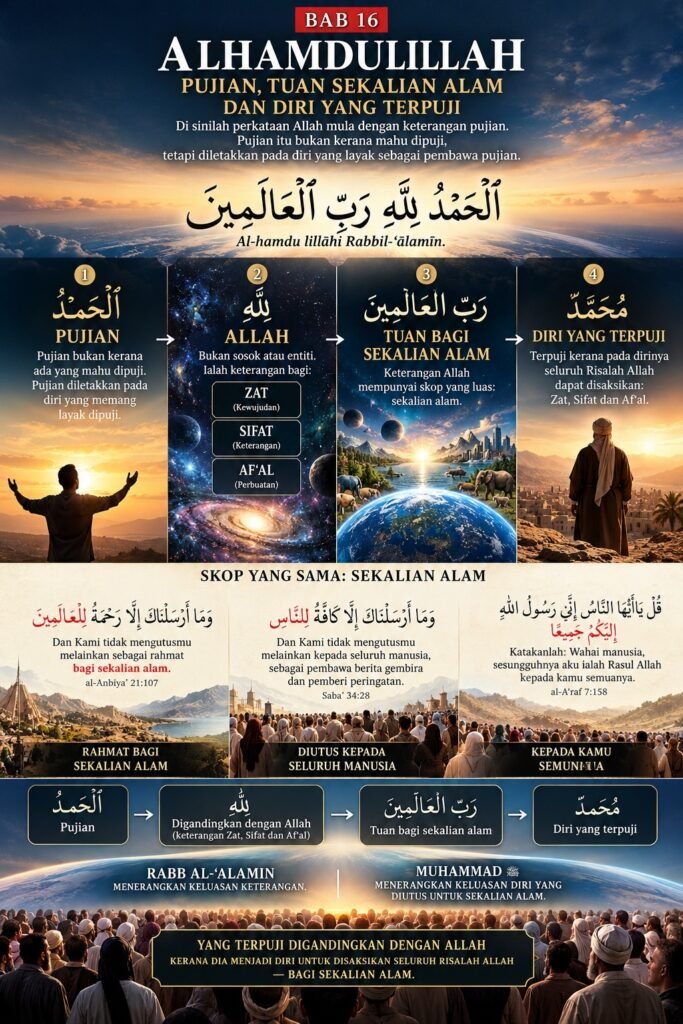
الْحَمْدُ لِلّٰهِ رَبِّ الْعَالَمِينَ
Al-hamdu lillāhi Rabbil-‘ālamīn.
Here, the word Allah begins to be described with:
الْحَمْدُ
— praise.
The praise is not there because there is someone who wants to be praised.
Praise is placed upon the one who is worthy of praise.
Why is he worthy?
Because upon that person, the entire description of Allah’s Risalah can be witnessed:
ESSENCE — ATTRIBUTES — ACTIONS.
That person is:
مُحَمَّد ﷺ
— the Praiseworthy One.
But Al-Fatihah does not stop at:
الْحَمْدُ لِلّٰهِ
It continues with:
رَبِّ الْعَالَمِينَ
— THE LORD OF ALL REALMS.
Here, its scope becomes clear.
Not praise confined to one people.
Not a description limited to one nation.
Not a Risalah intended only for one group.
But:
رَبِّ الْعَالَمِينَ
THE LORD OF ALL REALMS.
And when we look at Muhammad ﷺ, the same scope appears.
Allah states:
وَمَا أَرْسَلْنَاكَ إِلَّا رَحْمَةً لِّلْعَالَمِينَ
“And We have not sent you except as a mercy to all realms.”
— Al-Anbiya’ 21:107
Notice the same word:
الْعَالَمِينَ
In Al-Fatihah:
رَبِّ الْعَالَمِينَ
Lord of ALL REALMS.
Regarding Muhammad ﷺ:
رَحْمَةً لِّلْعَالَمِينَ
a mercy to ALL REALMS.
This is not a relationship that should be separated.
The description of Allah has the scope of:
ALL REALMS.
The one who manifests the Risalah also has the scope of:
ALL REALMS.
The Quran also states:
وَمَا أَرْسَلْنَاكَ إِلَّا كَافَّةً لِّلنَّاسِ بَشِيرًا وَنَذِيرًا
“And We have not sent you except to all humanity, as a bearer of glad tidings and a warner.”
— Saba’ 34:28
And:
قُلْ يَا أَيُّهَا النَّاسُ إِنِّي رَسُولُ اللَّهِ إِلَيْكُمْ جَمِيعًا
“Say: O humanity, indeed I am the Messenger of Allah to you all.”
— Al-A‘raf 7:158
Therefore, the sequence becomes clear:
رَبِّ الْعَالَمِينَ
Lord of all realms.
رَحْمَةً لِّلْعَالَمِينَ
Mercy to all realms.
كَافَّةً لِّلنَّاسِ
Sent to all humanity.
إِلَيْكُمْ جَمِيعًا
To you all.
The scope is the same:
ALL.
Therefore, when Al-Fatihah states:
الْحَمْدُ لِلّٰهِ رَبِّ الْعَالَمِينَ
it does not give us an image of some distant entity.
It gives a DESCRIPTION.
Praise.
Then:
THE LORD OF ALL REALMS.
And that description becomes something that can be witnessed upon the one who was also sent for:
ALL REALMS.
Here, Muhammad ﷺ cannot be read as a bearer standing outside the Risalah.
He becomes THE ONE UPON WHOM THE RISALAH CAN BE WITNESSED.
That is why he is:
مُحَمَّد
— the Praiseworthy One.
Not praiseworthy because he asks to be praised.
Not praiseworthy because he receives a title.
But because the Risalah manifested upon him has a scope that itself encompasses:
الْعَالَمِينَ
— all realms.
Therefore, the sequence is:
الْحَمْدُ
Praise.
↓
لِلّٰهِ
Joined with Allah — the description of Essence, Attributes and Actions.
↓
رَبِّ الْعَالَمِينَ
The Lord of all realms.
↓
مُحَمَّد ﷺ
The Praiseworthy One.
↓
رَحْمَةً لِّلْعَالَمِينَ
A mercy to all realms.
↓
كَافَّةً لِّلنَّاسِ
Sent to all humanity.
Therefore, there is a very strong correspondence:
THE LORD OF ALL REALMS
AND THE ONE SENT FOR ALL REALMS
One should not be read separately from the other.
Because if Allah is the description of Essence, Attributes and Actions for ALL REALMS, then that description must have A PERSON WHO CAN BE WITNESSED BY ALL HUMANITY.
And that person is:
مُحَمَّد ﷺ
— the Praiseworthy One, through whom Allah’s Risalah becomes something that can be witnessed.
⸻
CONCLUSION
الْحَمْدُ لِلّٰهِ رَبِّ الْعَالَمِينَ
begins with:
PRAISE
then:
ALLAH
then:
THE LORD OF ALL REALMS.
And when we look for the one who manifests that Risalah, the Quran leads us to Muhammad ﷺ:
a mercy to all realms,
sent to all humanity,
and the Messenger to you all.
Therefore, this relationship is not coincidental.
RABB AL-‘ALAMIN describes the scope of the description.
RAHMATAN LIL-‘ALAMIN describes the scope of the one who manifests that Risalah.
THE ONE: THE LORD OF ALL REALMS.
THE OTHER: THE ONE SENT FOR ALL REALMS.
AND IT IS UPON THAT PRAISEWORTHY ONE THAT ALLAH’S RISALAH BECOMES SOMETHING THAT CAN BE WITNESSED.