
MUKADDIMAH · M37
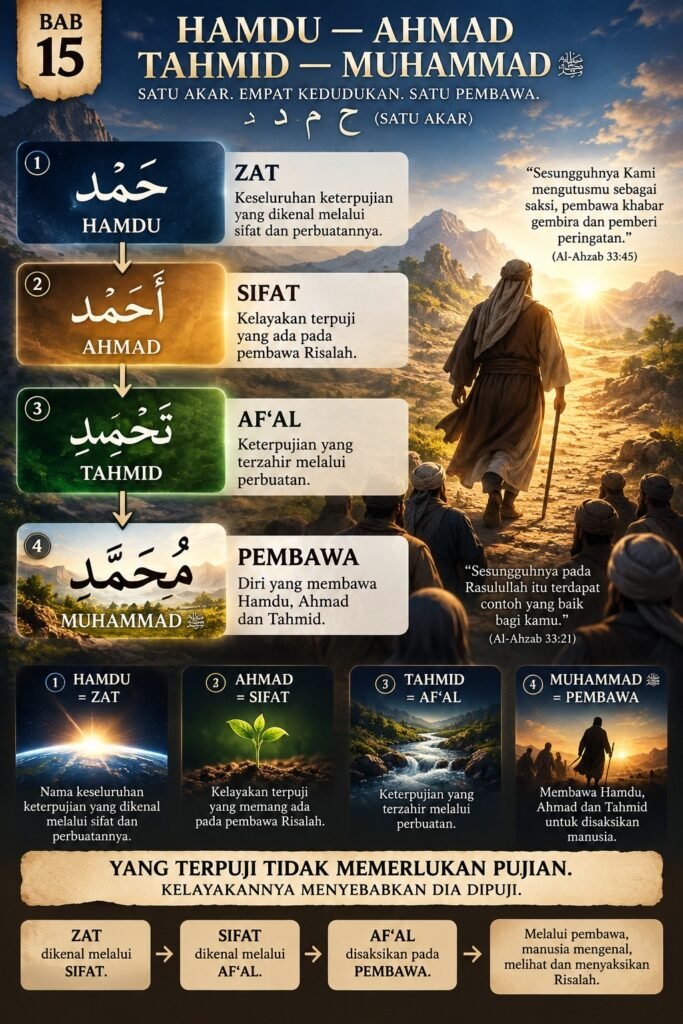
حَمْد → أَحْمَد → تَحْمِيد → مُحَمَّد
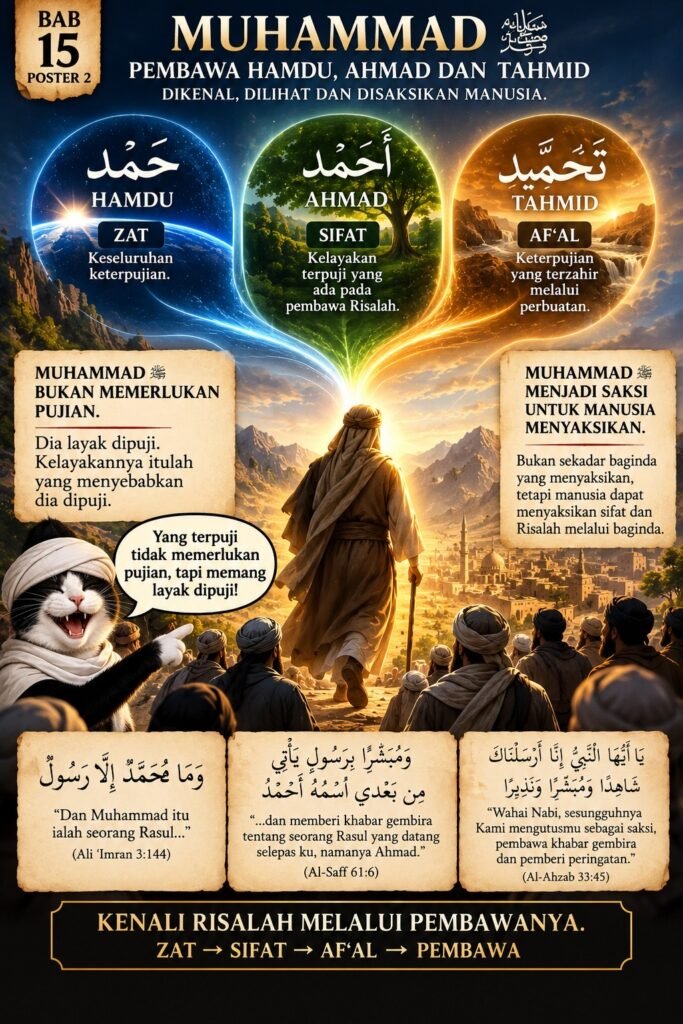
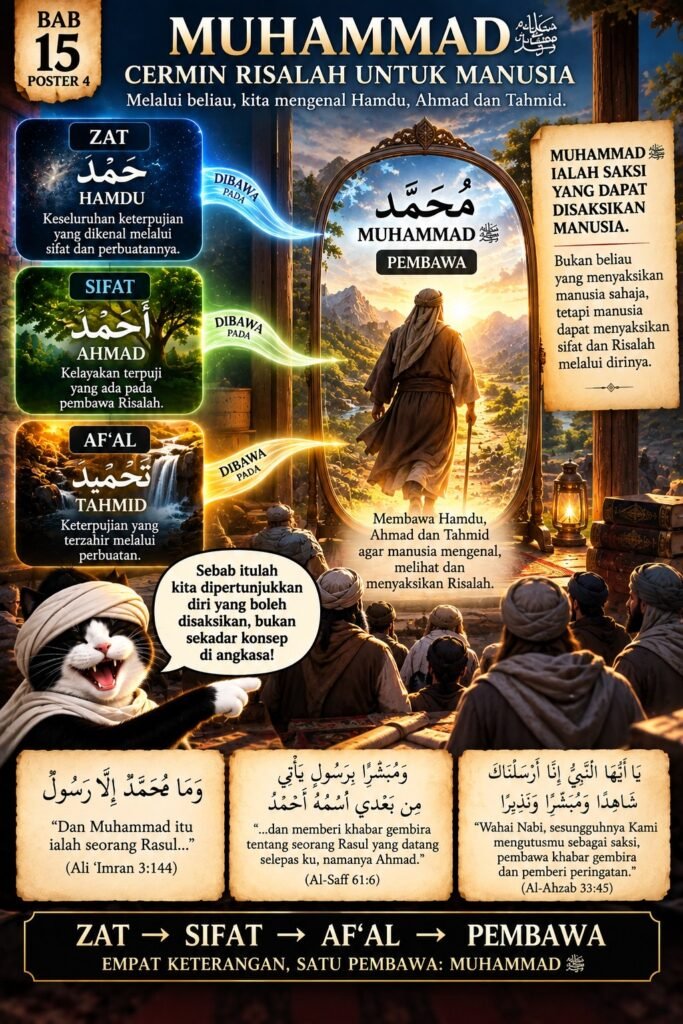
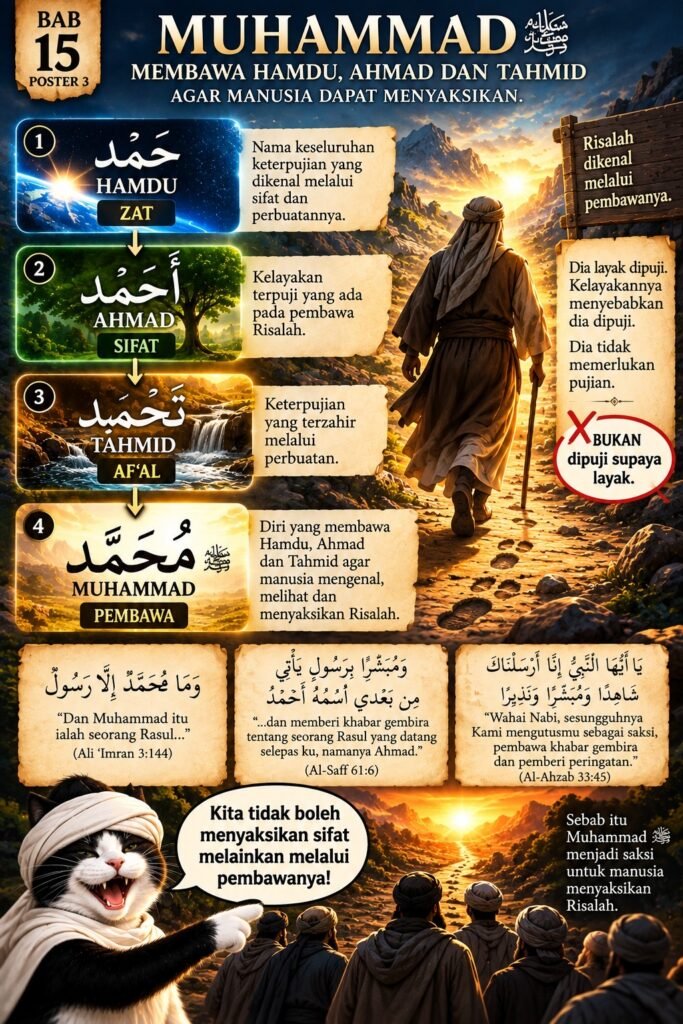
HAMDU = ESSENCE
AHMAD = ATTRIBUTE
TAHMID = ACTIONS
MUHAMMAD ﷺ = THE BEARER OF HAMDU, AHMAD AND TAHMID
The previous chapter established Muhammad ﷺ as the Great Bearer of the Risalah.
Now we look at something deeper.
Why do Hamdu, Ahmad, Tahmid and Muhammad all meet within the same root:
ح م د
This relationship opens again the structure that has been built since the beginning of this series:
ESSENCE → ATTRIBUTES → ACTIONS → BEARER
⸻
1. HAMDU — ESSENCE
حَمْد — Hamdu
Within the structure of this chapter, Hamdu is placed at the level of Essence.
Essence is the name or meaning encompassing the entirety of the attributes recognised through their actions.
Therefore, Hamdu should not be understood as the sound of praise floating without a bearer.
Hamdu is the name for the entirety of praiseworthiness that becomes known through attributes and actions.
Just as an “entrepreneur” is known through his attributes and his work, Hamdu must also have attributes and actions that describe it.
⸻
2. AHMAD — ATTRIBUTE
The Quran states:
وَمُبَشِّرًا بِرَسُولٍ يَأْتِي مِنۢ بَعْدِي اسْمُهُ أَحْمَدُ
“…and giving glad tidings of a Messenger who will come after me, whose name is Ahmad.”
— Al-Saff 61:6
Ahmad is placed at the level of Attribute.
It describes the quality of praiseworthiness contained within the Bearer of the Risalah.
Muhammad ﷺ does not become praiseworthy because people praise him.
HE IS PRAISEWORTHY BECAUSE HE IS INHERENTLY WORTHY OF PRAISE.
Human praise does not create his praiseworthiness.
Human beings merely acknowledge what is already there.
This is an important distinction.
THE ONE WHO IS PRAISEWORTHY DOES NOT REQUIRE PRAISE IN ORDER TO BECOME PRAISEWORTHY.
Praise does not make him worthy.
HIS WORTHINESS IS WHAT CAUSES HIM TO BE PRAISED.
⸻
3. TAHMID — ACTIONS
تَحْمِيد — Tahmid
Tahmid is placed at the level of Actions.
If Ahmad is the attribute of praiseworthiness, Tahmid is praiseworthiness manifested through actions.
An attribute cannot be witnessed if it does not appear through actions.
Trustworthiness is recognised through trustworthy actions.
Mercy is recognised through acts of mercy.
Truthfulness is recognised through truthful actions.
The same applies to praiseworthiness.
Therefore:
HAMDU — ESSENCE
AHMAD — ATTRIBUTE
TAHMID — ACTIONS
The three do not stand as three separate entities.
They are three layers of description.
⸻
4. MUHAMMAD ﷺ — THE BEARER OF ALL THREE
This is where the name Muhammad finds its position.
Muhammad ﷺ is:
THE BEARER OF HAMDU
THE BEARER OF AHMAD
THE BEARER OF TAHMID
He carries:
Its Essence — Hamdu.
Its Attribute — Ahmad.
Its Actions — Tahmid.
All of these are present upon one Bearer:
MUHAMMAD ﷺ
That is why Muhammad cannot be separated from the Risalah he carries.
The Risalah does not move by itself.
Attributes do not move by themselves.
Actions do not occur by themselves.
All of them require a bearer.
⸻
5. “I AM MUHAMMAD AND I AM AHMAD”
The Messenger of Allah ﷺ said:
لِي خَمْسَةُ أَسْمَاءٍ أَنَا مُحَمَّدٌ، وَأَحْمَدُ، وَأَنَا الْمَاحِي الَّذِي يَمْحُو اللَّهُ بِي الْكُفْرَ، وَأَنَا الْحَاشِرُ الَّذِي يُحْشَرُ النَّاسُ عَلَى قَدَمِي، وَأَنَا الْعَاقِبُ
“I have five names. I am Muhammad and I am Ahmad. I am Al-Mahi, through whom Allah erases disbelief; I am Al-Hashir, at whose feet the people will be gathered; and I am Al-‘Aqib.”
— Sahih Al-Bukhari, no. 3532
Notice:
أَنَا مُحَمَّدٌ وَأَنَا أَحْمَدُ
I am Muhammad and I am Ahmad.
The attribute does not stand beside him as something separate.
AHMAD IS UPON MUHAMMAD.
Muhammad carries Ahmad.
And that attribute is recognised through his actions.
⸻
6. BEING PRAISEWORTHY DOES NOT MEAN NEEDING PRAISE
This needs to be made very clear.
When it is said:
MUHAMMAD = THE PRAISEWORTHY ONE
do not immediately imagine that he requires people to praise him.
No.
A truthful person does not become truthful because someone else says:
“He is truthful.”
He is called truthful because truthfulness is already present within him.
The same applies to a trustworthy person.
He does not become trustworthy because he is given the title “trustworthy”.
The title comes because that quality is already present within him.
The same applies to Muhammad ﷺ.
HE IS NOT PRAISEWORTHY BECAUSE PEOPLE PRAISE HIM.
Rather:
PEOPLE PRAISE HIM BECAUSE HE IS WORTHY OF PRAISE.
Therefore, praiseworthiness is a quality of worthiness, not a dependence upon human praise.
⸻
7. WHAT DOES IT MEAN FOR MUHAMMAD ﷺ TO BE A “WITNESS”?
The Quran states:
يَا أَيُّهَا النَّبِيُّ إِنَّا أَرْسَلْنَاكَ شَاهِدًا وَمُبَشِّرًا وَنَذِيرًا
“O Prophet, indeed We have sent you as a witness, a bearer of glad tidings and a warner.”
— Al-Ahzab 33:45
The usual reading of the word شَاهِدًا — shahidan is:
“He witnesses.”
But this chapter invites us to look at another very important perspective:
HE IS ALSO THE ONE WHO CAN BE WITNESSED.
Why?
Because attributes cannot be seen with the eyes.
We cannot take a photograph of “trustworthiness”.
We cannot place “mercy” on a table.
We cannot point to “truth” as an object.
But when an attribute is present upon someone and manifested through their actions, people can say:
“I WITNESS TRUSTWORTHINESS.”
Not because trustworthiness has become an object.
But because trustworthiness is MANIFESTED THROUGH ITS BEARER.
This is how this chapter reads the function of Muhammad ﷺ as a witness.
⸻
8. HUMAN BEINGS WITNESS THE RISALAH THROUGH ITS BEARER
For Muhammad ﷺ to be a witness means that human beings have a person who can be witnessed in order to recognise what he carries.
Want to know mercy?
Look at its Bearer.
Want to know trustworthiness?
Look at its Bearer.
Want to know truth?
Look at its Bearer.
Want to know how the Risalah stands within life?
Look at its Bearer.
That is why the Quran states:
لَّقَدْ كَانَ لَكُمْ فِي رَسُولِ اللَّهِ أُسْوَةٌ حَسَنَةٌ
“Indeed, in the Messenger of Allah you have an excellent example.”
— Al-Ahzab 33:21
If the Risalah were only meant to be read as text, human beings would not require an uswah.
But humanity was given a Bearer to be seen, followed and witnessed.
⸻
9. AN ATTRIBUTE CANNOT BE WITNESSED WITHOUT A BEARER
Take a simple example.
Someone says:
“This is the attribute of love.”
We ask:
Where?
He cannot point to “love” as an object.
But when a mother cares for her child, people see her actions and say:
“THAT IS LOVE.”
What the eyes witness is the bearer and her actions.
Through them, people recognise the attribute.
Therefore, the sequence is:
ESSENCE is recognised through ATTRIBUTES.
ATTRIBUTES are recognised through ACTIONS.
ACTIONS are witnessed upon the BEARER.
This is the position of Muhammad ﷺ.
⸻
10. THE FORMULA OF CHAPTER 15
This entire chapter can be condensed into one structure:
حَمْد
HAMDU = ESSENCE
↓
أَحْمَد
AHMAD = ATTRIBUTE
↓
تَحْمِيد
TAHMID = ACTIONS
↓
مُحَمَّد ﷺ
MUHAMMAD = BEARER
Muhammad ﷺ carries Hamdu.
Muhammad ﷺ carries Ahmad.
Muhammad ﷺ carries Tahmid.
Through him, people can recognise its descriptions, see its attributes and witness its actions.
⸻
11. MUHAMMAD ﷺ IS THE ONE WORTHY OF PRAISE
Therefore, when it is said:
MUHAMMAD — THE PRAISEWORTHY ONE
do not read it as:
“One who wants to be praised.”
Read it as:
ONE WHO POSSESSES THE WORTHINESS TO BE PRAISED.
Worthiness comes before praise.
Praise merely acknowledges that worthiness.
Even if all humanity refused to praise him, that praiseworthiness would not disappear merely because people refused to acknowledge it.
What is true remains true even when it is denied.
The trustworthy remains trustworthy even when criticised.
The praiseworthy remains praiseworthy because of his worthiness.
⸻
12. WITNESSING REQUIRES SOMETHING THAT CAN BE WITNESSED
This is where the entire journey of the series begins to come together.
This series will arrive at:
SHAHADAH = WITNESSING
Therefore, the question is simple:
WHAT IS TO BE WITNESSED?
If everything is transferred into unseen entities that cannot be recognised through attributes and actions, how are human beings supposed to witness?
That is why the Risalah has a Bearer.
The Bearer lives.
The Bearer speaks.
The Bearer acts.
The Bearer manifests.
The Bearer becomes SHAHID — a witness who can be witnessed by humanity.
⸻
CONCLUSION
Chapter 15 brings us to four positions:
HAMDU = ESSENCE
The entirety of praiseworthiness.
AHMAD = ATTRIBUTE
The quality of being worthy of praise.
TAHMID = ACTIONS
Praiseworthiness manifested through actions.
MUHAMMAD ﷺ = BEARER
The one who carries Hamdu, Ahmad and Tahmid.
Muhammad ﷺ does not become praiseworthy because people praise him.
HE IS PRAISED BECAUSE HE IS WORTHY OF PRAISE.
And when he is described as a “witness”, do not stop at the image of him merely witnessing humanity.
Also understand his position as:
THE ONE WHO CAN BE WITNESSED BY HUMANITY.
Through the Bearer, attributes can be recognised.
Through his Actions, the Risalah can be witnessed.
Therefore, the formula of Chapter 15 is:
HAMDU — ESSENCE
AHMAD — ATTRIBUTE
TAHMID — ACTIONS
MUHAMMAD ﷺ — BEARER
And from here, we can enter an even sharper question in Chapter 16:
الْحَمْدُ لِلّٰهِ
If Hamdu has already been understood as Essence within this structure—
WHAT EXACTLY IS “ALHAMDULILLAH” DESCRIBING?
Detecting your location…