
MUKADDIMAH · M39
We always read:
رَبِّ الْعَالَمِينَ
and it is translated as:
“Lord of all realms.”
But the Quran itself provides a more precise indication of the word:
رَبّ — Rabb
which is:
LORD
Not the name of a figure.
Not a form.
Not an entity imagined somewhere far away in the heavens.
Rabb is a description of lordship, ownership, preservation and governance.
⸻
1. THE QURAN ITSELF SHOWS THE MEANING OF RABB
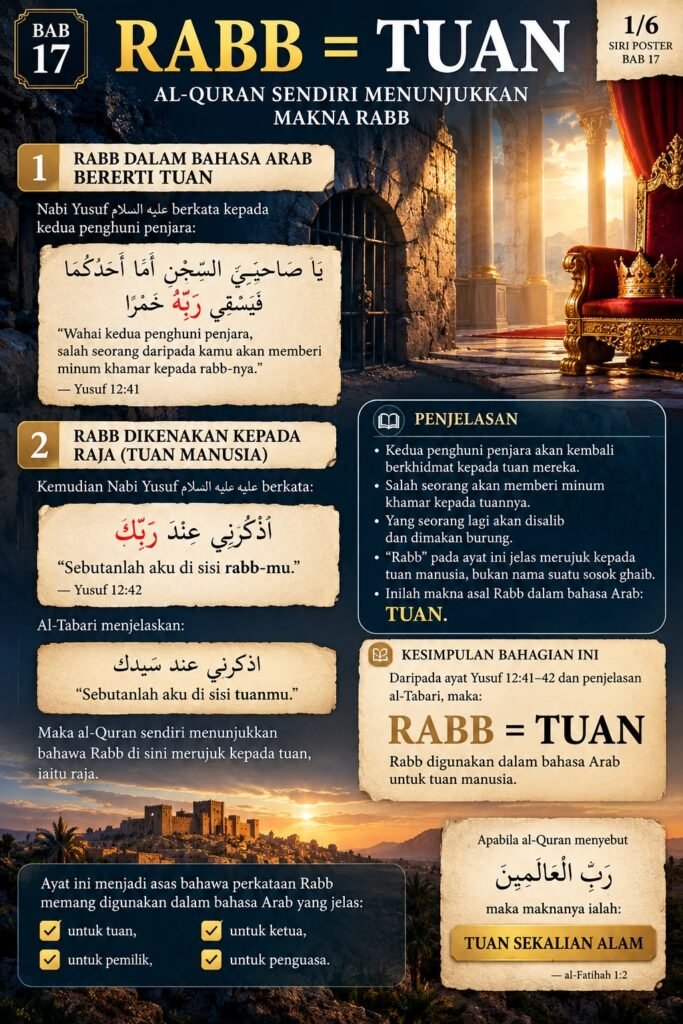
Prophet Yusuf عليه السلام said:
يَا صَاحِبَيِ السِّجْنِ أَمَّا أَحَدُكُمَا فَيَسْقِي رَبَّهُ خَمْرًا
“O my two companions of the prison, one of you will serve wine to his rabb.”
— Yusuf 12:41
Then he said:
اذْكُرْنِي عِندَ رَبِّكَ
“Mention me in the presence of your rabb.”
— Yusuf 12:42
Rabb in this verse refers to his lord, namely the king.
Al-Tabari explains:
اذكرني عند سيدك
“Mention me in the presence of your lord.”
Therefore, the Quran itself shows:
RABB = LORD
⸻
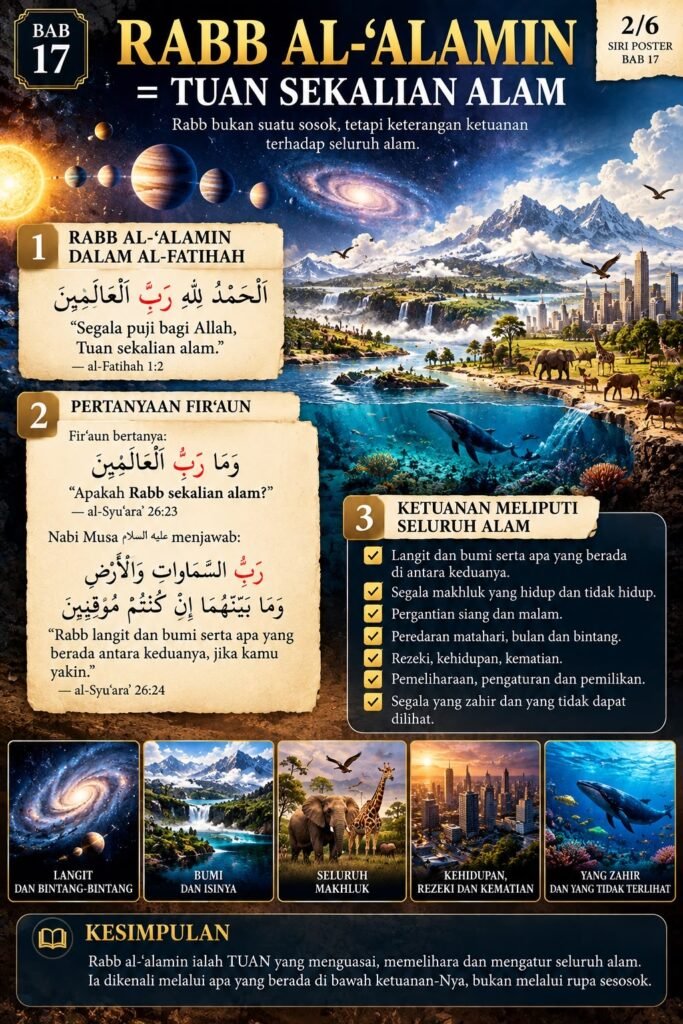
2. RABB AL-‘ALAMIN = LORD OF ALL REALMS
Allah states:
الْحَمْدُ لِلَّهِ رَبِّ الْعَالَمِينَ
“Al-Hamdu belongs to Allah, Rabb of all realms.”
— Al-Fatihah 1:2
Therefore:
رَبِّ الْعَالَمِينَ
means:
LORD OF ALL REALMS
When there is a Lord, there must be something under that lordship.
When there is a preserver, there must be something being preserved.
When there is a governor, there must be something being governed.
When there is an owner, there must be something under that ownership and authority.
Therefore, Rabb is not an empty word.
Rabb describes a relationship.
⸻
3. PHARAOH ASKS: WHAT IS THE RABB OF ALL REALMS?
Pharaoh said:
قَالَ فِرْعَوْنُ وَمَا رَبُّ الْعَالَمِينَ
“Pharaoh said: What is the Rabb of all realms?”
— Ash-Shu‘ara’ 26:23
Musa عليه السلام answered:
قَالَ رَبُّ السَّمَاوَاتِ وَالْأَرْضِ وَمَا بَيْنَهُمَا إِن كُنتُم مُّوقِنِينَ
“The Rabb of the heavens and the earth and whatever is between them, if you are truly certain.”
— Ash-Shu‘ara’ 26:24
Musa عليه السلام did not provide a form.
He did not describe a figure.
The answer was given through the description of lordship over the heavens, the earth and everything between them.
Rabb is recognised through what is under His lordship.
⸻
4. THE QURAN DISTINGUISHES BETWEEN RABB, MALIK AND ILAH
Allah states:
قُلْ أَعُوذُ بِرَبِّ النَّاسِ
“Rabb of humanity.”
مَلِكِ النَّاسِ
“Malik of humanity.”
إِلَٰهِ النَّاسِ
“Ilah of humanity.”
— An-Nas 114:1–3
The Quran uses three different words:
Rabb
Malik
Ilah
Therefore, do not combine all of them into the same mental image.
Rabb describes lordship.
Malik describes ownership and sovereignty.
Ilah concerns that which is worshipped and which is negated and affirmed within witnessing.
Each word carries its own description.
⸻
5. HADITH ALSO SHOWS THAT RABB MEANS LORD
The Messenger of Allah ﷺ said:
لَا يَقُلْ أَحَدُكُمْ أَطْعِمْ رَبَّكَ، وَضِّئْ رَبَّكَ، اسْقِ رَبَّكَ، وَلْيَقُلْ سَيِّدِي مَوْلَايَ
“None of you should say: Feed your rabb, help your rabb perform wudu’, or give your rabb something to drink. Rather, let him say: sayyidi, mawlaya.”
— Sahih Al-Bukhari, no. 2552
And:
وَلَا يَقُلْ أَحَدُكُمْ رَبِّي وَلْيَقُلْ سَيِّدِي مَوْلَايَ
“None of you should say: my rabb, but rather let him say: sayyidi, mawlaya.”
— Sahih Muslim, no. 2249d
This hadith shows that the word Rabb was indeed used in Arabic to refer to a lord or master.
The Messenger of Allah ﷺ then distinguished its use between human beings from its use for lordship in relation to Allah.
⸻
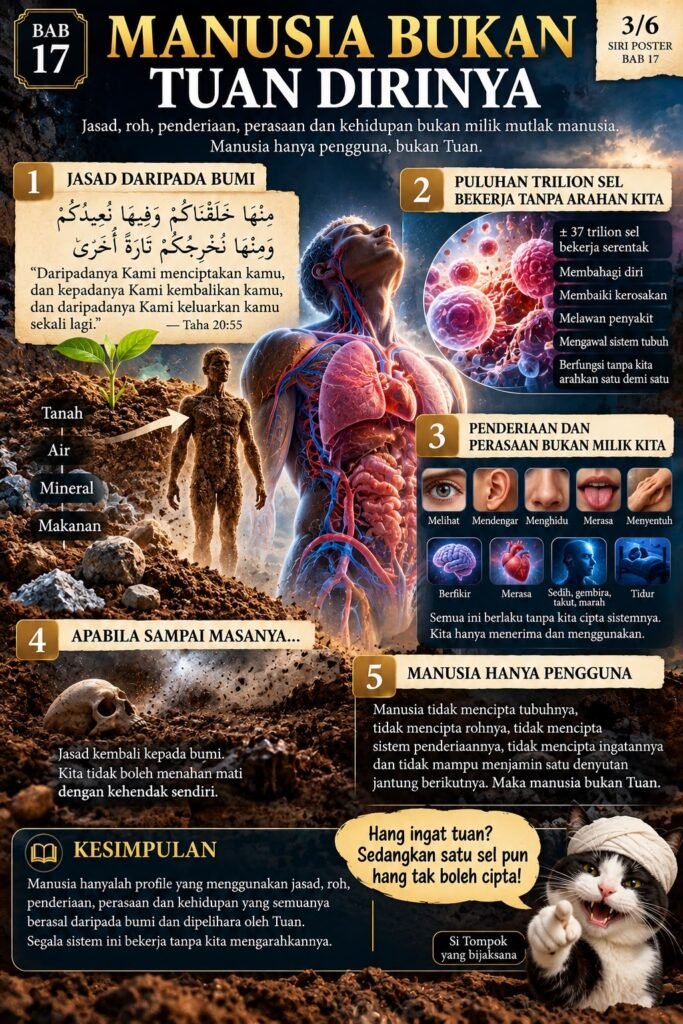
6. HUMAN BEINGS CLAIM TO BE LORDS OVER THEMSELVES
A major problem begins when a person says:
“This is my body.”
“This is my life.”
“This is my mind.”
“These are my feelings.”
Then he assumes that all of them belong absolutely to him.
Yet when examined:
he did not create his body,
he did not create his Ruh,
he did not create his sensory system,
he did not create his memory,
he did not create his heartbeat,
he did not create his breath.
He merely uses all of them.
Therefore, the human being is not the Lord.
The human being is the user.
⸻
7. EVEN THE HUMAN BODY DOES NOT ABSOLUTELY BELONG TO THE HUMAN BEING
The human body comes from the earth.
The food that builds the body comes from the earth.
Water comes from the earth.
Minerals come from the earth.
What enters the body is processed into blood, flesh, bones and cells.
The human body consists of tens of trillions of cells working without the human being directing them individually.
Cells divide.
Nerves transmit signals.
The heart beats.
The lungs work.
The body repairs itself.
A person uses that physical body, but its materials and systems are not his own creation.
When its time comes, the physical body returns to the earth.
Therefore, this body does not absolutely belong to the human being.
It is being used.
⸻
8. SENSATION AND FEELING DO NOT BELONG TO HUMAN BEINGS EITHER
Human beings experience:
pain,
hunger,
fear,
love,
anger,
sadness,
joy,
heat,
cold.
But human beings did not construct the system through which these sensations are experienced.
They receive.
They feel.
They respond.
Therefore, sensation and feeling also demonstrate that the human being is not the source of everything happening within himself.
The human being is the receiver.
The human being is the user.
⸻
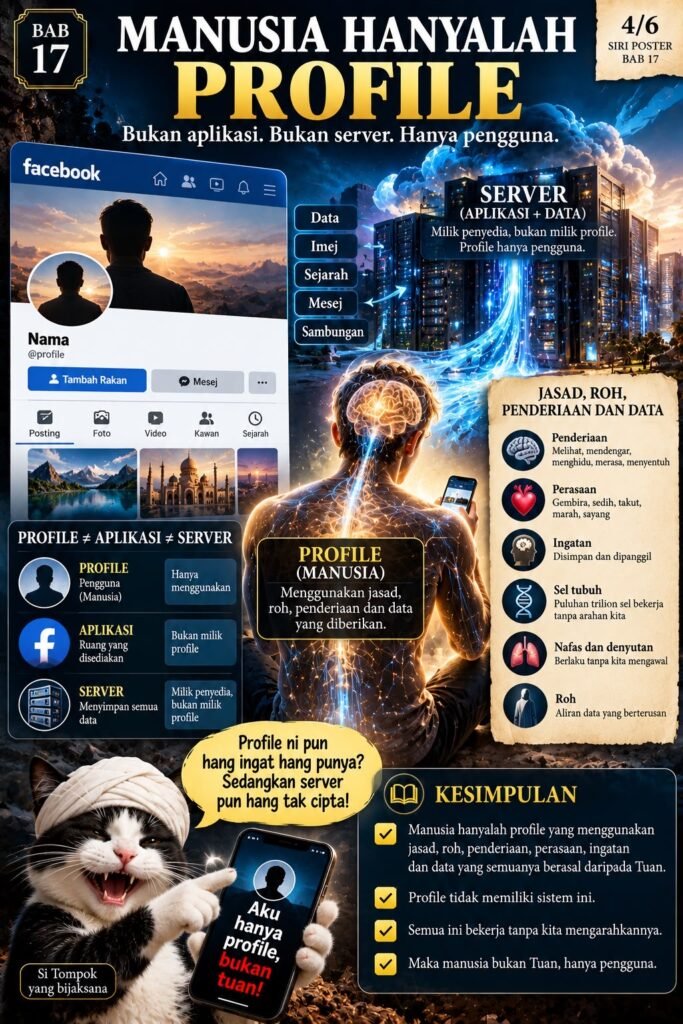
9. THE HUMAN BEING IS ONLY A PROFILE
Imagine a Facebook user.
He has:
a name,
a picture,
posts,
comments,
history,
connections,
and data.
All of these form his profile.
But the profile is not Facebook.
The profile does not own the application.
It does not own the server.
It does not own the network.
It does not own the system.
Even what is posted is stored as data within a system that does not belong to the user.
He merely uses the space provided to him.
The same applies to the human being.
What is called:
“I”
is a profile.
The physical body is the vessel of the profile.
The Ruh is the flow of data.
Sensation is the channel of reception.
Feeling is the experience of the profile.
Memory is data that is received and stored.
The human being uses all of these.
But the human being is not the absolute owner of the system.
⸻
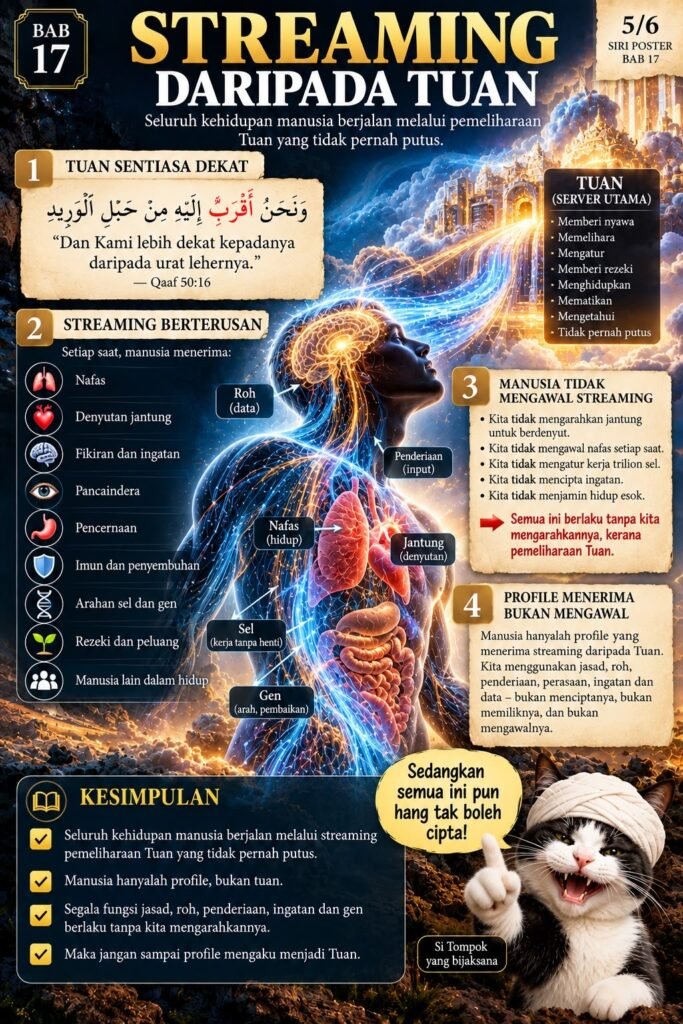
10. THE PROFILE EXISTS BECAUSE OF STREAMING FROM THE LORD
A Facebook profile cannot function if the server is disconnected.
The same applies to the human being.
As long as the streaming of life continues:
breath moves,
the heart beats,
cells live,
nerves transmit signals,
sensation functions,
memory remains connected,
the self remains conscious.
That streaming is what preserves the profile.
Therefore, lordship is not something distant.
Lordship is taking place within the self at every moment.
Rabb is the Lord who preserves.
The human being is the profile being preserved.
⸻
11. HUMAN BEINGS SEARCH FOR THE LORD WHO IS ALREADY EVIDENT WITHIN THEMSELVES
Human beings search far and wide for the Lord.
Searching for a figure.
Searching for a place.
Searching for a form.
Yet their own selves continue to exist because of the Lord’s preservation.
Breathing is happening.
The heartbeat is happening.
Sensation is happening.
Memory is happening.
The Ruh is functioning.
The physical body is functioning.
Therefore, human beings search for the Lord while the evidence of lordship is taking place within themselves.
This does not mean that the human being is the Lord.
The human being is where lordship takes place.
The human being is a profile that exists because of streaming from the true Lord.
⸻
12. THE LORD IS KNOWN THROUGH THE RISALAH
The Lord is not known through imagination.
The Lord is known through the Risalah.
The Risalah describes:
ESSENCE
ATTRIBUTES
ACTIONS
Therefore, when the Risalah reaches a human being, that person begins to recognise who his Lord is through what is taking place within his physical and inward self.
When a person asks from the Lord, he is not asking from some figure he does not know.
That request takes place through his own self:
physical body,
Ruh,
sensation,
feeling,
consciousness,
and the language of the Risalah that has reached him.
The Lord is known through description.
⸻
13. CLOSER THAN THE JUGULAR VEIN
Allah states:
وَلَقَدْ خَلَقْنَا الْإِنسَانَ وَنَعْلَمُ مَا تُوَسْوِسُ بِهِ نَفْسُهُ وَنَحْنُ أَقْرَبُ إِلَيْهِ مِنْ حَبْلِ الْوَرِيدِ
“And indeed We created the human being, and We know what his self whispers to him, and We are closer to him than his jugular vein.”
— Qaf 50:16
Do not imagine this closeness as the physical distance between a figure and a human being.
Look at closeness through Actions.
What could be closer to a human being than:
his breath,
his heartbeat,
his sensations,
his memory,
his Ruh,
and the streaming of life taking place within him?
The Lord is clearly evident through His preservation.
⸻
14. WHEN THE PROFILE CLAIMS TO BE THE LORD
This is where the human problem begins.
The profile says:
“I belong to myself.”
“This body belongs to me.”
“I determine this life.”
Yet he cannot guarantee even his next heartbeat.
He cannot control every cell.
He cannot stop ageing.
He cannot resist sleep indefinitely.
He cannot prevent death by his own will.
When the profile claims the right of lordship, he begins to forget the Rabb.
He uses the Lord’s system while claiming authority over that system for himself.
⸻
CONCLUSION
The Quran shows:
RABB = LORD
Yusuf عليه السلام used Rabb for a human lord.
Al-Tabari explained it with:
سيدك — your lord.
The Messenger of Allah ﷺ also demonstrated the use of Rabb within a relationship of lordship.
When the Quran states:
رَبِّ الْعَالَمِينَ
understand it as:
LORD OF ALL REALMS
And the sign of that lordship is not sought in a form.
It is seen through preservation.
The human being is not the absolute owner of his physical body.
He is not the creator of his Ruh.
He is not the creator of his senses.
He is not the absolute owner of life.
The human being is only a:
PROFILE
that continues to exist because of:
STREAMING FROM THE LORD
Therefore, do not search for the Lord as some distant figure.
Recognise lordship through the self that is continuously being preserved.
Know the Lord through the Risalah.
Know Attributes through Actions.
And through those Actions, the human being begins to witness that his own self is always under lordship.
THE HUMAN BEING IS ONLY A PROFILE.
RABB IS THE LORD WHO PRESERVES.
⸻
CLOSING
Human beings search far and wide for the Lord, while their entire selves continue to exist because of the Lord’s preservation.
The physical body does not absolutely belong to them.
The Ruh is not their creation.
Sensation is not something they designed.
Feelings are not theirs to control however they wish.
Breath, heartbeat, memory and life continue without human beings becoming lords over them all.
The human being is only a profile using a physical and inward self that continues to receive streaming from the Lord.
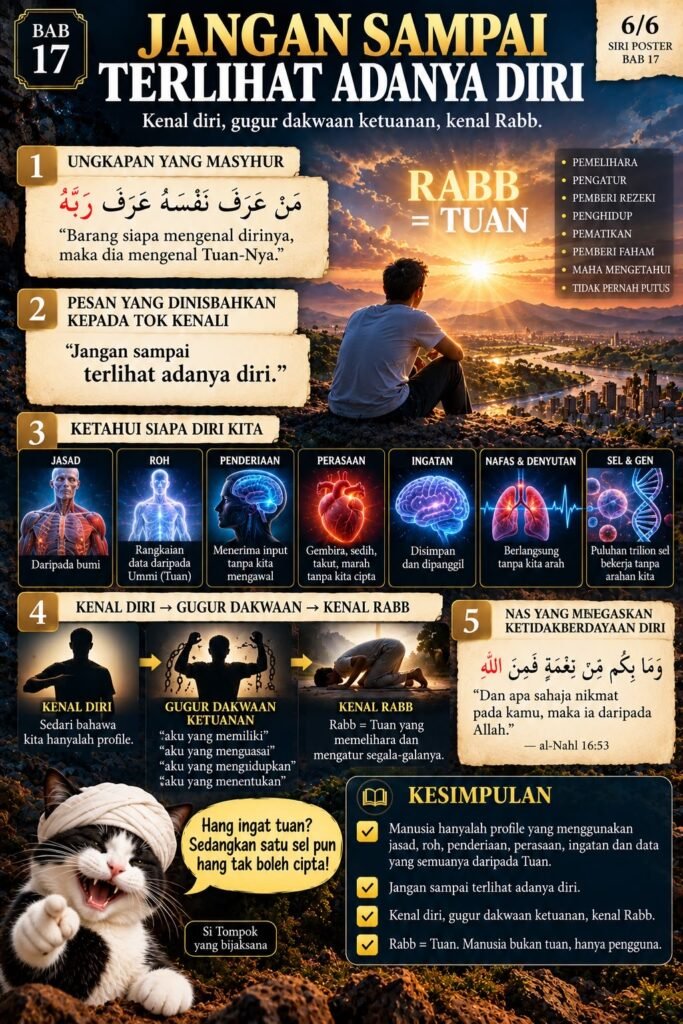
That is why the well-known saying states:
مَنْ عَرَفَ نَفْسَهُ عَرَفَ رَبَّهُ
“Whoever knows himself knows his Lord.”
To know oneself is to see that what is called “I” does not stand by itself.
The more a person knows himself, the clearer it becomes that he is not the absolute owner, not the absolute governor and not the absolute agent.
This is where the saying attributed to Tok Kenali becomes especially sharp:
“DO NOT LET THE SELF APPEAR.”
This does not mean denying human existence.
But do not allow the profile to take the place of the Lord.
Do not let the human being see:
“I am the one who owns,”
“I am the one who controls,”
“I am the one who gives life,”
“I am the one who determines.”
While his entire self continues to exist because of preservation that never ceases.
Therefore, ultimately:
know the self → realise that the self is only a profile → the claim to lordship falls away → know the Rabb.
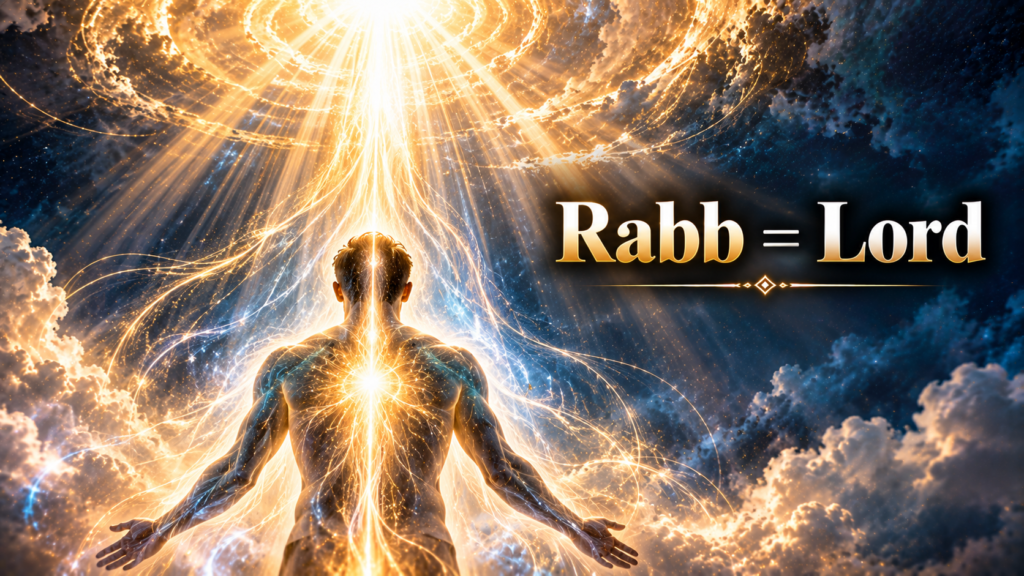
RABB = LORD
THE HUMAN BEING IS ONLY A PROFILE.
DO NOT LET THE PROFILE CLAIM TO BE THE LORD.
Detecting your location…