
MUKADDIMAH · M16
Hadith, Scholarly Authority and the Closing of Spiritual Inquiry
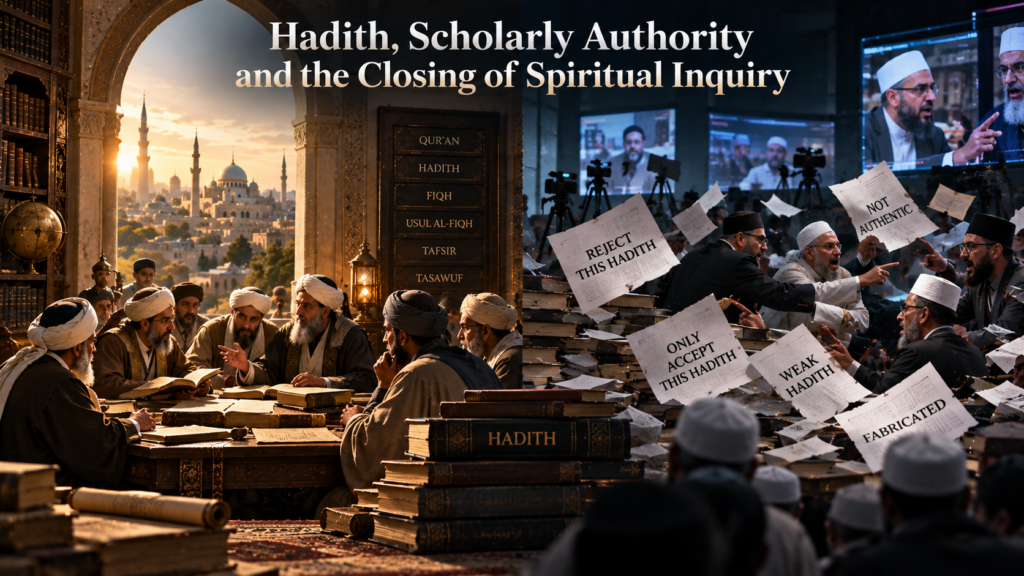
After the Qur’an, Hadith occupies a foundational place in understanding Islam.
Through Hadith, Muslims encounter reports concerning:
the words of Prophet Muhammad SAW,
his actions,
his judgments,
his explanations,
his character,
his worship,
and the experiences of those around him.
Without the enormous efforts of generations of Hadith scholars, much of this material could have been lost, confused or falsely attributed.
Their work therefore deserves serious respect.
But respect for scholarship should not prevent examination of scholarship itself.
A Hadith is transmitted.
Scholars investigate it.
Chains are examined.
Narrators are evaluated.
Texts are compared.
Then classifications are produced:
Sahih
Hasan
Da’if
and in some cases:
Mawdu’.
These classifications are essential tools.
But an important distinction must remain clear:
The Hadith is one thing.
The scholarly judgment concerning the Hadith is another.
The first concerns the report attributed to Prophet Muhammad SAW.
The second concerns a human scholarly assessment of how confidently that attribution can be established.
Confusing these two levels can create problems.
Hadith Scholarship Developed Because Muslims Took Transmission Seriously
The science of Hadith did not develop because early Muslim scholars were careless about Prophet Muhammad SAW.
It developed precisely because they were concerned about accuracy.
Reports circulated.
Memories differed.
Transmitters possessed different levels of reliability.
Political and sectarian conflicts occurred.
Fabrications appeared.
Human error existed.
Scholars therefore developed methods to examine what was being attributed to Rasulullah.
They studied:
Isnad — the chain of transmission
and:
Matn — the reported text.
They examined whether narrators met.
Whether transmission was chronologically possible.
Whether narrators were considered trustworthy.
Whether their memories were reliable.
Whether other chains supported or contradicted a report.
This was an extraordinary intellectual project.
Critical examination of Hadith is therefore part of the Islamic scholarly tradition itself.
The Six Famous Collections Do Not Represent One Single Method
Sunni Islam eventually gave particular prominence to six Hadith collections commonly known as:
Al-Kutub al-Sittah — the Six Books.
They are associated with:
Imam al-Bukhari,
Imam Muslim,
Imam Abu Dawud,
Imam al-Tirmidhi,
Imam al-Nasa’i,
and:
Imam Ibn Majah.
But these books are not identical.
Their compilers did not all apply precisely the same conditions.
Their collections had different purposes.
And not every narration appearing in all six collections possesses exactly the same scholarly status.
This is important.
“Contained in a Hadith collection” and “universally judged Sahih” are not identical propositions.
The scholarly tradition itself contains evaluation, disagreement and gradation.
Classification Is a Scholarly Judgment
Consider the term:
Da’if — weak.
People sometimes hear:
“This Hadith is weak”
and understand:
“The Prophet definitely never said this.”
But these statements are not necessarily equivalent.
A weak classification generally concerns the evidentiary strength of the transmission according to particular Hadith-critical criteria.
It may indicate a problem such as:
a break in transmission,
uncertainty concerning a narrator,
weak memory,
or another defect.
The classification therefore concerns:
our degree of confidence in attribution.
This distinction is fundamental.
Insufficient evidence of transmission is not automatically proof that an event never occurred.
At the same time, possibility is not proof.
A weak report cannot simply be declared authentic because someone likes its spiritual meaning.
Both errors should be avoided.
Weak Does Not Mean Automatically True Either
The opposite mistake is equally dangerous.
Someone encounters a weak narration that supports their preferred belief.
They say:
“Weak does not mean false, therefore I accept it as true.”
That reasoning is incomplete.
If weakness prevents certainty that the report came from Rasulullah, then intellectual honesty requires preserving that uncertainty.
A person may say:
the report exists,
its transmission has been judged weak,
and:
its meaning may be examined separately.
But they should not transform possibility into certainty.
Rejecting careless dismissal does not justify careless acceptance.
SiHulk’s method should require examination in both directions.
Mawdu’ Is a Stronger Judgment
Another distinction concerns:
Mawdu’ — fabricated.
This is more serious than simply calling a report weak.
A judgment of fabrication claims that the report has been falsely attributed.
Such a judgment therefore requires strong evidence.
The seriousness of the label should make scholars cautious.
If a report is truly fabricated, identifying it protects the Prophetic tradition.
But if the label is applied carelessly, authentic or potentially meaningful material could be unjustly dismissed.
The stronger the judgment, the stronger the responsibility to demonstrate its basis.
Human Methodology Does Not Become Revelation
Hadith methodology is a scholarly achievement.
But the methodology itself is not the Qur’an.
The rules developed by scholars are human attempts to determine reliability.
They may be rigorous.
They may be sophisticated.
They may represent centuries of accumulated expertise.
But they remain:
methodology.
This distinction does not diminish their value.
Medicine is valuable because of methodology.
History depends upon methodology.
Law depends upon methodology.
Scientific investigation depends upon methodology.
The point is simply:
A method is a means of approaching truth.
It should not be confused with truth itself.
Scholars Can Disagree
One of the clearest demonstrations that classification involves human judgment is scholarly disagreement.
A report may be strengthened by one scholar and weakened by another.
One may consider a narrator acceptable.
Another may identify a defect.
One may find supporting chains sufficient.
Another may not.
This does not mean Hadith scholarship is arbitrary.
It means scholarly reasoning operates within evidence.
Disagreement is possible because scholars are examining evidence rather than receiving a new Revelation.
This should produce intellectual maturity.
Not cynicism.
Not blind rejection.
And not blind obedience.
Authority Should Explain Its Reasoning
Suppose someone says:
“This Hadith is weak.”
A serious student should be able to ask:
Why?
Which narrator?
Which chain?
Which defect?
Which scholar made the judgment?
Are there other chains?
Did earlier scholars agree?
Did later scholars disagree?
Does the text appear elsewhere?
The purpose of these questions is not to pretend that every beginner is immediately equal to a specialist.
Specialised knowledge matters.
The purpose is to preserve:
traceability.
An authoritative judgment should have a scholarly pathway behind it.
Authority should lead towards evidence.
It should not replace evidence.
The Certificate Cannot Settle the Hadith by Itself
Imagine two people discussing a narration.
One possesses a doctorate.
The other does not.
The doctorate may indicate extensive training.
That matters.
But the question:
“Is this Hadith authentic?”
cannot ultimately be answered merely:
“The person declaring it authentic has a doctorate.”
The degree tells us something about the scholar.
It does not itself constitute the evidence for the Hadith.
The evidence still concerns:
chains,
narrators,
texts,
corroboration,
and:
methodology.
This distinction protects scholarship from credentialism.
Expertise deserves weight.
Evidence remains necessary.
SiHulk Should Not Reverse the Error
There is also a danger for movements that criticise established scholarship.
They may reject institutional authority only to create a new unquestionable authority of their own.
For example:
“The university scholar cannot be trusted, but our teacher must never be questioned.”
That does not solve the problem.
It merely relocates it.
If SiHulk insists that academic authority must explain itself, then SiHulk’s own teachers must also explain their evidence.
If outside interpretations can be examined, SiHulk interpretations must also be examinable.
A method is credible only when it applies to itself.
Hadith Contains More Than Law
Another important issue concerns how Hadith is used.
Hadith collections contain material concerning:
law,
worship,
ethics,
character,
eschatology,
dreams,
spirituality,
remembrance,
intention,
the heart,
and many other dimensions of religious life.
If Hadith is approached only as a source for legal rulings, a large part of its religious world can become secondary.
Prophet Muhammad SAW did not educate the community only by telling them:
permitted
and:
prohibited.
He also educated:
the heart,
intention,
character,
hope,
fear,
mercy,
humility,
and:
spiritual consciousness.
Reducing Hadith to legal extraction can therefore narrow our encounter with Rasulullah.
The Heart Is Part of Prophetic Teaching
Prophet Muhammad SAW said:
“Indeed, in the body there is a piece of flesh: if it is sound, the whole body is sound; and if it is corrupt, the whole body is corrupt. Indeed, it is the heart.”
This Hadith demonstrates that Prophetic education reaches inward.
The heart is not peripheral.
The condition of the heart affects the person as a whole.
Therefore, a study of Hadith that develops technical expertise while neglecting the spiritual condition of the student would itself be incomplete.
The science may become stronger while the scientist remains inwardly unexamined.
This possibility must be taken seriously.
Knowledge Can Produce Humility or Pride
The Qur’an says:
إِنَّمَا يَخْشَى اللهَ مِنْ عِبَادِهِ الْعُلَمَاءُ
“Only those of His servants who possess knowledge truly fear Allah.”
— Fatir 35:28
Knowledge should therefore have an inward consequence.
It should deepen awareness.
Responsibility.
Humility.
If knowledge instead produces:
arrogance,
contempt,
self-importance,
and:
unquestionable authority,
then something has become disconnected.
The problem is not knowledge.
The problem is what the nafs has done with knowledge.
Spiritual Narrations Require Careful Treatment
Some narrations concerning spirituality may possess weaker chains than narrations used to establish major legal rulings.
Historically, scholars have not always treated every category of narration identically.
This does not mean:
“Anything spiritual may be accepted.”
Nor does it mean:
“Weak reports should establish doctrine.”
Rather, it raises a methodological question.
What level of evidence is required for:
creed?
law?
virtues?
historical reports?
spiritual encouragement?
These questions have been debated within the scholarly tradition itself.
Therefore, a single simplistic rule applied to every report can obscure the complexity of Hadith scholarship.
Spiritual Inquiry Must Not Become a Refuge from Evidence
There is another side to the problem.
Someone may say:
“This is spiritual, therefore Hadith criticism does not matter.”
That would be dangerous.
Spiritual claims can affect people’s deepest beliefs.
They can create authority.
They can influence behaviour.
They can lead people towards teachers who claim extraordinary stations.
Therefore, spirituality needs evidence and discernment precisely because it concerns matters that are difficult to verify through ordinary observation.
The unseen should make us more careful, not less careful.
But Methodology Must Not Become a Wall Against Inquiry
The opposite danger is treating every question outside familiar categories as illegitimate.
A student asks about spiritual recognition.
They are told:
“Do not ask.”
They ask about the inward dimensions of Shahadah.
“Not necessary.”
They ask about the spiritual station of Rasulullah.
“Too dangerous.”
They ask about Tasawuf.
“Avoid it.”
If methodology becomes a mechanism for preventing questions rather than examining them, scholarship begins to close rather than guide inquiry.
SiHulk challenges this closure.
A question is not false merely because it is difficult.
It must be examined.
Protecting Aqidah and Preventing Inquiry Are Not the Same Thing
Scholars have legitimate reasons to protect communities from false doctrine.
Not every theological speculation is harmless.
Not every mystical claim is true.
Not every interpretation deserves equal acceptance.
But protection should operate through:
evidence
and:
explanation.
If an idea is wrong, demonstrate why.
If a narration is fabricated, demonstrate the defect.
If an interpretation contradicts the Qur’an, identify the contradiction.
If a spiritual claim lacks evidence, explain the problem.
“Do not ask” is not the same as an answer.
Rasulullah Cannot Be Reduced to a Database of Reports
Hadith studies can become highly technical.
Chains.
Narrators.
Dates.
Variants.
Categories.
Terminology.
All are necessary.
But the subject at the centre of this enormous scholarly project is:
Prophet Muhammad SAW.
The reports exist because generations wanted to preserve what was connected to him.
Therefore, technical expertise should ultimately deepen the relationship with:
Rasulullah
rather than turn him into an abstract database.
The chain should lead somewhere.
The text should lead somewhere.
The scholarship should lead somewhere.
Towards understanding the bearer of the Risalah.
Hadith Is a Path Towards Understanding the Rasul
If the Qur’an declares:
مُّحَمَّدٌ رَّسُولُ الله
then Hadith helps us encounter the details of that Risalah in lived form.
How did he pray?
How did he teach?
How did he respond to people?
How did he speak about the heart?
How did he describe Ihsan?
How did he warn about deception?
How did he deal with weakness?
How did he embody mercy?
These questions are not merely historical.
They contribute towards:
recognition of Rasulullah.
Therefore, the purpose of Hadith scholarship should not end with:
classification.
Classification protects the path.
Recognition is what the protected path should help make possible.
The Six Collections Should Not Become Six Closed Doors
The great Hadith collections should be approached with respect.
But respect should encourage study rather than produce intellectual paralysis.
Their compilers themselves investigated.
Compared.
Selected.
Evaluated.
Their work represents inquiry.
Therefore, to honour their legacy should include preserving the spirit of disciplined inquiry.
Transmission was examined because truth mattered.
That principle remains.
A Later Scholar Does Not Rewrite History Merely by Classification
Another distinction is useful.
Suppose a narration was transmitted centuries ago.
A later scholar examines its chain and classifies it as weak.
The later scholar has not travelled backwards in time and changed what historically occurred.
The scholar has made an evidentiary judgment:
“According to the available transmission evidence, this attribution cannot be established with sufficient confidence.”
That is a meaningful scholarly conclusion.
But it should be expressed at the correct level.
This protects us from confusing:
epistemic judgment
with:
absolute knowledge of every historical event.
Certainty Has Degrees
Not every religious proposition rests upon the same level of evidence.
Some matters are established by the Qur’an.
Some by mass transmission.
Some by highly reliable individual reports.
Some through reports carrying greater uncertainty.
Recognising these degrees is not weakness.
It is intellectual honesty.
The problem begins when:
uncertainty is presented as certainty
or:
strong evidence is treated as though it were mere speculation.
Both distort knowledge.
A mature educational system teaches students how to distinguish degrees of confidence.
The Percentage Problem
Claims are sometimes made that a certain percentage of Hadith has been rejected, weakened or declared fabricated.
Such claims require particular caution.
Before saying:
“10%”
or:
“12%”
we must ask:
10% of what?
All narrations?
Unique Hadith texts?
Chains of transmission?
A particular collection?
A particular scholar’s grading?
Does repetition count separately?
Which edition?
Which methodology?
Without defining the dataset and method, a percentage can create the appearance of precision without actually providing reliable information.
Therefore, SiHulk should not present a numerical percentage as historical fact unless it can be independently demonstrated.
A precise number requires precise evidence.
The underlying question can still be examined without relying on an unsupported statistic.
The Real Question Is Larger Than a Percentage
The deeper issue is not whether:
10%, 12%, or another percentage
has been classified in a particular way.
The deeper question is:
How should later scholarly authority relate to inherited Prophetic reports?
Should later classification be unquestionable?
No.
Should every weak narration automatically be accepted?
No.
Should Hadith methodology be abandoned?
No.
Should spiritual preference override evidence?
No.
Should scholarly judgment be open to scholarly examination?
Yes.
That is the more serious position.
Scholarship Must Remain Alive
A living scholarly tradition does not merely repeat earlier conclusions.
It understands how those conclusions were reached.
It preserves.
Tests.
Compares.
Re-examines.
Explains.
Sometimes confirms.
Sometimes corrects.
This is not disrespect towards earlier scholars.
It is part of the scholarly process they themselves practised.
A tradition becomes intellectually weak when conclusions survive but reasoning disappears.
Reason Has a Role
The student should therefore learn to ask:
What is the evidence?
How was this conclusion reached?
What does the text actually say?
What assumptions are being introduced by interpretation?
Are other scholarly positions available?
These questions do not make the student rebellious.
Properly disciplined, they make the student responsible.
The Qur’an says:
وَلَا تَقْفُ مَا لَيْسَ لَكَ بِهِ عِلْمٌ
“Do not follow that of which you have no knowledge.”
— Al-Isra’ 17:36
Reason therefore remains part of religious responsibility.
Spiritual Recognition Also Requires Discipline
SiHulk places great importance upon recognition.
But recognition cannot become an escape from scholarship.
A person cannot simply declare:
“My heart tells me this Hadith is authentic.”
Nor:
“My spiritual teacher experienced Kasyaf, therefore the narration must be true.”
Historical transmission and spiritual experience answer different questions.
Kasyaf cannot simply repair a broken Isnad as though the disciplines were interchangeable.
Likewise, an Isnad classification does not by itself exhaust every question concerning spiritual meaning.
Each form of knowledge must be understood according to its proper function.
Text, Transmission and Meaning
A mature approach can distinguish at least three questions.
First: Transmission
How reliably can this report be attributed to Prophet Muhammad SAW?
Second: Text
What exactly does the narration say?
Third: Meaning
How should it be understood?
These are related but not identical.
A narration may have a strong chain yet still require careful interpretation.
A weak narration may contain a meaning supported independently by stronger evidence.
Therefore, Hadith study cannot stop at a label.
Sahih is not itself a Tafsir of the Hadith.
Da’if is not itself a complete discussion of meaning.
Classification begins important work.
It does not finish every question.
The Heart of the Problem Is Authority
Eventually, the discussion returns to authority.
Who is allowed to say what Islam means?
The Qur’an?
Rasulullah?
The early community?
Hadith compilers?
Classical scholars?
Modern academics?
Spiritual teachers?
Institutions?
Every one of these categories involves different kinds of authority.
Problems emerge when distinctions disappear.
A scholar interprets Revelation.
The scholar is not Revelation.
A Hadith critic evaluates transmission.
The critic is not Rasulullah.
A spiritual teacher guides a seeker.
The teacher is not the destination.
An institution certifies academic achievement.
The certificate is not recognition.
These distinctions protect both knowledge and faith.
SiHulk’s Position Must Also Be Examined
SiHulk cannot demand scrutiny of everyone else while exempting itself.
If SiHulk interprets a Hadith differently, it must show why.
If it uses a weak narration, the classification should be acknowledged.
If it disagrees with a scholar, the disagreement should address evidence rather than attack credentials.
If it makes a historical claim, the claim should be sourced.
If it advances a distinctive spiritual interpretation, it should identify it as:
SiHulk interpretation
rather than presenting it as universal Muslim consensus.
This discipline strengthens rather than weakens the framework.
Recognition does not require intellectual carelessness.
Reopening Spiritual Inquiry
The purpose is therefore not to dismantle Hadith scholarship.
It is to prevent scholarship from becoming a closed gate.
Hadith should open pathways towards:
Rasulullah,
Ihsan,
purification,
Tawhid,
and:
recognition.
The technical sciences protect transmission.
The spiritual sciences examine inward transformation.
Reason examines interpretation.
Revelation provides the foundation.
These dimensions should communicate with one another.
Protection and exploration need not be enemies.
The Scholar and the Seeker Need Each Other
The seeker without scholarship can become vulnerable to imagination.
The scholar without inward education can become vulnerable to pride.
The spiritual teacher without accountability can become vulnerable to abuse.
The academic institution without spirituality can become vulnerable to reductionism.
Therefore, no single dimension should claim completeness.
The scholar needs humility.
The seeker needs knowledge.
The spiritual teacher needs evidence.
The student needs reason.
And all remain accountable to truth.
From Preservation Towards Recognition
The journey of Hadith can therefore be understood as:
Transmission → Preservation → Authentication → Understanding → Practice → Recognition
Transmission carries the report.
Preservation protects it.
Authentication evaluates its reliability.
Understanding examines its meaning.
Practice brings it into life.
Recognition asks what it reveals about:
Rasulullah
and:
the Risalah he bears.
If the journey stops at classification, something remains unfinished.
The Question Before Us
Hadith scholarship has performed one of the greatest acts of preservation in Islamic intellectual history.
That achievement should not be dismissed.
But neither should human scholarly methodology become an unquestionable substitute for Revelation itself.
The responsible position lies between two extremes.
One extreme says:
“If a scholar classified it, no further question is permitted.”
The other says:
“If I spiritually like the narration, scholarly classification does not matter.”
Neither is sufficient.
SiHulk calls instead for disciplined examination.
Respect the scholars.
Study their methodology.
Ask why a narration was classified.
Distinguish weak from fabricated.
Distinguish possibility from proof.
Distinguish transmission from interpretation.
Distinguish academic qualification from spiritual recognition.
And do not use spirituality as permission to abandon evidence.
At the same time, do not allow technical methodology to reduce Rasulullah to a collection of database entries whose only purpose is classification.
Hadith exists because the words, actions and guidance of Prophet Muhammad SAW matter.
The Isnad matters because Rasulullah matters.
Authentication matters because false attribution to Rasulullah matters.
Interpretation matters because the Risalah matters.
And spiritual education matters because the Risalah is intended to transform the human being.
The question therefore is not whether scholarship should have authority.
It should.
The question is:
What kind of authority?
Authority that closes inquiry?
Or authority that teaches people how to inquire responsibly?
Authority that demands dependence?
Or authority that leads towards evidence?
Authority that produces intellectual status?
Or knowledge that produces humility?
For SiHulk, scholarship fulfils its highest purpose when it protects the path without becoming the destination.
The scholar protects the transmission.
Reason examines the meaning.
The heart receives the guidance.
And the seeker continues towards recognition.
References
1.Al-Qur’an, Surah Fatir, 35:28.
2.Al-Qur’an, Surah Al-Isra’, 17:36.
3.Imam al-Bukhari, Sahih al-Bukhari, Kitab al-Iman, Hadith no. 52.
4.Imam Muslim, Sahih Muslim, Kitab al-Iman, Hadith no. 8a.