
MUKADDIMAH · M15
Dajjal and the Separation of Tawhid from Islamic Education
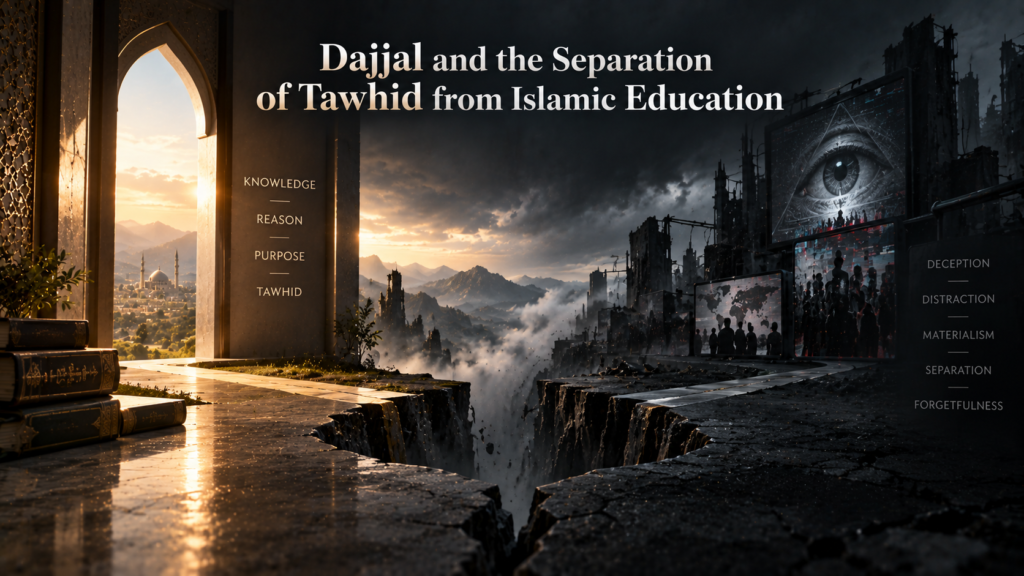
What would happen if a society became increasingly educated about religion while becoming increasingly distant from its deepest purpose?
More books could be published.
More institutions could be established.
More qualifications could be awarded.
More religious specialists could graduate.
More laws could be discussed.
More terminology could be memorised.
Yet another question would remain:
Does all of this necessarily produce recognition?
Knowledge is valuable.
Institutions are valuable.
Scholarship is necessary.
Islamic law is necessary.
Academic discipline can protect communities from ignorance.
But none of these should automatically be confused with:
Tawhid.
A person may possess extensive information about Islam without having undergone the inward journey through which belief becomes conscious recognition.
For SiHulk, this is where the subject of:
Dajjal
becomes relevant.
Not as a slogan to condemn every university.
Not as a label for everyone who disagrees.
And not as a historical claim that Dajjal literally established modern educational institutions.
Rather, SiHulk uses the Dajjalic pattern as an interpretive lens for examining a religious culture in which:
appearance can replace reality,
information can replace recognition,
and:
credentials can replace spiritual transformation.
Dajjal Is Associated with Deception
The Arabic term Dajjal is associated with deception, falsehood and the covering of truth.
Within the Prophetic tradition, Al-Masih al-Dajjal represents an extraordinary trial.
Prophet Muhammad SAW warned his community repeatedly about him.
In an authentic hadith, the Prophet SAW said:
“There has been no prophet who did not warn his people about the one-eyed liar.”
The seriousness of the warning should immediately prevent the subject from becoming merely sensational storytelling.
Dajjal concerns:
deception.
And deception becomes dangerous precisely because falsehood does not always appear obviously false.
If something looked completely absurd, few would follow it.
Powerful deception must contain enough appearance of truth to persuade.
The danger is not merely seeing falsehood.
The danger is mistaking falsehood for truth.
The Problem of Perception
The traditions concerning Dajjal repeatedly raise the problem of perception.
What appears desirable may conceal danger.
What appears threatening may not be what it seems.
Human judgment becomes confused.
This makes Dajjal relevant to a broader spiritual question:
How does a person distinguish appearance from reality?
A person who depends entirely upon outward appearance becomes vulnerable to deception.
A person who follows authority without examination becomes vulnerable.
A person who possesses information but lacks discernment remains vulnerable.
Therefore, protection from deception cannot be reduced merely to knowing the word:
Dajjal.
It requires an education capable of producing:
discernment.
Tawhid Must Be More Than a Chapter in a Textbook
In many religious curricula, Tawhid may appear as a subject.
Students learn definitions.
They study categories.
They memorise propositions.
They answer examination questions.
There is value in this.
Precise terminology can protect belief from confusion.
But SiHulk asks a further question:
Has Tawhid become something the student recognises—or merely something the student can describe?
A person may score highly in an examination about Tawhid.
But an examination cannot by itself establish that the person has moved from inherited belief towards recognition.
Tawhid as information is not automatically Tawhid as lived recognition.
This distinction lies at the centre of SiHulk’s educational criticism.
The Danger Is Separation
The problem is not the existence of:
Fiqh.
The problem is not:
Hadith studies.
The problem is not:
Tafsir.
The problem is not:
Arabic grammar.
The problem is not:
academic study.
The problem arises when these disciplines become separated from the fundamental question:
Who is being recognised through the religion being studied?
A student can spend years learning what actions are permissible and prohibited.
They can learn how contracts work.
How inheritance is divided.
How marriage is regulated.
How prayer is performed.
How fasting is invalidated.
These are legitimate subjects.
But if the educational journey never returns the student towards:
Allah,
Shahadah,
Rasulullah,
the heart,
and:
recognition,
religious knowledge can become fragmented.
Law Is Necessary, but Law Is Not the Whole Religion
Islam requires law and discipline.
Prayer has conditions.
Fasting has rules.
Zakat has calculations.
Marriage has responsibilities.
Transactions have ethical boundaries.
Therefore, criticising the reduction of Islam to law does not mean rejecting Islamic law.
The distinction is:
Fiqh answers important questions about action.
But the human being is more than action.
A person also:
thinks,
believes,
desires,
loves,
fears,
struggles,
and seeks recognition.
An education that perfects outward regulation while neglecting inward transformation may produce a person who knows precisely what is lawful but does not recognise the movements of pride within themselves.
Correct law does not automatically produce a purified heart.
Both are needed.
Dajjalic Deception Can Work Through Reduction
Within the SiHulk framework, one way deception operates is through:
reduction.
Take something large and reduce it until only one dimension remains.
Religion becomes:
law.
Knowledge becomes:
information.
Education becomes:
qualification.
Authority becomes:
credential.
Faith becomes:
identity.
Shahadah becomes:
pronunciation.
Spirituality becomes:
emotion.
When reduction occurs, the remaining part may still be true.
The danger lies in treating the part as though it were the whole.
A partial truth can become deceptive when it is presented as complete reality.
Information Can Create an Illusion of Knowledge
Modern human beings have access to extraordinary amounts of information.
Thousands of books can fit inside a digital device.
Lectures can be streamed instantly.
Search engines can retrieve religious discussions within seconds.
Classical texts can be searched electronically.
This access is valuable.
But information abundance creates a new danger:
the feeling that access to information is equivalent to knowledge.
A person searches.
Copies.
Quotes.
Posts.
Debates.
Yet may never deeply understand what they have encountered.
Even more importantly, information may never transform them.
Possessing information is not the same as being educated by it.
Memorisation Can Preserve Knowledge Without Completing It
Islamic civilisation has a profound tradition of memorisation.
The Qur’an has been preserved through memorisation across generations.
Hadith scholarship depended greatly upon careful transmission and memory.
Therefore, SiHulk does not oppose memorisation.
But memorisation has a function.
It preserves.
It carries.
It makes knowledge available.
The problem begins when:
the ability to repeat
is treated as:
the completion of understanding.
A student can memorise:
La ilaha illallah
without examining:
La
ilah
and:
Allah.
They can memorise the six pillars of Iman without examining what any of them signify.
They can memorise descriptions of Ihsan without cultivating the heart.
Memory carries the words.
Reason must examine them.
The heart must receive them.
Life must embody them.
Certificates Measure Particular Things
A certificate can be useful.
It may indicate that someone:
completed a programme,
passed examinations,
submitted research,
demonstrated technical competence,
or met institutional requirements.
There is nothing inherently wrong with this.
The mistake is expecting a certificate to measure what it was never designed to measure.
A certificate cannot necessarily prove:
sincerity.
It cannot certify:
freedom from arrogance.
It cannot prove:
spiritual recognition.
It cannot measure:
purification of the heart.
It cannot guarantee:
wisdom.
Therefore:
academic qualification and spiritual maturity are different categories.
A person may possess both.
They may possess one without the other.
The Certificate Can Become a New Form of Authority
A deeper problem appears when society begins to assume:
“This person has the highest qualification; therefore this person must possess the highest religious recognition.”
The conclusion does not necessarily follow.
Academic expertise can establish competence within a field.
It deserves appropriate respect.
But religious recognition includes dimensions that academic assessment cannot fully measure.
If the community forgets this distinction, the certificate can gradually become more than evidence of study.
It can become:
a symbol of unquestionable authority.
Then people stop asking:
What is the argument?
What is the evidence?
What is the condition of the teaching?
Instead, they ask only:
“What qualification does the speaker have?”
For SiHulk, this can become another form of intellectual dependency.
Rejecting Credentialism Does Not Mean Rejecting Expertise
This distinction must remain clear.
SiHulk’s criticism is not:
“Ignore scholars.”
Nor:
“Anyone’s opinion is equal to expertise.”
Nor:
“Academic training is useless.”
Specialised knowledge requires study.
Arabic requires study.
Hadith methodology requires study.
Jurisprudence requires study.
History requires study.
Textual criticism requires study.
Expertise matters.
But:
expertise should strengthen inquiry, not terminate it.
A scholar should be able to explain evidence.
A student should learn how reasoning works.
Authority should guide understanding rather than demand intellectual surrender.
The Qur’an Warns Against Following Without Knowledge
The Qur’an says:
وَلَا تَقْفُ مَا لَيْسَ لَكَ بِهِ عِلْمٌ
“Do not follow that of which you have no knowledge.”
— Al-Isra’ 17:36
The principle applies broadly.
Do not follow merely because something is popular.
Do not follow merely because it is inherited.
Do not follow merely because it is emotionally attractive.
And intellectual responsibility should not disappear merely because the speaker possesses authority.
Knowledge requires evidence and responsibility.
Institutions Can Serve Truth
Educational institutions should therefore not be treated as enemies.
A good institution can:
preserve manuscripts,
teach languages,
train researchers,
maintain scholarly standards,
enable debate,
protect intellectual traditions,
and transmit knowledge across generations.
These are valuable functions.
SiHulk’s concern is not the building.
Not the university.
Not the certificate itself.
The concern is the educational philosophy operating within them.
What kind of human being does the institution produce?
That is the deeper question.
An Educated Person Can Still Be Spiritually Blind
The Qur’an says:
فَإِنَّهَا لَا تَعْمَى الْأَبْصَارُ وَلَٰكِن تَعْمَى الْقُلُوبُ الَّتِي فِي الصُّدُورِ
“Indeed, it is not the eyes that become blind, but the hearts within the breasts that become blind.”
— Al-Hajj 22:46
Education can improve the intellect.
It can sharpen analysis.
It can expand vocabulary.
It can improve research.
But none of these automatically guarantees that the heart sees.
This is precisely why SiHulk insists that religious education must include:
Ihsan.
The heart requires education too.
The Greatest Deception May Look Intelligent
People often imagine deception as ignorance.
But deception can also appear sophisticated.
It can use:
technical terminology,
academic authority,
complex argument,
institutional prestige,
and enormous quantities of information.
The appearance of intelligence does not automatically establish truth.
Neither does simplicity establish truth.
The criterion must remain:
evidence,
reason,
Revelation,
and:
recognition.
This is where the SiHulk reading of Dajjal becomes particularly important.
Deception is dangerous when it looks convincing.
Dajjal Should Not Become a Label for Everyone We Oppose
There is another danger.
Religious communities can use powerful terms carelessly.
Someone disagrees with us:
Dajjal.
An institution teaches something we dislike:
Dajjal.
A scholar challenges our interpretation:
Dajjal.
This destroys serious analysis.
SiHulk should therefore distinguish between:
Al-Masih al-Dajjal
as described in Prophetic eschatology,
and:
a Dajjalic pattern
as an interpretive description of deception.
The two should not be casually collapsed.
Criticism requires precision.
Otherwise, a concept intended to expose deception can itself become rhetorical deception.
Tawhid Is the Centre
What then should remain at the centre of Islamic education?
For SiHulk:
Tawhid.
But Tawhid must be understood as more than the ability to recite a doctrinal formula.
Tawhid must move through:
reason,
negation,
affirmation,
recognition,
and:
witnessing.
The student should not merely know that Tawhid is important.
They must be educated towards what Tawhid demands.
Tawhid Without Recognition Can Become a Subject
Imagine a student studying Tawhid for an examination.
They learn the chapter.
Answer the questions.
Receive a high mark.
The semester ends.
The subject is completed.
But can:
Tawhid
really be completed like a semester module?
The academic course may end.
The journey of recognition does not.
This illustrates the danger of confusing:
studying Tawhid
with:
being transformed by Tawhid.
One can happen inside a classroom.
The other must enter the entire human being.
The Four Dimensions Must Remain Connected
SiHulk’s educational framework therefore becomes relevant:
Islam — Action
Iman — Reason
Ihsan — Spirituality
Qiamah — Transformation
If education concentrates only upon Islam as outward practice, imbalance develops.
If it concentrates only upon intellectual belief, another imbalance develops.
If spirituality is excluded, the heart may remain uneducated.
If transformation and struggle are excluded, knowledge may never challenge the ego.
The four dimensions must remain connected.
Action.
Understanding.
Heart.
Transformation.
The Dajjalic Pattern Is Fragmentation
Within SiHulk’s interpretive framework, one of the most dangerous patterns of deception is therefore:
fragmentation.
Separate law from Tawhid.
Separate knowledge from recognition.
Separate intellect from spirituality.
Separate qualification from character.
Separate religious authority from accountability.
Separate Shahadah from conscious witnessing.
Then each fragment continues to exist.
But the relationship between them disappears.
The result may still look religious.
That is precisely why the problem can be difficult to recognise.
A Religious System Can Be Busy Yet Spiritually Empty
Imagine a system filled with:
classes,
seminars,
degrees,
conferences,
debates,
publications,
fatwas,
and examinations.
Activity is everywhere.
But ask:
Are hearts being purified?
Are students learning to examine inherited assumptions?
Are they being taught how to recognise the movements of the nafs?
Are they becoming more humble as their knowledge increases?
Are they moving from information towards recognition?
If these questions disappear, religious activity may continue while the spiritual centre weakens.
Busyness is not necessarily depth.
Tawhid Should Organise the Disciplines
The solution is not to destroy religious disciplines.
It is to reconnect them.
Fiqh should return the person towards obedience.
Hadith should return the person towards Rasulullah.
Tafsir should open the Qur’an towards understanding.
Arabic should enable deeper engagement with Revelation.
History should teach discernment.
Tasawuf should cultivate the inward human being.
All should ultimately serve:
recognition.
The disciplines are paths.
They should not become destinations detached from the centre.
The Teacher Must Ask What Knowledge Is Producing
An educational system often asks:
What does the student know?
It should also ask:
What is this knowledge producing?
Greater humility?
Or greater arrogance?
Greater responsibility?
Or greater entitlement?
Greater ability to recognise truth?
Or greater ability to win arguments?
Greater spiritual maturity?
Or greater dependence upon titles?
The answer reveals whether education is transforming the human being or merely expanding their intellectual inventory.
Dajjal and the Eye of Perception
Prophetic descriptions of Dajjal famously emphasise his defective sight.
Without turning every physical description into allegory, the imagery naturally raises an educational question:
What happens when human perception becomes one-dimensional?
A person may see law but not spirituality.
Information but not wisdom.
Credentials but not character.
Appearance but not reality.
Muhammad the human being but not Rasulullah.
Religious identity but not Shahadah as recognition.
For SiHulk, this one-dimensional perception provides a powerful way of thinking about educational imbalance.
To see only one dimension is not to see the whole.
Protection Requires Knowledge
Prophet Muhammad SAW did not teach the community to face Dajjal through ignorance.
He taught knowledge.
Among the well-known Prophetic instructions is the memorisation of verses from Surah Al-Kahf as protection from the trial of Dajjal.
This is important.
The answer to deceptive knowledge is not:
less knowledge.
The answer is:
knowledge properly understood.
Knowledge connected with Revelation.
Knowledge accompanied by discernment.
Knowledge that protects rather than merely impresses.
Surah Al-Kahf and the Education of Perception
Surah Al-Kahf repeatedly confronts human assumptions.
Things are not always what they initially appear to be.
Wealth can deceive.
Power can deceive.
Surface judgment can be incomplete.
Human knowledge has limits.
The Surah repeatedly trains the reader not to make reality identical to first appearance.
This makes its connection with protection from Dajjal especially meaningful.
The seeker must learn how to see beyond appearance without abandoning evidence.
That is a sophisticated form of education.
Reason and Spirituality Must Work Together
A person with spirituality but no intellectual discipline can be deceived by emotion.
A person with intellectual discipline but no spiritual cultivation can be deceived by ego.
Therefore:
reason needs the heart.
The heart needs reason.
Reason examines the claim.
The heart examines the self receiving the claim.
Revelation provides the criterion.
The teacher guides.
The seeker struggles.
Together, these provide a stronger defence against deception.
The Problem Is Not Modernity Alone
It would be too simple to blame everything on modern universities.
Human beings have always been capable of:
pride,
blind imitation,
abuse of authority,
superficial learning,
and spiritual neglect.
These problems can exist in:
universities,
madrasahs,
mosques,
spiritual orders,
families,
and independent religious movements.
No institution is automatically immune.
SiHulk itself would not be immune merely because it criticises others.
Every educational system must examine itself.
Otherwise, criticism of institutional ego can become another form of institutional ego.
SiHulk Must Be Subject to the Same Test
If SiHulk argues that religious education should produce recognition, then SiHulk must also ask:
Does our own education produce recognition?
If SiHulk criticises blind obedience, it must permit responsible questioning.
If it criticises credentialism, it must not replace academic titles with unquestionable internal titles.
If it criticises spiritual emptiness, it must cultivate the heart.
If it criticises institutional arrogance, it must guard against its own arrogance.
If it criticises unexamined doctrine, its own doctrine must also be examined.
A principle that applies only to opponents is not a serious principle.
This self-examination is essential to intellectual and spiritual integrity.
From Education Towards Tawhid
Islamic education should therefore move through a deeper progression:
Information → Understanding → Discernment → Practice → Purification → Recognition
Information matters.
But it must become understanding.
Understanding must develop discernment.
Discernment must influence practice.
Practice must enter the heart.
The heart must undergo purification.
And the journey must move towards:
recognition.
This restores Tawhid to the centre.
The Question Before Us
The question is not:
“Should Muslims have universities?”
Yes, Muslims need serious institutions of knowledge.
The question is not:
“Should scholars have qualifications?”
Qualifications can demonstrate genuine study and expertise.
The question is not:
“Should Muslims study Fiqh?”
Fiqh is necessary.
The deeper question is:
“What happens when the instruments of education become substitutes for the purpose of education?”
When:
the certificate replaces wisdom,
memorisation replaces understanding,
law replaces the whole religion,
authority replaces evidence,
information replaces recognition,
and:
religious appearance replaces spiritual transformation.
Within SiHulk’s interpretive framework, this is where the Dajjalic problem becomes educational.
Not because every university is Dajjal.
Not because every scholar is deceived.
Not because academic knowledge is an enemy of Tawhid.
But because deception succeeds whenever:
the appearance of knowledge is mistaken for the completion of knowledge.
Islamic education must therefore remain whole.
The body must learn submission.
The mind must reason.
The heart must be cultivated.
The nafs must be confronted.
The student must learn to distinguish.
The teacher must remain accountable.
The scholar must remain humble.
And Tawhid must remain more than a chapter that can be completed and forgotten.
Tawhid must become recognition.
Because the greatest educational failure would not necessarily be producing people who know nothing about religion.
It may be producing people who know enormous amounts about religion while never confronting the fundamental question:
What have I actually recognised?
And in an age of abundant information, impressive credentials and powerful institutions, that question becomes more important—not less.
References
1.Al-Qur’an, Surah Al-Isra’, 17:36.
2.Al-Qur’an, Surah Al-Hajj, 22:46.
3.Al-Qur’an, Surah Al-Kahf, 18:1–10.
4.Imam al-Bukhari, Sahih al-Bukhari, Kitab al-Fitan, Hadith no. 7131.
5.Imam Muslim, Sahih Muslim, Kitab al-Fitan wa Ashrat al-Sa’ah, Hadith no. 2933a.
6.Imam Muslim, Sahih Muslim, Kitab Salat al-Musafirin wa Qasriha, Hadith no. 809a.