
MUKADDIMAH · M17
From Ulama to Ulama Su’: The Crisis of Religious Authority
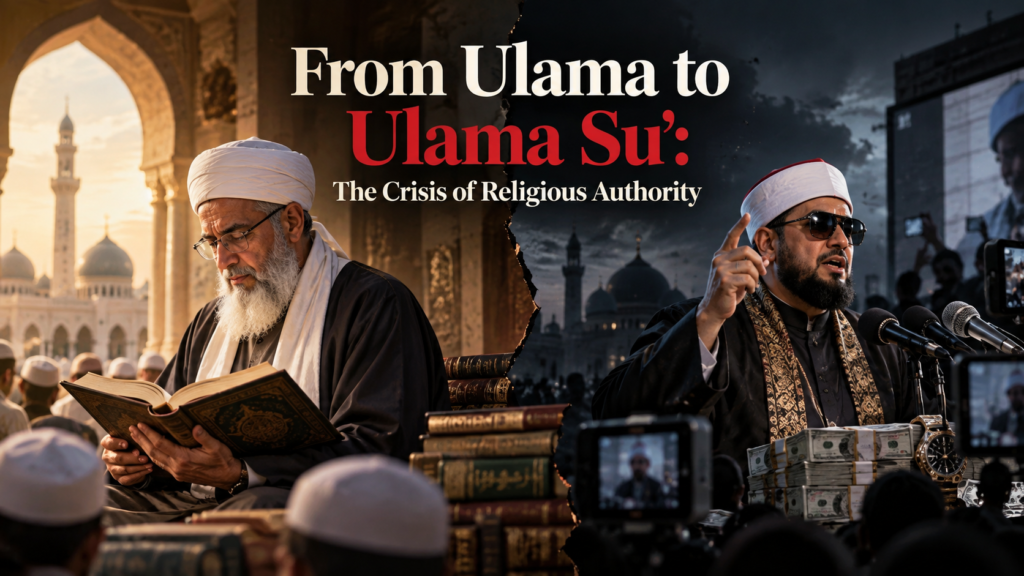
Islam honours knowledge.
The Qur’an asks:
هَلْ يَسْتَوِي الَّذِينَ يَعْلَمُونَ وَالَّذِينَ لَا يَعْلَمُونَ
“Are those who know equal to those who do not know?”
— Az-Zumar 39:9
Knowledge matters.
Teachers matter.
Scholars matter.
Communities need people who dedicate their lives to:
the Qur’an,
Hadith,
Arabic,
Fiqh,
history,
spiritual education,
and the preservation of religious knowledge.
Therefore, questioning religious authority does not mean rejecting scholarship.
The deeper question is:
What happens when knowledge becomes authority, and authority becomes attached to the self?
A scholar remains human.
Knowledge does not automatically eliminate:
pride,
fear,
ambition,
attachment,
competition,
or the desire for recognition.
Indeed, religious knowledge can give the nafs something extremely powerful:
the authority to speak in the name of religion.
This is why the difference between:
Ulama
and:
Ulama Su’
must be examined carefully.
What Is an Alim?
The Arabic word:
عَالِم — ‘Alim
comes from the relationship with:
‘Ilm — knowledge.
Its plural is:
عُلَمَاء — Ulama.
At its basic level, an alim is:
one who knows.
But the Qur’anic concept of religious knowledge goes beyond possessing information.
The Qur’an says:
إِنَّمَا يَخْشَى اللهَ مِنْ عِبَادِهِ الْعُلَمَاءُ
“Only those of His servants who possess knowledge truly fear Allah.”
— Fatir 35:28
The verse connects:
knowledge
with:
khashyah — reverent fear and awareness.
This relationship is important.
The Qur’an does not present the ideal scholar merely as someone whose mind contains more information.
Knowledge should produce an inward consequence.
The more one knows, the greater the responsibility.
Knowledge Should Produce Humility
Imagine standing at the edge of an ocean.
A person who has never studied the ocean may think it is simple.
A marine scientist understands how much complexity lies beneath the surface.
Greater knowledge reveals how much remains unknown.
The same principle should operate in religious scholarship.
The deeper a person enters the Qur’an, Hadith and the intellectual tradition, the more they should recognise the seriousness of speaking about religion.
Knowledge should therefore produce:
carefulness,
humility,
responsibility,
and:
awareness of one’s limitations.
Knowledge that produces only confidence but never humility should be examined.
The Scholar Is Not Revelation
A fundamental distinction must remain:
The Qur’an is Revelation.
The scholar interprets Revelation.
These are not the same thing.
Likewise:
Rasulullah bears the Risalah.
The scholar studies the Risalah.
The scholar may possess extraordinary expertise.
But the scholar does not become the source of Revelation.
This distinction protects both scholarship and the community.
When a scholar’s interpretation is treated as though disagreement with it is automatically disagreement with Allah, the boundary between:
Revelation
and:
human interpretation
has become dangerously blurred.
Respect Is Not Worship
Students should respect teachers.
Communities should respect genuine scholars.
Expertise deserves appropriate weight.
But respect must not become intellectual worship.
A scholar can make a mistake.
A teacher can misunderstand evidence.
A Mufti can change an opinion.
A jurist can disagree with another jurist.
A Hadith scholar can classify a narration differently from another specialist.
The existence of disagreement within Islamic scholarship itself demonstrates:
human interpretation remains human.
Therefore:
respect the scholar,
but:
examine the argument.
Authority Has a Legitimate Function
Religious authority is not inherently dangerous.
Without qualified teachers, every person could invent their own religion.
Without scholarship, complex texts could be misunderstood.
Without expertise, historical context could disappear.
Without Hadith criticism, fabricated reports could circulate without resistance.
Without Fiqh, religious practice could become chaotic.
Authority therefore has an important role.
The question is not:
“Should religious authority exist?”
The question is:
“What should govern religious authority?”
For SiHulk, the answer must include:
knowledge,
evidence,
reason,
spiritual integrity,
and:
accountability.
Authority Becomes Dangerous When It Cannot Be Questioned
Imagine a religious teacher saying:
“You are not allowed to ask why.”
At first, the instruction may appear to protect the student from confusion.
But if it becomes a permanent principle, the student is being trained not to understand.
They are being trained to obey authority.
This creates a dangerous educational culture.
A teacher may sometimes need to say:
“You need more foundation before entering this question.”
That can be reasonable.
But this is different from saying:
“This question must never be examined.”
A difficult question is not automatically a forbidden question.
The Qur’an Does Not Praise Blind Following
The Qur’an repeatedly criticises people who treat inherited authority as sufficient proof.
It says:
وَإِذَا قِيلَ لَهُمُ اتَّبِعُوا مَا أَنزَلَ الله قَالُوا بَلْ نَتَّبِعُ مَا أَلْفَيْنَا عَلَيْهِ آبَاءَنَا
“When it is said to them, ‘Follow what Allah has revealed,’ they say, ‘Rather, we follow what we found our forefathers following.’”
— Al-Baqarah 2:170
The problem is not that ancestors possess no knowledge.
The problem is making:
“Our people have always said this”
the final proof.
The same principle can apply to institutions.
Tradition deserves study.
Tradition does not eliminate the responsibility to understand.
The Qur’an Warns Against Religious Authority Consuming Wealth Wrongfully
Religious authority can also become connected to material interest.
The Qur’an warns:
إِنَّ كَثِيرًا مِّنَ الْأَحْبَارِ وَالرُّهْبَانِ لَيَأْكُلُونَ أَمْوَالَ النَّاسِ بِالْبَاطِلِ وَيَصُدُّونَ عَن سَبِيلِ الله
“Indeed, many rabbis and monks consume people’s wealth wrongfully and turn them away from the way of Allah.”
— At-Tawbah 9:34
The verse concerns religious authorities among earlier communities, but the warning contains a principle from which Muslims should also learn.
Religious status does not make a person immune from corruption.
Someone can occupy a sacred office while behaving wrongly.
Religious appearance cannot itself guarantee spiritual integrity.
The Nafs Can Wear the Clothing of Scholarship
Before becoming a scholar, someone may desire:
money,
status,
attention,
or influence.
After becoming a scholar, those desires do not automatically disappear.
They may simply become religious.
Instead of:
“I want people to admire my wealth,”
the nafs says:
“I want people to admire my knowledge.”
Instead of:
“I want social power,”
it says:
“I want religious authority.”
Instead of:
“I want people to follow me,”
it says:
“People must follow me because I represent the truth.”
The language changes.
The nafs survives.
This is why spiritual education is essential even for scholars.
What Is Meant by Ulama Su’?
The expression:
Ulama Su’
is commonly used to refer to:
corrupt or evil scholars.
The term should not be used casually.
It is a serious accusation.
A scholar should not be called Ulama Su’ merely because:
they disagree with SiHulk,
they belong to another school,
they criticise a SiHulk interpretation,
or:
they possess an academic qualification.
Disagreement is not proof of corruption.
The label must concern conduct and corruption, not merely difference of opinion.
This distinction is essential.
Otherwise, “Ulama Su’” becomes nothing more than an insult for opponents.
A Scholar Can Be Wrong Without Being Corrupt
This principle must be protected.
A sincere scholar may make an error.
A researcher may use incomplete evidence.
A jurist may reach a conclusion with which another jurist disagrees.
A teacher may later revise an opinion.
None of these automatically establishes:
corruption.
Human fallibility is different from deliberate distortion.
The distinction can be expressed:
Error ≠ Corruption
Disagreement ≠ Dishonesty
Different Interpretation ≠ Ulama Su’
Without these distinctions, religious criticism becomes unjust.
When Does Religious Authority Become Corrupt?
Corruption becomes a more appropriate concern when religious authority knowingly uses religion to serve:
personal power,
wealth,
institutional interest,
political pressure,
reputation,
or:
the suppression of truth.
A scholar who discovers strong evidence against their own position but deliberately hides it to protect status faces a different moral problem from a scholar who sincerely interprets the evidence differently.
The difference lies in:
integrity.
This is why only Allah ultimately knows the complete inward condition of a person.
Public criticism should therefore focus first upon:
arguments,
evidence,
conduct,
and:
institutional behaviour
rather than pretending to possess perfect knowledge of someone’s heart.
The Qur’an Condemns Concealing Truth
The Qur’an says:
وَلَا تَلْبِسُوا الْحَقَّ بِالْبَاطِلِ وَتَكْتُمُوا الْحَقَّ وَأَنتُمْ تَعْلَمُونَ
“Do not mix truth with falsehood or conceal the truth while you know.”
— Al-Baqarah 2:42
The final words are crucial:
“while you know.”
There is a moral difference between:
not knowing
and:
knowing but concealing.
The latter is an ethical failure.
Knowledge increases responsibility.
The scholar who knows therefore carries a heavier burden concerning honesty.
Knowledge Can Be Sold
Another danger arises when religious knowledge becomes a commodity.
This does not mean scholars must work without income.
Teachers need food.
Institutions require funding.
Researchers need resources.
Receiving payment for legitimate work is not itself corruption.
The problem appears when:
money determines truth.
When an interpretation changes because a sponsor demands it.
When religious silence is purchased.
When institutional funding determines which questions may be asked.
When access to religious authority becomes a commercial product.
At that point, the relationship between:
knowledge
and:
interest
must be examined.
Political Power Can Influence Religious Authority
Throughout history, religion and political power have interacted in complicated ways.
Sometimes scholars advised rulers courageously.
Sometimes they resisted rulers.
Sometimes they worked within governments for legitimate reasons.
And sometimes religious authority became entangled with political interest.
Therefore, employment by an institution or government does not automatically make a scholar corrupt.
Nor does independence automatically make someone truthful.
The criterion remains:
evidence and integrity.
The question is whether authority can still speak truth when truth becomes inconvenient.
The Certificate Can Become a Shield
Academic qualifications can demonstrate real expertise.
But a credential can become problematic when used to avoid argument.
For example:
“I have a doctorate. You are not qualified to question me.”
The first sentence may be true.
The second does not necessarily follow.
A specialist may know much more than the questioner.
But the specialist should still be able to explain the basis of a conclusion at an appropriate level.
A qualification establishes expertise.
It does not establish infallibility.
This distinction protects the dignity of genuine scholarship.
The Unqualified Person Also Has Responsibilities
Criticism of authority should not produce the opposite arrogance.
Someone without training may read one translation online and assume they have overturned centuries of scholarship.
That is also a problem.
Reason requires humility on both sides.
The expert must not use expertise as infallibility.
The beginner must not mistake curiosity for mastery.
Responsible inquiry recognises levels of knowledge without turning those levels into unquestionable caste.
The Crisis Begins When Titles Replace Evidence
Consider two questions:
“Who said it?”
and:
“Why is it true?”
Both can matter.
Who said something helps us evaluate expertise.
But eventually:
the evidence matters.
If a statement is accepted only because:
a famous scholar said it,
a prestigious university teaches it,
a government institution approved it,
or:
a particular organisation published it,
then authority has begun replacing inquiry.
Titles should guide us towards evidence, not away from it.
Religious Institutions Can Protect Their Own Systems
Institutions naturally develop structures.
Positions.
Curricula.
Standards.
Funding.
Reputation.
Once established, institutions may become resistant to ideas that challenge their framework.
This is not unique to religion.
It happens in politics.
Academia.
Business.
Science.
And social organisations.
Human beings become attached to systems they have built.
Therefore, institutional resistance does not automatically prove that the institution is wrong.
But neither does institutional authority automatically prove that it is right.
The claim must still be examined.
A Majority Is Not Automatically Proof
Large numbers can create psychological authority.
If thousands of scholars hold one view, that consensus or broad agreement deserves serious consideration.
It should not be dismissed casually.
But the reasoning behind the position still matters.
The Qur’an itself repeatedly asks human beings to distinguish truth from mere following.
Therefore, SiHulk should neither worship majority opinion nor dismiss it merely because it is majority opinion.
The responsible question is:
What is the evidence, and how strong is the agreement?
Minority Status Is Not Proof Either
The opposite romanticism must also be rejected.
A movement may think:
“Everyone rejects us, therefore we must be correct.”
That does not follow.
False ideas can also be unpopular.
Being attacked does not prove truth.
Being a minority does not prove spiritual superiority.
Therefore, SiHulk cannot use opposition as evidence of its own correctness.
Truth requires evidence whether held by millions or by one person.
The Scholar Must Be Able to Say “I Do Not Know”
One of the greatest signs of intellectual integrity is the ability to say:
“I do not know.”
Religious authority can make these words difficult.
People expect answers.
A scholar may fear appearing weak.
But pretending certainty where certainty does not exist is more dangerous.
The Qur’an commands:
وَلَا تَقْفُ مَا لَيْسَ لَكَ بِهِ عِلْمٌ
“Do not follow that of which you have no knowledge.”
— Al-Isra’ 17:36
Knowledge has boundaries.
Recognising those boundaries is part of scholarship.
Humility is not ignorance.
It is knowledge of the limits of knowledge.
The Scholar Must Remain a Student
Religious learning does not end when someone receives a title.
A scholar continues:
reading,
examining,
correcting,
learning,
and:
reconsidering.
The moment authority convinces a person that they no longer need correction, knowledge becomes dangerous.
The genuine scholar remains teachable.
This is especially important because new information can emerge.
Manuscripts can be discovered.
Arguments can be reconsidered.
Historical assumptions can be corrected.
The tradition remains alive through disciplined learning.
Spiritual Authority Faces the Same Danger
The problem does not belong only to academic scholars.
A Mursyid can also become corrupted by authority.
A spiritual teacher may begin with sincere guidance but gradually enjoy:
obedience,
admiration,
financial dependence,
and:
personal loyalty.
Therefore, replacing academic authority with spiritual authority does not automatically solve the problem.
Every form of human authority requires accountability.
The nafs can wear an academic robe.
The nafs can also wear a Sufi cloak.
The clothing is not the issue.
The inward condition is.
Kasyaf Cannot Make a Teacher Infallible
Claims of spiritual unveiling must not become tools of domination.
A teacher cannot simply say:
“I know through Kasyaf, therefore you may not question me.”
Personal spiritual experience does not become universal Revelation.
If a claim affects doctrine, community governance or another person’s rights, it requires appropriate evidence and accountability.
Otherwise, spiritual language can become more difficult to challenge than academic authority.
Unverifiable authority is especially vulnerable to abuse.
Rasulullah Is the Measure, Not the Scholar
The purpose of Islamic scholarship is ultimately to serve the Risalah.
The scholar studies Prophet Muhammad SAW.
The Hadith specialist investigates reports from him.
The jurist seeks to understand guidance derived from Revelation.
The spiritual teacher seeks inward transformation through that guidance.
Therefore, none of them should become a replacement for:
Rasulullah.
The chain of authority should point back towards the Risalah.
Scholar → Knowledge → Risalah → Rasulullah
If the scholar becomes the final destination, the direction has been reversed.
The Scholar Should Lead Towards Allah, Not Towards Himself
The Qur’an describes Prophet Muhammad SAW as:
وَدَاعِيًا إِلَى الله بِإِذْنِهِ
“A caller to Allah by His permission…”
— Al-Ahzab 33:46
If Rasulullah calls towards Allah, religious teachers should be especially careful not to call people ultimately towards themselves.
The teacher may be respected.
Loved.
Consulted.
Followed within legitimate boundaries.
But the teacher’s function is guidance.
Authority should point beyond itself.
A teacher who makes their own personality the centre of religion has distorted the direction of teaching.
The Crisis of Authority Is Also a Crisis of the Nafs
At the deepest level, the problem is not merely institutional.
It is spiritual.
The nafs wants:
certainty,
superiority,
recognition,
control,
and:
security.
Religious authority can provide all five.
Therefore, a scholar needs spiritual education precisely because scholarship increases influence.
The more authority a person possesses, the more seriously they must examine:
why they want to be obeyed.
This question can be uncomfortable.
But it is necessary.
Knowledge Without Purification Can Become Power
Knowledge gives a person the ability to influence others.
Religious knowledge gives them the ability to influence:
belief,
behaviour,
family decisions,
community relationships,
and:
spiritual identity.
This is enormous power.
Without purification, knowledge can therefore become a weapon of the ego.
The problem is not knowledge.
The problem is knowledge serving the nafs.
This is where the concept of Ulama Su’ becomes spiritually significant.
Ulama Su’ Is a Warning, Not a Weapon
SiHulk should therefore use the term carefully.
It should function first as:
a warning to every person who possesses religious authority.
Before pointing towards another scholar, the teacher should ask:
Could this happen to me?
Am I protecting truth or protecting status?
Do I welcome evidence that challenges me?
Can I admit error?
Do I become angry when questioned?
Do I use religious language to control others?
Has knowledge made me humble?
Or has it given my ego a more respectable identity?
These questions turn the concept inward.
The most useful warning is the one we are willing to apply to ourselves.
SiHulk Must Not Create Its Own Ulama Su’
If SiHulk criticises corrupt religious authority, it must build safeguards against reproducing the same problem internally.
SiHulk teachers should therefore remain:
accountable,
open to evidence,
open to responsible questions,
clear about sources,
careful with doctrinal claims,
and:
willing to distinguish interpretation from Revelation.
No teacher should become unquestionable merely because they teach SiHulk doctrine.
No internal title should replace evidence.
No claim of spiritual recognition should remove accountability.
Otherwise, SiHulk would reproduce the very authority structure it criticises.
Authority Must Be Collective Where Possible
One safeguard is governance.
Important doctrinal decisions should not depend unnecessarily upon one personality.
Sources should be documented.
Interpretations should be reviewed.
Historical claims should be verified.
Major doctrinal developments should be discussed.
Disagreement should be recorded rather than hidden.
This reduces the risk that:
personal preference becomes communal doctrine.
Collective review does not guarantee truth.
But it creates accountability.
The Community Also Has Responsibility
Religious authority becomes unhealthy partly because communities sometimes demand certainty from scholars.
People want:
simple answers,
immediate rulings,
clear enemies,
and:
someone who will think for them.
This creates pressure for scholars to appear certain even when issues are complicated.
Therefore, reforming religious authority also requires educating the community.
People must learn that:
“I do not know”
can be a responsible answer.
“There are several scholarly views”
can be an honest answer.
“The evidence is uncertain”
can be a mature answer.
Religion does not become weaker when uncertainty is acknowledged accurately.
Questioning Must Have Adab
Responsible inquiry does not mean hostility.
A student does not need to insult a teacher in order to ask a difficult question.
A scholar does not need to humiliate another scholar in order to disagree.
The Qur’an commands:
ادْعُ إِلَىٰ سَبِيلِ رَبِّكَ بِالْحِكْمَةِ وَالْمَوْعِظَةِ الْحَسَنَةِ وَجَادِلْهُم بِالَّتِي هِيَ أَحْسَنُ
“Invite to the way of your Lord with wisdom and good instruction, and argue with them in the best manner.”
— An-Nahl 16:125
Truth does not require bad character.
Critical thinking and Adab can coexist.
The Strongest Scholar Does Not Need to Fear Questions
If a position has strong evidence, questions provide an opportunity to explain it.
If the evidence is weak, questions provide an opportunity to discover that weakness.
Either way, responsible inquiry serves knowledge.
Authority that survives only by preventing questions is fragile.
Truth does not become weaker because it is examined.
Human interpretations may become weaker.
And when they do, they should be corrected.
From Authority Towards Responsibility
Religious authority should therefore be reframed.
Instead of:
“I possess knowledge, therefore you must obey me,”
the scholar should understand:
“I possess knowledge, therefore my responsibility is greater.”
Greater knowledge means greater responsibility to:
verify,
explain,
teach,
remain humble,
correct mistakes,
protect the vulnerable,
and:
avoid speaking without evidence.
Authority becomes:
Amanah — trust.
Not privilege.
The Real Measure of the Scholar
How then should a scholar be evaluated?
Qualifications matter.
Knowledge matters.
Methodology matters.
But other questions also matter.
Does the scholar show evidence?
Can they distinguish certainty from interpretation?
Can they admit error?
Do they treat opponents fairly?
Does knowledge produce humility?
Are they accountable?
Do they direct people towards the Risalah rather than towards their own personality?
These questions reveal a more complete picture of religious authority.
From Ulama Towards Recognition
The function of the scholar should ultimately be:
Scholar → Teaching → Understanding → Recognition
The scholar teaches.
The student reasons.
The heart receives.
The person practises.
The nafs is confronted.
Recognition deepens.
The scholar therefore does not own the seeker’s faith.
The scholar serves the journey.
When authority understands itself this way, knowledge becomes service rather than domination.
The Question Before Us
The crisis of religious authority cannot be solved simply by removing scholars.
Islam needs scholars.
It cannot be solved by removing universities.
Knowledge requires institutions.
It cannot be solved by giving everyone equal authority regardless of expertise.
Complex disciplines require specialists.
And it cannot be solved merely by replacing academic scholars with spiritual teachers.
Every human authority can be corrupted by the nafs.
The real question is:
What kind of authority does religion need?
Authority that possesses knowledge?
Yes.
But also:
authority that knows its limits.
Authority that teaches?
Yes.
But also:
authority that can be questioned responsibly.
Authority that preserves tradition?
Yes.
But also:
authority that understands why the tradition says what it says.
Authority that receives respect?
Yes.
But never:
authority that becomes an object of intellectual worship.
The distinction between:
Ulama
and:
Ulama Su’
therefore does not begin with academic clothing, institutional affiliation or disagreement with SiHulk.
It begins with the relationship between:
knowledge
and:
integrity.
A scholar may possess knowledge and remain humble.
Another may use knowledge to enlarge the self.
A spiritual teacher may guide people towards recognition.
Another may use spirituality to create dependency.
An institution may preserve knowledge.
Another may protect its own status at the expense of inquiry.
The outward category alone does not decide the inward reality.
For SiHulk, the answer is not to abolish authority.
It is to make authority accountable to truth.
The scholar must remain beneath the Risalah.
The teacher must remain beneath the truth they teach.
The institution must remain open to examination.
The student must remain intellectually awake.
And SiHulk itself must remain subject to the same standards it demands from others.
Because the moment any religious community begins to say:
“Everyone else’s authority must be examined, but ours must not,”
the crisis has already entered that community.
Knowledge should not produce a throne for the scholar.
It should produce an Amanah.
And the greater the knowledge, the heavier that Amanah becomes.
References
1.Al-Qur’an, Surah Az-Zumar, 39:9.
2.Al-Qur’an, Surah Fatir, 35:28.
3.Al-Qur’an, Surah Al-Baqarah, 2:170.
4.Al-Qur’an, Surah At-Tawbah, 9:34.
5.Al-Qur’an, Surah Al-Baqarah, 2:42.
6.Al-Qur’an, Surah Al-Isra’, 17:36.
7.Al-Qur’an, Surah Al-Ahzab, 33:46.
8.Al-Qur’an, Surah An-Nahl, 16:125.