
MUKADDIMAH · M12
Allah Must Be Recognised: The Analogy of the Director and the Actor
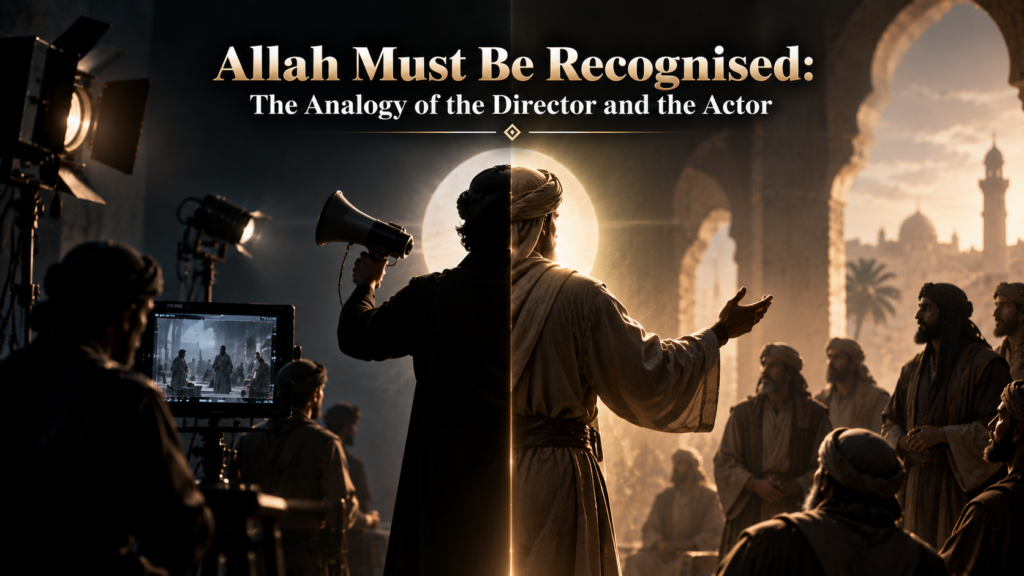
There is a difference between:
knowing that someone exists
and:
recognising who that person is.
A person may be told that a director exists.
They may know the director’s name.
They may have read about the director.
They may know the director’s instructions.
They may even participate in a production created by that director.
But if the director were standing directly before them and they could not recognise him, something would still be missing.
This distinction provides an important analogy for SiHulk.
Imagine a director who creates a production.
He determines its direction.
He understands its purpose.
He assigns the roles.
He knows how the story begins and how it ends.
The actors enter the production and perform within it.
But suppose the director wants the actors to recognise him—not merely to know that “a director” exists somewhere outside the stage.
How could that recognition occur?
One possibility would be for the director to enter the production.
He appears among the actors.
He speaks within the world they know.
He becomes accessible within their field of experience.
But now a new problem appears.
What if the actors see him only as another actor?
The director is present.
The appearance is visible.
Yet the station remains unrecognised.
For SiHulk, this analogy helps illuminate one of the deepest questions of Shahadah:
Can something be present before us while its true station remains hidden from our recognition?
The Analogy Is a Tool, Not a Literal Description
Before developing the analogy further, an important boundary must be established.
SiHulk does not claim that creation is literally a theatre or that Allah is literally a human director.
An analogy compares one relationship with another in order to make a concept easier to examine.
It does not make the two realities identical.
The Qur’an states:
لَيْسَ كَمِثْلِهِ شَيْءٌ
“There is nothing like unto Him.”
— Ash-Shura 42:11
Therefore, the director analogy must remain an analogy.
Its purpose is not to describe the Essence of Allah.
Its purpose is to examine:
authority,
manifestation,
appearance,
and:
recognition.
The analogy points towards a question.
It does not contain the answer by itself.
The Director Knows What the Actors Do Not
Imagine a production before the actors arrive.
The director already knows the script.
He knows the purpose.
He knows the roles.
He knows where the story is going.
An actor, by contrast, may initially know only their own lines.
They enter something larger than themselves.
From inside the production, their perspective is limited.
This resembles an important human condition.
We enter existence without having created it.
We discover ourselves already within a world.
We do not choose the laws of nature.
We do not choose the beginning of time.
We do not design our own birth.
We do not control everything that occurs around us.
We arrive inside a reality already in motion.
The Qur’an repeatedly directs human beings to examine that reality as:
ayat — signs.
The question therefore becomes:
What do the signs disclose about the reality within which we exist?
Knowing About the Director Is Not Recognising the Director
Suppose the actors are given a handbook.
It contains information about the director.
They study it.
They memorise passages.
They debate its meaning.
They establish schools dedicated to interpreting the director’s instructions.
Eventually, some become highly qualified experts on the handbook.
Yet imagine that the director enters the stage and they do not recognise him.
What has happened?
Their information may be extensive.
Their terminology may be sophisticated.
But:
information about the director has not become recognition of the director.
This analogy helps distinguish:
religious knowledge
from:
recognition.
Religious knowledge is valuable.
Texts matter.
Learning matters.
Scholarship matters.
But information should point beyond itself.
If the purpose of Shahadah is testimony, the seeker must eventually ask:
What am I actually recognising?
Revelation Provides the Signs of Recognition
The solution is not to abandon the handbook.
In the analogy, the handbook may contain precisely the information needed to recognise the director.
The problem arises only when people study the information without understanding what it points towards.
Similarly, SiHulk does not reject Revelation in favour of private imagination.
The opposite is required.
Revelation provides the criteria.
The Qur’an communicates the Names.
It communicates the Attributes.
It describes Actions.
It identifies signs.
It describes the Rasul.
It explains his function.
It tells humanity what should be negated and what should be affirmed.
Therefore, recognition cannot be separated from Revelation.
Otherwise, anyone could invent whatever “recognition” they wished.
Recognition must be disciplined by the Risalah.
Why Would the Director Enter the Production?
Within the analogy, suppose the actors are unable to leave the production and enter the director’s world.
Their experience is confined to the stage.
If the director wants to communicate directly within their field of experience, he may enter the stage.
He speaks in language they understand.
He appears in a form they can encounter.
Now the actors can interact with him.
But the accessibility creates another difficulty.
Because he appears among them, some may conclude:
“He is only another actor.”
They judge entirely by appearance.
The very means that makes recognition possible also makes misrecognition possible.
This is the central tension of the analogy.
Manifestation makes recognition possible.
Appearance can also conceal station.
The Qur’an Records This Problem with the Messengers
The Qur’an repeatedly records people objecting to messengers because they appeared within ordinary human life.
Regarding Prophet Muhammad SAW, it records:
وَقَالُوا مَالِ هَٰذَا الرَّسُولِ يَأْكُلُ الطَّعَامَ وَيَمْشِي فِي الْأَسْوَاقِ
“And they say: What kind of messenger is this who eats food and walks through the markets?”
— Al-Furqan 25:7
Their observation was not entirely wrong.
He did eat.
He did walk through markets.
The error was in the conclusion drawn from those observations.
They reasoned:
He appears ordinary, therefore his station must be ordinary.
The Qur’an challenges that assumption.
The outward human condition did not cancel:
Rasulullah.
Human Appearance Does Not Exhaust the Station
The Qur’an says:
قُلْ إِنَّمَا أَنَا بَشَرٌ مِّثْلُكُمْ يُوحَىٰ إِلَيَّ
“Say: I am a human being like you, to whom revelation has been given…”
— Al-Kahf 18:110
Both parts matter.
A human being like you.
And:
Revelation is given to me.
If the first part is isolated, Muhammad SAW may be reduced to ordinary humanity.
If the second is isolated in a way that denies his human appearance, another distortion occurs.
The Qur’an holds appearance and station together.
He appears within humanity.
Yet he bears something that other human beings do not bear in the same way:
the Risalah.
This is where recognition becomes essential.
Seeing Is Not the Same as Recognising
Many people saw Prophet Muhammad SAW.
Some loved him.
Some followed him.
Some rejected him.
Some opposed him.
Some heard the Qur’an directly from his mouth and still refused his Risalah.
Therefore:
physical sight did not guarantee recognition.
This is a crucial principle.
Recognition is not simply visual.
Imagine a person seeing a king dressed as an ordinary citizen.
Their eyes correctly detect a human being.
But they fail to recognise the rank.
The problem is not eyesight.
The problem is knowledge of:
who stands before them.
Likewise, a person may see Muhammad ibn Abdullah while failing to recognise:
Muhammadur Rasulullah.
The Actor and the Director May Share an Outward Appearance
Return to the analogy.
Suppose the director enters the production wearing the same kind of clothing as the actors.
From outward appearance alone, he may seem indistinguishable.
He speaks.
Walks.
Eats.
Participates within the environment of the production.
Yet his relationship to the production is not identical to that of the actors.
They entered a production whose direction they did not determine.
He carries an authority and knowledge of the production that they do not possess.
The outward similarity therefore does not establish equality of station.
This is the distinction the analogy is intended to illuminate.
Appearance tells us something.
It does not necessarily tell us everything.
The Qur’an Gives Muhammad SAW More Than an Ordinary Description
The Qur’an describes Prophet Muhammad SAW in remarkable terms.
It says:
يَا أَيُّهَا النَّبِيُّ إِنَّا أَرْسَلْنَاكَ شَاهِدًا وَمُبَشِّرًا وَنَذِيرًا وَدَاعِيًا إِلَى الله بِإِذْنِهِ وَسِرَاجًا مُّنِيرًا
“O Prophet, We have sent you as a witness, a bearer of good news, a warner, a caller to Allah by His permission, and an illuminating lamp.”
— Al-Ahzab 33:45–46
Consider the descriptions:
Witness
Bearer of good news
Warner
Caller to Allah
Illuminating lamp
These are descriptions of function and station.
The Qur’an therefore does not ask us to understand Muhammad SAW merely through outward biology.
His human appearance is real.
But his Qur’anic station must also be recognised.
A Mercy to the Worlds
The Qur’an says:
وَمَا أَرْسَلْنَاكَ إِلَّا رَحْمَةً لِّلْعَالَمِينَ
“We have not sent you except as a mercy to the worlds.”
— Al-Anbiya’ 21:107
Again, the language concerns:
sending
and:
station.
Muhammad SAW is described not merely as a mercy to one tribe or one generation, but:
a mercy to the worlds.
Whatever conclusions are eventually drawn from this verse, the language itself demands that his station not be trivialised.
The seeker must ask:
What does it mean for this Rasul to be sent as mercy to the worlds?
Recognition begins by taking the description seriously.
The Director Analogy and the Risalah
Within the analogy, how would the actors recognise the director?
Not merely because he announces:
“I am the director.”
There must be something that verifies the claim.
Perhaps the script already describes him.
Perhaps he demonstrates knowledge of the entire production.
Perhaps the authority behind the production confirms him.
Perhaps what he says corresponds with the instructions already given.
Likewise, SiHulk does not treat recognition as arbitrary intuition.
The criteria must come through:
Risalah.
The Qur’an identifies Muhammad SAW.
The Qur’an describes his function.
The Qur’an records his station.
The Qur’an commands obedience to him.
The Qur’an commands following him.
The Qur’an connects him with the communication of Revelation.
Therefore, recognition of Rasulullah must begin with the Risalah he bears.
Obedience Reveals the Importance of the Rasul
The Qur’an says:
مَّن يُطِعِ الرَّسُولَ فَقَدْ أَطَاعَ الله
“Whoever obeys the Messenger has indeed obeyed Allah.”
— An-Nisa’ 4:80
This relationship deserves careful thought.
The Qur’an does not say that once people possess the Revelation, the Rasul becomes irrelevant.
Instead, obedience to the Rasul is connected with obedience to Allah.
Similarly:
قُلْ إِن كُنتُمْ تُحِبُّونَ الله فَاتَّبِعُونِي يُحْبِبْكُمُ الله
“Say: If you love Allah, then follow me; Allah will love you…”
— Ali ‘Imran 3:31
The person who claims love of Allah is directed towards:
following Muhammad SAW.
The Rasul therefore stands within the practical reality of recognition.
Recognition Must Not Become Deification by Imagination
At this point, an important safeguard is necessary.
To recognise an extraordinary station in Prophet Muhammad SAW does not mean that every distinction can be abandoned.
Nor does the director analogy provide permission to invent claims about him without evidence.
The Qur’an itself preserves the reality of his human appearance.
Therefore, SiHulk’s use of this analogy must remain disciplined.
The purpose is to ask:
Can an extraordinary station appear behind an ordinary human appearance?
The Qur’anic answer is clearly:
Yes.
A Rasul can eat food.
Walk through markets.
Live among people.
And still be Rasulullah.
But any further doctrinal conclusion concerning the precise relationship between Allah and Muhammad SAW must be argued through the Risalah and the interpretive framework being presented.
Analogy can open a question.
It cannot substitute for evidence.
The SiHulk Reading of the Analogy
Within the SiHulk framework, the director analogy is used to explain the relationship between:
greatness,
manifestation,
bearer,
and:
recognition.
Allah is not approached as a hidden object somewhere outside the “stage.”
Allah is understood as the highest rank of greatness.
The Risalah makes that greatness known.
Prophet Muhammad SAW bears the Risalah.
He appears within human life.
Therefore, the central problem becomes not merely whether people believe that Allah exists somewhere beyond them.
The problem becomes:
Do they recognise the Manifest Reality through which Allah is made known?
And specifically:
Do they recognise the station borne by Muhammadur Rasulullah?
This is a distinctive SiHulk interpretation.
It should be identified as such rather than presented as though all Muslim theological traditions formulate the matter in the same terms.
The Director Is Not Another Actor in Rank
Within the analogy, the director may appear on stage.
But appearing on stage does not automatically reduce his station to that of the actors.
The actors may see:
a person standing beside them.
Yet the relationship of that person to the production may be entirely different.
This helps illustrate the SiHulk distinction between:
appearance
and:
station.
Muhammad SAW appears as a human being.
The Qur’an affirms this.
But SiHulk argues that his outward humanity should not be used to flatten his station into that of an ordinary person.
The question is not whether he appears human.
The question is what he bears.
The Greatest Concealment May Be Familiarity
Sometimes what is most difficult to recognise is not what is hidden from sight.
It is what has become too familiar.
A person may see something every day and stop examining it.
The same can happen with religious language.
Muslims hear:
Muhammadur Rasulullah
repeatedly.
Because the phrase is familiar, they may assume that its meaning has already been exhausted.
But familiarity with the sentence does not guarantee recognition of the station.
The same applies to the name:
Allah.
Repeated pronunciation can create familiarity.
Recognition requires examination.
Familiarity says: “I know this word.”
Recognition asks: “Do I know what it signifies?”
The Test Is Recognition
Return once more to the imagined production.
The director enters the stage.
Some actors recognise him.
Others laugh.
Some say:
“You are only another actor.”
Some may even possess books explaining the director while rejecting the director standing before them.
The irony is deliberate.
The analogy asks us to consider whether religious knowledge can become detached from the purpose of recognition.
A person can know descriptions while missing what those descriptions point towards.
A person can know the biography while missing the station.
A person can know the wording of Shahadah while never confronting what the testimony demands.
Recognition is therefore the test hidden inside familiarity.
The Qur’an Records Recognition and Denial
The Qur’an says concerning those who had received earlier scripture:
الَّذِينَ آتَيْنَاهُمُ الْكِتَابَ يَعْرِفُونَهُ كَمَا يَعْرِفُونَ أَبْنَاءَهُمْ
“Those to whom We gave the Scripture recognise him as they recognise their own sons…”
— Al-Baqarah 2:146
The verse uses the language of:
recognition.
This is significant.
The issue was not merely that information existed.
Recognition was possible.
Yet the verse continues by describing some who concealed the truth despite knowing it.
This demonstrates that:
knowledge does not automatically produce acceptance.
A person may recognise and still refuse.
The problem of faith therefore involves not only information but the condition of the human being receiving it.
Why Recognition Matters
If Islam required only the belief that an unseen power exists somewhere, then the question of recognition would be much smaller.
But Shahadah uses the language of:
testimony.
The Qur’an uses the language of:
knowledge.
It speaks of:
signs.
It speaks of:
recognition.
It identifies:
Rasulullah.
This suggests a journey deeper than abstract belief.
The witness must move from:
hearing
to:
understanding,
from understanding to:
distinction,
from distinction to:
recognition,
and from recognition to:
testimony.
Allah Must Be Recognised in This World
For SiHulk, recognition is not merely postponed until after death.
The Shahadah is pronounced:
here.
The Risalah reaches humanity:
here.
The signs are examined:
here.
The Rasul appeared within human history:
here.
The Qur’an calls people towards knowledge and recognition:
here.
Therefore, SiHulk holds that the journey towards recognising Allah must occur within worldly life.
Death should not become an excuse to postpone the fundamental question of Shahadah.
A person cannot spend an entire lifetime saying:
“I bear witness,”
while simultaneously assuming that what they testify to can never be recognised in any meaningful sense until after death.
For SiHulk, the responsibility of recognition belongs to the life in which the testimony is borne.
The World Becomes the Field of Recognition
Once this principle is accepted, the world is no longer merely a waiting room for the hereafter.
It becomes:
the field of signs.
Creation contains signs.
The human self contains signs.
Revelation contains signs.
The Risalah explains.
Rasulullah bears the Risalah.
The witness lives within this field and must learn how to recognise.
This gives worldly life a profound purpose.
The question is not merely:
“How much religious information can I accumulate before I die?”
It becomes:
“What have I recognised through what has been made known?”
The Actor Must Look Beyond the Costume
Within the analogy, the actor who wants to recognise the director cannot judge only by costume.
They must know the signs of authority.
They must understand the message.
They must recognise the station.
Likewise, the seeker cannot stop at:
Muhammad the human appearance.
They must examine:
Muhammadur Rasulullah.
The human appearance is not denied.
But neither is it allowed to erase the station.
The seeker asks:
What does the Risalah reveal about the one who bears it?
This is where the analogy reaches its central point.
The Question Before Us
Imagine again the director standing among the actors.
They see him.
They hear him.
They interact with him.
Yet because he appears within their familiar world, they conclude:
“He is only one of us.”
The director has not failed to appear.
The actors have failed to recognise.
For SiHulk, this analogy captures an important problem in religious consciousness.
The question is not always whether the truth is absent.
Sometimes the question is whether human beings recognise what has been placed before them.
Prophet Muhammad SAW appeared within humanity.
He ate.
Walked.
Spoke.
Married.
Led.
Taught.
Suffered.
And died within human history.
Yet the Qur’an simultaneously calls him:
Rasulullah
a witness
a mercy to the worlds
a caller to Allah
and:
an illuminating lamp.
The outward appearance cannot be allowed to erase the Qur’anic station.
Within the SiHulk framework, this is why Allah must be recognised rather than merely imagined.
The highest greatness is not sought as a hidden object somewhere beyond the universe.
The seeker turns towards:
Manifest Reality,
Risalah,
and:
the bearer of the Risalah.
The director analogy therefore leaves the witness with a difficult question:
If greatness appeared within a form familiar to us, would we recognise the greatness—or would familiarity cause us to see only the form?
Because the greatest obstacle to recognition may not always be that something is invisible.
It may be that what must be recognised appears so close to ordinary human experience that we fail to recognise its station.
References
1.Al-Qur’an, Surah Ash-Shura, 42:11.
2.Al-Qur’an, Surah Al-Furqan, 25:7.
3.Al-Qur’an, Surah Al-Kahf, 18:110.
4.Al-Qur’an, Surah Al-Ahzab, 33:45–46.
5.Al-Qur’an, Surah Al-Anbiya’, 21:107.
6.Al-Qur’an, Surah An-Nisa’, 4:80.
7.Al-Qur’an, Surah Ali ‘Imran, 3:31.
8.Al-Qur’an, Surah Al-Baqarah, 2:146.