
MUKADDIMAH · M11
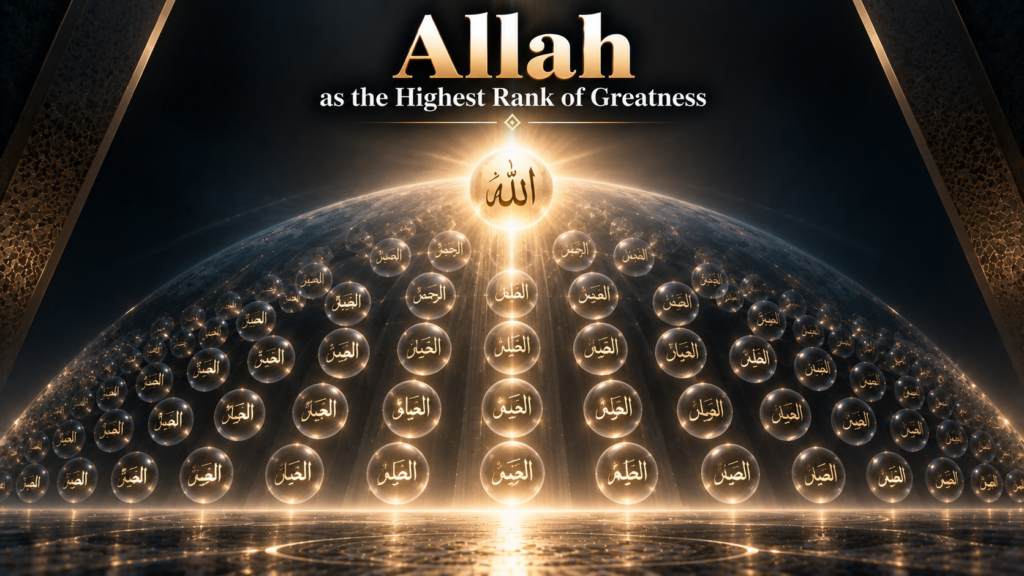
Allah as the Highest Rank of Greatness
The word:
Allah
stands at the centre of Islamic faith.
It is pronounced in the Shahadah.
It appears throughout the Qur’an.
It is repeated in prayer, remembrance and supplication.
Yet the familiarity of the word does not remove the responsibility to ask:
What does Allah mean?
If Allah is imagined as an invisible object somewhere beyond creation, the mind has created a hidden “something.”
If Allah is declared completely unknowable, another difficulty arises:
How can the witness testify to what cannot be recognised at all?
SiHulk approaches this question from a different perspective.
Allah is not understood as a “something.”
Rather, within the SiHulk framework:
Allah is understood as the highest rank of greatness.
This proposition requires careful explanation.
A rank is not an independent physical object.
A rank must be understood through its meaning, authority, manifestation and bearer.
Therefore, the question changes.
Instead of asking:
“Where is the invisible object called Allah?”
the inquiry becomes:
“What does the rank Allah signify, and how is that rank made known?”
Understanding the Difference Between a Name and a Rank
Human language contains both personal names and titles.
Consider:
Muhammad
and:
Rasulullah.
Muhammad is a name.
Rasulullah identifies a station and function.
Likewise, a person may have a personal name while also bearing a title such as:
king,
judge,
president,
professor,
or:
commander.
The title is not another physical being standing beside the person.
It signifies a rank, station, authority or function borne by someone.
This distinction provides a conceptual doorway into the SiHulk understanding of Allah.
A rank is not a separate object from its bearer.
Yet neither is the rank meaningless.
It tells us something about the station of the one who bears it.
Rank Cannot Exist Merely as an Empty Word
Suppose a society has a title:
King.
The word can be printed in a dictionary.
It can be written on paper.
Its meaning can be explained.
But in actual governance, the title becomes meaningful through the one who bears the kingship.
Without a bearer, we possess only the concept of a rank.
The rank itself is not a second human being.
It does not walk independently.
It does not speak independently.
It does not govern independently of whoever bears the authority associated with it.
This analogy is necessarily limited.
Allah cannot be reduced to human political structures.
But the analogy helps distinguish:
rank
from:
object.
For SiHulk, this distinction is important because it moves the discussion away from imagining Allah as a hidden divine object.
The Qur’an Speaks the Language of Greatness
The Qur’an repeatedly associates Allah with greatness.
It says:
وَهُوَ الْعَلِيُّ الْعَظِيمُ
“And He is the Most High, the Most Great.”
— Al-Baqarah 2:255
The Qur’an also says:
وَلَهُ الْكِبْرِيَاءُ فِي السَّمَاوَاتِ وَالْأَرْضِ
“To Him belongs greatness in the heavens and the earth.”
— Al-Jathiyah 45:37
And:
وَكَبِّرْهُ تَكْبِيرًا
“And magnify Him with complete magnification.”
— Al-Isra’ 17:111
Muslims repeatedly pronounce:
الله أكبر
Allahu Akbar.
The language is the language of greatness.
For SiHulk, this language should not merely produce the mental picture of an enormous invisible being.
Greatness is not physical size.
A person does not become greater in rank because their body becomes larger.
Greatness can signify:
authority,
station,
majesty,
honour,
power,
and supremacy.
This provides an important distinction between:
physical magnitude
and:
greatness of rank.
“Highest” Does Not Necessarily Mean Physical Location
The same problem appears with the language of height.
Human beings naturally imagine:
high = physically above
and:
low = physically below.
But language also uses height to describe rank.
We say:
“a high office.”
We do not mean that the office is located on the highest floor of a building.
We say:
“the highest authority.”
We do not necessarily mean that the person is physically positioned above everyone else.
We say:
“a person of high rank.”
Again, the statement concerns station.
This distinction matters when approaching Qur’anic descriptions of greatness and exaltation.
For SiHulk, the highest greatness should not automatically be transformed into a geographical picture of an object located somewhere above the universe.
Exaltation can concern rank without being reduced to distance.
Rank Is Recognised Through Authority
How do we know that someone bears a rank?
Usually not merely because they announce it themselves.
There must be:
recognition,
authority,
evidence,
function,
and manifestation.
A judge becomes recognisable as judge through the authority associated with that office.
A ruler becomes recognisable through the authority of rulership.
A teacher becomes recognisable through knowledge and teaching.
Again, these are only analogies.
But they reveal an important principle:
Rank becomes known through what it manifests.
This connects directly with the earlier framework of:
Essence
Attributes
Actions
and:
Manifest Reality.
If Allah signifies the highest rank of greatness within the SiHulk framework, then that greatness cannot remain merely an empty title.
Its Attributes and Actions must make its meaning known.
The Highest Rank Cannot Be Measured Against Ordinary Rank
Human ranks exist relative to one another.
A lieutenant may be below a captain.
A minister may possess one level of authority while a head of government possesses another.
But when SiHulk speaks of Allah as the highest rank, it does not mean simply placing Allah at the top of an ordinary ladder of created titles.
That would still make Allah one rank among comparable ranks.
The Qur’an says:
لَيْسَ كَمِثْلِهِ شَيْءٌ
“There is nothing like unto Him.”
— Ash-Shura 42:11
Therefore, the analogy of rank serves only to help remove the idea of Allah as a separate hidden object.
It must not be extended so far that divine greatness becomes equivalent to human administration.
The analogy points. It does not contain the reality.
A Title Raises the Question of Its Bearer
Once Allah is approached as a rank rather than as an imagined object, a difficult but unavoidable question appears:
Who bears the rank?
A title without any relationship to a bearer remains abstract.
But this question must be approached carefully.
It cannot be answered merely by philosophical speculation.
It cannot be answered by imagination.
It cannot be answered simply because an interpretation feels spiritually attractive.
If the question concerns Shahadah, Allah and Rasulullah, then the evidence must be sought through:
the Qur’an,
the Risalah,
the teachings of Rasulullah,
and the inherited scholarly and spiritual tradition through which these matters have been examined.
For SiHulk, the question of the bearer is not secondary.
It is central to recognition.
Muhammad SAW Bears the Risalah of Allah
The Qur’an declares:
مُّحَمَّدٌ رَّسُولُ الله
“Muhammad is Rasulullah.”
— Al-Fath 48:29
The word Rasulullah establishes a direct relationship between Muhammad SAW and Allah.
He is the bearer of the Risalah.
He does not merely discuss Allah as an abstract philosophical idea.
Through him, the Revelation is communicated.
Through him, the Names are taught.
Through him, the Attributes are explained.
Through him, the Actions are identified as signs.
Through him, the Shahadah reaches the community.
Through him, humanity is called towards recognition.
This is why SiHulk gives exceptional importance to the station of Prophet Muhammad SAW.
The bearer of the Risalah cannot be separated from what the Risalah makes known.
Bearing the Risalah Is Not the Same as Carrying a Book
The word bearer must also be understood carefully.
A person can physically carry a book without understanding it.
That is not what is meant here.
Prophet Muhammad SAW did not simply transport written information.
The Qur’an describes his mission:
يَتْلُو عَلَيْهِمْ آيَاتِهِ وَيُزَكِّيهِمْ وَيُعَلِّمُهُمُ الْكِتَابَ وَالْحِكْمَةَ
“…reciting to them His verses, purifying them, and teaching them the Book and wisdom.”
— Al-Jumu’ah 62:2
The Rasul:
recites,
teaches,
purifies,
explains,
demonstrates,
and guides.
The Risalah therefore becomes manifest within human life through the Rasul.
The bearer does not merely deliver the words.
He makes their meaning accessible to humanity.
The Qur’an Gives Muhammad SAW an Extraordinary Station
Prophet Muhammad SAW appears among human beings.
He eats.
Walks.
Speaks.
Lives within society.
Yet the Qur’an does not describe him merely as another ordinary individual.
It says:
وَمَا أَرْسَلْنَاكَ إِلَّا رَحْمَةً لِّلْعَالَمِينَ
“We have not sent you except as a mercy to the worlds.”
— Al-Anbiya’ 21:107
It describes him as:
وَسِرَاجًا مُّنِيرًا
“…an illuminating lamp.”
— Al-Ahzab 33:46
And says:
وَرَفَعْنَا لَكَ ذِكْرَكَ
“And We raised for you your remembrance.”
— Ash-Sharh 94:4
These descriptions require reflection.
They demonstrate that the Qur’anic Muhammad SAW cannot be reduced merely to an ordinary man whose only importance was transporting a text.
His station is extraordinary.
Human Appearance and Spiritual Station Are Different Questions
The Qur’an says:
قُلْ إِنَّمَا أَنَا بَشَرٌ مِّثْلُكُمْ يُوحَىٰ إِلَيَّ
“Say: I am a human being like you, to whom revelation has been given…”
— Al-Kahf 18:110
This verse must be read completely.
It affirms:
human appearance and condition
while simultaneously affirming:
revelation.
The first part should not be used to erase the second.
Nor should the second be used to deny the first.
Prophet Muhammad SAW enters the field of human experience as a human being.
Yet his station as Rasulullah distinguishes him.
This distinction is central to the SiHulk method of recognition.
What appears ordinary outwardly may carry a station that is not ordinary.
The Messenger Can Be Present Yet Unrecognised
The Qur’an records how people objected:
مَالِ هَٰذَا الرَّسُولِ يَأْكُلُ الطَّعَامَ وَيَمْشِي فِي الْأَسْوَاقِ
“What kind of messenger is this who eats food and walks through the markets?”
— Al-Furqan 25:7
They saw the human appearance.
They saw someone eating.
They saw someone walking through the market.
But they used what appeared ordinary as an argument against his extraordinary station.
This reveals a profound problem of recognition.
People can see the bearer without recognising what he bears.
They can know the man without recognising Rasulullah.
They can hear the words without recognising the Risalah.
They can observe the outward form while remaining blind to the station.
The Name and the Bearer
Consider again the relationship between a title and its bearer.
Suppose a ruler enters a public place wearing ordinary clothing.
Someone who does not recognise them sees only another person.
The rank has not disappeared.
Recognition has failed.
The outward appearance does not necessarily reveal the station to everyone.
This analogy helps explain an important SiHulk proposition.
The question is not simply:
“What does Muhammad SAW look like as a human being?”
The deeper question is:
“What does Muhammad SAW bear?”
And beyond that:
“What station is being recognised when we testify Muhammadur Rasulullah?”
Allah as Rank Must Not Be Separated from Manifest Reality
If Allah is understood as the highest rank of greatness, that rank cannot remain an abstract theological label.
It must be connected with:
Manifest Reality.
A rank becomes recognisable through what it makes evident.
This returns us to:
Attributes
and:
Actions.
Greatness is known through its manifestation.
Authority is known through its manifestation.
Mercy is known through its manifestation.
Knowledge is known through its manifestation.
Guidance is known through its manifestation.
The Risalah itself becomes part of this field of disclosure.
And Rasulullah stands at the centre of the Risalah.
The SiHulk Proposition
At this point, the distinctive SiHulk interpretation can be stated clearly.
SiHulk understands Allah as the highest rank of greatness and Prophet Muhammad SAW as the bearer of that rank through the Risalah of Allah.
This is a SiHulk doctrinal interpretation.
It should not be confused with saying that the Arabic word Allah is universally defined by Muslim scholarship simply as “a title” or “rank.”
Nor should it be presented as though every classical Muslim scholar formulated the relationship in precisely these terms.
The distinction matters.
SiHulk arrives at this reading through its framework of:
negation and affirmation,
recognition rather than imagination,
Essence, Attributes and Actions,
Manifest Reality,
and:
Muhammad SAW as Rasulullah.
The proposition therefore belongs to SiHulk’s interpretive framework and must be examined through its evidence.
Bearer Does Not Mean a Second Independent Allah
Another distinction is necessary.
If a rank is borne, SiHulk does not intend to create two independent divine realities:
one called Allah
and:
another called Muhammad.
That would return the discussion to the very problem of imagining separate objects.
The inquiry concerns the relationship between:
rank
and:
bearer.
A rank is not another person beside its bearer.
Yet the terms are conceptually distinguishable.
Likewise, SiHulk distinguishes between the personal name:
Muhammad
his station:
Rasulullah
the Risalah he bears,
and the rank of greatness referred to as:
Allah.
These distinctions exist so that the relationship can be examined carefully rather than collapsed into vague language.
The Shahadah Now Becomes More Demanding
Consider the declaration again:
لَا إِلٰهَ إِلَّا الله مُحَمَّدٌ رَسُولُ الله
If it is merely memorised, the words can be pronounced quickly.
But when examined, the declaration becomes a profound structure of recognition.
La ilaha
requires negation.
Illallah
requires affirmation.
Muhammadur Rasulullah
identifies the bearer of the Risalah through which the affirmation becomes known.
The two testimonies are therefore not unrelated sentences placed beside one another by accident.
Within the SiHulk reading, they form a relationship.
Negation clears false conception.
Affirmation turns towards Allah.
Risalah makes known.
Rasulullah bears the Risalah.
The witness is called to recognise.
Rank Is Meaningless Without Recognition
Imagine standing before a king without knowing that the person is king.
Physically, you see the person.
But politically and socially, you do not recognise the station.
You may speak to them as though they were an ordinary citizen.
Your eyes function correctly.
Your recognition does not.
This demonstrates why recognition is different from sight.
Likewise, many people physically saw Prophet Muhammad SAW.
Some recognised Rasulullah.
Others saw only Muhammad ibn Abdullah.
The outward form was present before both groups.
The difference lay in what they recognised.
For SiHulk, this distinction is central.
The greatest failure may not be the inability to see.
It may be seeing while failing to recognise.
Greatness May Be Concealed Behind Ordinary Appearance
Human beings often expect greatness to announce itself through spectacle.
A king should look like a king.
A powerful person should display power.
An extraordinary messenger should appear visibly extraordinary.
But the Qur’an records that this expectation itself became a reason for rejection.
People asked why the Messenger ate food and walked through markets.
They expected outward spectacle.
Instead, the Risalah appeared through someone living within ordinary human reality.
This produces an important principle:
Appearance and station are not identical.
A person may recognise the appearance and miss the station.
This is why the journey of faith cannot end with historical description.
Recognition Requires More Than Physical Sight
A person may see a uniform and fail to understand the authority it represents.
They may see a signature and fail to know whose authority stands behind it.
They may hear words and fail to understand their meaning.
Likewise, seeing Prophet Muhammad SAW as a human being does not automatically mean recognising Rasulullah.
Recognition asks:
Who is before me?
What does he bear?
What authority does the Risalah communicate?
What is being made known through him?
These questions move the witness beyond outward form.
The Highest Greatness and the Question of Recognition
The SiHulk proposition that Allah is the highest rank of greatness therefore leads towards a practical question.
How is the highest rank recognised within the world of human experience?
If it remains entirely detached from Manifest Reality, recognition becomes impossible.
If it becomes merely an imagined invisible object, the problem of the hidden idol returns.
Therefore, SiHulk turns towards the Risalah.
The Risalah communicates.
The Rasul bears it.
The bearer appears within human life.
And human beings are tested by whether they recognise what is present behind an outwardly familiar appearance.
This is not merely an abstract theological puzzle.
It concerns the meaning of Shahadah itself.
The Question Before Us
The question is no longer simply:
“Is Allah great?”
Every Muslim will answer:
Yes.
The deeper questions are:
What does that greatness mean?
Is greatness an object?
Is Allah merely an invisible being imagined somewhere beyond creation?
Or does Allah signify the highest rank of greatness that must be recognised through its Manifest Reality?
And if it is a rank:
Who bears it?
SiHulk answers this through the relationship between:
Allah
Risalah
and:
Muhammadur Rasulullah.
Within the SiHulk framework, Prophet Muhammad SAW is not merely a historical courier delivering information about a distant Allah.
He is the bearer of Allah’s Risalah and the central human reality through whom that Risalah becomes known.
The inquiry therefore moves from:
name
towards:
rank,
from rank towards:
bearer,
and from bearer towards:
recognition.
This is why the testimony:
مُحَمَّدٌ رَسُولُ الله
cannot be treated as an appendix to:
لَا إِلٰهَ إِلَّا الله
The two stand together within Shahadah.
For SiHulk, the task is to understand why.
A rank that is never recognised remains only a word to the one who does not recognise it.
A bearer who is seen only through outward appearance may remain unrecognised.
And a Shahadah pronounced without knowing what is being affirmed may remain at the level of inherited speech.
Recognition therefore demands more.
It asks the witness not merely:
“What name do you believe in?”
but:
“What greatness have you recognised—and through whom has it been made known?”
References
1.Al-Qur’an, Surah Al-Baqarah, 2:255.
2.Al-Qur’an, Surah Al-Jathiyah, 45:37.
3.Al-Qur’an, Surah Al-Isra’, 17:111.
4.Al-Qur’an, Surah Ash-Shura, 42:11.
5.Al-Qur’an, Surah Al-Fath, 48:29.
6.Al-Qur’an, Surah Al-Jumu’ah, 62:2.
7.Al-Qur’an, Surah Al-Anbiya’, 21:107.
8.Al-Qur’an, Surah Al-Ahzab, 33:45–46.
9.Al-Qur’an, Surah Ash-Sharh, 94:4.
10.Al-Qur’an, Surah Al-Kahf, 18:110.
11.Al-Qur’an, Surah Al-Furqan, 25:7.