
MUKADDIMAH · M13
Four Dimensions of Islamic Education: Islam, Iman, Ihsan and Qiamah
What does it mean to be educated in Islam?
Is a person educated because they know how to pray?
Because they have memorised the pillars of faith?
Because they can recite Arabic terminology?
Because they possess certificates in Islamic studies?
Because they understand jurisprudence?
All of these may contribute to religious education.
But none of them, by itself, necessarily represents the whole human being.
A human being:
acts,
thinks,
feels,
and:
struggles to become.
If religious education addresses only one of these dimensions, something remains undeveloped.
A person may know the correct outward actions while their understanding remains weak.
They may possess sophisticated intellectual knowledge while their heart remains untouched.
They may experience spiritual emotion while lacking discipline.
They may understand all three but never struggle against the self sufficiently for knowledge to transform their life.
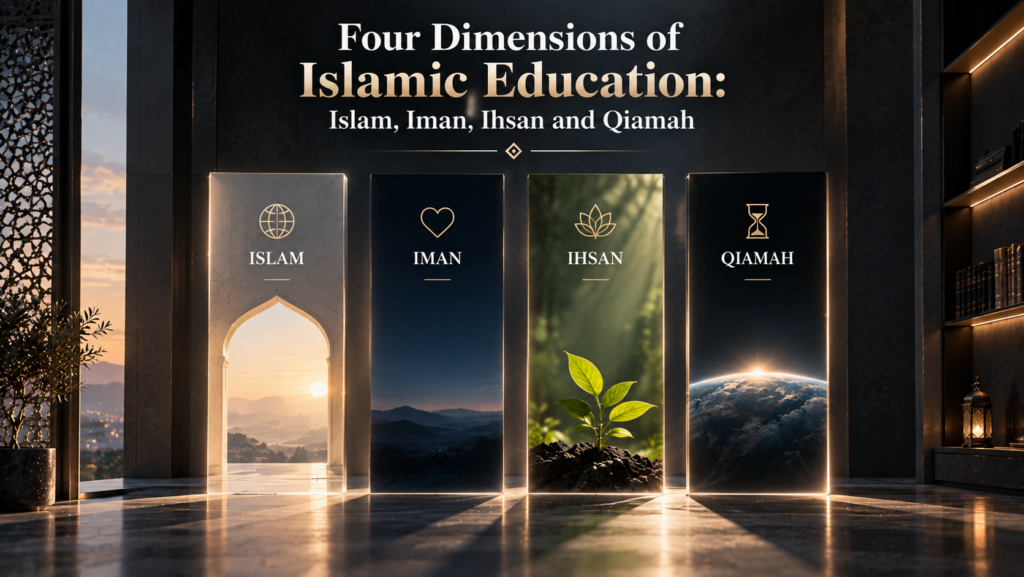
For SiHulk, Islamic education should therefore be understood through four interconnected dimensions:
Islam — Action
Iman — Reason
Ihsan — Spirituality
Qiamah — Transformation
These dimensions should not be understood as four separate religions.
They describe different aspects of the same journey.
The Hadith of Jibril Gives a Foundational Structure
One of the most important Prophetic narrations concerning religious education is the Hadith of Jibril.
Jibril AS came to Prophet Muhammad SAW and asked him about:
Islam
Iman
Ihsan
and:
the Hour.
When the encounter ended, Prophet Muhammad SAW explained:
“That was Jibril. He came to teach you your religion.”
The narration is significant because the Prophet SAW described the entire encounter as:
teaching religion.
Religion was not presented through outward practice alone.
Nor through belief alone.
Nor through spirituality alone.
Different dimensions were brought together within one educational encounter.
SiHulk takes this integrated structure seriously while developing its own pedagogical framework.
The first three dimensions—Islam, Iman and Ihsan—come directly from the terminology of the Hadith of Jibril.
The fourth term:
Qiamah
is used by SiHulk as a distinctive educational category concerning effort, struggle, sacrifice and transformation.
It should therefore not be confused with claiming that classical Islam universally identifies “Qiamah” as a fourth pillar beside Islam, Iman and Ihsan.
It is a SiHulk pedagogical formulation.
Islam — The Dimension of Action
Islam Must Enter Human Behaviour
When Jibril AS asked:
“What is Islam?”
Prophet Muhammad SAW answered through outward acts of submission.
The testimony.
Prayer.
Zakat.
Fasting Ramadan.
Pilgrimage for the one able to perform it.
This gives the first dimension:
Islam concerns what the human being does.
Faith cannot remain entirely inside the mind.
It must enter action.
A person may understand the importance of prayer intellectually.
But eventually they must pray.
They may understand charity.
But eventually something must be given.
They may understand fasting.
But understanding fasting is not the same as fasting.
Religious knowledge becomes embodied through practice.
The Body Is Part of Religious Education
Islamic education therefore includes training the body.
The body stands in prayer.
Bows.
Prostrates.
Fasts.
Travels.
Gives.
Serves.
Restrains itself.
A religion that exists only as an idea has not yet entered the fullness of human life.
Islam moves knowledge into action.
This is why outward religious practice remains necessary.
SiHulk does not reject religious law or practice.
The problem arises when religious education is reduced to practice alone.
A person can perform an action without understanding what it means.
They can pray because their family taught them to pray.
They can fast because everyone around them fasts.
They can recite the Shahadah because they memorised it in childhood.
The action may be correct.
But another question remains:
Does the person understand what they are doing?
That question leads towards Iman.
Iman — The Dimension of Reason
Belief Requires Understanding
When Jibril AS asked about Iman, Prophet Muhammad SAW described belief in:
Allah,
the angels,
the Books,
the messengers,
the Last Day,
and divine decree.
These are not primarily physical actions.
They concern:
understanding
and:
belief.
For SiHulk, this is where:
reason — akal
becomes essential.
A person cannot physically point towards an angel in the same way that they point towards a chair.
They cannot observe the Last Day as a present physical event.
They cannot understand divine decree merely through bodily movement.
These matters require thought.
Meaning.
Interpretation.
Reason.
Therefore:
Iman educates the intellect.
Reason Does Not Replace Revelation
To say that Iman involves reason does not mean that the human intellect creates the contents of faith independently.
Reason does not invent the angels.
Reason does not invent Revelation.
Reason does not decide what a Rasul is simply according to personal preference.
Revelation informs.
Reason examines and understands what has been communicated.
The relationship can be expressed:
Revelation provides guidance.
Reason seeks understanding.
Without Revelation, reason can wander into speculation.
Without reason, Revelation may be repeated without being understood.
Islamic education needs both.
Memorising the Pillars of Iman Is Not Yet Iman
Many Muslim children can recite:
Allah
Angels
Books
Messengers
Last Day
Qada’ and Qadar
But memorisation raises a further question.
What do these words actually mean?
What is Allah?
What is a Rasul?
What is Revelation?
What does Qada’ and Qadar signify?
Why should these things be believed?
What distinguishes knowledge from assumption?
A student who can reproduce six words has demonstrated memory.
They have not necessarily demonstrated understanding.
Therefore, SiHulk does not treat memorisation as the enemy.
Memorisation preserves information.
But preserved information must eventually be examined by reason.
Information → Understanding → Recognition → Iman
This is the educational movement.
Iman Should Prevent Blind Religious Inheritance
If a person simply believes because their parents believed, the question of reason remains unresolved.
The Qur’an repeatedly criticises the attitude of following ancestors without examination.
It says:
وَإِذَا قِيلَ لَهُمُ اتَّبِعُوا مَا أَنزَلَ الله قَالُوا بَلْ نَتَّبِعُ مَا أَلْفَيْنَا عَلَيْهِ آبَاءَنَا
“When it is said to them, ‘Follow what Allah has revealed,’ they say, ‘Rather, we follow what we found our forefathers following.’”
— Al-Baqarah 2:170
The issue is not that everything inherited from parents is automatically wrong.
The issue is making inheritance itself the proof of truth.
Iman requires something deeper.
The person must eventually know why they believe.
Ihsan — The Dimension of the Spiritual Heart
Knowledge and Action Do Not Exhaust Religion
Jibril AS then asked Prophet Muhammad SAW:
“What is Ihsan?”
The Prophet SAW answered:
“That you worship Allah as though you see Him; and if you do not see Him, He surely sees you.”
This introduces another dimension.
Islam concerns action.
Iman concerns belief and understanding.
Ihsan concerns the quality of spiritual consciousness within the action.
Two people may perform exactly the same prayer outwardly.
They stand at the same time.
Recite the same verses.
Bow in the same direction.
Complete the same number of raka’at.
Yet the inner condition of the two prayers may be completely different.
One may be present.
The other distracted.
One sincere.
The other concerned with appearance.
One spiritually conscious.
The other moving mechanically.
Outward form alone cannot reveal everything occurring within the heart.
Ihsan educates the inward human being.
The Human Being Has an Inner Life
The Qur’an speaks repeatedly about the heart.
It says:
أَلَا بِذِكْرِ الله تَطْمَئِنُّ الْقُلُوبُ
“Surely, in the remembrance of Allah do hearts find rest.”
— Ar-Ra’d 13:28
The heart here cannot simply be reduced to the physical organ pumping blood.
Religious language addresses an inward dimension of the human being.
The person experiences:
love,
fear,
sincerity,
envy,
pride,
humility,
hope,
attachment,
anger,
longing,
and remembrance.
These cannot be educated merely by memorising regulations.
The inward human being requires cultivation.
Ihsan Makes Worship More Than Movement
Without the spiritual dimension, prayer can become exercise.
Fasting can become hunger.
Giving can become public performance.
Religious study can become intellectual competition.
Leadership can become ego.
Even preaching can become a means of self-display.
Ihsan asks:
What is happening inside the person who acts?
Why are they praying?
Why are they teaching?
Why are they giving?
Why are they speaking?
Who are they trying to impress?
What does their heart seek?
This makes Ihsan essential to education.
Correct action without inward refinement can still leave the ego intact.
Ihsan and Spiritual Education
Within SiHulk, this spiritual dimension includes the education of:
the heart,
feelings,
and:
the soul.
This is where the discipline traditionally associated with:
Tasawuf
becomes relevant.
Tasawuf, when properly understood, is not simply the wearing of particular clothing, repeating particular terminology or joining a spiritual social group.
Its educational concern is the inward transformation of the human being.
The heart must be examined.
The ego must be discovered.
Attachments must be confronted.
Sincerity must be cultivated.
Recognition must deepen beyond intellectual definition.
This requires more than reading alone.
The Heart Can Know What the Tongue Denies
A person may speak beautiful religious language while hiding something entirely different inwardly.
The Qur’an says:
يَوْمَ لَا يَنفَعُ مَالٌ وَلَا بَنُونَ إِلَّا مَنْ أَتَى الله بِقَلْبٍ سَلِيمٍ
“The Day when neither wealth nor children will benefit, except one who comes to Allah with a sound heart.”
— Ash-Shu’ara’ 26:88–89
The emphasis upon the heart demonstrates that religious transformation cannot be measured only through external performance.
The inner human being matters.
This is the domain of Ihsan.
Qiamah — The Dimension of Transformation
Knowing Is Not Yet Becoming
A person may now possess three things:
correct practice,
intellectual understanding,
and:
spiritual awareness.
Yet another question remains:
What are they willing to struggle against and sacrifice in order to be transformed?
This is where SiHulk introduces the category:
Qiamah.
Within the SiHulk educational framework, Qiamah concerns:
rising into effort,
struggling against the self,
sacrificing attachment,
and:
allowing knowledge to transform the centre of the person.
It is not merely about knowing.
It is about becoming.
Qiamah Is a SiHulk Educational Term
This distinction should be explicit.
In standard Islamic terminology, al-Qiyamah commonly refers to the Resurrection or Day of Judgment.
SiHulk’s educational use of Qiamah is a specific pedagogical formulation.
Here it refers to the movement of:
effort and transformation.
It should not be presented as though the Hadith of Jibril names Qiamah as a fourth category parallel to Islam, Iman and Ihsan.
The Hadith does not do that.
The term is being used by SiHulk to organise its own educational understanding.
This distinction preserves intellectual honesty while allowing the concept to be developed.
Transformation Requires Struggle
The human being does not automatically become transformed simply because truth has been explained.
The nafs resists.
Habit resists.
Pride resists.
Attachment resists.
Fear resists.
Comfort resists.
A person may know exactly what is right and still refuse to act because it threatens their ego or possessions.
Therefore transformation requires:
mujahadah — struggle.
The Qur’an says:
وَأَمَّا مَنْ خَافَ مَقَامَ رَبِّهِ وَنَهَى النَّفْسَ عَنِ الْهَوَىٰ فَإِنَّ الْجَنَّةَ هِيَ الْمَأْوَىٰ
“As for the one who feared standing before his Lord and restrained the self from desire, then Paradise will indeed be the refuge.”
— An-Nazi’at 79:40–41
Notice the movement.
The person does not merely learn that desire exists.
They restrain it.
Knowledge becomes struggle.
The Nafs Must Be Confronted
The Qur’an records:
إِنَّ النَّفْسَ لَأَمَّارَةٌ بِالسُّوءِ
“Indeed, the self certainly commands towards evil…”
— Yusuf 12:53
The nafs is not defeated through theoretical knowledge alone.
A person may know the dangers of pride and remain proud.
They may give lectures about sincerity while seeking admiration.
They may speak about detachment while being controlled by possessions.
They may understand anger while remaining enslaved by anger.
Therefore, the struggle must become experiential.
The person must encounter themselves.
Qiamah concerns this confrontation.
Wealth Reveals Attachment
The Qur’an repeatedly connects faith with the willingness to give.
It says:
لَن تَنَالُوا الْبِرَّ حَتَّىٰ تُنفِقُوا مِمَّا تُحِبُّونَ
“You will never attain righteousness until you spend from what you love.”
— Ali ‘Imran 3:92
The verse does not merely say:
give what you no longer want.
It says:
from what you love.
Why?
Because sacrifice reveals attachment.
Giving something meaningless to us may require little inward transformation.
Giving what we love exposes the relationship between:
self
and:
possession.
This is why sacrifice of wealth forms an important part of the SiHulk concept of Qiamah.
Faith Must Cost the Ego Something
The Qur’an describes believers:
إِنَّمَا الْمُؤْمِنُونَ الَّذِينَ آمَنُوا بِالله وَرَسُولِهِ ثُمَّ لَمْ يَرْتَابُوا وَجَاهَدُوا بِأَمْوَالِهِمْ وَأَنفُسِهِمْ فِي سَبِيلِ الله
“The believers are only those who believe in Allah and His Messenger, then do not doubt, and strive with their wealth and themselves in the way of Allah.”
— Al-Hujurat 49:15
Notice again that belief is followed by striving.
They believe.
Then:
they strive.
With:
their wealth
and:
their selves.
This is the movement from belief towards transformation.
If faith never challenges attachment, comfort, ego or self-interest, the person should ask how deeply that faith has entered them.
Qiamah Is Not Self-Destruction
Struggle against the self does not mean hatred of human existence.
Sacrifice does not mean destroying one’s life.
Spiritual discipline should not become psychological or physical self-harm.
The purpose is not to erase human responsibility.
It is to remove the false supremacy of the ego.
The distinction is important.
The self exists.
But it should not become the centre around which all truth must revolve.
Qiamah therefore asks whether the person can move from:
“What do I want?”
towards:
“What is true?”
From:
“What benefits me?”
towards:
“What is required?”
From:
“What do I possess?”
towards:
“What am I willing to release?”
From Self-Centredness Towards Recognition
The nafs naturally interprets reality through itself.
My status.
My opinion.
My wealth.
My achievement.
My reputation.
My knowledge.
My religious position.
Even spirituality can become:
my spiritual status.
This is why ego can survive religious education.
It simply changes clothing.
The person is no longer proud of worldly success.
Now they become proud of religious success.
The underlying centre remains:
I.
Qiamah attempts to confront this centre.
The problem is not merely what the person knows.
The problem is what still occupies the centre of their consciousness.
Transformation Is More Than Behavioural Improvement
A person may become more disciplined.
More polite.
More charitable.
More knowledgeable.
These are valuable developments.
But SiHulk uses Qiamah to ask an even deeper question:
Has the relationship with the self changed?
Can the person surrender the need to be recognised?
Can they sacrifice without demanding praise?
Can they serve without building an identity around being a servant?
Can they learn without becoming proud of knowledge?
Can they recognise truth even when truth destroys an assumption they have defended for years?
This is transformation at a deeper level.
The Four Dimensions Must Work Together
Islam Without Iman
If Islam becomes separated from Iman, religious practice may become mechanical.
A person knows:
what to do
but not:
why they are doing it.
Rules remain.
Understanding weakens.
Religion can then become mere conformity.
Iman Without Islam
If Iman is separated from Islam, belief may remain intellectual.
A person can speak brilliantly about theology while neglecting prayer, charity and ethical responsibility.
They understand concepts.
But understanding never enters the body.
Knowledge remains unembodied.
Islam and Iman Without Ihsan
A person may act correctly and understand correctly while remaining spiritually hard.
They know the law.
They know the arguments.
They fulfil outward obligations.
Yet pride, envy, anger and self-display remain untouched.
This produces religious intelligence without inward refinement.
Ihsan brings the heart into education.
Ihsan Without Islam and Iman
Spiritual feeling alone is also insufficient.
A person may experience emotion, peace or mystical language while neglecting disciplined practice and sound understanding.
Not every feeling is guidance.
Not every unusual experience is truth.
Not every inward impression should be treated as Revelation.
Therefore, Ihsan must remain connected with:
Islam
and:
Iman.
Spirituality requires both discipline and criteria.
Islam, Iman and Ihsan Without Qiamah
The first three dimensions can still remain largely descriptive unless the person actually struggles to change.
They may know how to act.
Know why they believe.
Understand inward spirituality.
Yet continue protecting the ego whenever genuine sacrifice is demanded.
Qiamah asks:
What happens when knowledge costs something?
When truth threatens status?
When generosity threatens wealth?
When sincerity threatens reputation?
When humility threatens intellectual pride?
When spiritual discipline threatens comfort?
This is where education becomes transformation.
Body, Mind, Heart and Struggle
The four dimensions can therefore be understood through four aspects of human education:
Islam educates action.
Iman educates reason.
Ihsan educates the spiritual heart.
Qiamah transforms through struggle and sacrifice.
The body acts.
The mind understands.
The heart experiences.
The whole person struggles and changes.
None should dominate to the exclusion of the others.
Education Should Produce a Complete Human Being
A successful Islamic education should therefore not be measured only by how much information a student can reproduce.
Nor only by how accurately they perform rituals.
Nor merely by how spiritual they appear.
The question is whether the whole person is being educated.
Can they act correctly?
Can they reason?
Can they distinguish evidence from assumption?
Can they examine inherited belief?
Can they recognise their own ego?
Can they cultivate sincerity?
Can they restrain desire?
Can they sacrifice?
Can knowledge transform them?
These questions provide a much broader measure of education.
The Problem of Fragmented Religious Education
When these dimensions are separated, different imbalances can emerge.
One institution may specialise in law but rarely discuss inward transformation.
Another may emphasise theology but neglect lived practice.
Another may emphasise spirituality but lack intellectual discipline.
Another may produce activism without sufficient inward purification.
The result can be a fragmented human being.
SiHulk’s four-dimensional framework attempts to reunite these elements.
Action must have understanding.
Understanding must enter the heart.
The heart must be tested through transformation.
Religious Certificates Cannot Measure Everything
Academic qualifications can measure particular abilities.
A student may demonstrate:
knowledge of Arabic,
knowledge of jurisprudence,
ability to research,
understanding of history,
or familiarity with religious texts.
These are legitimate educational achievements.
But a certificate cannot by itself prove:
sincerity.
It cannot prove that the nafs has been disciplined.
It cannot prove recognition.
It cannot prove spiritual maturity.
It cannot prove that knowledge has transformed the heart.
This does not make formal education worthless.
It simply establishes its limits.
What can be examined on paper is not the entirety of religion.
The Teacher Must Educate More Than Memory
If religious education concerns all four dimensions, the teacher’s function also changes.
The teacher cannot merely transfer information.
They must help students:
act,
understand,
reflect,
examine themselves,
and:
transform.
Different dimensions may require different methods.
Islam may require practical instruction.
Iman may require reasoning and discussion.
Ihsan may require spiritual guidance and inward discipline.
Qiamah requires actual struggle, sacrifice and lived transformation.
A classroom alone cannot necessarily provide every dimension.
Knowledge Must Become Life
The progression can therefore be expressed:
Learn → Understand → Practise → Internalise → Struggle → Transform
This is more than an academic curriculum.
It is a journey.
A verse memorised should become understood.
Understanding should affect action.
Action should educate the heart.
The heart should expose the nafs.
The nafs should be confronted.
Sacrifice should loosen attachment.
And the person should emerge changed.
Knowledge that never enters life remains incomplete as education.
Islam Gives Form
Islam provides form.
Prayer has form.
Fasting has form.
Zakat has form.
Pilgrimage has form.
Shahadah has words.
The human being requires form because inward intention without discipline can become vague.
Islam therefore gives the journey structure.
The body learns submission.
Iman Gives Understanding
Iman asks:
What does the form mean?
Who is Allah?
What is Rasul?
What is Revelation?
What is the Last Day?
What is divine decree?
What am I actually affirming?
Reason prevents religious form from becoming empty repetition.
The mind learns distinction.
Ihsan Gives Depth
Ihsan asks:
What is happening inside you while you perform the form and understand its meaning?
Is the heart present?
Is the intention sincere?
Has pride entered?
Has fear distorted you?
Has love transformed the action?
The heart learns presence.
Qiamah Gives Movement
Qiamah asks:
What will you now do with everything you know?
Will you struggle?
Will you sacrifice?
Will you confront the nafs?
Will you release attachment?
Will you allow truth to change you?
The whole person must rise into transformation.
From Education Towards Recognition
Within SiHulk, the purpose of these four dimensions is ultimately not the accumulation of religious identity.
It is:
recognition.
Islam disciplines the action.
Iman disciplines the reasoning.
Ihsan disciplines the spiritual heart.
Qiamah disciplines attachment to the self.
As these dimensions work together, the person becomes increasingly capable of moving beyond inherited religion towards conscious testimony.
Religion ceases to be merely:
what my family taught me
or:
what my institution certified me to know.
It becomes something examined, understood, lived and transformed into recognition.
The Question Before Us
What kind of Muslim does Islamic education seek to produce?
Someone who knows the rules?
Yes—but not only that.
Someone who understands belief?
Yes—but not only that.
Someone with spiritual sensitivity?
Yes—but not only that.
Someone willing to struggle against the nafs and sacrifice what they love?
Yes.
Because the human being is not merely a body.
Not merely an intellect.
Not merely a heart.
And not merely an isolated self seeking comfort.
For SiHulk, Islamic education must address the whole journey:
Islam — Action
Iman — Reason
Ihsan — Spirituality
Qiamah — Transformation
Islam teaches the person to act.
Iman teaches the person to understand.
Ihsan teaches the person to cultivate the inward reality.
Qiamah demands that the person rise, struggle, sacrifice and change.
Action without understanding can become habit.
Understanding without spirituality can become intellectual pride.
Spirituality without discipline can become imagination.
And all three without transformation can leave the self sitting at the centre of religion.
The goal of education must therefore reach deeper.
The body must submit.
The mind must understand.
The heart must awaken.
And the self must undergo transformation.
Only then does religious education move beyond the transfer of information and towards the formation of a human being.
References
1.Imam Muslim, Sahih Muslim, Kitab al-Iman, Hadith no. 8a.
2.Al-Qur’an, Surah Al-Baqarah, 2:170.
3.Al-Qur’an, Surah Ar-Ra’d, 13:28.
4.Al-Qur’an, Surah Ash-Shu’ara’, 26:88–89.
5.Al-Qur’an, Surah An-Nazi’at, 79:40–41.
6.Al-Qur’an, Surah Yusuf, 12:53.
7.Al-Qur’an, Surah Ali ‘Imran, 3:92.
8.Al-Qur’an, Surah Al-Hujurat, 49:15.