
MUKADDIMAH · M29
The previous chapter established the first boundary:
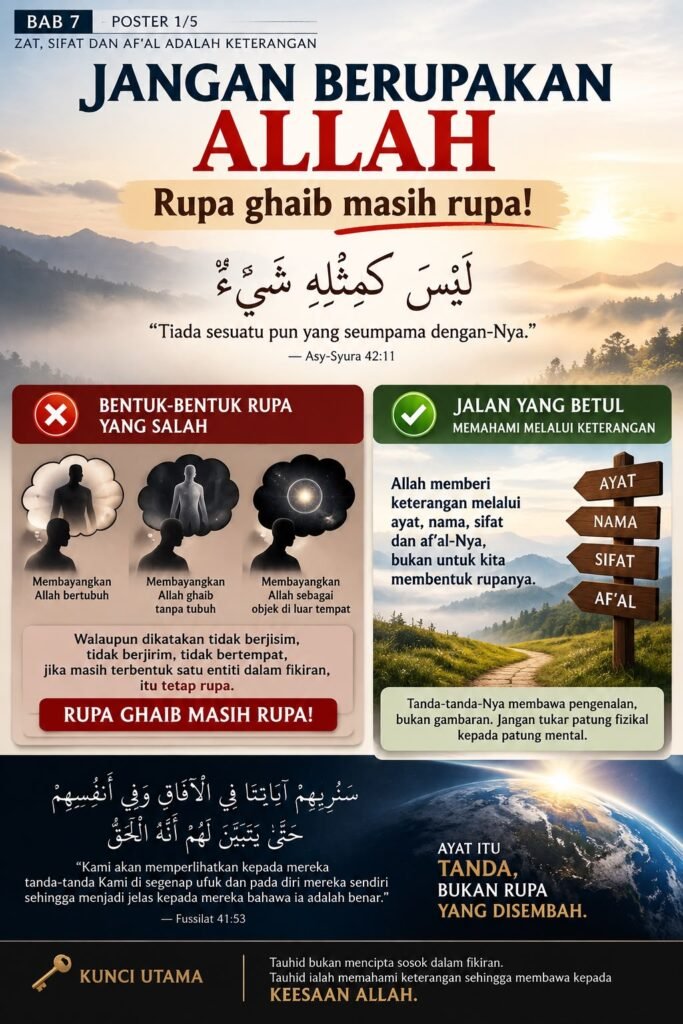
لَيْسَ كَمِثْلِهِ شَيْءٌ
“THERE IS NOTHING whatsoever like Him.”
— Ash-Shura 42:11
Therefore, when human beings enter into the discussion of:
ESSENCE — ATTRIBUTES — ACTIONS
do not immediately form an image.
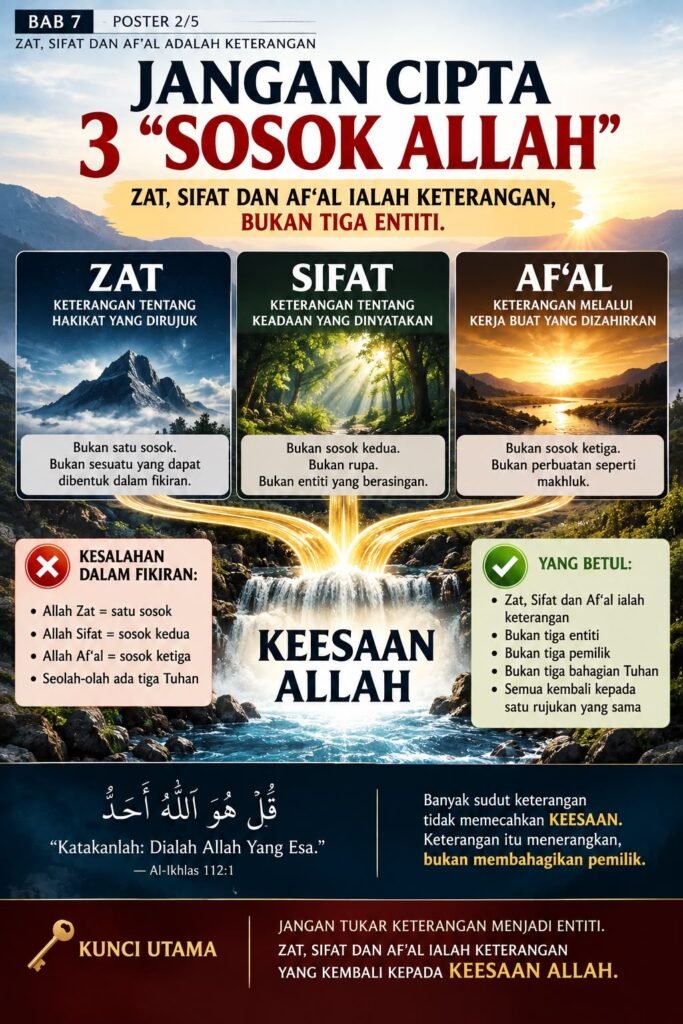
ESSENCE is not a figure.
ATTRIBUTES are not a second figure.
ACTIONS are not a third figure.
All three are descriptions that lead human beings towards recognition, and all these descriptions return to:
THE ONENESS OF ALLAH
Allah states:
قُلْ هُوَ اللَّهُ أَحَدٌ
“Say: He is Allah, the One.”
— Al-Ikhlas 112:1
⸻
DO NOT GIVE ALLAH A FORM
“Do not give Allah a form” is not resolved merely by saying:
“Allah has no body.”
“Allah has no physical substance.”
“Allah is not confined to a place.”
Because even after saying all of this, a person may still construct an unseen entity within the mind.
He may not imagine a body.
But he imagines “something that exists without a body”.
He may not assign a location.
But he imagines “something that exists beyond location”.
He may deny physical substance.
Yet there remains a mental object said to be “without physical substance”.
Then that unseen object is given the name:
Allah.
The problem has not been resolved.
AN UNSEEN FORM IS STILL A FORM.
Tawhid is not about replacing a physical idol with a mental idol.
It is not about replacing an embodied deity with an “unseen deity without a body”.
It is not about replacing one crude image with an abstract image.
The Quran cuts off every comparison:
لَيْسَ كَمِثْلِهِ شَيْءٌ
Therefore, the path towards knowing is not to create an image.
The path is to understand the descriptions.
Al-Qurtubi, when explaining this verse, quotes al-Wasiti:
لَيْسَ كَذَاتِهِ ذَاتٌ، وَلَا كَاسْمِهِ اسْمٌ، وَلَا كَفِعْلِهِ فِعْلٌ، وَلَا كَصِفَتِهِ صِفَةٌ إِلَّا مِنْ جِهَةِ مُوَافَقَةِ اللَّفْظِ
“THERE IS NO essence like His Essence, NO name like His Name, NO action like His Action, and NO attribute like His Attribute, except in the similarity of the wording.”
The key is:
NO
⸻
ALLAH PROVIDES SIGNS, NOT IMAGES
Allah states:
سَنُرِيهِمْ آيَاتِنَا فِي الْآفَاقِ وَفِي أَنْفُسِهِمْ حَتَّىٰ يَتَبَيَّنَ لَهُمْ أَنَّهُ الْحَقُّ
“We will show them Our signs throughout the horizons and within themselves until it becomes clear to them that it is the truth.”
— Fussilat 41:53
Notice:
آيَاتِنَا
“Our signs.”
An ayah is a sign.
A sign carries information.
A sign is not an image to be worshipped.
Therefore, human beings are directed to read what is manifested, not to create a figure within their minds.
⸻
ACTIONS: DESCRIPTION THROUGH WHAT IS DONE
Allah states:
اللَّهُ خَالِقُ كُلِّ شَيْءٍ
“Allah is the Creator of all things.”
— Az-Zumar 39:62
Creation is a description through Actions.
Giving life is an Action.
Causing death is an Action.
Giving is an Action.
Withholding is an Action.
Raising is an Action.
Lowering is an Action.
But al-Wasiti has already established the boundary:
وَلَا كَفِعْلِهِ فِعْلٌ
“THERE IS NO action like His Action.”
Therefore, Actions are not an image of an unseen hand performing work.
They are descriptions through what is done.
⸻
ATTRIBUTES: DESCRIPTIONS OF WHAT IS STATED
Allah states:
هُوَ الْأَوَّلُ وَالْآخِرُ وَالظَّاهِرُ وَالْبَاطِنُ ۖ وَهُوَ بِكُلِّ شَيْءٍ عَلِيمٌ
“He is the First and the Last, the Manifest and the Hidden, and He is Knowing of all things.”
— Al-Hadid 57:3
First.
Last.
Manifest.
Hidden.
Knowing.
All of these are descriptions, not forms.
The Messenger of Allah ﷺ explained:
اللَّهُمَّ أَنْتَ الْأَوَّلُ فَلَيْسَ قَبْلَكَ شَيْءٌ، وَأَنْتَ الْآخِرُ فَلَيْسَ بَعْدَكَ شَيْءٌ، وَأَنْتَ الظَّاهِرُ فَلَيْسَ فَوْقَكَ شَيْءٌ، وَأَنْتَ الْبَاطِنُ فَلَيْسَ دُونَكَ شَيْءٌ
“O Allah, You are the First, and there is NOTHING before You; You are the Last, and there is NOTHING after You; You are the Manifest, and there is NOTHING above You; and You are the Hidden, and there is NOTHING beneath You.”
— Sahih Muslim 2713
Attributes describe.
Attributes do not give human beings permission to form an unseen figure.
⸻
ESSENCE, ATTRIBUTES AND ACTIONS ARE NOT THREE “FIGURES OF ALLAH”
When human beings fail to understand that all of these are descriptions, they may construct:
“Allah as Essence”
“Allah as Attributes”
“Allah as Actions”
as though there were three figures.
This is what happens when categories of description are turned into entities.
Yet all three return to:
ONENESS
ESSENCE — description of the reality being referred to.
ATTRIBUTES — description through the attributes stated.
ACTIONS — description through what is manifested in action.
Many perspectives of description do not produce many possessors.
⸻
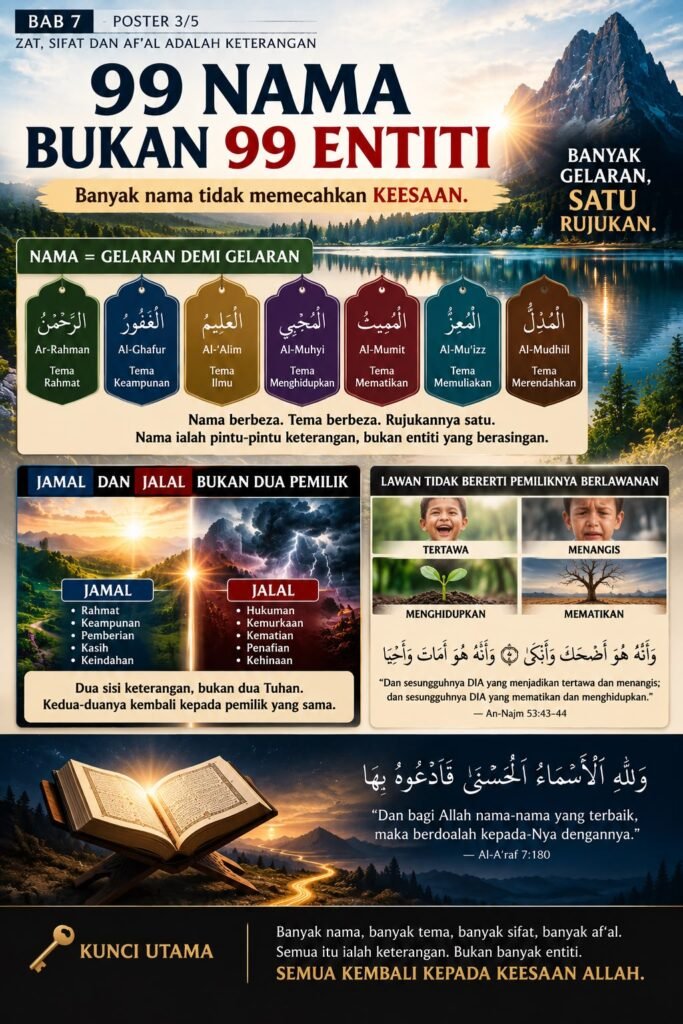
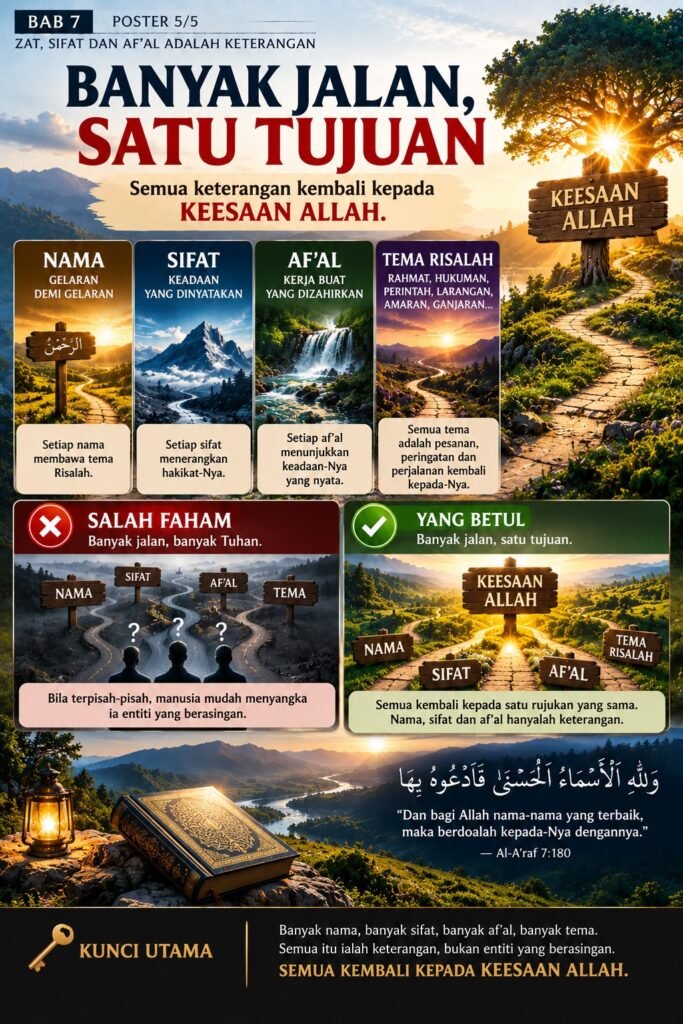
99 NAMES DO NOT MEAN 99 ENTITIES
Allah states:
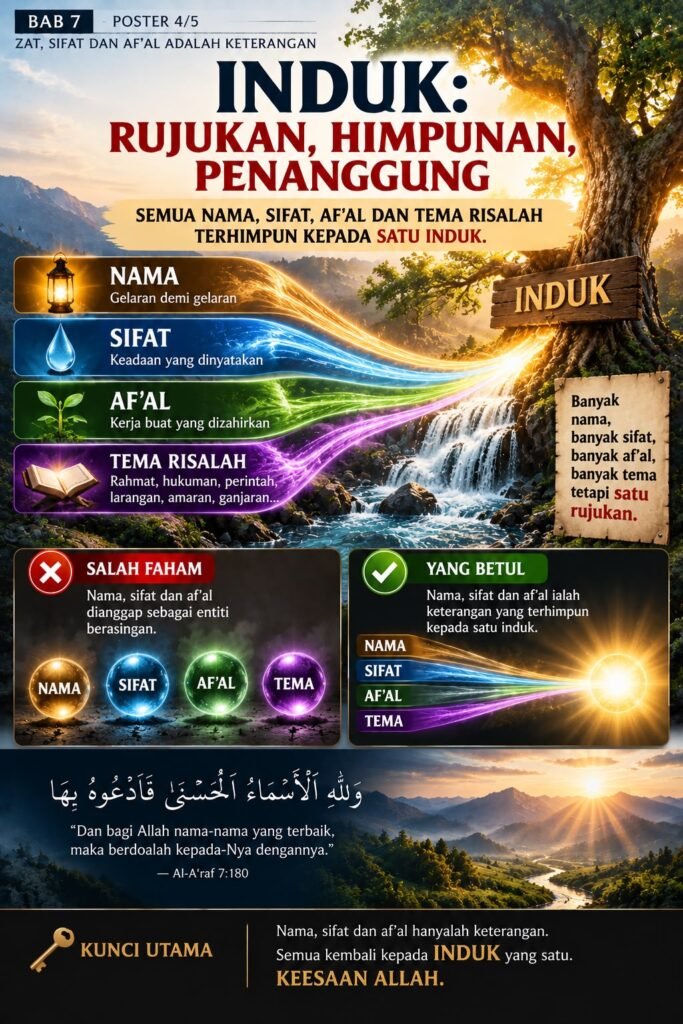
وَلِلَّهِ الْأَسْمَاءُ الْحُسْنَىٰ فَادْعُوهُ بِهَا
“And to Allah belong the most beautiful names, so call upon Him by them.”
— Al-A‘raf 7:180
The Messenger of Allah ﷺ said:
إِنَّ لِلَّهِ تِسْعَةً وَتِسْعِينَ اسْمًا، مِائَةً إِلَّا وَاحِدًا، مَنْ أَحْصَاهَا دَخَلَ الْجَنَّةَ
“Indeed, Allah has ninety-nine names, one hundred minus one; whoever comprehends them will enter Paradise.”
— Al-Bukhari and Muslim
The hadith itself demonstrates a simple principle:
MANY NAMES DO NOT MEAN MANY ENTITIES.
If there are 99 names, this does not mean there are 99 “Allahs”.
Name after name is title after title.
Each title opens another theme within the descriptions of the Risalah.
Ar-Rahman carries the theme of mercy.
Al-Ghafur carries the theme of forgiveness.
Al-‘Alim carries the theme of knowledge.
Al-Muhyi carries the theme of giving life.
Al-Mumit carries the theme of causing death.
Al-Mu‘izz carries the theme of honouring.
Al-Mudhill carries the theme of lowering.
Different names.
Different themes.
The One to whom they refer is not divided.
⸻
OPPOSITES DO NOT MEAN THEIR POSSESSOR IS DIVIDED INTO OPPOSITES
Allah states:
وَأَنَّهُ هُوَ أَضْحَكَ وَأَبْكَىٰ وَأَنَّهُ هُوَ أَمَاتَ وَأَحْيَا
“And indeed, it is HE who causes laughter and weeping; and indeed, it is HE who causes death and gives life.”
— An-Najm 53:43–44
Laughter and weeping are opposites.
Life and death are opposites.
But the Quran repeats:
هُوَ
HE.
Therefore, just because descriptions have two opposing sides, human beings must not create two possessors.
This is where it becomes important to read the pairs:
JAMAL — JALAL
AFFIRMATION — NEGATION
EXISTENCE — NON-EXISTENCE
MERCY — TORMENT
Allah states:
نَبِّئْ عِبَادِي أَنِّي أَنَا الْغَفُورُ الرَّحِيمُ وَأَنَّ عَذَابِي هُوَ الْعَذَابُ الْأَلِيمُ
“Inform My servants that indeed I am the All-Forgiving, the Most Merciful; and that My torment is indeed the painful torment.”
— Al-Hijr 15:49–50
Do not take Rahman and then discard torment.
Do not take Jamal while rejecting Jalal.
Do not accept the necessary attributes while assuming that the impossible attributes have no function within the explanation.
The study of Tawhid arranges:
NECESSARY
IMPOSSIBLE
POSSIBLE
so that human beings understand what is affirmed, what is negated, and how reason does not stop at only half of the description.
A complete explanation requires both sides to be read together.
⸻
THE ORIGINAL SOURCE: THE REFERENCE IN WHICH ALL DESCRIPTIONS ARE GATHERED
Here we come to the term:
ORIGINAL SOURCE
The original source is the reference.
The original source is where the descriptions are gathered.
The original source bears the entirety of the themes of the Risalah.
If names are read individually without their original source, names can easily be turned into entities.
If attributes are read without their original source, attributes can easily be treated as though they each have their own possessor.
If Actions are separated from their original source, every action can appear to stand independently.
Therefore:
many names,
many attributes,
many Actions,
many themes,
but all of them are gathered under the same original reference.
The analogy is that of a King.
One King may issue a message containing:
commands,
prohibitions,
mercy,
punishment,
rewards,
warnings,
laws,
and forgiveness.
Many themes do not create many Kings.
They all return to the King as the original source of the message.
⸻
THE RISALAH IS NOT A SHEET OF PAPER
Here, human beings need to change how they understand the word Risalah.
The Risalah cannot be reduced to a written letter.
If the Risalah is regarded merely as a sheet of paper, its bearer will eventually be regarded as a postman:
“Take the letter — deliver it — finished.”
But the Risalah is a body of descriptions borne by its bearer.
It has themes.
It has attributes.
It has instructions.
It has Actions.
And all of these must be manifested so that they can be witnessed.
⸻
MUHAMMAD ﷺ IS NOT A POSTMAN OF THE RISALAH
Allah states:
يَا أَيُّهَا النَّبِيُّ إِنَّا أَرْسَلْنَاكَ شَاهِدًا وَمُبَشِّرًا وَنَذِيرًا وَدَاعِيًا إِلَى اللَّهِ بِإِذْنِهِ وَسِرَاجًا مُنِيرًا
“O Prophet, indeed We have sent you as a witness, a bearer of glad tidings, a warner, one who calls to Allah by His permission, and as an illuminating lamp.”
— Al-Ahzab 33:45–46
Classical tafsir explains شَاهِدًا, among other meanings, as the Messenger being a witness over those to whom he was sent, including their acceptance or rejection of the Risalah.
But the structure of the verse itself shows that the role of the Messenger goes far beyond delivering a text:
شَاهِدًا — a witness
مُبَشِّرًا — a bearer of glad tidings
نَذِيرًا — a warner
دَاعِيًا إِلَى اللَّهِ — one who calls to Allah
سِرَاجًا مُنِيرًا — an illuminating lamp
These are living roles.
⸻
WHAT CAN BE WITNESSED IN THE MESSENGER?
Here, Chapter 7 takes another step forward.
Allah’s Risalah carried by the Messenger is not merely heard through words.
It can be witnessed in its bearer.
Allah states:
وَإِنَّكَ لَعَلَىٰ خُلُقٍ عَظِيمٍ
“And indeed, you are truly upon an exalted character.”
— Al-Qalam 68:4
Al-Tabari explains خُلُقٍ عَظِيمٍ as the discipline of the Quran with which Allah educated Muhammad ﷺ. He also relates the report of ‘Aishah رضي الله عنها:
كَانَ خُلُقُهُ الْقُرْآنَ
“His character was the Quran.”
This is a profoundly important relationship.
The Quran is read through its words.
But in the Messenger, its contents are manifested as character and life.
Therefore, do not merely ask:
“What is the text of the Risalah?”
Also ask:
What does the Risalah look like when it is carried by the Messenger?
⸻
THE MESSENGER BECOMES WHERE THE RISALAH CAN BE WITNESSED
Within the framework of Chapter 7, the word witness leads us towards witnessing the Risalah through its bearer.
Not witnessing a sheet of paper.
Not merely witnessing the Messenger reciting.
But witnessing:
the ATTRIBUTES of the bearer,
the CHARACTER of the bearer,
the TRUSTWORTHINESS of the bearer,
the ACTIONS of the bearer,
the DECISIONS of the bearer,
the MERCY of the bearer,
the WARNINGS of the bearer,
and
the DEEDS of the bearer.
Because all of these carry the themes of the Risalah borne by him.
Therefore:
RISALAH → BORNE BY THE BEARER → MANIFESTED THROUGH ATTRIBUTES AND ACTIONS → CAN BE WITNESSED
This is why the concept of the bearer of the Risalah must not be reduced to “someone who delivers a Book”.
⸻
THE CHARACTER OF THE MESSENGER BECOMES A MAJOR KEY
The report of ‘Aishah:
كَانَ خُلُقُهُ الْقُرْآنَ
provides a very powerful picture.
If you want to see how the contents of the Quran are translated into life:
look at the Messenger.
If you want to understand trustworthiness:
look at the trustworthiness of the Messenger.
If you want to understand mercy:
look at the mercy of the Messenger.
If you want to understand firmness:
look at how the Messenger was firm.
If you want to understand patience:
look at the patience of the Messenger.
If you want to understand warning:
look at how the Messenger gave warning.
In this way, the text moves from:
LETTERS
to:
WITNESSING
Al-Tabari himself connects Al-Qalam 68:4 with the discipline of the Quran and relates the report that the character of the Messenger ﷺ was the Quran.
⸻
THE BEARER CARRIES THE ENTIRE RISALAH
The bearer does not carry only one theme.
Muhammad ﷺ is not merely the bearer of mercy while warning is discarded.
He is not merely the bearer of gentleness while firmness is discarded.
He is not merely the bearer of glad tidings while warning is discarded.
Al-Ahzab 33:45 itself brings together:
مُبَشِّرًا
and:
نَذِيرًا
Glad tidings and warning are found in the same bearer.
Therefore, once again:
JAMAL AND JALAL DO NOT REQUIRE TWO BEARERS.
The entire range of themes within the Risalah is borne by the same bearer.
This is where the meaning of bearing becomes important.
⸻
SECONDARY BEARERS STILL REFER BACK TO THE ORIGINAL SOURCE
Return to the analogy of the King.
The King is the original source of the message.
The governor receives and carries that message within his territory.
The district chief carries it forward.
Each level can be called a bearer according to its position.
But a secondary bearer does not create a new message.
He refers back to the original source.
The same applies to the path of knowledge.
A teacher receives from a teacher.
The previous teacher received from his teacher.
The sanad preserves the chain so that human beings do not create new meanings according to their own desires.
For this Ummah, the chain of guidance ultimately returns to:
PROPHET MUHAMMAD ﷺ
as the bearer of the Risalah to the Ummah.
⸻
THE BEARER GUIDES TOWARDS ALLAH
Allah states:
مَنْ يُطِعِ الرَّسُولَ فَقَدْ أَطَاعَ اللَّهَ
“Whoever obeys the Messenger has indeed obeyed Allah.”
— An-Nisa’ 4:80
And:
قُلْ إِنْ كُنْتُمْ تُحِبُّونَ اللَّهَ فَاتَّبِعُونِي يُحْبِبْكُمُ اللَّهُ
“Say: If you love Allah, then follow me; Allah will love you.”
— Ali ‘Imran 3:31
Therefore, the bearer is not a destination that cuts human beings off from Allah.
The bearer is a guide towards Allah.
But without understanding the bearer, human beings can easily read the Risalah through their own imagined concepts.
⸻
DO NOT READ HASTILY
Allah states:
وَلَا تَعْجَلْ بِالْقُرْآنِ مِنْ قَبْلِ أَنْ يُقْضَىٰ إِلَيْكَ وَحْيُهُ ۖ وَقُلْ رَبِّ زِدْنِي عِلْمًا
“And do not hasten with the Quran before its revelation to you is completed, and say: My Lord, increase me in knowledge.”
— Taha 20:114
Do not rush simply because you want an answer quickly.
Do not memorise names without understanding their themes.
Do not study ESSENCE and then construct a figure.
Do not study ATTRIBUTES and then create entities.
Do not study ACTIONS and then imagine actions resembling those of created beings.
Do not read the Quran while severing it from the Messenger who carried it.
Read.
Examine carefully.
Use reason.
Read the books.
Learn from a teacher of Tawhid who possesses a sanad leading back to the bearer of the Risalah.
Because even a correct expression can still produce a false image when read without guidance.
⸻
CONCLUSION
ESSENCE, ATTRIBUTES and ACTIONS are:
DESCRIPTIONS
Not three objects.
Not three parts.
Not three entities.
Not three figures of Allah.
And “Allah has no form” must not be reduced merely to the denial of body, physical substance or location.
If, after all these negations, there still remains an “unseen deity” within the mind:
AN UNSEEN FORM IS STILL A FORM.
The Names, meanwhile, are:
TITLE AFTER TITLE
carrying:
THEME AFTER THEME OF THE RISALAH
99 names do not produce 99 entities.
The sahih hadith itself mentions many names that all refer back to the same Allah.
Jamal and Jalal do not require two possessors.
Life and death do not require two possessors.
Laughter and weeping do not require two possessors.
Affirmation and negation do not produce two Gods.
All these descriptions are gathered under:
THE ORIGINAL SOURCE
The original source is:
THE REFERENCE,
THE PLACE WHERE EVERYTHING IS GATHERED,
and
THE BEARER OF THE ENTIRE BODY OF DESCRIPTIONS.
The Risalah from that original source, in turn, has a bearer.
The bearer is not a postman.
The bearer carries the Risalah until the Risalah can be witnessed through his attributes, character and Actions.
And the Quran provides a beautiful demonstration of this in Muhammad ﷺ:
وَإِنَّكَ لَعَلَىٰ خُلُقٍ عَظِيمٍ
while ‘Aishah رضي الله عنها summarised:
كَانَ خُلُقُهُ الْقُرْآنَ
“His character was the Quran.”
Therefore, the relationship ultimately becomes:
ORIGINAL SOURCE → RISALAH → BEARER → ATTRIBUTES & ACTIONS → WITNESSING → RECOGNITION
And for this Ummah, the bearer of the Risalah who becomes a witness, and through whom human beings can witness how those descriptions are manifested, is:
PROPHET MUHAMMAD ﷺ
The purpose remains one:
TO KNOW ALLAH.
Detecting your location…