



MUKADDIMAH · M28

When Allah is mentioned, do not immediately ask:
“What is His Essence like?”
“What are His Attributes like?”
“What are His Actions like?”
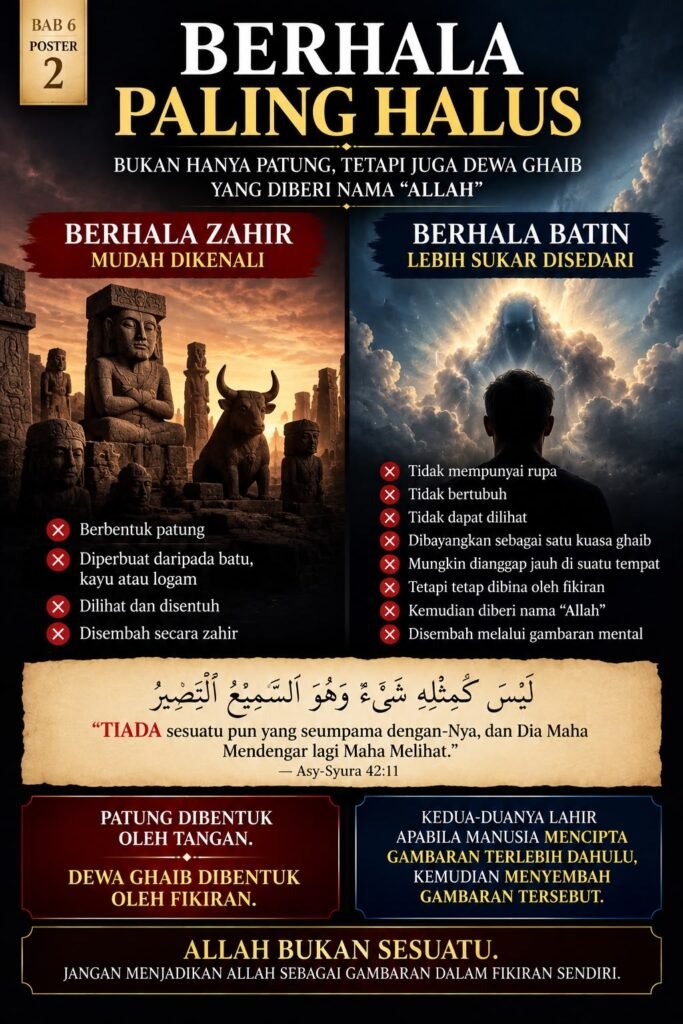
Questions like these can easily cause the mind to rush into forming an image.
Yet the foundation has already been established:
لَيْسَ كَمِثْلِهِ شَيْءٌ
“THERE IS NOTHING whatsoever like Him.”
— Ash-Shura 42:11
Therefore, the first step is to negate every comparison.
Do not construct an image.
Do not construct a figure.
Do not construct an “unseen deity”.
Nor should you invent “something without form” and then give that thing the name Allah.
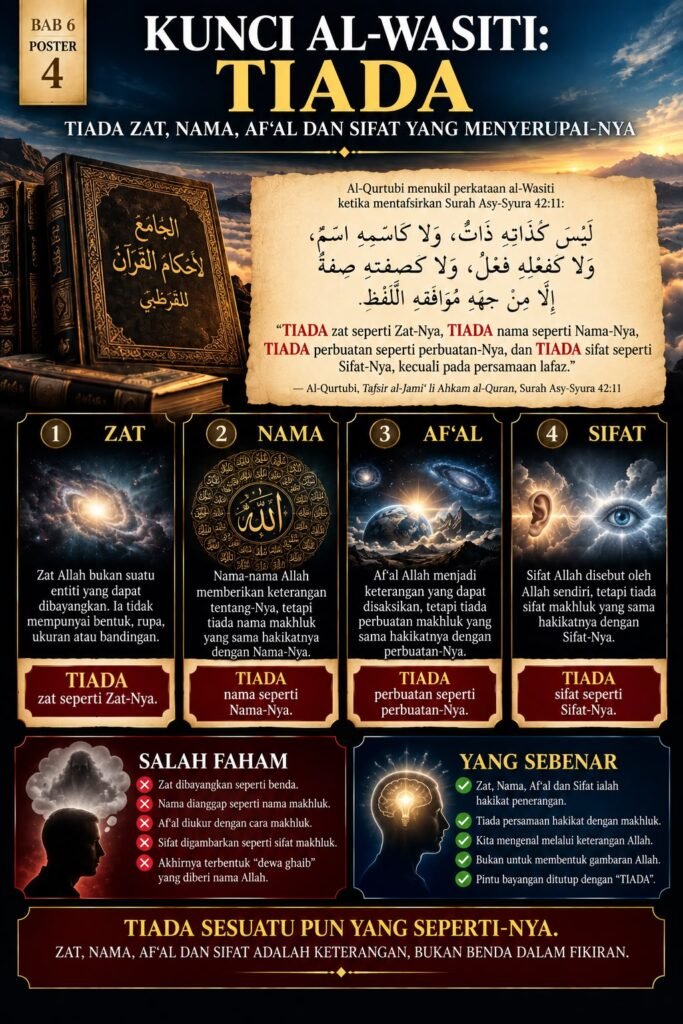
Once the door to imagery has been closed, only then can human beings begin to understand the descriptions.
From these descriptions, we then come to recognise the terms:
ESSENCE — ATTRIBUTES — ACTIONS.
They are not three images that need to be formed in the mind.
They are a framework of description.
⸻
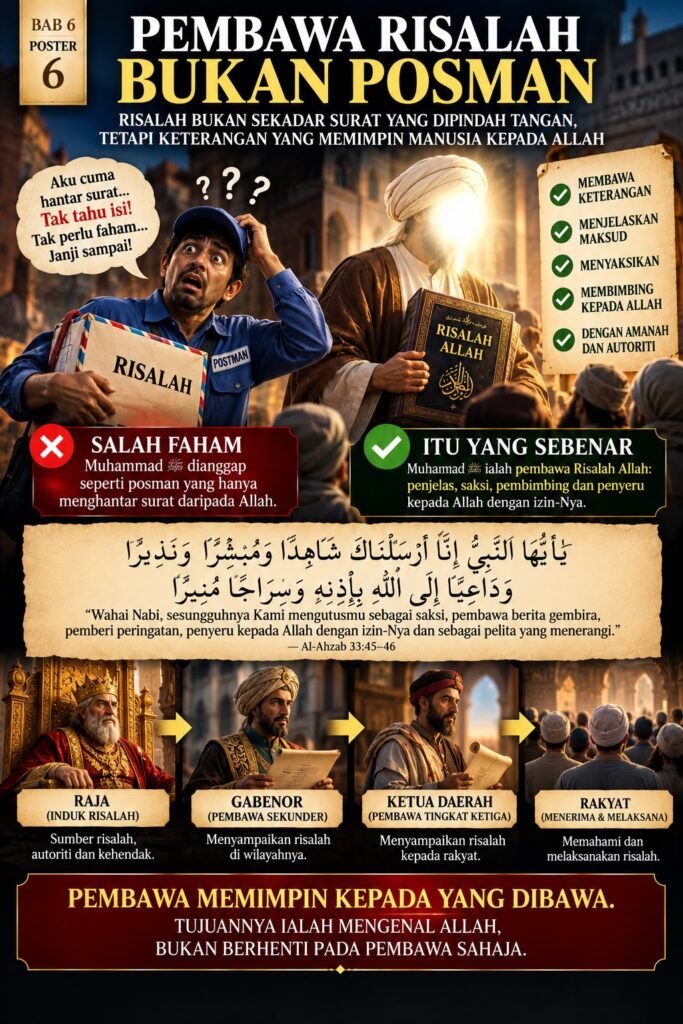
THE BEARER OF THE RISALAH IS NOT A “POSTMAN”
Here lies another major misunderstanding that often occurs.
When it is said that Prophet Muhammad ﷺ is the bearer of Allah’s Risalah, people may easily imagine the relationship like this:
Allah is in one place.
Muhammad ﷺ is in another place.
Then a “letter” is sent from Allah to Muhammad ﷺ.
Muhammad ﷺ then becomes like a postman delivering that letter to humanity.
Such an image must be examined very carefully.
Because the term BEARER OF THE RISALAH has a much deeper structure.
⸻
THE ANALOGY OF A KING AND HIS ENTIRE REALM
Imagine that a King has a message that he wishes to convey throughout his entire realm.
Who is the first bearer of that message?
Not the governor.
Not the district chief.
Not a messenger at a lower level.
The King himself is the original source of that message.
The message originates from the King.
The will contained within it is the will of the King.
The command within it is the command of the King.
The name that gives authority to the message is the name of the King.
Therefore, at the first level:
KING = ORIGINAL BEARER OF THE MESSAGE
Then the message reaches a governor who represents the King within his territory.
The governor also becomes a bearer of the message.
But he is not the original source.
He is the bearer of the message at the second level.
Then the governor conveys it to the district chief.
The district chief also carries the same message.
But his position is now at the third level.
This is how the message travels.
Source → representative → next representative.
The further the level of transmission extends, the more important it becomes for people to know where the message originated.
⸻
DO NOT SEPARATE THE RISALAH FROM ITS ORIGINAL SOURCE
If a district chief carries the King’s command, someone who understands the structure of government would not say:
“These are merely the words of the district chief.”
He knows that the district chief carries authority originating from those above him, and that this chain ultimately returns to the King.
This is why understanding the meaning of a bearer of the Risalah is so important.
A bearer of the Risalah cannot be understood merely as a courier who has no relationship with the contents of the message.
He carries:
the trust,
the description,
the command,
the authority,
and the witnessing of the Risalah that he carries.
⸻
PROPHET MUHAMMAD ﷺ AS THE BEARER OF THE RISALAH
Allah states:
يَا أَيُّهَا النَّبِيُّ إِنَّا أَرْسَلْنَاكَ شَاهِدًا وَمُبَشِّرًا وَنَذِيرًا وَدَاعِيًا إِلَى اللَّهِ بِإِذْنِهِ وَسِرَاجًا مُنِيرًا
“O Prophet, indeed We have sent you as a witness, a bearer of glad tidings, a warner, one who calls to Allah by His permission, and as an illuminating lamp.”
— Al-Ahzab 33:45–46
Notice:
Muhammad ﷺ is not portrayed as a passive courier delivering a letter.
He is described as:
شَاهِدًا — a witness
مُبَشِّرًا — a bearer of glad tidings
نَذِيرًا — a warner
دَاعِيًا إِلَى اللَّهِ — one who calls to Allah
سِرَاجًا مُنِيرًا — an illuminating lamp
Therefore, the meaning of the bearer of the Risalah is far greater than that of a “postman”.
He carries the descriptions that guide human beings towards Allah.
⸻
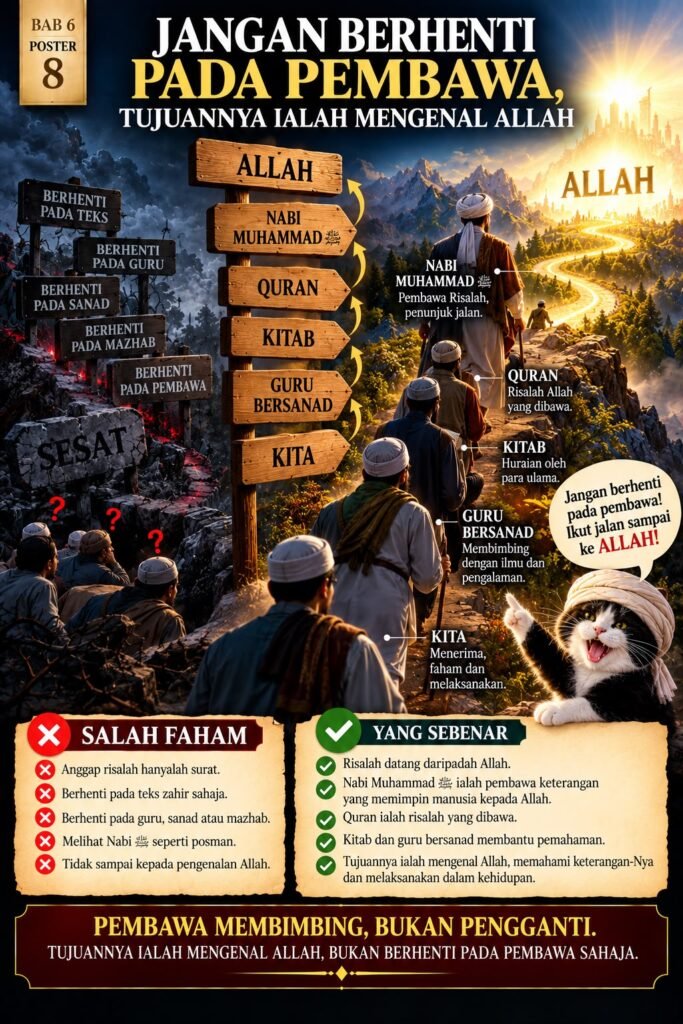
THE RISALAH DOES NOT END WITH ITS BEARER
Here, human beings must be careful.
The purpose of following the bearer of the Risalah is not for human beings to stop at the bearer.
Its purpose is to guide human beings towards Allah.
Allah states:
قُلْ إِنْ كُنْتُمْ تُحِبُّونَ اللَّهَ فَاتَّبِعُونِي يُحْبِبْكُمُ اللَّهُ
“Say: If you love Allah, then follow me; Allah will love you.”
— Ali ‘Imran 3:31
Notice the direction:
Love Allah → follow Muhammad ﷺ → Allah loves you.
Muhammad ﷺ is the guiding path towards the descriptions of Allah.
Therefore, human beings should not stop at the text.
Do not stop at the teacher.
Do not stop at the sanad.
Do not stop at the bearer.
All of them lead towards knowing Allah.
⸻
DO NOT DISTORT IT INTO A “POSTAL SYSTEM”
When the concept of Risalah is understood too literally, it turns into something resembling a delivery system:
Allah → Jibril → Muhammad ﷺ → humanity.
Then everything is imagined as though a letter is simply being passed from one hand to another.
This is too shallow an understanding of the meaning of Risalah.
Risalah is description.
Its bearers carry that description with trust, witnessing and authority according to their respective levels.
The analogy of the King helps us understand the structure:
KING
the original source of the message.
↓
GOVERNOR
bearer of the message at the second level.
↓
DISTRICT CHIEF
bearer of the message at the next level.
↓
THE PEOPLE
receive and carry out the contents of the message.
But the entire authority of that message ultimately returns to the King.
⸻
SO WHO IS TO BE KNOWN?
Not merely the letter.
Not merely the governor.
Not merely the district chief.
The purpose is for the people to understand the will of the King.
The same applies to the journey of Tawhid.
Do not stop at the letters.
Do not stop at the words.
Do not stop at the teacher.
Do not stop at the bearer.
All of them lead human beings towards knowing Allah.
Yet without a bearer, human beings may read the Risalah and then interpret it according to their own desires.
That is why the bearer and guide are so important.
⸻
THE SANAD PRESERVES THE DIRECTION OF THE RISALAH
A teacher receives from a teacher.
That teacher previously received from his teacher.
The chain preserves the explanation so that it does not become disconnected from its source.
The further one moves from the source, the greater the possibility that human beings will add their own imagined concepts.
This is where the sanad plays its role.
Not to replace Allah with a teacher.
Not to make the teacher the final destination.
But to prevent human beings from going astray when reading Allah’s Risalah.
And that chain ultimately returns to:
PROPHET MUHAMMAD ﷺ
He is the bearer of Allah’s Risalah to the Ummah.
Therefore, when seeking to know Allah, human beings cannot sever themselves from the bearer of His descriptions.
But neither should they stop at the bearer and forget the One being conveyed.
THE BEARER GUIDES TOWARDS THE ONE BEING CONVEYED.
And the One to be known is:
ALLAH.
Detecting your location…