
MUKADDIMAH · M04
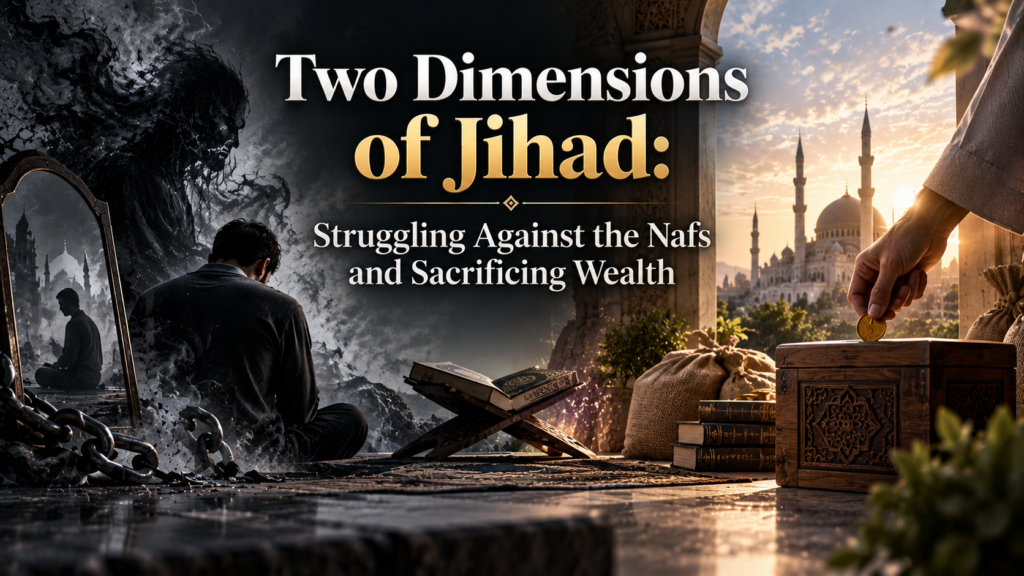
Two Dimensions of Jihad: Struggling Against the Nafs and Sacrificing Wealth
Human beings naturally understand struggle when it is visible.
We recognise struggle when someone fights an opponent.
We recognise sacrifice when someone loses something.
We recognise effort when it produces something that can be seen.
But some of the most difficult struggles in human life are largely invisible.
No one else may see the moment when a person restrains their anger.
No one may know how difficult it was for them to surrender something they love.
No one may witness the battle between conscience and desire taking place within the heart.
This raises an important question:
What if the most immediate struggle is not against another human being, but against ourselves?
The Qur’an repeatedly confronts the human being with two powerful attachments:
the self — nafs
and
what the self possesses — wealth.
The nafs desires.
Wealth gives the nafs the ability to fulfil many of those desires.
One struggle therefore concerns governing the self.
Another concerns being willing to sacrifice what the self wants to possess.
These two dimensions provide an important foundation for understanding jihad as a process of transformation rather than merely an external confrontation.
The Nafs Is Within Us
It is easy to identify an enemy standing in front of us.
It is much harder to recognise an enemy when its voice sounds like our own.
The Qur’an records the words:
إِنَّ النَّفْسَ لَأَمَّارَةٌ بِالسُّوءِ إِلَّا مَا رَحِمَ رَبِّي
“Indeed, the soul is certainly prone to command evil, except those upon whom my Lord has mercy.”
— Yusuf 12:53
The nafs is not something encountered only by openly sinful people.
Every human being must confront desire.
The desire to possess.
The desire to dominate.
The desire to be praised.
The desire to retaliate.
The desire to be recognised.
The desire to prove oneself right.
The desire to place oneself above another.
The desire to satisfy whatever the self wants.
Not every desire is automatically evil.
Human beings require desire to eat, work, marry, build, protect and continue life.
The problem arises when desire becomes the master rather than something governed.
The question therefore is not whether a person has desires.
The question is whether the person governs desire, or desire governs the person.
The Enemy That Travels with Us
An external opponent can leave.
A conflict can end.
A battlefield can become silent.
But the nafs travels with the human being.
It enters the home with us.
It enters our work.
It enters our friendships.
It enters our disagreements.
It can even enter our worship.
A person may pray and still desire to be admired for their piety.
They may give charity and still want everyone to know that they gave.
They may teach religion while secretly enjoying authority over others.
They may defend truth while becoming addicted to defeating people in argument.
They may condemn arrogance while remaining unable to accept correction themselves.
This makes the struggle against the nafs particularly difficult.
The nafs can use even a good action to strengthen the sense of self.
A person may therefore appear victorious outwardly while remaining defeated inwardly.
Restraining Desire
The Qur’an connects success with the ability to restrain the nafs:
وَأَمَّا مَنْ خَافَ مَقَامَ رَبِّهِ وَنَهَى النَّفْسَ عَنِ الْهَوَىٰ فَإِنَّ الْجَنَّةَ هِيَ الْمَأْوَىٰ
“But as for the one who feared standing before his Lord and restrained the soul from desire, then Paradise will certainly be the refuge.”
— An-Nazi’at 79:40–41
The verse does not describe the destruction of the human being.
It describes restraint.
The self wants something.
But the person does not automatically obey it.
There is a space between desire and action.
Within that space, a struggle occurs.
The person must decide:
Who commands whom?
Does anger command the person?
Does greed command the person?
Does pride command the person?
Does lust command the person?
Does fear command the person?
Or can the person recognise these movements within themselves and refuse to become their servant?
This is one of the deepest meanings of self-discipline.
Strength Is Not Merely Defeating Another Person
Human beings often associate strength with the ability to overpower someone else.
The Prophet Muhammad SAW redirected that understanding.
Abu Hurairah reported that the Prophet taught that the strong person is not merely the one who defeats others physically, but the person who controls themselves when angry.
This is significant.
Anger produces an immediate demand from the nafs:
Respond.
Strike back.
Humiliate them.
Make them feel what they made you feel.
Self-control interrupts that command.
It creates a moment in which reason, conscience and responsibility can operate.
Therefore:
Strength is not only the power to act.
Strength is also the power to restrain oneself from acting wrongly.
A person may possess the ability to retaliate and deliberately choose not to transgress.
That restraint is not necessarily weakness.
It may require greater strength than retaliation.
The Nafs Wants to Be Seen
The struggle becomes even more subtle when we consider recognition.
Human beings often want their actions to be noticed.
If they give, they want someone to know.
If they sacrifice, they want appreciation.
If they achieve something, they want acknowledgement.
If they serve, they may want status in return.
This is why an outwardly good act does not automatically reveal what is happening inwardly.
The Qur’an warns against spending wealth for the purpose of being seen by people:
وَالَّذِينَ يُنفِقُونَ أَمْوَالَهُمْ رِئَاءَ النَّاسِ
“And those who spend their wealth to be seen by people…”
— An-Nisa’ 4:38
The action exists.
The wealth has been spent.
But the intention changes the spiritual meaning of the act.
This reveals how deeply the nafs can operate.
It does not always say:
“Do evil.”
Sometimes it says:
“Do good—but make sure everyone sees you doing it.”
The struggle against the nafs therefore requires more than controlling obvious wrongdoing.
It also requires examining why we do what we do.
Wealth Reveals Attachment
The second dimension of struggle concerns wealth.
Human beings need material resources.
Islam does not teach that possessing wealth is inherently wrong.
The issue is attachment.
Do we possess wealth?
Or does wealth possess us?
The Qur’an says:
لَن تَنَالُوا الْبِرَّ حَتَّىٰ تُنفِقُوا مِمَّا تُحِبُّونَ
“You will never attain righteousness until you spend from that which you love.”
— Ali ‘Imran 3:92
The verse does not merely speak about giving.
It speaks about giving from:
what you love.
That qualification changes everything.
Giving away what has no value to us may require little sacrifice.
Giving from what we love confronts attachment directly.
The hand opens.
But before the hand opens, something inside the person must loosen its grip.
That internal struggle is part of the sacrifice.
Wealth and the Self Are Frequently Mentioned Together
The Qur’an repeatedly joins wealth and the self when speaking about striving.
For example:
انْفِرُوا خِفَافًا وَثِقَالًا وَجَاهِدُوا بِأَمْوَالِكُمْ وَأَنفُسِكُمْ فِي سَبِيلِ الله
“Go forth, whether light or heavy, and strive with your wealth and yourselves in the way of Allah.”
— At-Tawbah 9:41
Elsewhere:
إِنَّمَا الْمُؤْمِنُونَ الَّذِينَ آمَنُوا بِالله وَرَسُولِهِ ثُمَّ لَمْ يَرْتَابُوا وَجَاهَدُوا بِأَمْوَالِهِمْ وَأَنفُسِهِمْ فِي سَبِيلِ الله
“The believers are only those who believe in Allah and His Messenger, then doubt not, and strive with their wealth and themselves in the way of Allah…”
— Al-Hujurat 49:15
This relationship deserves attention.
Striving is not described solely through physical confrontation.
Wealth itself becomes part of the test.
A person may speak passionately about sacrifice while remaining unwilling to surrender anything they personally value.
But when wealth is involved, belief encounters something concrete.
The question becomes:
What are you actually prepared to give up?
Giving Is More Than Losing Money
Sacrificing wealth should not be understood merely as becoming poorer.
The deeper question concerns the relationship between the human being and possession.
Money can represent:
security,
comfort,
status,
independence,
power,
future plans,
and sometimes even:
identity.
To give from wealth can therefore challenge several layers of attachment simultaneously.
This is why the Qur’an says:
وَمَن يُوقَ شُحَّ نَفْسِهِ فَأُولَٰئِكَ هُمُ الْمُفْلِحُونَ
“And whoever is protected from the greed of their own soul—it is they who are successful.”
— Al-Hashr 59:9
Notice again the relationship between possession and the nafs.
The problem is not merely money.
The problem is the greed of the self.
Wealth exposes it.
Sacrifice confronts it.
Giving What We Do Not Need Is Different from Sacrifice
Suppose someone owns one hundred items and gives away something they were already planning to discard.
Technically, they have given something.
But little attachment has been challenged.
Now imagine giving something genuinely valued.
Something that could have been used for personal comfort.
Something that required effort to acquire.
Something that the self wanted to keep.
The internal experience changes.
Sacrifice begins when giving costs us something.
This does not mean Islam requires people to destroy their financial security or neglect those dependent upon them.
Responsibility remains important.
The principle concerns attachment:
Can wealth be released when a rightful purpose requires it?
Or does the fear of losing possession become stronger than every other consideration?
The answer reveals something about the relationship between the person and the material world.
Wealth Is a Test
The Qur’an describes wealth and children as a test:
إِنَّمَا أَمْوَالُكُمْ وَأَوْلَادُكُمْ فِتْنَةٌ
“Your wealth and your children are only a test…”
— At-Taghabun 64:15
A test does not necessarily mean that the thing itself is evil.
Rather, it reveals something about the person encountering it.
Wealth can be used for generosity.
It can also produce greed.
Authority can be used for justice.
It can also produce arrogance.
Knowledge can guide.
It can also produce pride.
Religion itself can produce humility—or become another identity through which the nafs feels superior.
The test reveals:
What controls the human being?
This is why the struggle against the nafs and sacrifice of wealth cannot be completely separated.
The external possession exposes the internal attachment.
Sacrifice Without Sincerity Can Still Feed the Nafs
Even sacrifice itself must be examined.
A person may donate a large amount of wealth and become proud of their generosity.
They may sacrifice publicly and expect loyalty in return.
They may give to a community and later believe that the community belongs to them.
They may fund religious work and then demand authority because they paid for it.
In such cases, wealth has left the hand.
But the nafs may have gained something else:
status.
This demonstrates why the two struggles must remain connected.
Sacrifice of wealth without struggle against the nafs can simply transform one form of attachment into another.
The person loses money but gains pride.
They surrender possession but acquire influence.
They give outwardly while the self becomes larger inwardly.
The deeper struggle therefore asks:
Can you give without making yourself greater through the act of giving?
The Purpose Is Not Self-Destruction
Struggling against the nafs does not mean hating oneself.
Nor does it mean destroying every human desire.
Likewise, sacrificing wealth does not mean deliberately making oneself destitute.
The objective is discipline, not destruction.
A horse without direction may run wherever its impulses carry it.
A horse that has been trained does not cease to possess strength.
Its strength has been disciplined.
The same principle can be applied to the human self.
Desire remains.
Energy remains.
Ambition remains.
Emotion remains.
But these forces should not rule without restraint.
The purpose is not to eliminate the self as a biological existence.
The purpose is to prevent the self from becoming the unquestioned ruler of the human being.
From Possessing to Releasing
There is a simple way to observe attachment.
Notice what happens when something is threatened.
When status is threatened, pride appears.
When wealth is threatened, fear appears.
When reputation is threatened, anger appears.
When an opinion is challenged, defensiveness appears.
When control is threatened, the desire to dominate appears.
These moments reveal what ordinary circumstances may hide.
They show us where the self has attached itself.
The struggle therefore requires observation.
What am I unable to release?
What am I afraid to lose?
What makes me angry when challenged?
What must other people recognise about me before I feel satisfied?
These questions turn jihad inward.
Instead of beginning with an enemy somewhere else, the human being begins by examining the structures of attachment within themselves.
Sacrifice Changes the Relationship with Ownership
When a person learns to give, something begins to change.
The person may still possess wealth.
But possession no longer carries exactly the same meaning.
The hand can hold without the heart being completely captured by what the hand holds.
This is an important distinction.
Possession is not necessarily attachment.
A person can possess little and still be consumed by greed.
Another can possess much and remain capable of giving generously.
The spiritual question therefore cannot be answered merely by looking at the amount of wealth someone owns.
The question is:
What place does that wealth occupy within them?
Can it be used?
Can it be shared?
Can it be sacrificed?
Or has it become part of the person’s sense of self?
The Deeper Meaning of Victory
Victory is often imagined as overcoming someone else.
But there is another kind of victory.
A person becomes angry but refuses injustice.
That is a victory.
A person has the opportunity to take what does not belong to them but refuses.
That is a victory.
A person desires recognition but chooses sincerity.
That is a victory.
A person loves wealth but gives from it when sacrifice is required.
That is a victory.
A person discovers that they were wrong and accepts correction despite the pain to their pride.
That is a victory.
None of these victories may appear in history books.
There may be no crowd.
No medal.
No public celebration.
But something significant has happened.
The self wanted to rule, and the human being refused to surrender to it.
Jihad as Transformation
The struggle against the nafs and the sacrifice of wealth ultimately meet at one point:
attachment to the self.
The self wants to preserve itself.
It wants to preserve what belongs to it.
It wants comfort.
It wants recognition.
It wants superiority.
It wants control.
Jihad confronts this attachment through effort.
The person learns restraint.
The person learns sacrifice.
The person learns sincerity.
The person learns to give.
The person learns to accept correction.
The person learns that not every desire must be obeyed.
The person learns that possession does not have to become identity.
This is why jihad cannot be understood only through the language of conflict with other people.
There is also an internal transformation taking place.
The human being is struggling with what they themselves have become attached to.
The Struggle Closest to Us
It is easy to search for enemies outside ourselves.
It is harder to examine what rules us from within.
Before asking whom we are prepared to fight, perhaps another question deserves attention:
What within ourselves are we prepared to resist?
Can we resist greed?
Can we resist arrogance?
Can we resist uncontrolled anger?
Can we resist the desire to dominate?
Can we sacrifice something we genuinely love?
Can we give without demanding recognition?
Can we possess without becoming possessed by what we own?
These questions bring jihad much closer to everyday human life.
The struggle does not begin only when armies meet.
It can begin in the moment between anger and retaliation.
Between possession and generosity.
Between pride and humility.
Between desire and restraint.
Between being praised and remaining sincere.
Between being corrected and refusing to defend the ego.
For SiHulk, these dimensions of jihad are essential because transformation cannot occur while the nafs remains unquestioned.
The struggle against the nafs disciplines the self.
The sacrifice of wealth loosens attachment.
Together, they confront a fundamental obstacle in the journey of recognition:
the human tendency to place the self at the centre of everything.
References
1.Al-Qur’an, Surah Yusuf, 12:53.
2.Al-Qur’an, Surah An-Nazi’at, 79:40–41.
3.Al-Qur’an, Surah An-Nisa’, 4:38.
4.Al-Qur’an, Surah Ali ‘Imran, 3:92.
5.Al-Qur’an, Surah At-Tawbah, 9:41.
6.Al-Qur’an, Surah Al-Hujurat, 49:15.
7.Al-Qur’an, Surah Al-Hashr, 59:9.
8.Al-Qur’an, Surah At-Taghabun, 64:15.
9.Imam al-Bukhari, Sahih al-Bukhari, Kitab al-Adab, Hadith no. 6114.
10.Imam Muslim, Sahih Muslim, Kitab al-Birr wa al-Silah wa al-Adab, Hadith no. 2609a.