
MUKADDIMAH · M03
Islam Is Not Violence: Understanding Jihad and Warfare
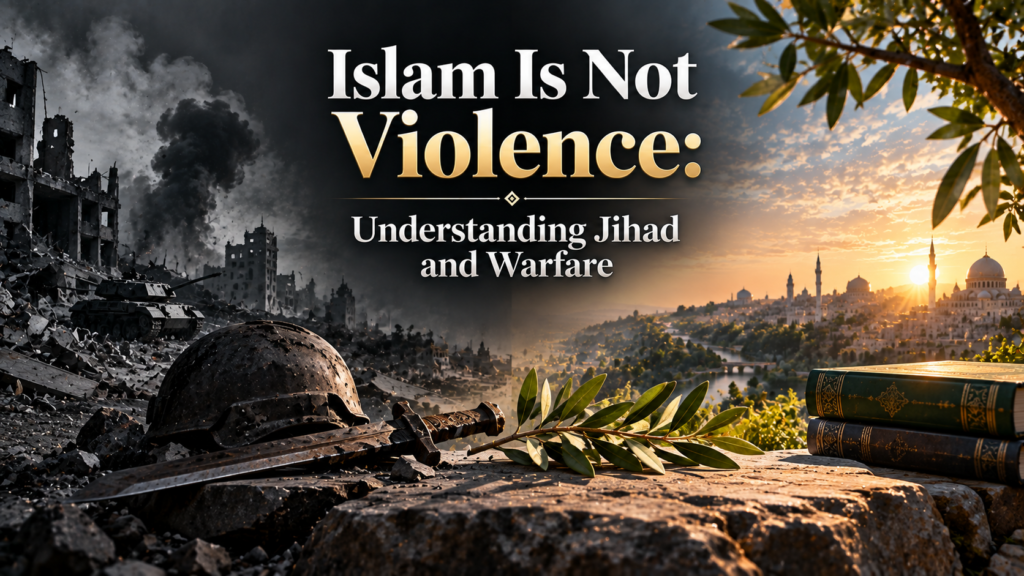
Few Islamic terms are as widely recognised and as frequently misunderstood as jihad.
For some, the word immediately produces images of war, weapons, violence and death. Acts of terrorism committed in the name of Islam have strengthened this association, while political conflicts have often used religious language to justify actions that require much deeper examination.
But a serious question must be asked:
Does jihad simply mean war?
If every reference to jihad is automatically interpreted as an instruction to fight or kill, then an important distinction has already been lost.
The Arabic word jihad carries the meaning of striving, exerting effort and struggling towards an objective. Armed struggle can enter the wider Islamic discussion of conflict, but warfare does not exhaust the meaning of jihad.
For SiHulk, the discussion must begin by separating concepts that are too often collapsed into one another.
Struggle is not automatically warfare.
Warfare is not automatically aggression.
And religious language does not automatically make violence righteous.
Understanding jihad therefore requires reason, context and responsibility.
Jihad Begins with Striving
The word jihad comes from an Arabic root associated with exertion, effort and striving.
This can already be seen in the Qur’an in contexts where jihad cannot simply mean armed warfare.
Allah says:
وَإِن جَاهَدَاكَ عَلَىٰ أَن تُشْرِكَ بِي مَا لَيْسَ لَكَ بِهِ عِلْمٌ فَلَا تُطِعْهُمَا
“But if they strive to make you associate with Me that of which you have no knowledge, then do not obey them…”
— Luqman 31:15
Here, the same root is used for parents striving or exerting pressure upon their child.
The verse is clearly not saying that the parents are conducting an armed war.
The meaning is effort, pressure and striving towards an objective.
This linguistic distinction matters because it prevents us from beginning with a false equation:
Jihad = war.
A more careful understanding begins with:
Jihad = striving or exerting effort.
The next question is therefore not merely:
“Is there jihad?”
It is:
“What is the person striving against, what are they striving for, and by what means?”
The Struggle Against the Self
One of the most immediate struggles experienced by every human being takes place within the human being.
Desire pulls.
Anger reacts.
Pride resists correction.
Greed wants more.
Jealousy compares.
Fear weakens resolve.
The ego wants recognition.
These forces do not require a battlefield to exist.
They are already present within us.
The Qur’an speaks directly about the nafs:
إِنَّ النَّفْسَ لَأَمَّارَةٌ بِالسُّوءِ إِلَّا مَا رَحِمَ رَبِّي
“Indeed, the soul is certainly prone to command evil, except those upon whom my Lord has mercy.”
— Yusuf 12:53
Elsewhere, the Qur’an connects success with restraining the self from its desires:
وَأَمَّا مَنْ خَافَ مَقَامَ رَبِّهِ وَنَهَى النَّفْسَ عَنِ الْهَوَىٰ فَإِنَّ الْجَنَّةَ هِيَ الْمَأْوَىٰ
“But as for the one who feared standing before his Lord and restrained the soul from desire, then Paradise will certainly be the refuge.”
— An-Nazi’at 79:40–41
This struggle is continuous.
A person may defeat another human being and still remain defeated by their own anger.
They may possess authority over thousands of people while having little authority over themselves.
They may speak about religion while remaining controlled by pride.
They may condemn the sins of others while being unable to recognise their own.
The struggle against the nafs therefore concerns something fundamental:
Can a human being govern themselves before attempting to govern others?
Jihad Through Wealth
Struggle is also connected with sacrifice.
The Qur’an repeatedly speaks of striving with wealth and oneself.
For example:
انْفِرُوا خِفَافًا وَثِقَالًا وَجَاهِدُوا بِأَمْوَالِكُمْ وَأَنفُسِكُمْ فِي سَبِيلِ الله
“Go forth, whether light or heavy, and strive with your wealth and yourselves in the way of Allah.”
— At-Tawbah 9:41
The presence of wealth is significant.
It demonstrates that jihad cannot be understood solely through the image of physical combat.
Wealth can become an object of attachment.
Human beings work to acquire it, protect it and increase it.
To surrender part of what one possesses for a greater purpose therefore requires struggle against selfishness, fear and attachment.
The Qur’an also says:
لَن تَنَالُوا الْبِرَّ حَتَّىٰ تُنفِقُوا مِمَّا تُحِبُّونَ
“You will never attain righteousness until you spend from that which you love.”
— Ali ‘Imran 3:92
Giving what is unwanted may be easy.
Giving what is loved reveals something deeper.
Sacrifice tests whether possessions are merely held by the hand or have begun to possess the heart.
For SiHulk, this is an important dimension of jihad:
Struggle against the nafs and sacrifice of wealth are connected.
Both challenge attachment to the self.
Warfare Requires Its Own Context
If jihad does not simply mean warfare, this does not mean that the Qur’an contains no discussion of armed conflict.
It clearly does.
But warfare must be read within its own language, circumstances and limits.
The Qur’an states:
وَقَاتِلُوا فِي سَبِيلِ الله الَّذِينَ يُقَاتِلُونَكُمْ وَلَا تَعْتَدُوا
“Fight in the way of Allah those who fight you, but do not transgress.”
— Al-Baqarah 2:190
Two elements appear together.
There is permission to fight.
But there is also a boundary:
Do not transgress.
The verse does not present violence as an unlimited religious licence.
The instruction itself contains restraint.
This distinction is essential.
The existence of warfare in Islam does not mean that Islam commands unrestricted violence.
Conflict has conditions.
Conduct has boundaries.
And the mere existence of an enemy does not remove moral responsibility.
Permission to Fight Came with Oppression
Another important passage appears in Surah Al-Hajj:
أُذِنَ لِلَّذِينَ يُقَاتَلُونَ بِأَنَّهُمْ ظُلِمُوا
“Permission to fight has been given to those who are being fought because they have been wronged…”
— Al-Hajj 22:39
The following verse speaks about people being driven from their homes unjustly.
This context matters.
The passage presents permission to fight alongside wrongdoing, persecution and expulsion.
It does not describe a community simply searching for people to attack because they hold another belief.
This is one reason context cannot be removed from verses concerning warfare.
If a verse revealed within persecution and conflict is extracted from that setting and converted into a universal instruction to attack anyone outside one’s community, the reader may radically change what the passage is addressing.
A text about conflict must be read as a text about conflict.
And its conditions must not be discarded.
Defence Is Not the Same as Aggression
Suppose someone attacks another person.
The victim protects themselves.
Both people may physically fight.
An observer who sees only the final moment might say:
“Both are violent.”
But that description is incomplete.
One initiated the aggression.
The other responded to it.
The physical action may appear similar, but the cause, intention and circumstances are different.
The same distinction matters when discussing warfare.
Defending life is not identical to attacking the innocent.
Protecting a community from aggression is not identical to initiating aggression.
Resisting expulsion is not identical to expelling others.
The Qur’anic prohibition:
“Do not transgress”
therefore remains crucial.
The question is not simply whether force occurred.
We must also ask:
Why did it occur?
Who initiated the aggression?
What conditions existed?
Who was targeted?
What limits were imposed?
Without these questions, moral judgment becomes shallow.
Even Conflict Has Limits
Islamic teachings concerning warfare do not make every human being on the opposing side a legitimate target.
In Sahih Muslim, ‘Abdullah ibn ‘Umar reported that a woman was found killed during one of the Prophet’s military expeditions, and the killing of women and children was disapproved of.
This is significant because it establishes a distinction between participation in conflict and mere presence within a population.
The existence of war does not erase all boundaries.
This principle is essential when religious language is used to justify indiscriminate killing.
If civilians can simply be killed because they belong to another society, ethnicity or religion, then the distinction between combatant and non-combatant disappears.
But the Prophetic reports preserve such distinctions.
Therefore:
Warfare does not suspend moral responsibility.
A person does not become righteous merely because they claim to act for religion.
Their conduct must still be examined.
The Qur’an Does Not Command Hostility Towards Everyone
Another important principle appears in Surah Al-Mumtahanah:
لَا يَنْهَاكُمُ الله عَنِ الَّذِينَ لَمْ يُقَاتِلُوكُمْ فِي الدِّينِ وَلَمْ يُخْرِجُوكُم مِّن دِيَارِكُمْ أَن تَبَرُّوهُمْ وَتُقْسِطُوا إِلَيْهِمْ
“Allah does not forbid you from dealing kindly and justly with those who have neither fought you because of religion nor driven you from your homes…”
— Al-Mumtahanah 60:8
This verse makes an important distinction.
People who do not fight you are not treated in the same manner as those who wage aggression against you.
The Qur’an explicitly leaves room for:
kindness and justice.
This makes indiscriminate hostility difficult to defend.
Difference of religion by itself does not automatically create a battlefield.
A neighbour does not become an enemy merely because they believe differently.
A colleague does not become a military opponent because they belong to another faith.
A peaceful society does not become a war zone merely because Muslims live among people with different beliefs.
Difference is not aggression.
And disagreement is not warfare.
Violence Committed in the Name of Islam Must Still Be Examined
History contains many examples of human beings using sacred language to justify political ambition, revenge, tribalism, conquest and violence.
Muslims are not exempt from the possibility of abusing religious language.
A person can shout religious words while acting from anger.
A group can use Islamic terminology while pursuing political power.
A movement can call something jihad while violating the boundaries established by the very sources it claims to defend.
Therefore, the phrase:
“This was done in the name of Islam”
does not by itself establish:
“Islam commanded this.”
The claim must be examined.
What text is being used?
What does the text say?
What was its context?
What conditions were attached to it?
What conduct did the Prophet Muhammad SAW permit or prohibit?
Religious vocabulary cannot substitute for evidence.
Jihad Must Not Become a Shortcut for Killing
The word jihad carries enormous emotional and historical weight.
For that reason, it must be used responsibly.
If jihad is casually translated as “holy war,” the listener may immediately assume that the essential meaning of the term is religious killing.
That is misleading.
The concept begins much more broadly with striving and exertion.
Depending upon context, that striving may concern the self, wealth, steadfastness, religious commitment or, in specific circumstances, armed struggle.
These contexts should not be collapsed into a single meaning.
Otherwise:
every struggle becomes war,
and
every war becomes sacred.
That is precisely the kind of confusion careful reading should prevent.
The More Immediate Battlefield
There is a temptation in religious discourse to focus upon enemies outside ourselves.
It is easier to identify another person as corrupt than to confront corruption within oneself.
It is easier to speak about defeating an enemy than to defeat arrogance.
It is easier to condemn greed in society than to sacrifice one’s own wealth.
It is easier to demand discipline from others than to discipline one’s own desires.
But the nafs accompanies the human being everywhere.
A person does not need to cross a border to encounter it.
They wake with it.
They work with it.
They pray with it.
They argue with it.
They carry it into their relationships.
They may even carry it into their religious practice.
The struggle against the nafs therefore cannot be treated as something minor.
A human being who cannot recognise the tyranny of their own ego may easily commit injustice while imagining themselves righteous.
This is why spiritual struggle and moral discipline cannot be separated from the wider understanding of jihad.
Strength Is Also Self-Control
The Prophet Muhammad SAW gave an important teaching concerning strength.
Abu Hurairah reported that the Prophet said that the strong person is not merely the one who overcomes others physically, but the one who controls himself when angry.
This shifts the meaning of strength.
Human beings often admire the person who can overpower another.
But Prophetic teaching directs attention inward.
Can you overpower your own anger?
Can you restrain yourself when you have the ability to retaliate?
Can you control the ego when it demands victory?
Can you remain just towards someone you dislike?
These questions reveal another form of struggle.
Sometimes the greater display of strength is not striking.
It is restraining the hand.
Sometimes courage is not shouting.
It is controlling anger.
Sometimes victory is not defeating another person.
It is refusing to allow the nafs to control what you become.
Jihad and Sacrifice
The two dimensions emphasised here—struggle against the nafs and sacrifice of wealth—share a common foundation.
Both require a person to surrender something the self wants to preserve.
The nafs wants its desires.
Jihad against the nafs requires restraint.
The self wants to possess.
Sacrifice requires giving.
The self wants recognition.
Sincerity requires acting without needing recognition.
The self wants victory.
Justice sometimes requires accepting restraint.
The self wants comfort.
Responsibility may require sacrifice.
Seen this way, jihad is not primarily a celebration of destruction.
It is a discipline of struggle.
The question is what is being struggled against, what is being sacrificed, and towards what purpose the effort is directed.
Islam Is Not Violence
Islam cannot be understood by selecting the existence of warfare from its sources and then defining the entire religion through that one reality.
The Qur’an discusses warfare because human societies experience conflict.
It also places boundaries around conflict.
It speaks about oppression.
It speaks about people being expelled from their homes.
It distinguishes those who fight from those who do not.
It commands justice.
It prohibits transgression.
And Islamic teaching also directs human attention towards the struggle within the self.
The proper conclusion is therefore not:
“Islam contains no concept of warfare.”
That would be inaccurate.
Nor should the conclusion be:
“Jihad means killing those who do not share our religion.”
That is also an unacceptable reduction.
A more careful understanding is:
Jihad is striving. Warfare is a specific matter with its own conditions and boundaries.
Where armed conflict occurs, its justification and conduct must be examined.
Where no aggression exists, religious difference alone cannot simply be converted into permission for violence.
And before a human being becomes preoccupied with defeating everyone outside themselves, there remains a struggle much closer to home:
the struggle against the self.
A person who sacrifices wealth, restrains desire, controls anger, resists arrogance and refuses injustice is engaged in a struggle that reaches directly into the formation of character.
The purpose is not to produce a human being eager to destroy.
The purpose is to produce a human being capable of governing the self before claiming authority over others.
References
1.Al-Qur’an, Surah Luqman, 31:15.
2.Al-Qur’an, Surah Yusuf, 12:53.
3.Al-Qur’an, Surah An-Nazi’at, 79:40–41.
4.Al-Qur’an, Surah At-Tawbah, 9:41.
5.Al-Qur’an, Surah Ali ‘Imran, 3:92.
6.Al-Qur’an, Surah Al-Baqarah, 2:190.
7.Al-Qur’an, Surah Al-Hajj, 22:39–40.
8.Al-Qur’an, Surah Al-Mumtahanah, 60:8.
9.Imam al-Bukhari, Sahih al-Bukhari, Kitab al-Jihad wa al-Siyar, Hadith no. 3015.
10.Imam Muslim, Sahih Muslim, Kitab al-Jihad wa al-Siyar, Hadith no. 1744b.
11.Imam al-Bukhari, Sahih al-Bukhari, Kitab al-Adab, Hadith no. 6114.
12.Imam Muslim, Sahih Muslim, Kitab al-Birr wa al-Silah wa al-Adab, Hadith no. 2609a.