
MUKADDIMAH · M50
CHAPTER 28 -THE SERVANT OF ALLAH — A SERVANT TO WHAT?
When the expression:
عَبْدُ اللَّهِ
‘ABDULLĀH
is mentioned, many people immediately imagine:
a servant
standing before
an unseen Master named Allah.
The relationship is then imagined as:
employer → employee
or:
master → servant
as two separate figures.
This is where we need to stop.
Because the previous chapters have established:
ALLAH IS NOT A FIGURE.
Allah is the explanation of:
ESSENCE + ATTRIBUTES + ACTIONS.
Therefore, ‘Abdullāh (عَبْدُ اللَّهِ) must not immediately be understood through an image of two figures.
⸻
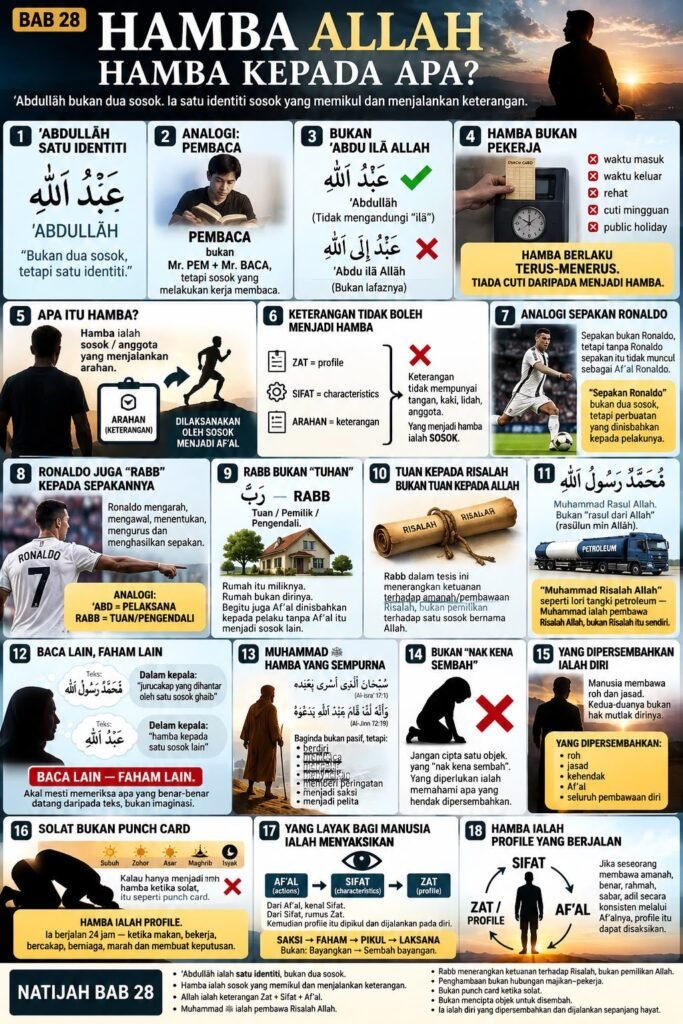
1. ‘ABDULLĀH IS ONE IDENTITY
Consider the Malay word:
PEMBACA — READER
Does it mean there are two entities:
“Mr. PEM”
and:
“Mr. BACA”?
No.
Pembaca is a single noun.
It refers to:
the individual who performs the act of reading.
“Baca” means the act of reading.
“Pembaca” identifies the individual who performs that action.
We should approach:
عَبْدُ اللَّهِ
in the same way.
Do not immediately divide it in your imagination into:
Mr. Servant
and:
Mr. Allah
and then construct a relationship between two figures.
Within the thesis of this chapter:
‘ABDULLĀH IS ONE IDENTITY.
⸻
2. NOT ‘ABDU ILĀ ALLAH
The misunderstanding becomes clearer when:
عَبْدُ اللَّهِ
is understood as though it means:
“a servant TO Allah.”
The mind then constructs a direction:
servant → towards → Allah
as though the expression were:
‘abdu ilā Allāh
Yet the expression:
عَبْدُ اللَّهِ
does not contain:
إِلَى — ilā — towards
Therefore, do not mentally insert “towards” and then use that addition to construct two figures.
First, read what is actually there.
⸻
3. A SERVANT IS NOT AN EMPLOYEE
One source of confusion is understanding servitude through the model of employment.
An employee has:
an employer,
a starting time,
a finishing time,
breaks,
weekly days off,
public holidays,
a punch card.
A servant is not like that.
If someone only becomes a “servant” during:
Fajr,
Dhuhr,
Asr,
Maghrib,
Isha,
and then returns to carrying a different profile outside those times—
that begins to resemble a work schedule.
As though someone:
punches in during prayer
and punches out after the salam. 😜
But the profile of a servant has no rest day.
SERVITUDE IS CONTINUOUS.
⸻
4. WHAT IS A SERVANT?
To understand a servant, do not begin by asking, “Who is the Master?”
Begin with function.
A servant is:
THE INDIVIDUAL / INSTRUMENT THAT CARRIES OUT INSTRUCTIONS.
An instruction is not a figure.
An instruction is:
AN EXPLANATION.
For example:
“Raise your hand.”
That instruction is not the hand.
The instruction is not the human being.
It is an explanation.
Then:
the hand moves.
Only then does the instruction become:
AF‘AL — ACTION.
Therefore:
EXPLANATION → CARRIED OUT BY THE INDIVIDUAL → BECOMES ACTION
⸻
5. AN EXPLANATION CANNOT BECOME A SERVANT
This is important.
Essence is a profile/explanation.
Attributes are characteristics/explanations.
Instructions are explanations.
An explanation does not possess:
hands,
feet,
a tongue,
limbs.
Therefore, an explanation does not become a servant.
The one who becomes the servant is:
THE INDIVIDUAL WHO CARRIES AND EXECUTES THE EXPLANATION.
This is where the physical body has its function.
The individual becomes the means through which:
the profile is carried,
attributes are manifested,
actions are performed.
⸻
6. SERVITUDE CAN BE UNDERSTOOD THROUGH THE ANALOGY OF A KICK
Consider Cristiano Ronaldo.
Ronaldo performs:
A KICK.
The kick is not Ronaldo.
But without Ronaldo as the doer, that kick would not appear as Ronaldo’s action.
We can say:
“Ronaldo’s kick.”
This does not produce two figures:
Mr. Ronaldo
and:
Mr. Kick.
The kick is an action attributed to its doer.
From the perspective of performing the action, Ronaldo is the individual who executes the kick.
Within the philosophical analogy of this chapter, this illustrates the functional aspect of:
‘ABD.
⸻
7. RONALDO IS ALSO THE “RABB” OF HIS KICK IN THIS ANALOGY
Now consider another perspective.
The kick does not control Ronaldo.
It is Ronaldo who:
directs,
controls,
determines,
manages,
and produces the kick.
Therefore, within the analogy of this chapter, from the perspective of control and direction:
RONALDO = RABB OF HIS KICK.
This is not a literal Arabic definition of every usage of Rabb (رَبّ).
It is an analogy used to distinguish two functions:
‘ABD → the executor
RABB → the Master/controller of what is carried or performed
One individual can be understood from two functional perspectives.
⸻
8. RABB IS NOT “GOD”
Chapter 17 established that:
رَبّ — RABB
must not automatically be reduced to:
“God”.
Rabb means:
MASTER / OWNER / CONTROLLER.
But “Master” does not necessarily mean an employer.
For example:
A house belongs to someone.
The house is not that person.
Land belongs to someone.
The land is not that person.
Likewise, an action can be attributed to its doer without that action becoming another figure.
⸻
9. MASTER OF ALLAH’S RISALAH — NOT MASTER OF ALLAH
This distinction must be maintained carefully.
Do not say:
“Master of Allah.”
Because that could create the impression that Allah is an object being owned.
The more precise expression within this thesis is:
MASTER OF ALLAH’S RISALAH.
The Risalah is something that is:
shouldered,
carried,
protected,
managed,
and manifested.
Therefore, when discussing the position of the bearer, Rabb explains mastery over the responsibility of carrying the Risalah, not ownership of a figure named Allah.
⸻
10. مُحَمَّدٌ رَسُولُ اللَّهِ
Now consider the declaration:
مُحَمَّدٌ رَسُولُ اللَّهِ
Muhammad Rasul Allah.
The wording is not:
رَسُولٌ مِنَ اللَّهِ
“A messenger from Allah.”
In the text:
رَسُولُ اللَّهِ
expresses a direct relationship.
Within the functional explanation presented in this book:
MUHAMMAD ﷺ IS THE BEARER OF ALLAH’S RISALAH.
The shortened expression:
Muhammad Risalah Allah
can be understood like:
a petroleum tanker
meaning:
a tanker that carries petroleum.
The tanker is not petroleum.
But the expression identifies what the tanker carries.
Therefore:
Muhammad ﷺ is not the Risalah as though they were the same object.
Rather:
HE IS THE BEARER OF ALLAH’S RISALAH.
⸻
11. READING IS ONE THING, UNDERSTANDING IS ANOTHER
This is a problem of language that must be recognised.
The text states:
مُحَمَّدٌ رَسُولُ اللَّهِ
But the reader’s mind introduces:
“Muhammad is a spokesperson sent by an unseen figure named Allah.”
That additional image does not necessarily come from the wording itself.
It comes from the reader’s frame of understanding.
Likewise:
عَبْدُ اللَّهِ
is read as one expression,
but understood as:
“a servant who submits to another figure.”
Once again:
WHAT IS READ IS ONE THING — WHAT IS UNDERSTOOD IS ANOTHER.
That is why reason must examine what actually comes from the text and what has been introduced by imagination.
⸻
12. THE SERVANT OF ALLAH IS NOT AN EMPLOYER–EMPLOYEE RELATIONSHIP
Within the thesis of this chapter:
‘ABDULLĀH
is one identity referring to an individual who:
carries a profile,
bears characteristics,
and manifests actions.
Using the terminology of Chapter 27:
Essence = Profile
Attributes = Characteristics
Af‘al = Actions
It is the individual who carries all three.
Therefore, a servant is the individual who executes the explanation, not an employee who comes to serve an unseen employer for a few hours.
⸻
13. MUHAMMAD ﷺ — THE PERFECT SERVANT IN CARRYING THE RISALAH
The Quran states:
سُبْحَانَ الَّذِي أَسْرَىٰ بِعَبْدِهِ
— Al-Isra’ 17:1
The Prophet is described as:
بِعَبْدِهِ
His servant.
Al-Jinn 72:19 also states:
وَأَنَّهُ لَمَّا قَامَ عَبْدُ اللَّهِ يَدْعُوهُ
The position of a servant is not passive.
The Prophet ﷺ:
stood,
recited,
taught,
purified,
warned,
bore witness,
became a lamp.
A servant acts.
A servant carries out instructions.
A servant manifests the explanation through actions.
⸻
14. A SERVANT DOES NOT MEAN “SOMEONE MUST WANT TO BE WORSHIPPED”
When the word:
servant
is mentioned, many people immediately introduce another assumption:
“If there is a servant, there must be someone who wants to be worshipped.”
Servitude is then immediately transformed into a relationship between:
a worshipper
and:
an object of worship.
Once again, two figures emerge.
This chapter questions that frame.
What is required is not to create an object that “wants to be worshipped”.
What is required is to understand:
WHAT IS MEANT TO BE PRESENTED?
⸻
15. WHAT IS PRESENTED IS THE SELF
Human beings carry:
the Ruh
and:
the physical body.
But neither belongs to them absolutely.
In the language of servitude, what must be returned is:
THE SELF.
Not a gift for an unseen figure.
Not food.
Not money.
Not ritual movements as “payment”.
But:
the Ruh,
the physical body,
the will,
the actions,
the entire manifestation of the self.
The self is presented back to the path of the explanation it carries.
⸻
16. PRAYER IS NOT A PUNCH CARD OF SERVITUDE
This will be explored in greater detail in Chapter 29.
But the principle can already be understood.
If someone considers themselves a servant only during prayer, they have turned prayer into a:
PUNCH CARD.
Clock in.
Perform the movements.
Complete the salam.
Clock out.
Yet:
SERVITUDE IS A PROFILE.
It operates:
24 hours a day.
While eating.
While working.
While speaking.
While conducting business.
While angry.
While making decisions.
If the profile changes as soon as someone leaves the prayer row, servitude has not yet become part of that person’s profile.
⸻
17. THE PROPER ROLE OF HUMAN BEINGS IS TO WITNESS
Human beings are not being asked to construct a figure to whom worship can be presented.
Within the framework of this book, the human task is:
TO WITNESS.
Witness:
Actions.
From Actions, recognise:
Attributes.
From Attributes, understand:
Essence/Profile.
Then carry and manifest that profile within the self.
Therefore, servitude follows:
WITNESS → UNDERSTAND → CARRY → ACT
Not:
IMAGINE → WORSHIP THE IMAGINATION.
⸻
18. A SERVANT IS A PROFILE IN ACTION
Ultimately, a servant is not merely a title attached to someone.
It is a living profile.
If someone consistently manifests:
trustworthiness,
truthfulness,
compassion,
patience,
justice,
through their actions, that profile becomes observable.
Once again, the method established in Chapter 27 applies:
ACTIONS → ATTRIBUTES → ESSENCE / PROFILE.
And once the profile has been established:
ESSENCE / PROFILE → ATTRIBUTES → ACTIONS.
Servitude becomes a continuous cycle of life.
⸻
THE OUTCOME
The mistake begins when:
عَبْدُ اللَّهِ
is interpreted as two figures:
a servant
and:
Allah
and their relationship is then imagined as that of an employer and an employee.
Within the thesis of this chapter:
‘ABDULLĀH IS ONE IDENTITY.
Just like:
PEMBACA — READER
does not mean:
Mr. PEM + Mr. BACA.
A servant is:
THE INDIVIDUAL WHO CARRIES AND EXECUTES THE EXPLANATION.
Allah is:
THE EXPLANATION OF ESSENCE + ATTRIBUTES + ACTIONS.
Muhammad ﷺ is:
THE BEARER OF ALLAH’S RISALAH.
And from the perspective of responsibility for carrying it:
THE MASTER OF ALLAH’S RISALAH.
Therefore, servitude is not a relationship between two figures.
Not shift work.
Not a punch card during prayer.
Not the creation of an object to be worshipped.
It is:
THE PRESENTATION OF THE SELF.
The Ruh and the physical body are not absolute possessions to be used however one wishes.
What is required is to witness the explanation, carry it and manifest it through actions.
A SERVANT IS NOT A TITLE.
A SERVANT IS THE INDIVIDUAL WHO PUTS THE PROFILE INTO ACTION.
And when it truly becomes a profile:
THERE ARE NO DAYS OFF FROM BEING A SERVANT.