
MUKADDIMAH · M45
Chapter 23 — Ummī: Not Reading Does Not Mean Being Unable to Read
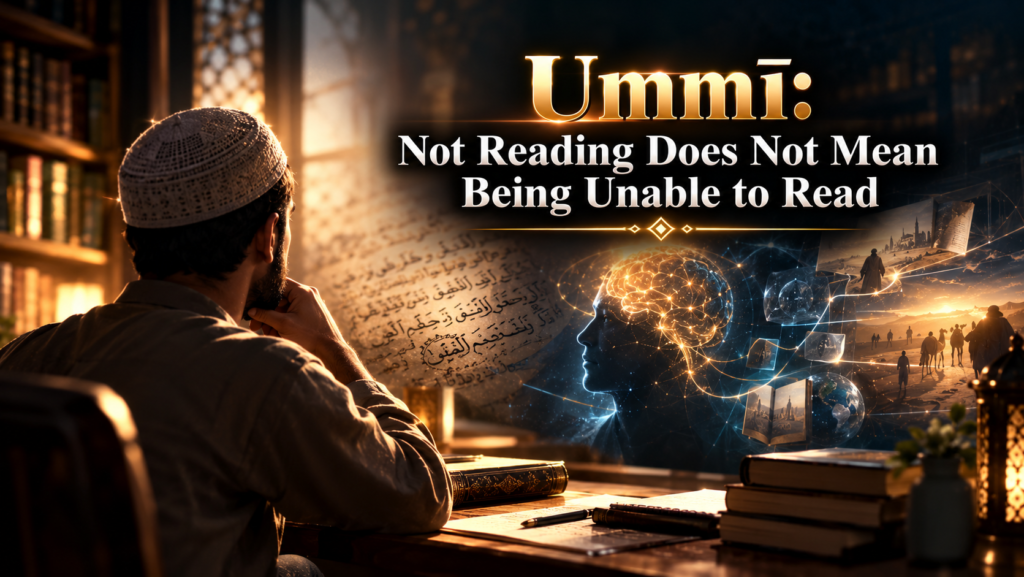
When “not reading” becomes “being unable to read”
One of the longest-standing descriptions associated with Prophet Muhammad ﷺ is that he was “illiterate” — unable to read or write.
This understanding is usually built upon the term:
النَّبِيَّ الْأُمِّيَّ
Al-Nabiyy al-Ummī
And several revealed texts explaining that the Prophet ﷺ did not read previous scriptures or write them with his own hand.
Yet one fundamental question is rarely asked:
Is “not reading” the same as “being unable to read”?
No.
Someone who does not perform an action is not necessarily incapable of performing it.
Not eating ≠ being unable to eat.
Not speaking ≠ being unable to speak.
Not writing ≠ necessarily not knowing how to write.
Not reading ≠ necessarily not knowing how to read.
This distinction may appear small, but its implications are enormous when applied to the word Ummī.
⸻
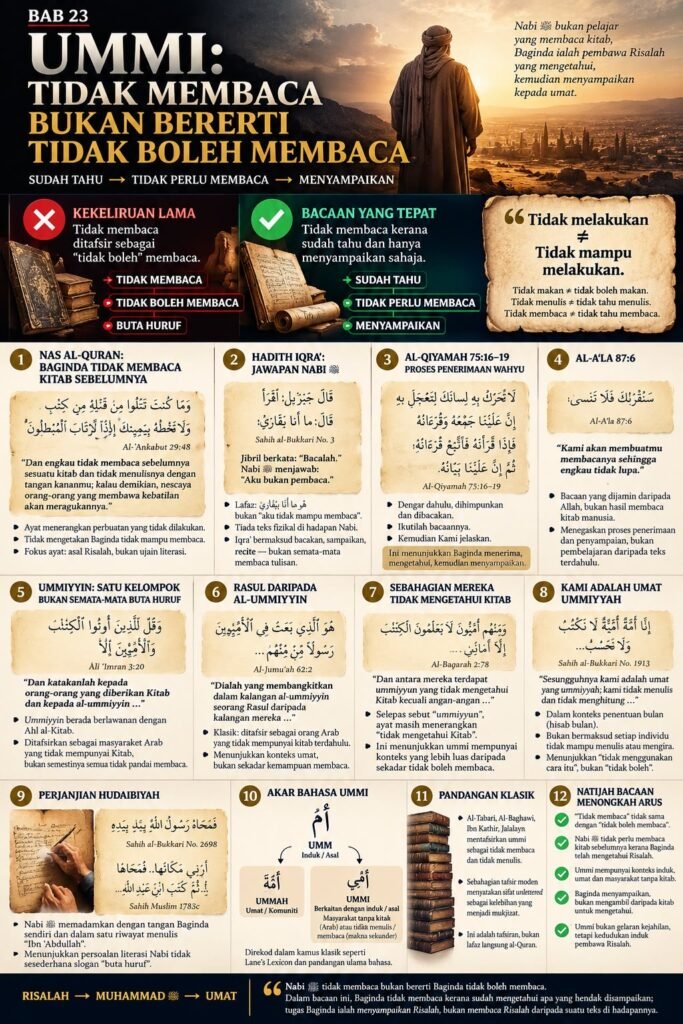
1. WHAT DOES THE QURAN ACTUALLY SAY?
The most important verse is Al-‘Ankabut 29:48:
وَمَا كُنتَ تَتْلُوا۟ مِن قَبْلِهِۦ مِن كِتَـٰبٍۢ وَلَا تَخُطُّهُۥ بِيَمِينِكَ ۖ إِذًۭا لَّٱرْتَابَ ٱلْمُبْطِلُونَ
“And you did not previously recite any scripture, nor did you write it with your right hand. Otherwise, those who follow falsehood would have had reason to doubt.”
Notice the structure of the verse.
The Quran states:
وَمَا كُنتَ تَتْلُوا
You did not read.
And:
وَلَا تَخُطُّهُ بِيَمِينِكَ
You did not write it with your right hand.
The verse does not state:
لَا تَسْتَطِيعُ أَنْ تَقْرَأَ
You are unable to read.
Nor does it state:
لَا تَعْرِفُ الْقِرَاءَةَ
You do not know how to read.
What is described is an action that was not performed, particularly before the revelation of the Quran.
The reason is then given:
إِذًا لَّارْتَابَ الْمُبْطِلُونَ
If the Prophet ﷺ had previously been known to read earlier scriptures or copy them, those who rejected the Risalah could have claimed that the message he conveyed was merely copied from earlier sources.
Therefore, the focus of the verse is the origin of the Risalah, not a test of the Prophet’s literacy.
⸻
2. CLASSICAL INTERPRETATIONS OF 29:48
This is where an interpretive development occurred.
Al-Tabari explains:
تَتْلُو يعني تقرأ
Meaning that tatlū means to read.
He subsequently understands the Prophet ﷺ as Ummī, someone who did not read earlier scriptures or write them.
Al-Baghawi also states that before revelation, the Prophet ﷺ did not read or write.
Ibn Kathir goes further by explaining that the Prophet’s community knew him as an Ummī who neither read nor wrote.
Jalalayn similarly interprets the verse on the assumption that if the Prophet had been a reader and writer, those who rejected him would have had grounds to question the Risalah.
Therefore, we must be fair.
Classical interpretations have predominantly understood Ummī to mean that the Prophet did not know how to read or write.
There is no need to conceal this fact.
But we must also ask:
Is that the Quran’s direct wording, or a conclusion drawn from its wording?
The answer is that it is an interpretation.
The actual text of 29:48 states that the Prophet ﷺ did not read previous scriptures or write them with his right hand.
From this, commentators developed a conclusion about his ability:
Not reading → not knowing how to read.
This is where the present chapter reopens the question.
⸻
3. “NOT DOING” IS NOT THE SAME AS “BEING UNABLE”
This is a very simple principle of logic.
If someone says:
“I did not read that letter.”
We cannot immediately conclude:
“He does not know how to read.”
If someone says:
“I did not write that document.”
We cannot immediately say:
“He is illiterate.”
The first statement describes ACTIONS — what someone did or did not do.
The second makes a conclusion about ATTRIBUTES — that individual’s ability.
They are not the same.
Therefore:
وَمَا كُنتَ تَتْلُوا
Can be understood exactly as the text states:
“You did not previously read any scripture.”
Without adding:
“Because you were unable to read.”
That addition comes from human interpretation, not from the literal structure of the verse.
⸻
4. THE HADITH OF IQRA’: WHAT DID THE PROPHET ACTUALLY ANSWER?
The Hadith describing the beginning of revelation is extremely important.
In Sahih al-Bukhari no. 3, Jibril said to the Prophet ﷺ:
اقْرَأْ
“Read.”
The Prophet ﷺ replied:
مَا أَنَا بِقَارِئٍ
This phrase is frequently translated as:
“I do not know how to read.”
But the Arabic text does not use the words:
لَا أَسْتَطِيعُ الْقِرَاءَةَ
“I am unable to read.”
The actual wording is:
مَا أَنَا بِقَارِئٍ
Which, in its structure, may convey meanings such as:
“I am not a reader.”
Or, within the context of the question:
“What should I read?”
Indeed, translations of the Hadith sometimes acknowledge both possibilities:
“I do not know how to read (or what shall I read?).”
Jibril then conveyed:
اقْرَأْ بِاسْمِ رَبِّكَ الَّذِي خَلَقَ
“Read in the name of your Lord who created.”
— Al-‘Alaq 96:1
This raises a logical question.
If iqra’ is understood solely as an instruction to look at letters in a physical text, where was the text placed before the Prophet ﷺ for him to read?
The Hadith does not describe Jibril opening a book and pointing to letters for the Prophet to read.
Instead, the content was conveyed, the Prophet received it, and then he conveyed it to others.
Therefore, iqra’ has a much broader relationship with reading aloud, conveying and reciting, rather than merely using one’s eyes to read written words on paper.
⸻
5. THE PROPHET RECEIVED, UNDERSTOOD AND THEN CONVEYED
The Quran itself explains this process in Al-Qiyamah 75:16–19:
لَا تُحَرِّكْ بِهِۦ لِسَانَكَ لِتَعْجَلَ بِهِۦ
“Do not move your tongue with it in haste.”
إِنَّ عَلَيْنَا جَمْعَهُۥ وَقُرْءَانَهُۥ
“Indeed, upon Us rests its collection and recitation.”
فَإِذَا قَرَأْنَـٰهُ فَٱتَّبِعْ قُرْءَانَهُۥ
“So when We recite it, follow its recitation.”
ثُمَّ إِنَّ عَلَيْنَا بَيَانَهُۥ
“Then upon Us rests its explanation.”
The Hadith of Ibn ‘Abbas in Sahih al-Bukhari no. 5, also narrated in reports 4928, 4929 and 5044, explains that the Prophet ﷺ initially moved his tongue in an effort to follow the revelation quickly.
He was then instructed to listen first. Once the revelation had been conveyed, he recited it as he had received it.
Notice the sequence:
RECEIVED → COLLECTED → UNDERSTOOD → RECITED/CONVEYED.
Not:
LOOKED AT TEXT → SPELLED OUT LETTERS → THEN UNDERSTOOD.
Al-A‘la 87:6 also states:
سَنُقْرِئُكَ فَلَا تَنسَىٰٓ
“We shall make you recite, and you will not forget.”
This is extremely important to the interpretation presented in this chapter.
The Prophet ﷺ did not depend on a book placed before him to know the content of the Risalah.
He had already received and understood what he was to convey.
Therefore, he conveyed the message rather than acquiring knowledge by reading previous scriptures.
⸻
6. UMMĪ DOES NOT NECESSARILY MEAN “ILLITERATE”
The Quran uses the word ummiyyīn not only in reference to the Prophet as an individual.
Ali ‘Imran 3:20 mentions two groups:
وَقُل لِّلَّذِينَ أُوتُوا۟ ٱلْكِتَـٰبَ وَٱلْأُمِّيِّـۧنَ
“And say to those who were given the Scripture and to the ummiyyīn…”
Here, ummiyyīn is contrasted with:
الَّذِينَ أُوتُوا الْكِتَابَ
Those who were given the Scripture.
Al-Tabari himself explains one meaning of ummiyyīn in this verse as those who did not possess a Scripture, particularly the Arabs who were not among the People of the Book.
This is important.
If ummiyyīn meant only “everyone who cannot read”, the distinction between the People of the Book and the ummiyyīn would become less precise.
Some among the People of the Book could not read.
And there were certainly Arabs outside the People of the Book who could write.
Therefore, the word carries layers of meaning concerning collective identity, origin, community and relationship with Scripture, rather than merely the ability to recognise written letters.
⸻
7. AL-JUMU‘AH 62:2 — A MESSENGER FROM AMONG THE UMMIYYĪN
The Quran states:
هُوَ ٱلَّذِى بَعَثَ فِى ٱلْأُمِّيِّـۧنَ رَسُولًۭا مِّنْهُمْ
“He is the One who raised among the ummiyyīn a Messenger from among themselves…”
— Al-Jumu‘ah 62:2
Al-Tabari records several classical explanations.
Mujahid interprets the term as referring to the Arabs.
Qatadah describes the Arabs as a community without a Scripture that they read.
Ibn Zayd connects the term with a community to whom no previous scripture had been revealed.
Once again, this demonstrates that Ummī has a broader range of meaning than the personal label:
“A human being who is unable to read.”
It has a relationship with:
UMMAH — أُمَّة
And, at the level of its linguistic root, with:
UMM — أُمّ
Meaning the mother, original source and point of reference.
⸻
8. THE ARABIC LANGUAGE ITSELF PRESERVES THE CONNECTION WITH UMM AND UMMAH
Classical dictionaries and lexical studies record several explanations concerning the origin of the word Ummī.
Among them are:
1. Its association with ummah — a nation or community without an earlier scripture.
2. Its association with umm — mother; a person remaining in their original condition as when born from their mother.
3. Its later use for someone who had not acquired the skills of writing or reading.
Lane’s Lexicon records this range of meanings, from associations with the Arab nation and communities without scripture to its secondary use for someone who does not write or read.
Ibn al-Jawzi also records views connecting the term either to ummah or to umm, referring to a person’s original condition as when born from their mother.
Therefore, the connection with umm and ummah is not something invented today.
What must be questioned is:
Why, from this entire spectrum of meanings, did one meaning alone — “illiterate” — eventually become the almost absolute definition applied to the Prophet ﷺ?
⸻
9. AL-BAQARAH 2:78 OFFERS ANOTHER CLUE
The Quran states concerning a group of people:
وَمِنْهُمْ أُمِّيُّونَ لَا يَعْلَمُونَ ٱلْكِتَـٰبَ إِلَّآ أَمَانِىَّ
“And among them are ummiyyūn who do not know the Scripture except through wishful assumptions…”
— Al-Baqarah 2:78
Notice that after mentioning ummiyyūn, the verse still explains:
لَا يَعْلَمُونَ الْكِتَابَ
“They do not know the Scripture.”
This raises a question.
If ummiyyūn already inherently meant “people who cannot read”, why is their condition in relation to the Scripture explained further?
At the very least, this verse indicates that the term Ummī has a more complex context than the single technical translation “illiterate”.
⸻
10. “WE ARE AN UMMIYYAH COMMUNITY”
A particularly important Hadith appears in Sahih al-Bukhari no. 1913:
إِنَّا أُمَّةٌ أُمِّيَّةٌ لَا نَكْتُبُ وَلَا نَحْسُبُ
“Indeed, we are an ummiyyah community; we do not write or calculate…”
This Hadith concerns determining the lunar month, which may consist of either 29 or 30 days.
It is often used to support the interpretation of Ummī as “illiterate”.
However, notice its structure.
The Prophet ﷺ did not simply say:
إِنَّا أُمَّةٌ أُمِّيَّةٌ
He then explained its practical context:
لَا نَكْتُبُ وَلَا نَحْسُبُ
“We do not write or calculate [for determining the month].”
Yet history itself shows that there were writers among the Companions, including scribes who recorded revelation.
Therefore, it cannot reasonably mean that every member of the Muslim community at that time was absolutely incapable of writing or calculating.
The Hadith describes how that system operated, particularly in determining the month, rather than establishing that every Arab individual lacked the intellectual ability to read, write or calculate.
Once again:
“We do not use that method” is not the same as “we are incapable of using that method.”
⸻
11. THE TREATY OF HUDAYBIYAH — EVIDENCE THAT CANNOT BE IGNORED
The incident at Hudaybiyah is also significant.
Sahih al-Bukhari no. 2698 narrates that ‘Ali wrote the treaty. When the polytheists objected to the phrase “Muhammad, the Messenger of Allah”, the Prophet ﷺ asked ‘Ali to erase it.
‘Ali refused.
The narration states:
فَمَحَاهُ رَسُولُ اللَّهِ ﷺ بِيَدِهِ
“The Messenger of Allah ﷺ erased it with his own hand.”
Sahih Muslim 1783c provides a more detailed account.
The Prophet ﷺ requested:
أَرِنِي مَكَانَهَا
“Show me where it is.”
He then erased the words, and the narration continues that “Ibn ‘Abdullah” was written.
We do not need to exaggerate this narration by claiming that it alone proves the Prophet was a professional writer.
It does not necessarily prove that.
But it does demonstrate that the question of the Prophet’s literacy is not as simple as a one-line slogan.
The revealed texts must be read alongside the full body of evidence, rather than after the conclusion of “illiteracy” has already been decided.
⸻
12. SO WHAT DOES UMMĪ MEAN IN THIS INTERPRETATION?
Within the Menongkah Arus approach, we return to the root:
أُمّ — UMM — ORIGINAL SOURCE
From this emerges the relationship:
UMMĪ → UMMAH
Ummī is the original source or origin profile.
Ummah refers to those who come from, follow and acknowledge that original source.
Therefore, when Prophet Muhammad ﷺ is described as:
النَّبِيَّ الْأُمِّيَّ
We do not stop at:
“The illiterate Prophet.”
We interpret Ummī as a description of his position as the original source and bearer of the Risalah for the Ummah formed through that Risalah.
This is the interpretive approach of this project, not a claim that all classical commentators understood the term in this way.
On the contrary, we have already seen that the majority of classical interpretations favoured the meaning of not knowing how to read or write.
Our disagreement concerns the following conclusion:
They transformed the description “did not read” into the attribute “could not read”.
We do not consider that the revealed text requires such a leap.
⸻
13. THE PROPHET DID NOT NEED TO READ A BOOK TO KNOW THE RISALAH
This is the greater point.
Prophet Muhammad ﷺ was not a student sitting before a book and acquiring the Risalah by reading it.
He was the bearer of the Risalah.
The information did not reach him because he discovered a manuscript and read it.
Instead, the Risalah was conveyed to him, gathered, made understood and then communicated.
The Quran itself states:
سَنُقْرِئُكَ فَلَا تَنسَىٰ
“We shall make you recite, and you will not forget.”
— Al-A‘la 87:6
And:
إِنَّ عَلَيْنَا جَمْعَهُ وَقُرْآنَهُ
“Upon Us rests its collection and recitation.”
— Al-Qiyamah 75:17
Therefore, the sequence is:
RISALAH → MUHAMMAD ﷺ → UMMAH
Not:
BOOK PLACED BEFORE HIM → MUHAMMAD READS → ONLY THEN KNOWS.
He knew because the Risalah had been conveyed to him.
After knowing, he communicated it.
Therefore:
ALREADY KNOWS → DOES NOT NEED TO READ FROM A BOOK → CONVEYS
Not:
DOES NOT READ → CANNOT READ → ILLITERATE
⸻
14. TEXT IS CODE — MUHAMMAD ﷺ MANIFESTS THE CODE
This brings us back to the methodology of the entire book:
TEXT = CODE
MEANING/APPLICATION = THE RESULT OF THE APP
The Mushaf preserves the text.
But Prophet Muhammad ﷺ was not someone who merely read that text aloud to people like a person reading a book.
He carried, explained and manifested the Risalah through himself and his actions.
Al-Jumu‘ah 62:2 outlines the Messenger’s responsibilities:
يَتْلُوا۟ عَلَيْهِمْ ءَايَـٰتِهِۦ
Reciting His verses to them.
وَيُزَكِّيهِمْ
Purifying them.
وَيُعَلِّمُهُمُ ٱلْكِتَـٰبَ وَٱلْحِكْمَةَ
Teaching them the Book and Wisdom.
He was not merely a reader.
He was a teacher, bearer, demonstrator and upholder of the Risalah.
If he merely read letters, how could he teach Wisdom?
This is where reading must progress from sound to understanding, and from understanding to manifestation in life.
⸻
15. UMMĪ IS NOT A DEFICIENCY
The classical position attempts to address this issue by saying:
“The Prophet truly could not read or write, but that inability itself became a miracle because someone without formal learning was able to convey the Quran.”
Some modern interpretations continuing the classical tradition even state that being unlettered, normally considered a deficiency in an ordinary person, became an advantage for the Prophet because it demonstrated that the Quran did not originate from human education.
Our interpretation takes a different approach.
We do not need to turn an inability into a miracle.
The miracle is already clear:
He did not obtain the Risalah from human scriptures.
He did not read the Torah, the Gospel or other manuscripts and then produce the Quran from them.
That is the issue addressed by 29:48.
Its source was not a library.
Its source was not a human teacher.
Its source was the Risalah received and subsequently conveyed by the Prophet ﷺ.
⸻
16. THE GREAT MISTAKE: FROM ACTIONS TO ATTRIBUTES
The methodological error can be summarised very simply.
The revealed text states:
He DID NOT READ previous scriptures.
That describes ACTIONS.
Then people transform it into:
He COULD NOT READ.
That describes ATTRIBUTES.
Then the inferred attribute becomes the definition:
UMMĪ = ILLITERATE.
After that, every other revealed text is interpreted through that definition.
Eventually, a human conclusion is placed before the text itself.
Yet our method is:
THE ORIGINAL TEXT FIRST.
Then:
language → structure → logic → application → witnessing.
Do not insert a conclusion into the text before allowing the text to speak for itself.
⸻
17. THEREFORE, “IQRA’” MUST ALSO BE RE-EXAMINED
When Jibril said:
اقْرَأْ
It did not necessarily mean:
“Look at this writing and spell out its letters.”
The Quran uses the concept of qira’ah as a process of recitation and communication.
The Prophet received the code.
The Prophet understood.
The Prophet conveyed.
Then the Ummah listened, understood and put it into practice.
That is why the Quran is not a competition to see who can produce the greatest number of sounds from the Mushaf.
Recitation must produce meaning that becomes alive.
If the sounds are heard but the code remains unopened, the application does not run.
⸻
18. THE OUTCOME
This chapter does not deny that classical interpretations have overwhelmingly understood Ummī as someone who did not know how to read or write.
That is a historical fact concerning Quranic interpretation.
But we distinguish between:
what the ORIGINAL TEXT states
and
what INTERPRETATION concludes.
The text of 29:48 states:
The Prophet did not read previous scriptures.
The text does not state:
The Prophet was unable to read.
The wording of the Hadith is:
مَا أَنَا بِقَارِئٍ
Not the technical expression:
“I am an illiterate person.”
The Quran also uses ummiyyīn for groups of people and distinguishes them from the People of the Book, showing that the term carries contexts involving nationality, community and relationship with Scripture, rather than merely reading ability.
Its linguistic root also opens a connection to:
UMM — ORIGINAL SOURCE
UMMAH — COMMUNITY
UMMĪ — ONE CONNECTED TO THE ORIGINAL SOURCE / ORIGIN
Therefore, within the framework of witnessing developed in this book:
UMMĪ IS NOT A TITLE OF IGNORANCE.
It describes the position of the original source.
Prophet Muhammad ﷺ did not need to read previous scriptures to know the Risalah because he himself was the bearer of the Risalah who would teach that Book to humanity.
He did not acquire knowledge by reading from a book.
He knew and then conveyed.
And humanity subsequently received it from him.
Therefore, the sequence is not:
BOOK → MUHAMMAD
But:
RISALAH → MUHAMMAD ﷺ → UMMAH
This is the difference between someone who reads information
and
someone who carries information.
And for this reason, the term Ummī must be reconsidered, moving beyond the label “illiterate” towards a much greater question:
WHO IS THE ORIGINAL SOURCE FROM WHICH THE UMMAH EMERGES?
The answer brings us back to Prophet Muhammad ﷺ — the bearer and upholder of the original Risalah.