
ISLAM
Ummiy and Ummah: The Bond with the Source That Is Not Severed by the Source, but Can Be Betrayed by the Ummah
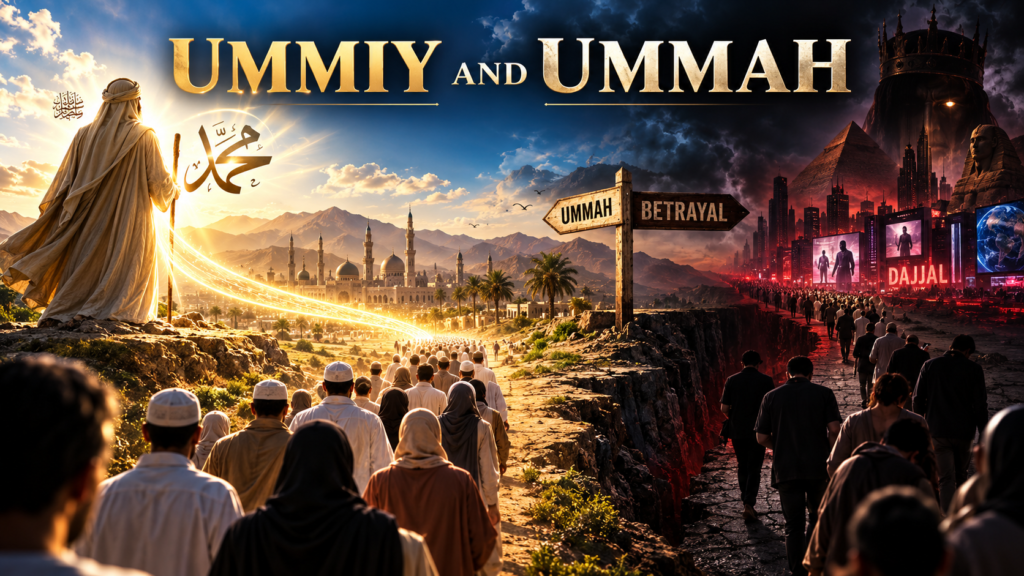
There is a profoundly significant relationship that is often treated too lightly:
أُمِّيّ — Ummiy
and
أُمَّة — Ummah
In the interpretation we are developing, these are not merely two words that happen to sound similar.
They point to a relationship:
source → community
origin → those who remain attached to that origin
the original bearer of the Message → those who receive and continue the Message
The Quran refers to Prophet Muhammad ﷺ as:
النَّبِيَّ الْأُمِّيَّ
“al-Nabi al-Ummiy”
— Al-A‘raf 7:157–158
In mainstream Quranic exegesis, أُمِّيّ has a broad range of explanations and is commonly associated with not reading or writing, or not having received a previous scripture. But in the conceptual interpretation we are developing, attention is given to its relationship with:
أُمّ — umm
which carries the meaning of mother, origin or source.
From this arises a major question:
If there is an Ummiy, who is his Ummah?
⸻
ADAM IS THE ORIGIN OF HUMANITY, NOT THE SOURCE OF ALL THE WORLDS
Adam AS is the origin of human lineage.
All human beings trace their ancestry back to Adam.
But Adam is not described as a mercy to all the worlds.
Prophet Muhammad ﷺ, on the other hand, is described as:
وَمَا أَرْسَلْنَاكَ إِلَّا رَحْمَةً لِّلْعَالَمِينَ
“And We have not sent you except as a mercy to all the worlds.”
— Al-Anbiya’ 21:107
And:
قُلْ يَا أَيُّهَا النَّاسُ إِنِّي رَسُولُ اللَّهِ إِلَيْكُمْ جَمِيعًا
“Say: O humanity, indeed I am the Messenger of Allah to all of you.”
— Al-A‘raf 7:158
And:
وَمَا أَرْسَلْنَاكَ إِلَّا كَافَّةً لِّلنَّاسِ بَشِيرًا وَنَذِيرًا
“And We have not sent you except to all humanity as a bearer of glad tidings and a warner.”
— Saba’ 34:28
Therefore, the scope of Muhammad’s ﷺ Message is not limited to:
the Arab people,
one community,
one era,
or one region.
It extends to:
all humanity
and, more broadly:
الْعَالَمِينَ — all the worlds.
⸻
ADAM IS THE ORIGIN OF HUMANITY; MUHAMMAD ﷺ IS THE SOURCE OF THE MESSAGE
This is where the distinction lies.
Adam AS
is the origin of human lineage.
But:
Muhammad ﷺ
is the bearer of the Message sent to all humanity and as a mercy to all the worlds.
Therefore, Adam can serve as the first example for humanity:
Even if you are the origin of humanity in terms of lineage,
you yourself still belong within the framework of a greater Message.
The Messenger of Allah ﷺ said:
أَنَا سَيِّدُ وَلَدِ آدَمَ يَوْمَ الْقِيَامَةِ … وَمَا مِنْ نَبِيٍّ يَوْمَئِذٍ آدَمُ فَمَنْ سِوَاهُ إِلَّا تَحْتَ لِوَائِي
“I am the leader of the children of Adam on the Day of Judgement… and there will be no prophet on that day, whether Adam or anyone else, except that he will be under my banner.”
— Narrated by al-Tirmidhi
Notice:
Adam is under the banner of Muhammad ﷺ.
Therefore, being the father of humanity does not mean being the source of the entire Message.
⸻
THE PROPHETS THEMSELVES DO NOT STAND SEPARATELY
Allah says:
وَإِذْ أَخَذَ اللَّهُ مِيثَاقَ النَّبِيِّينَ لَمَا آتَيْتُكُم مِّن كِتَابٍ وَحِكْمَةٍ ثُمَّ جَاءَكُمْ رَسُولٌ مُّصَدِّقٌ لِّمَا مَعَكُمْ لَتُؤْمِنُنَّ بِهِ وَلَتَنصُرُنَّهُ
“And when Allah took the covenant of the prophets: After I have given you the Book and wisdom, then a Messenger comes to you confirming what is with you, you must surely believe in him and support him.”
— Ali ‘Imran 3:81
This verse carries profound significance.
The prophets themselves are not permitted to stand as disconnected systems.
They are bound to:
affirm
and
support
the Messenger who comes bearing the truth and confirming the Message that preceded him.
In classical exegesis, this verse is also associated with the obligation of the prophets to affirm Muhammad ﷺ if he were sent during their lifetimes.
Therefore, the prophets are not “competing sources.”
They belong to one continuity of the Message.
⸻
UMMIY IS NOT MERELY A TITLE
The Quran says:
الَّذِينَ يَتَّبِعُونَ الرَّسُولَ النَّبِيَّ الْأُمِّيَّ
“Those who follow the Messenger, the Ummiy Prophet…”
— Al-A‘raf 7:157
The verse does not stop at:
recognising the title.
It says:
يَتَّبِعُونَ — they follow.
Therefore, the relationship with the Ummiy is not merely about knowing that he bears that title.
That relationship must remain alive through:
acknowledgement,
following,
affirmation,
and attachment to the Message.
A person may utter:
النَّبِيَّ الْأُمِّيَّ
a thousand times.
But if that person does not acknowledge his position as the source of the Message to which they must remain attached, merely uttering the title does not necessarily establish the true Ummiy–Ummah relationship.
⸻
THE UMMAH DOES NOT CREATE THE UMMIY
This is the most important point.
A child does not create its mother.
A community does not create its source.
The Ummiy does not become the Ummiy because the Ummah acknowledges him.
He retains his position regardless.
If human beings reject that relationship, it is not the position of the source that changes.
What changes is:
the position of those who reject it.
Therefore:
THE UMMIY DOES NOT SEVER HIS BOND WITH THE UMMAH.
What can happen is:
THE UMMAH REBELS AND SEVERS ITS OWN BOND WITH THE UMMIY.
The simplest analogy is:
A child can reject its mother.
But the child’s rejection does not mean that its mother ceases to be its mother.
What is damaged is:
the child’s relationship with its source.
The same applies within this framework.
⸻
ALL HUMANITY FALLS WITHIN THE SCOPE OF THE MESSAGE
The Messenger of Allah ﷺ said that the earlier prophets were sent specifically to their own peoples, whereas he was sent to all humanity.
In an authentic Hadith:
وَكَانَ النَّبِيُّ يُبْعَثُ إِلَى قَوْمِهِ خَاصَّةً وَبُعِثْتُ إِلَى النَّاسِ عَامَّةً
“A prophet used to be sent specifically to his own people, whereas I have been sent to all humanity.”
— Narrated by al-Bukhari and Muslim
Therefore, following the sending of Muhammad ﷺ, his Message does not belong to one small community.
It concerns:
all humanity.
In terms of its call and scope, all humanity falls within the reach of his Message.
But not all human beings acknowledge that relationship.
This is where the distinction lies between:
being within the scope of the Message
and
acknowledging oneself as part of the Ummah that remains attached to the Ummiy.
⸻
THE UMMAH IS A RELATIONSHIP, NOT MERELY A LABEL
A person may say:
“I am part of the Ummah of Muhammad.”
But the real questions are:
Does that person remain attached to him?
Does that person carry his Message?
Does that person affirm him?
Does that person make him the source of their religious understanding?
Or is the name Muhammad merely mentioned in the Shahadah, while the relationship with his Message has already been severed by:
fanaticism,
inherited tradition,
institutions,
prominent figures,
schools of thought,
or ego?
If the relationship with the source has been replaced by attachment to something else, then the name “Ummah” alone is not enough.
Because the Ummah is not merely an identity.
It is:
a bond with the Ummiy.
⸻
IBRAHIM AND ISMAIL PRAYED FOR AN UMMAH
Ibrahim and Ismail AS prayed:
رَبَّنَا وَاجْعَلْنَا مُسْلِمَيْنِ لَكَ وَمِن ذُرِّيَّتِنَا أُمَّةً مُّسْلِمَةً لَّكَ
“Our Lord, make us both those who submit to You, and from our descendants, an Ummah that submits to You.”
— Al-Baqarah 2:128
The prayer then continues:
رَبَّنَا وَابْعَثْ فِيهِمْ رَسُولًا مِّنْهُمْ يَتْلُو عَلَيْهِمْ آيَاتِكَ وَيُعَلِّمُهُمُ الْكِتَابَ وَالْحِكْمَةَ وَيُزَكِّيهِمْ
“Our Lord, raise among them a Messenger from among themselves who will recite Your verses to them, teach them the Book and wisdom, and purify them.”
— Al-Baqarah 2:129
Observe the relationship:
The Ummah
is not left without:
a Messenger.
The Ummah must have:
a bearer of the Message.
Therefore, the concept of the Ummah is directly connected to the bearer of the Message.
⸻
MUHAMMAD ﷺ IS NOT MERELY FOR THOSE WHO CAME AFTER HIM
A misunderstanding can easily arise when human beings imagine:
Adam for the time of Adam.
Nuh for the time of Nuh.
Ibrahim for the time of Ibrahim.
Musa for the time of Musa.
Isa for the time of Isa.
Muhammad for the time of Muhammad.
Everything is then understood as separate lines.
Yet the Quran shows:
the covenant of the prophets
and
the continuity of the Message.
Therefore, Muhammad ﷺ is not merely a figure at the end of a chronology.
In the interpretation we are developing, he is:
the Ummiy — the source of the Message
who stands at the centre of the Ummah’s relationship with that Message.
⸻
ADAM SERVES AS AN EXAMPLE FOR HUMANITY
Adam is the father of humanity.
But Adam himself did not close himself off from the Message.
He belongs within the framework of prophethood.
And on the Day of Judgement, Adam himself will be under the banner of Muhammad ﷺ, according to the Hadith mentioned earlier.
Therefore, human beings today need to learn from Adam’s position:
Do not allow the origin of your lineage to prevent you from recognising the source of the Message.
Adam is:
the origin of humanity.
But humanity must recognise:
the source of the Message.
⸻
ACKNOWLEDGING THE UMMIY DOES NOT MEAN MERELY UTTERING THE TITLE
This must be clear.
A person may recite:
النَّبِيَّ الْأُمِّيَّ
without understanding its relationship with the Ummah.
Acknowledging the Ummiy means:
acknowledging the source of the bond,
acknowledging the source of the Message,
remaining attached to his Message,
and not constructing a religion disconnected from him.
That is why the relationship:
Ummiy → Ummah
is not merely a decorative linguistic association.
It is a living relationship.
⸻
IT IS THE UMMAH THAT REBELS, NOT THE UMMIY
If human beings reject Muhammad ﷺ,
Muhammad ﷺ does not lose his position.
If a generation forgets him,
he does not change.
If a religious system merely mentions his name but no longer understands his Message,
he remains:
the Ummiy.
It is they who change.
They are the ones who:
distance themselves,
sever the bond,
rebel,
or replace the original bond with another attachment.
Therefore:
THE SOURCE DOES NOT ABANDON THE CHILD.
IT IS THE CHILD WHO CAN REBEL AGAINST THE SOURCE.
And:
THE UMMIY DOES NOT BECOME DISCONNECTED FROM THE UMMAH.
IT IS THE UMMAH THAT CAN SEVER ITS OWN BOND WITH THE UMMIY.
⸻
FROM THE UMMIY ARISES THE RESPONSIBILITY OF THE UMMAH
If the Ummah remains attached to its source, what is its responsibility?
It is not merely to mention the name Muhammad ﷺ.
Rather, it is to:
carry the Message.
Allah says:
وَكَذَٰلِكَ جَعَلْنَاكُمْ أُمَّةً وَسَطًا لِّتَكُونُوا شُهَدَاءَ عَلَى النَّاسِ وَيَكُونَ الرَّسُولُ عَلَيْكُمْ شَهِيدًا
“And thus We have made you a middle Ummah so that you may be witnesses over humanity, and the Messenger may be a witness over you.”
— Al-Baqarah 2:143
Notice the structure:
Messenger → Ummah → humanity
The Messenger is a witness over the Ummah.
The Ummah, in turn, is a witness over humanity.
Therefore, the Ummah is not a passive community.
The Ummah is:
the bearer of the continuity of witnessing.
⸻
THIS IS THE RELATIONSHIP OF THE BEARERS OF THE MESSAGE
Now the broader structure begins to emerge:
Muhammad ﷺ = Ummiy / source of the Message
Ummah = those who remain attached to the source
Mukmin = those who carry and manifest the Message
Humanity = those who receive the call and the witnessing
Therefore, the bearers of the Message after Prophet Muhammad ﷺ do not stand independently.
They must:
remain attached to the source.
They do not bring a new religion.
They do not create a new Message.
They carry:
the original Message.
⸻
IF THE BOND WITH THE SOURCE IS SEVERED, THE MESSAGE CAN BECOME AN INVENTION
This is where the great danger lies.
When human beings no longer remain attached to the Ummiy, religion can become:
memorisation,
institutions,
identity,
disputes,
power,
and inherited tradition.
The name Muhammad ﷺ is still mentioned.
But Muhammad ﷺ is no longer:
the source of their way of thinking.
At that point, the Ummah may still bear the name Ummah,
but its relationship with the Ummiy has become extremely weak.
⸻
CONCLUSION
Adam AS is:
the origin of humanity in terms of lineage.
But Adam is not the source of all the worlds.
Muhammad ﷺ, on the other hand, was sent as:
رَحْمَةً لِّلْعَالَمِينَ
“A mercy to all the worlds.”
And he stated that:
Adam and the prophets will be under his banner.
The prophets themselves were bound by:
مِيثَاق — a covenant
to affirm and support the Messenger who comes bearing the truth.
Therefore, within the relationship we are developing:
أُمِّيّ — UMMIY
is the source of the Message.
And:
أُمَّة — UMMAH
consists of those who remain attached to that source.
But this relationship is not severed by the source.
THE UMMIY REMAINS THE UMMIY.
What can happen is:
THE UMMAH REBELS,
THE UMMAH REJECTS,
THE UMMAH SEVERS ITS OWN BOND WITH THE SOURCE.
Therefore, do not merely ask:
“Am I part of the Ummah of Muhammad?”
Ask:
“Am I truly attached to Muhammad ﷺ as the Ummiy — the source of the Message?”
Because:
UTTERING THE TITLE UMMIY DOES NOT NECESSARILY MEAN ACKNOWLEDGING THE SOURCE.
CLAIMING TO BELONG TO THE UMMAH DOES NOT NECESSARILY MEAN REMAINING ATTACHED.
And ultimately:
ADAM IS THE ORIGIN OF HUMANITY.
MUHAMMAD ﷺ IS THE BEARER OF THE MESSAGE FOR ALL THE WORLDS.
KNOWING THE ORIGIN OF ONE’S LINEAGE IS NOT ENOUGH.
THE UMMAH MUST RECOGNISE AND REMAIN ATTACHED TO THE SOURCE OF THE MESSAGE.
Note on linguistic precision: In this article, أُمِّيّ (Ummiy) is read conceptually through its relationship with أُمّ (umm: mother, origin, source) and أُمَّة (Ummah) to explore the meaning of the source–community relationship: the origin to which a community remains attached, and the community that maintains its relationship with that origin.
However, it must be clearly distinguished that أُمِّيّ is not أَعْمَى. The word أَعْمَى comes from the root ع م ي (‘ayn–mim–ya), which carries the meaning of blindness, whereas أُمِّيّ is a different word in both spelling and linguistic root. Therefore, the Malay expression “buta huruf” (literally, “blind to letters”) is merely an idiomatic expression for being unable to read or write; it is not evidence that أُمِّيّ comes from a root meaning blindness.
In classical Quranic exegesis and dictionaries, أُمِّيّ does have several lexical explanations, including the meanings of not reading or writing, or not possessing a previous scripture. This article does not deny the existence of those usages. What it highlights is a layer of meaning worthy of tadabbur: the relationship between أُمّ — origin/source, أُمِّيّ — Ummiy, and أُمَّة — Ummah.
Therefore, when this article uses the expression “Ummiy = source,” it refers to a conceptual interpretation of Prophet Muhammad’s ﷺ position as the source of the Message to which the Ummah remains attached, not a claim that this is the only dictionary meaning of the word أُمِّيّ.
أُمِّيّ IS NOT أَعْمَى.
“ILLITERATE” DOES NOT DEFINE ITS LINGUISTIC ROOT.
WHAT IS BEING CONTEMPLATED HERE IS THE UMMIY–UMMAH RELATIONSHIP: THE SOURCE AND THOSE WHO REMAIN ATTACHED TO IT.