
ISLAM
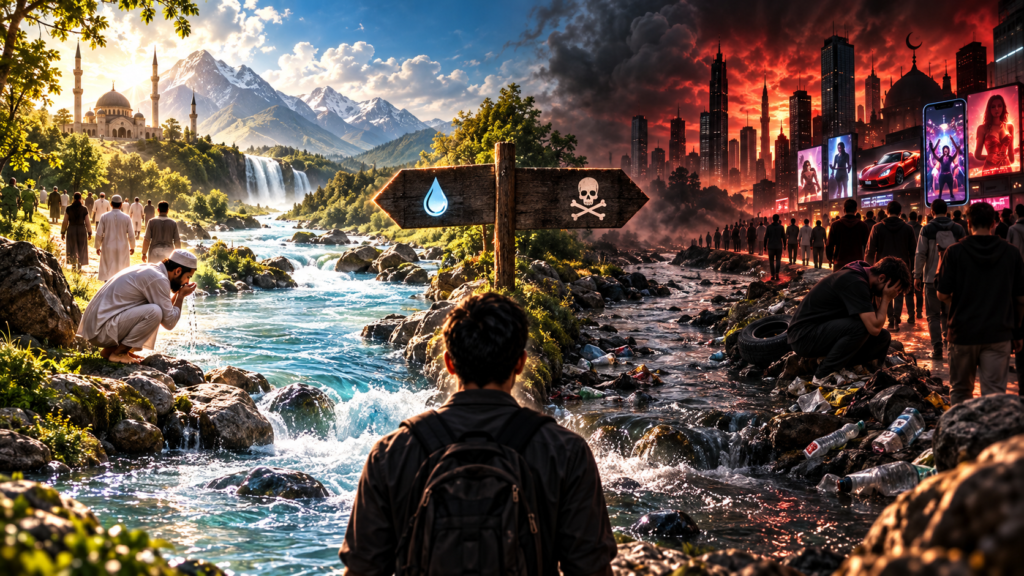
The Test of the River: The River Is Not at Fault, but the Choice
Allah says:
فَلَمَّا فَصَلَ طَالُوتُ بِالْجُنُودِ قَالَ إِنَّ اللَّهَ مُبْتَلِيكُم بِنَهَرٍ فَمَن شَرِبَ مِنْهُ فَلَيْسَ مِنِّي وَمَن لَّمْ يَطْعَمْهُ فَإِنَّهُ مِنِّي إِلَّا مَنِ اغْتَرَفَ غُرْفَةً بِيَدِهِ فَشَرِبُوا مِنْهُ إِلَّا قَلِيلًا مِّنْهُمْ…
“When Talut set out with his troops, he said: Indeed, Allah will test you with a river. Whoever drinks from it is not one of my followers, and whoever does not taste it is one of my followers, except for the one who scoops up a handful with his hand. But they drank from it, except for a few of them…”
— Surah al-Baqarah 2:249
This verse is not merely a story about a river.
It is a story about human choice when something is placed before a person.
THE RIVER IS THERE, BUT HUMAN BEINGS ARE THE ONES WHO CHOOSE
The river is available.
The water is right before their eyes.
But the river does not force anyone to drink.
The water does not enter the body on its own.
Human beings are the ones who choose.
That is why the real test does not lie in the existence of the river.
The real test is:
What do human beings do when something is offered to them?
Therefore, it is not the fault of those who provided the river.
It is not the river’s fault.
It is not the water’s fault.
The one being tested is you, the person who chooses.
DRINKING MEANS ACCEPTING
The verse uses the word:
شَرِبَ
“to drink”
Drinking means that something has already entered the body.
Before drinking, there is still room to think.
After drinking, the decision has already been made.
In this reflection on the Quran:
DRINKING = ACCEPTING
Accepting because of conviction.
Accepting because of fear.
Accepting because of pressure.
Accepting because everyone else is doing it.
Accepting because of fear of losing one’s job.
Accepting because one wants to enter college.
Accepting because one wants to enter a mall.
Accepting because one wants to enter a mosque.
Accepting because one wants to cross a border.
But whatever the reason, the decision still takes place within the individual.
SCOOPING WITH THE HAND MEANS EVALUATING
The verse provides an exception:
إِلَّا مَنِ اغْتَرَفَ غُرْفَةً بِيَدِهِ
“Except for the one who scoops up a handful with his hand.”
Why is the hand mentioned?
Because the hand symbolises the power of choice.
With the hand, human beings can:
take,
hold,
look,
smell,
evaluate,
think,
and then decide.
Therefore:
THE HAND = THE POWER OF CHOICE
SCOOPING = THE PROCESS OF EVALUATION
DRINKING = THE DECISION TO ACCEPT
This is the difference between a person who immediately swallows something and a person who pauses for a moment to think.
DO NOT SIMPLY SWALLOW
Scooping does not mean rejecting.
Scooping means taking something in a controlled manner.
Take a little.
Examine it.
Evaluate it.
Think.
Compare.
Then make a decision.
This is reason being actively exercised.
Not immediately believing.
Not immediately becoming afraid.
Not immediately rejecting.
But evaluating before accepting.
THE MODERN AGE AND BIOLOGICAL TECHNOLOGY
In the modern age, the “river” does not necessarily come in the form of water.
There are substances that enter the body.
There are technologies that affect cells.
There are substances that influence gene expression.
There are gene therapies.
There are DNA-editing technologies.
And there is CRISPR-Cas9, which is specifically designed to edit the genome.
This is not a fairy tale.
DNA can indeed be edited.
Gene sequences can be cut.
Certain sections can be altered.
Specific genes can be deleted.
Certain sequences can be inserted.
Therefore, now that human beings possess technology capable of modifying their own biological code, the principle of “scooping before drinking” becomes increasingly important.
WHEN DNA CAN BE EDITED, HUMAN BEINGS MUST EVALUATE
If something has the potential to affect the body at a profound level, human beings cannot merely ask:
“Who instructed me to do it?”
“Is everyone taking it?”
“Will I be allowed into the mall?”
“Will I be allowed to work?”
“Will I be allowed to fly?”
The real questions are:
What exactly is entering the body?
What is its mechanism?
Are its effects temporary or permanent?
Does it merely produce a protein, or does it alter the genome?
Is it gene therapy?
Does it involve a vector?
Does it involve DNA editing?
What are the long-term risks?
Can its effects be inherited?
This is what evaluation means.
DO NOT CONFUSE ALL TECHNOLOGIES
Evaluation also means not rushing to conclusions.
Not all technologies work in the same way.
Not all mRNA edits DNA.
Not all gene therapy involves CRISPR.
Not every substance that enters the body alters the genome.
Therefore, someone who truly “scoops” must understand the differences.
Otherwise, that person is not evaluating.
That person is merely afraid.
And fear without knowledge can also lead people astray.
IT IS NOT THE FAULT OF THOSE WHO PROVIDE THE RIVER
This is the most important part.
The river is provided.
The choice is available.
But the decision still takes place within the individual.
Other people may apply pressure.
Other people may make offers.
Other people may impose conditions.
But human beings still have one final opportunity:
to choose.
Therefore, do not shift all the blame onto external parties afterwards.
Do not merely say:
“Someone told me to.”
“The government told me to.”
“My employer told me to.”
“The college told me to.”
“I couldn’t travel.”
“I wasn’t allowed to enter.”
All of these may constitute pressure.
But you still have your hands.
You still have your reason.
You still have a choice.
THE HAND IS A SYMBOL OF RESPONSIBILITY
As long as something remains in the hand, it has not yet entered the body.
That is the opportunity for consideration.
That is the opportunity for freedom.
That is the opportunity for responsibility.
Once it has been consumed, that decision becomes part of the individual.
Therefore, the individual also bears its effects.
THE MAJORITY IS NOT PROOF
The verse states:
فَشَرِبُوا مِنْهُ إِلَّا قَلِيلًا مِّنْهُمْ
“But they drank from it, except for a few of them.”
Many people may make the same decision.
Many people may choose the same path.
Many people may give the same reasons.
But the number of people who make a choice is not an absolute measure of truth.
The test remains an individual one.
THE REAL TEST IS REASON UNDER PRESSURE
Talut’s troops were thirsty.
The physical pressure was intense.
It is under such circumstances that human beings can easily lose their ability to make sound judgments.
Therefore, the test of the river is really about this:
Can human beings still think when they are under pressure?
Can they still evaluate when they are afraid?
Can they still make choices when many people are urging them to act?
Can they still ask questions before accepting?
DNA EDITING MAKES THIS QUESTION EVEN MORE SIGNIFICANT
In the past, human beings may only have consumed food, drinks or medicine.
Today, human beings are capable of editing biological code.
Therefore, the question of choice is no longer a small matter.
When something has the potential to affect genetics, human beings must exercise greater care.
Because the body is not something external.
It is part of the self.
Therefore, when the self changes, the consequences return to the self.
CONCLUSION
Surah al-Baqarah 2:249 is not merely a story about a river.
It is a lesson about the power of choice.
The river is not at fault.
The water is not at fault.
Technology is not necessarily at fault.
The one being tested is the human being.
What that person chooses.
What that person accepts.
What that person allows to enter their body.
THE HAND REPRESENTS THE POWER OF CHOICE.
SCOOPING REPRESENTS THE PROCESS OF EVALUATION.
DRINKING REPRESENTS THE DECISION TO ACCEPT.
IT IS NOT THE FAULT OF THOSE WHO PROVIDE THE RIVER.
WHETHER THE CHOICE IS RIGHT OR WRONG DEPENDS ON YOUR OWN DECISION.