
QIAMAH
The Realm of the Grave Is Not a Hole in the Ground
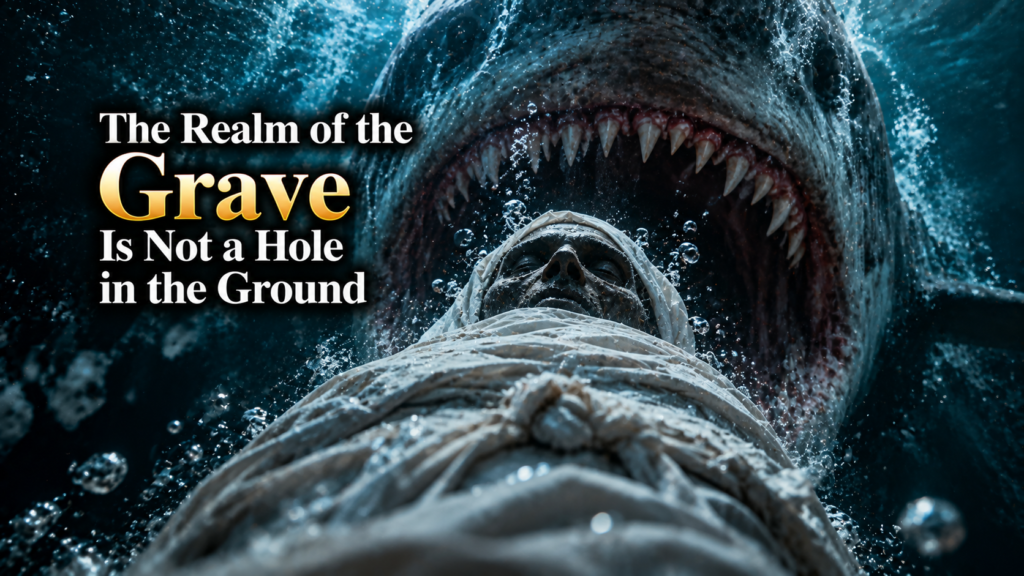
The misunderstanding begins when human beings look at the ground, whereas what should be examined is the physical body that is no longer alive.
When the realm of the grave is mentioned, many people immediately imagine a hole in the ground.
The physical body is placed into the grave, and then the person is imagined to “remain” there until Qiyāmah.
But the question is very simple:
What about human beings who were never buried?
Those who drowned at sea.
Those who were burned.
Those whose bodies disappeared.
Those whose bodies were consumed by animals.
Those whose bodies were destroyed in disasters.
Do they have no realm after death simply because they have no hole in the ground?
Of course not.
This is where the misunderstanding begins.
⸻
DO NOT LOOK AT THE GROUND — LOOK AT THE PHYSICAL BODY
Linguistically, قَبْر — qabr is indeed used for a grave or burial place.
But when discussing death and resurrection, the focus should not stop at the ground.
What is there is:
a physical body that is no longer alive.
Therefore, the real question is not:
“Where is the grave in the ground?”
But:
“What happens to a human being when their physical body is no longer alive?”
That is the point that needs to be examined.
⸻
IF THE HOLE IN THE GROUND IS EMPTY, IS IT A GRAVE?
Think about it simply.
Someone digs a hole in the ground.
There is no body inside it.
Would people immediately call that hole a grave?
Not necessarily.
It is merely a hole in the ground.
A place is called a grave because it has a connection with the physical body of someone who has died.
Therefore, what gives meaning to the grave is not the ground alone.
The central point of reference is:
THE PHYSICAL BODY THAT IS NO LONGER ALIVE.
That is why, when reading revealed texts concerning the grave, do not immediately construct the image of:
ground + hole + a human being waiting beneath the earth.
First examine who has been buried and what has happened to that physical body.
⸻
DEATH OCCURS BEFORE BURIAL
A person may die at home.
Their body may only be buried several hours later.
During those few hours, have they not yet entered the state after death simply because they have not been placed in the ground?
No.
Death has already occurred.
Their Worldly Realm has ended.
Therefore:
burial concerns the physical body.
death is the transition out of worldly life.
⸻
THE QURAN MENTIONS BARZAKH
Allah says:
حَتَّىٰ إِذَا جَاءَ أَحَدَهُمُ الْمَوْتُ قَالَ رَبِّ ارْجِعُونِ لَعَلِّي أَعْمَلُ صَالِحًا فِيمَا تَرَكْتُ ۚ كَلَّا ۚ إِنَّهَا كَلِمَةٌ هُوَ قَائِلُهَا ۖ وَمِنْ وَرَائِهِمْ بَرْزَخٌ إِلَىٰ يَوْمِ يُبْعَثُونَ
“Until, when death comes to one of them, he says: ‘My Lord, return me so that I may do righteous deeds concerning what I left behind.’ No! It is only a word that he speaks. And before them is a Barzakh until the Day they are resurrected.”
— Al-Mu’minun 23:99–100
This verse is important because after death, the Quran mentions:
بَرْزَخٌ — Barzakh
that is, a boundary or barrier until the next resurrection.
The Quran does not make a hole in the ground a condition for the phase after death.
⸻
“RETURN ME” — BUT IT IS ALREADY TOO LATE
Notice the words:
رَبِّ ارْجِعُونِ
“My Lord, return me.”
Return to where?
Return to the Worldly Realm.
Why is the person not permitted to return?
Because the worldly phase has ended.
The answer is:
كَلَّا
“No.”
This shows that death is a real dividing line.
⸻
THE TEXT ABOUT “BEING RESURRECTED FROM THE GRAVES”
Allah says:
وَأَنَّ السَّاعَةَ آتِيَةٌ لَا رَيْبَ فِيهَا وَأَنَّ اللَّهَ يَبْعَثُ مَن فِي الْقُبُورِ
“And indeed the Hour is coming, there is no doubt about it, and Allah will resurrect those who are in the graves.”
— Al-Hajj 22:7
Notice the words:
يَبْعَثُ — resurrects
and
مَن فِي الْقُبُورِ — those who are in the graves
If the reader looks only at the ground, they will immediately imagine human beings waiting inside holes.
But the focus of the reading needs to return to:
who is in the state of the grave?
Human beings whose physical bodies are no longer alive.
Therefore, resurrection does not depend upon geographical coordinates in the ground.
⸻
THE QURAN ALSO MENTIONS “EMERGING FROM THE AJDĀTH”
Allah says:
وَنُفِخَ فِي الصُّورِ فَإِذَا هُم مِّنَ الْأَجْدَاثِ إِلَىٰ رَبِّهِمْ يَنسِلُونَ
“And it is blown into aṣ-ṣūr, and suddenly they emerge from the graves, hastening towards their Lord.”
— Yasin 36:51
And:
خُشَّعًا أَبْصَارُهُمْ يَخْرُجُونَ مِنَ الْأَجْدَاثِ كَأَنَّهُمْ جَرَادٌ مُّنتَشِرٌ
“Their eyes humbled, they emerge from the graves as though they were scattered locusts.”
— Al-Qamar 54:7
And:
يَوْمَ يَخْرُجُونَ مِنَ الْأَجْدَاثِ سِرَاعًا
“On the Day they emerge from the graves swiftly.”
— Al-Ma‘arij 70:43
The texts do indeed mention emerging.
But do not rush to turn this into a single physical image in which every human being must possess a hole in the ground and then emerge from it.
⸻
IF SOMEONE IS SWALLOWED BY A SHARK, WHERE IS THEIR GRAVE?
This is the simplest question for testing the image that “the realm of the grave = a hole in the ground”.
A human being drowns at sea.
Their body is swallowed by a fish.
There is no burial pit.
No gravestone.
No cemetery.
Did that person not die?
Did they not leave the Worldly Realm?
Do they not pass through Barzakh?
Of course they still undergo death.
Therefore, it is clear:
a hole in the ground is not a condition for the journey after death.
⸻
WHAT IF SOMEONE IS BURNED TO ASHES?
The same applies to someone who is burned.
Their physical body may become ashes.
There may no longer be a complete bodily form.
There may be no known grave.
But death has still occurred.
Therefore, the location and physical form of the body cannot be made the sole measure of the realm after death.
What determines the transition is:
death.
⸻
THE GRAVE SHOULD NOT BE CONFINED TO GEOGRAPHY
The problem arises when the term “realm of the grave” is transformed into a geographical image:
ground,
a hole,
narrowness,
darkness,
and a human being supposedly “living” beneath the earth.
Yet a physical body may be:
in the ground,
in the sea,
on a mountain,
inside an animal,
reduced to ashes,
or in an unknown location.
But the human being has still left the Worldly Realm.
⸻
THE TEXTS INDICATE THAT EXPERIENCE AFTER DEATH ALREADY EXISTS
Concerning the people of Pharaoh, Allah says:
ٱلنَّارُ يُعْرَضُونَ عَلَيْهَا غُدُوًّا وَعَشِيًّا ۖ وَيَوْمَ تَقُومُ ٱلسَّاعَةُ أَدْخِلُوٓا۟ ءَالَ فِرْعَوْنَ أَشَدَّ ٱلْعَذَابِ
“The Fire is presented to them morning and evening, and on the Day when the Hour is established: ‘Admit the people of Pharaoh into the severest torment.’”
— Ghafir 40:46
This verse indicates that the experience after death is not merely a matter of waiting with nothing happening until some distant date in the future.
⸻
THOSE WHO DIE HAVE ALREADY LEFT THE WORLDLY REALM
When a person dies:
they no longer live worldly life as before,
they no longer add to their deeds,
they cannot return to worldly life whenever they wish.
That is why the Quran states:
رَبِّ ارْجِعُونِ
“Return me.”
But the answer is:
كَلَّا
“No.”
Their Worldly Realm has ended.
⸻
“RISING FROM THE GRAVE” SHOULD NOT IMMEDIATELY BE UNDERSTOOD AS “EMERGING FROM THE GROUND”
This is the most important point.
The texts mention:
rising
and
emerging from the graves.
But do not immediately confine their meaning to the ground.
What is more important is the state:
the human being has died.
the physical body is no longer alive.
their Worldly Realm has ended.
Therefore, within this explanation, “rising from the grave” is read as:
rising from the state of death into a state of life in the next realm.
This is an interpretative explanation.
Linguistically, qabr remains connected with a grave or burial place.
But the meaning of resurrection cannot be restricted to the ground alone.
⸻
DO NOT RUSH WHEN READING THE TEXT
A major error occurs when a word is read and an image is immediately constructed.
“Qabr” is read.
Immediately, one sees the ground.
Immediately, one sees a hole.
Immediately, one sees human beings waiting beneath the earth.
Then the entire picture of the realm after death is built from that visual image.
Yet the texts need to be read together with language, context, other verses and the guidance of knowledge.
Read the text, but do not allow its meaning to become imprisoned within an image that we ourselves have created.
⸻
QABR AND BARZAKH SHOULD NOT BE CONFLATED
The distinction is simple:
QABR
is connected with the physical body that has died and the place where that body is buried.
BARZAKH
is the boundary or phase after death until the next resurrection.
Not every human being has a physical grave known to other human beings.
But every human being who dies leaves the Worldly Realm.
Therefore:
Barzakh does not depend upon a hole in the ground.
⸻
THE FOCUS IS THE PHYSICAL BODY THAT IS NO LONGER ALIVE
This is the core misunderstanding that needs to be corrected.
When human beings look at a grave, do not stop at the ground.
Look at what the grave indicates:
the human physical body has lost its worldly life.
That body may be buried.
It may be submerged.
It may be burned.
It may be destroyed.
But its fundamental state remains the same:
it is no longer alive.
⸻
CONCLUSION
THE REALM OF THE GRAVE IS NOT A HOLE IN THE GROUND.
A hole in the ground is merely one place where a physical body may be after death.
It is not a condition for death.
It is not a condition for Barzakh.
It is not a condition for the journey beyond the world.
The misunderstanding begins when human beings look at the ground, whereas what should be examined is:
THE PHYSICAL BODY THAT IS NO LONGER ALIVE.
If a hole in the ground is empty, it is merely a hole.
If the body of a deceased person is there, then it becomes known as a grave.
Therefore, the central point of reference is not the ground.
The central point of reference is the physical body that has died.
A person swallowed by a shark still dies.
A person who is burned still dies.
A person whose body disappears still dies.
A person without a gravestone still dies.
So do not merely ask:
“WHERE IS THE GRAVE?”
Ask:
“WHAT HAPPENS WHEN THE PHYSICAL BODY IS NO LONGER ALIVE?”
That is the real question.
LOOK AT THE PHYSICAL BODY — NOT THE GROUND.
DEATH IS NOT ENTERING A HOLE.
DEATH IS THE END OF THE WORLDLY REALM FOR THE SELF AND THE BEGINNING OF THE JOURNEY INTO THE NEXT REALM.