
QIAMAH
The Realm of the End — Happiness or Suffering
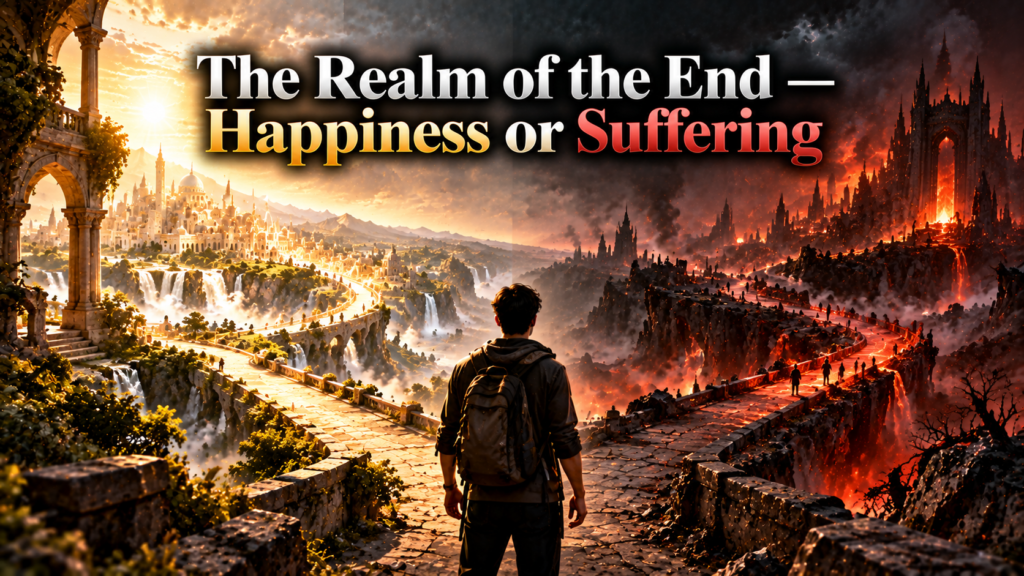
The Akhirah is the final and everlasting realm.
The world is where human beings prepare the seed for that final realm.
Human beings themselves come into this world through a seed. From the seed, the physical body is formed; from the body, life develops; and from life, the pattern of the self is formed.
That pattern is what is carried towards the end.
Therefore, life in the Akhirah needs to be understood as the manifestation of the seed of the self.
⸻
THE WORLD IS THE PLACE TO PREPARE THE SEED
Allah gives a parable:
كَلِمَةً طَيِّبَةً كَشَجَرَةٍ طَيِّبَةٍ أَصْلُهَا ثَابِتٌ
“A good word is like a good tree; its root is firmly established.”
— Ibrahim 14:24
The sequence is:
origin → tree → fruit → seed.
A good tree produces something from itself.
The same applies to human beings.
A person comes from a seed, grows like a “tree” in this world, and then produces the state of the self for the life that follows.
The human seed carries information for the formation of the physical body.
In the language of modern science, the seed carries DNA.
But the seed of the self also carries the pattern of:
what is believed,
what is loved,
what is rejected,
what is thought,
what is held with certainty,
and how a person acts.
Therefore, preserving the seed means preserving its origin, pattern and fitrah.
⸻
THE UMMĪ SEED IS THE ORIGINAL PATTERN
The most noble seed is the Ummī seed — the original source.
Ummī is the original pattern to be followed.
Muhammad ﷺ is the bearer of Allah’s Risalah and the embodiment of the character described by the Quran.
‘Aishah رضي الله عنها said regarding the Prophet ﷺ:
كَانَ خُلُقُهُ الْقُرْآنَ
“His character was the Quran.”
Therefore, the Quran can be read through the sequence:
QURAN → MUHAMMAD ﷺ → CHARACTER → ACTIONS → HUMAN PATTERN
The Ummī seed is not a matter of bloodline.
It is the human pattern that returns to the noble original pattern.
⸻
THE QALB IS THE PROFILE OF THE SEED
The qalb is the profile of the self.
It is where the pattern is formed of:
what is believed,
what is loved,
what is rejected,
what is feared,
what is assumed,
and what has become certain.
That profile forms the seed of the self.
In a modern analogy:
the qalb is the profile;
Ummī is the original source;
the record of the self is not erased when one episode of life comes to an end.
The Akhirah manifests what has been formed by that profile.
⸻
HAPPINESS AND SUFFERING CAN ALREADY BE FELT IN THIS WORLD
Human beings already know the experience of bliss and suffering while still living in this world.
Some people live simple lives, yet their qalb is at peace.
They feel content.
They are not excessively afraid of losing what they have.
They have prepared themselves.
They sleep peacefully.
They are not constantly pursued by unresolved anxiety.
This is an example of bliss already experienced in this world.
On the other hand, some people are wealthy.
A large house.
Abundant wealth.
Almost anything they ask for can be bought.
Yet they cannot sleep peacefully.
They fear losing what they have.
They want more.
What they possess never feels enough.
Their minds are filled with anxiety.
Their qalb is constantly burdened by something unresolved.
This is an example of how suffering can be experienced even when the body is surrounded by luxury.
Therefore, bliss and suffering do not depend solely on what exists outside the self.
They are connected to the state of the qalb.
⸻
THE BLISS AND SUFFERING OF THIS WORLD ARE STILL TEMPORARY
But there is one major difference.
In this world, bliss can still change.
Happy today, sad tomorrow.
Calm today, anxious tomorrow.
Rich today, poor tomorrow.
Sick today, healed tomorrow.
The same applies to worldly suffering.
It has an end.
Human beings can still learn.
They can still correct their mistakes.
They can still apologise.
They can still change their minds.
They can still replace assumption with certainty.
They can still seek Nūr.
The world is the place of correction.
As long as we are still here, the seed can still be cared for.
⸻
THE AKHIRAH IS THE FINAL END
The Akhirah is different.
The Akhirah is the final realm.
Once the final realm is reached, the period of preparation has ended.
The seed has been carried forward.
The pattern has been formed.
What could previously be corrected in the world has now reached its final outcome.
That is why the Akhirah is so weighty.
Not merely because it is “longer” than this world.
But because it is the final end, with no other world afterwards to return to and correct the seed.
What has become stable will remain stable.
What is still burning will continue to face its own burning state.
The Akhirah is the realm that remains forever and ever.
⸻
THE NOBLE SEED ALREADY EXPERIENCES HAPPINESS
A person who has prepared a noble seed has actually already begun to experience its fruits in this world.
When the qalb is illuminated, certainty is firm and the self is stable, a person experiences tranquillity.
Allah states:
أَلَا بِذِكْرِ اللَّهِ تَطْمَئِنُّ الْقُلُوبُ
“Surely, in the remembrance of Allah do hearts find tranquillity.”
— Ar-Ra‘d 13:28
The important word is:
تَطْمَئِنُّ — becomes tranquil, becomes stable.
A qalb that has reached stability is not easily manipulated by loss and fear.
It is already prepared.
That is why happiness does not need to wait until the Akhirah before it begins to be experienced.
A good seed already begins to bear fruit while still in this world.
The Akhirah completes that state.
⸻
NŪR EMERGES WHEN THE QALB REACHES CERTAINTY
The world is where human beings seek Nūr.
Nūr is not a flashlight.
Nūr is the illumination of the qalb after thought has worked until it reaches certainty.
The sequence is:
think → examine → understand → assumption disappears → certainty → qalb becomes illuminated → stability.
A person who has attained Nūr already has direction.
He no longer depends entirely on the assumptions of others.
He is no longer easily tossed back and forth.
And that Nūr is what is carried towards the Akhirah.
Allah states:
يَسْعَىٰ نُورُهُم بَيْنَ أَيْدِيهِمْ وَبِأَيْمَانِهِمْ
“Their Nūr will move before them and on their right.”
— Al-Hadid 57:12
Notice:
Their Nūr.
That light has already become connected to their own selves.
⸻
PARADISE IS THE STATE THAT HAS ARRIVED
Paradise is the final outcome of a seed that has reached stability.
Allah describes the inhabitants of Paradise:
لَا يَبْغُونَ عَنْهَا حِوَلًا
“They will not desire any transfer from it.”
— Al-Kahfi 18:108
Why do they not wish to leave?
Because they have arrived.
No longer searching.
No longer chasing.
No longer feeling that something is missing.
No longer being burned by unresolved desires.
What is desired has reached stability.
That is happiness.
⸻
THE GREAT MISUNDERSTANDING ABOUT HELL
On the other hand, human beings have long inherited an image of Hell as a place where people are thrown into a bonfire or an oven.
A child hears it from his father.
The father hears it from his teacher.
The teacher repeats what he heard.
The next generation accepts the same image without returning to examine how the Quran describes Nār.
The Quran warns against following inherited beliefs without using reason:
إِنَّا وَجَدْنَا آبَاءَنَا عَلَىٰ أُمَّةٍ وَإِنَّا عَلَىٰ آثَارِهِم مُّهْتَدُونَ
“Indeed, we found our forefathers upon a way, and indeed, we are guided by following in their footsteps.”
— Az-Zukhruf 43:22
And:
بَلْ نَتَّبِعُ مَا أَلْفَيْنَا عَلَيْهِ آبَاءَنَا
“Rather, we follow what we found our forefathers upon.”
— Al-Baqarah 2:170
The problem is repeating without examining.
When the ulama su’ merely repeat inherited imagery without opening people towards witnessing its meaning within themselves, the next generation inherits the same imagery.
Eventually, the word Nār continues to be imagined as though a body is being placed inside an oven.
Yet the Quran itself directs human beings to look deeper.
⸻
WORLDLY FIRE TEACHES THE MEANING OF BURNING INTENSITY
Fire in this world is a lesson.
A small fire can be a friend.
It cooks.
It warms.
It illuminates.
But when it receives fuel without restraint:
it grows,
it spreads,
it BURNS MORE INTENSELY.
This is the characteristic that needs to be understood.
Not merely the appearance of fire.
But the law of its intensification.
A single spark can become a massive fire if it continues to receive fuel.
The same applies to the human self.
One assumption.
One anger.
One regret.
One unfulfilled desire.
If it continues to receive fuel:
it intensifies.
⸻
NĀR IS A STATE THAT CONTINUES TO BURN
Allah states:
نَارُ اللَّهِ الْمُوقَدَةُ الَّتِي تَطَّلِعُ عَلَى الْأَفْئِدَةِ
“The Nār of Allah, kindled, which rises over the hearts.”
— Al-Humazah 104:6–7
Notice the target mentioned in the verse:
الْأَفْئِدَةِ — the hearts.
The verse directs attention towards the state of the self.
A qalb filled with regret, anger, disappointment, mistaken assumptions and an inability to accept reality can remain in turmoil.
Nār is a state that does not reach stability.
⸻
HUMAN BEINGS THEMSELVES BECOME THE FUEL
Allah states:
وَقُودُهَا النَّاسُ وَالْحِجَارَةُ
“Its fuel is people and stones.”
— Al-Baqarah 2:24
Human beings themselves are described as fuel.
In a reading focused on the self:
memories become fuel.
assumptions become fuel.
regret becomes fuel.
anger becomes fuel.
unfulfilled desires become fuel.
A person does not need wood from outside to cause the state within to burn intensely.
The self itself is already enough to become the fuel.
⸻
STONE IS AN IMAGE OF THE HARDENED QALB
The Quran explains:
فَهِيَ كَالْحِجَارَةِ أَوْ أَشَدُّ قَسْوَةً
“Then the hearts became like stones, or even harder.”
— Al-Baqarah 2:74
Therefore, stone has a very strong relationship with the hardened qalb.
The harder the qalb becomes, the more difficult it is to receive Nūr.
The more it rejects Nūr, the darker it becomes.
The darker it becomes, the more unstable it becomes.
The more unstable it becomes, the more easily it burns intensely.
⸻
IT SUBSIDES, THEN BURNS AGAIN
Allah states:
كُلَّمَا خَبَتْ زِدْنَاهُمْ سَعِيرًا
“Whenever it subsides, We increase for them the blazing fire.”
— Al-Isra’ 17:97
This verse can be read through human experience itself.
A person remembers his mistake.
It burns.
His thoughts become distracted.
He forgets for a moment.
It subsides.
Then the memory returns.
It burns again.
“Why did I do that?”
“Why didn’t I listen?”
“Why did I assume I was already right?”
“I was given a chance.”
As long as the matter remains unresolved, the burning can return again and again.
In this world, human beings still have the opportunity to correct that state.
In the Akhirah, the realm of correction has ended.
That is the enormous difference.
⸻
WHY ARE THE HYPOCRITES DEEPER?
Allah states:
إِنَّ الْمُنَافِقِينَ فِي الدَّرْكِ الْأَسْفَلِ مِنَ النَّارِ
“Indeed, the hypocrites will be in the lowest depths of Nār.”
— An-Nisa’ 4:145
A person who rejects knows that he rejects.
But a hypocrite may live with the assumption:
“I am already Muslim.”
“I am already right.”
“I already know.”
“I am already safe.”
When reality is unveiled, the collision between what was assumed and what is actually true becomes immense.
That is why mistaken assumptions can produce an even more intense burning state.
⸻
PARADISE AND HELL ALREADY HAVE THEIR SHADOWS IN THIS WORLD
Human beings can already see small examples of both.
Paradise in this world:
feeling content,
having a tranquil heart,
sleeping peacefully,
not being excessively afraid,
not endlessly chasing,
and being prepared for whatever comes.
Hell in this world:
possessing much but never feeling satisfied,
being wealthy but unable to sleep,
being successful but constantly fearing loss,
being praised but continually seeking more praise,
and regretting something while being unable to release the mistake from the mind.
But all of these are still temporary.
The world can still change.
The world still has tomorrow.
The world still provides opportunities for correction.
The Akhirah has no world after it.
That is the realm of the final end.
⸻
THE AKHIRAH MANIFESTS THE SEED
The world is the field of preparation.
The qalb forms the profile of the seed.
Ummī is the original source.
Nūr forms stability.
Nār represents a state that continues to burn.
What has been built in this world will reach its final outcome in the Akhirah.
For those who have prepared a noble seed, their happiness has already begun in this world and reaches stability in the final realm.
For those who leave this world with a hardened qalb, unresolved assumptions and turmoil that continues to live within them, that state enters a realm that no longer provides an opportunity for correction.
⸻
CLOSING
The world is the place to plant, shape and correct the seed.
Human beings can still change.
They can still learn.
They can still realise their mistakes.
They can still replace assumption with certainty.
They can still attain Nūr.
That is why worldly bliss and worldly suffering still have an end.
But the Akhirah is the final realm.
There is no new episode in which to rebuild the seed.
There is no next world in which to return and correct what has already been formed.
Therefore:
PARADISE = illuminated, fulfilled, arrived, stable.
HELL = unresolved, unsatisfied, unstable, continuously BURNING.
In this world, we already experience small examples of both.
The difference is:
the world is still temporary.
the Akhirah is the final end.
And that final state remains forever.