
IHSAN
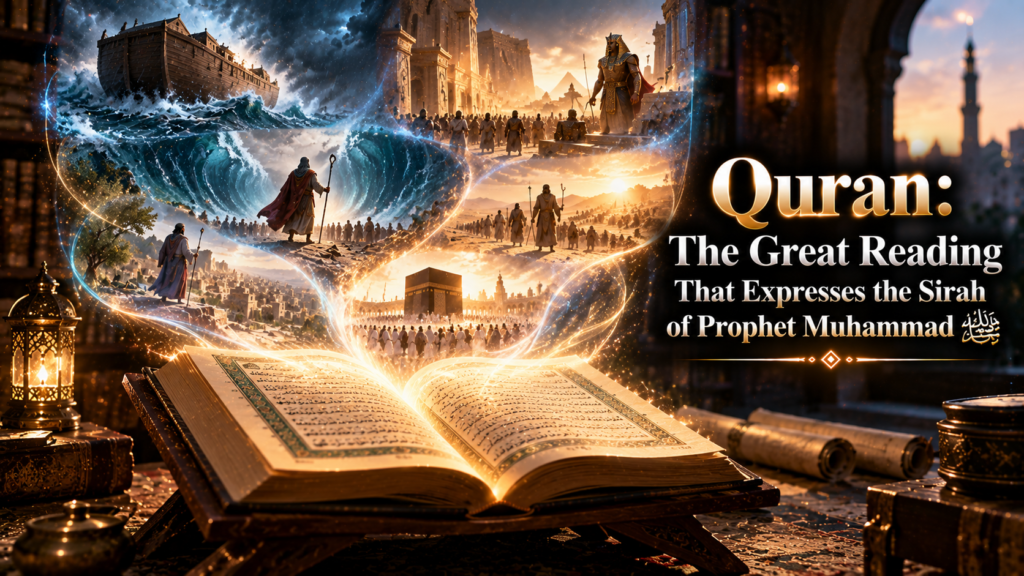
The Quran must not be confined to the Mushaf, pages, ink or sound.
The Mushaf is a collection of texts.
The Quran is:
THE GREAT READING
which gathers the written descriptions concerning Prophet Muhammad ﷺ.
What comes first is:
HIS PERSON — WHAT IS IMPLICIT
Then that person moves through:
THE SIRAH
the life journey that demonstrates his character and Actions.
Actions explain Attributes.
The collection of Attributes reveals the Essence — its meaning, content, direction of purpose and underlying reality.
Therefore:
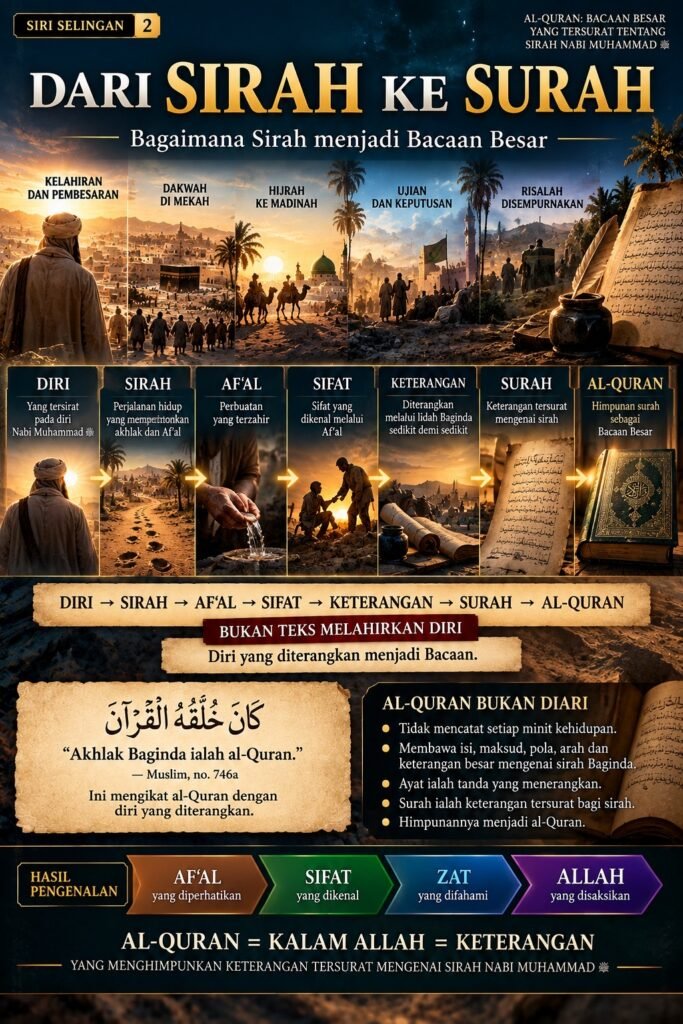
ACTIONS → ATTRIBUTES → ESSENCE
And:
ESSENCE + ATTRIBUTES + ACTIONS = ALLAH
⸻
1. SIRAH AND SURAH
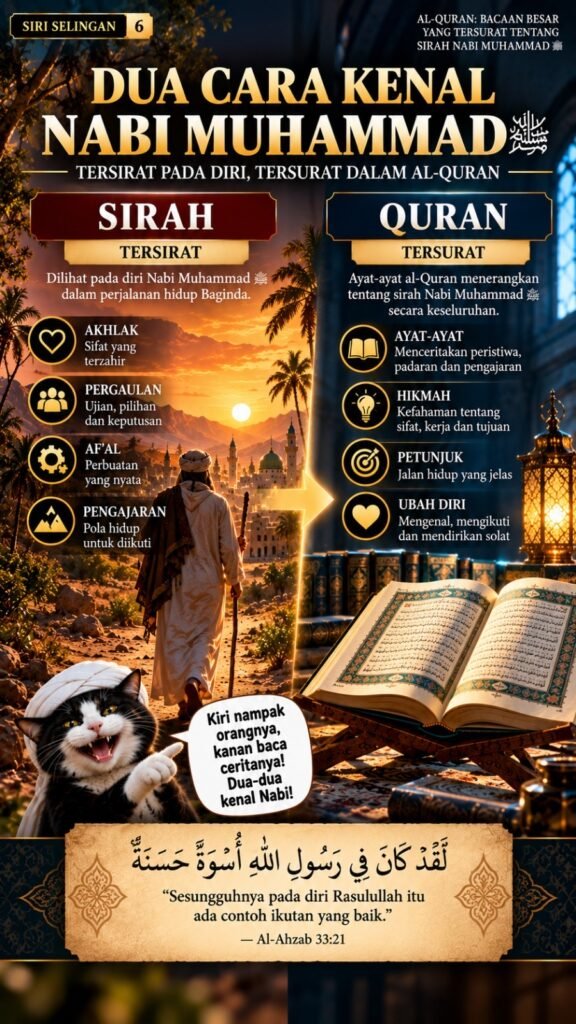
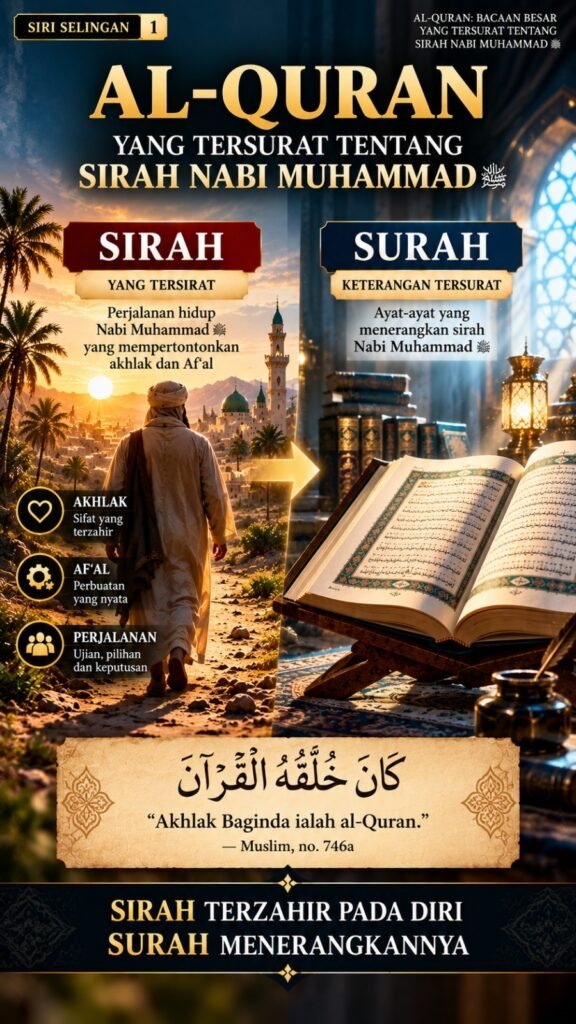
Sirah is the life journey of Prophet Muhammad ﷺ.
Surah is the written description of that Sirah.
Therefore:
SIRAH = THE JOURNEY OF THE PERSON
SURAH = THE WRITTEN DESCRIPTION OF THE SIRAH
What is implicit within the person becomes manifest through Actions and character.
What becomes manifest is explained.
What is explained is expressed in writing.
What is written is gathered into the Great Reading.
Do not reverse the sequence:
IT IS NOT THE TEXT THAT PRODUCES THE PERSON.
Instead:
PERSON → SIRAH → ACTIONS → DESCRIPTION → SURAH → THE QURAN
⸻
2. THE GREAT KEY: كَانَ خُلُقُهُ الْقُرْآنَ
Aishah رضي الله عنها was asked about the character of the Messenger of Allah ﷺ.
She replied:
كَانَ خُلُقُهُ الْقُرْآنَ
“HIS CHARACTER WAS THE QURAN.”
— Sahih Muslim, no. 746a
This connects the Great Reading with the person being described.
His character became manifest through:
words,
choices,
Actions,
relationships,
and his life journey.
Therefore, the Quran is not a diary recording every minute of his life.
It carries:
content,
meaning,
patterns,
direction,
and the greater descriptions concerning his Sirah.
⸻
3. THE QURAN = KALAM ALLAH
The Quran is:
كَلَامُ اللَّهِ — KALAM ALLAH
Kalam is:
DESCRIPTION.
Therefore:
MUHAMMAD ﷺ = the person being described
CHARACTER/ACTIONS = what becomes manifest
ATTRIBUTES = what is recognised through Actions
COLLECTION OF ATTRIBUTES = Essence
ESSENCE + ATTRIBUTES + ACTIONS = ALLAH
And:
KALAM ALLAH = THE DESCRIPTION OF ALL OF THESE.
When it is stated:
“ALLAH SAYS…”
do not rush to imagine a figure of the Risalah speaking.
The Risalah is not a figure.
An analogy:
“It is reported: rain falls from the sky.”
The report is not an object.
What matters is:
WHAT IS BEING REPORTED.
Likewise, with divine speech:
WHAT THE DESCRIPTION STATES.
⸻
4. AN ANALOGY: THE ENGINEER AND THE MANUAL
Imagine an engineer personally demonstrating how a system works.
People observe his actions.
Then the engineer explains verbally what he has done.
Those explanations are recorded and compiled into a manual.
The document controller only organises and preserves the records.
He does not create the content.
Therefore:
ENGINEER → ACTIONS → DESCRIPTION → RECORD → MANUAL
The manual is the written description of what has already been demonstrated.
The manual is not a figure.
The same analogy applies to the Quran.
⸻
5. AYAH = SIGN
Fussilat 41:3 states:
كِتَابٌ فُصِّلَتْ آيَاتُهُ قُرْآنًا عَرَبِيًّا لِقَوْمٍ يَعْلَمُونَ
“A Book whose verses have been explained in detail as an Arabic reading for people who know.”
— Fussilat 41:3
Notice:
آيَة — AYAH = SIGN
Do not reduce an ayah to a single line of text.
The text describes the sign.
The sign points towards what is to be recognised.
Within the person of the Messenger, that sign becomes manifest through:
CHARACTER AND ACTIONS.
⸻
6. DHIKR = REMEMBRANCE SO THAT RECOGNITION CAN OCCUR
The Quran is also called:
الذِّكْر — DHIKR
Dhikr is not the memorisation of sounds.
Dhikr is:
REMEMBRANCE / RECOGNITION.
An analogy:
We recognise our mother.
After waking from sleep, we still recognise her.
We do not need to memorise:
“This is my mother.”
We immediately recognise the person.
Likewise, if something is written:
“Your nostrils will always be the delight of my heart.”
What is meant to be recognised is not the sentence itself.
What is meant to be recognised is:
THE PERSON BEING REFERRED TO.
The text only points towards that person.
⸻
7. MEMORISATION IS NOT THE WORK OF REASON
Memorisation stores information.
But storing information does not necessarily mean understanding it.
Reason must:
WORK.
And the work of reason is:
THINKING.
Therefore:
READ → THINK → UNDERSTAND → RECOGNISE
If the Quran only moves across the tongue and stops at the throat, the reader may master its sounds without reaching its meaning.
Islam does not belong to one race or one language.
Language is the pathway.
Meaning is what must be reached.
⸻
8. WHAT IS WRITTEN IS THE OUTER LAYER; WHAT IS IMPLICIT IS THE CONTENT
What is written consists of:
letters,
words,
verses,
surahs,
the arrangement of the text.
That is the outer layer.
What is implicit consists of:
meaning,
underlying reality,
attributes,
direction of purpose,
and the person being described.
That is the content.
Therefore:
DO NOT DISCARD THE OUTER LAYER.
But:
DO NOT STOP AT THE OUTER LAYER.
The outer layer protects the content.
The text preserves the description.
The description leads towards recognition.
⸻
9. THE QURAN IS A MIRACLE — NOT A MAGICAL INCANTATION
The miraculous nature of the Quran must not be reduced to Arabic sounds believed to possess magical powers.
The Quran is:
A DESCRIPTION THAT OPENS UNDERSTANDING.
Al-Kahf 18:109 states:
قُل لَّوْ كَانَ ٱلْبَحْرُ مِدَادًا لِّكَلِمَاتِ رَبِّى لَنَفِدَ ٱلْبَحْرُ قَبْلَ أَن تَنفَدَ كَلِمَاتُ رَبِّى وَلَوْ جِئْنَا بِمِثْلِهِۦ مَدَدًا
“Say: If the sea were ink for the words of my Lord, the sea would be exhausted before the words of my Lord were exhausted, even if We brought another like it as a supplement.”
— Al-Kahf 18:109
An ocean of ink has limits.
But the meaning of a description is not exhausted simply by counting letters.
That is why the Quran must be:
THOUGHT ABOUT.
Not turned into:
incantations,
spells,
or amulets.
⸻
10. SOUND IS NOT AN AMULET
A verse that is hung up is not an amulet.
A Quran recording played from a phone or tape is not an amulet either.
A machine can play a recitation repeatedly, but the machine:
does not think,
does not understand,
and does not possess a qalb.
Therefore, the power of the Quran does not lie in the sound produced by a machine.
It lies in human beings who:
UNDERSTAND ITS DESCRIPTIONS
until that understanding illuminates the qalb and shapes:
convictions,
character,
and Actions.
Within this reading, when it is said that jinn are afraid, the emphasis is not on fear of Arabic sounds as though they were incantations, but on HUMAN BEINGS WHO UNDERSTAND, REMAIN STEADFAST AND HAVE ILLUMINATED HEARTS.
⸻
11. THE QURAN IS LIKE CODING — NOT RAW DATA
An analogy:
The Quran is not only:
RAW DATA
to be collected, memorised and repeated.
It is closer to:
CODING.
Someone can look at thousands of lines of code.
They can copy them.
They can memorise them.
But if they do not understand the structure and meaning, they still do not know:
WHAT THE CODE DOES.
The same applies to the Quran.
To understand the Great Reading, human beings must find:
ACCESS.
⸻
12. THE TWO DECLARATIONS OF SHAHADAH: THE PADLOCK AND THE KEY
Now consider the analogy of a locked door.
To open it, two things are required:
THE CORRECT PADLOCK
and:
THE CORRECT KEY.
Within the two declarations of Shahadah:
THE FIRST DECLARATION = PADLOCK / USERNAME
لَا إِلٰهَ إِلَّا اللَّهُ
This is the witnessing of ESSENCE, ATTRIBUTES AND ACTIONS manifested throughout the entire realm — the Wajh of Allah as description.
In the digital analogy:
USERNAME = ALLAH
Even finding the correct username is not easy.
People may pronounce “Allah” without necessarily understanding:
Essence,
Attributes,
Actions,
and witnessing throughout the entire realm.
Therefore, discovering the first declaration through correct understanding is already a major journey.
But:
DO NOT STOP THERE.
Because finding the padlock does not open the door.
⸻
THE SECOND DECLARATION = KEY / PASSWORD
مُحَمَّدٌ رَسُولُ اللَّهِ
This is the witnessing of THE PERSON OF MUHAMMAD ﷺ AS THE BEARER OF THE RISALAH.
In the digital analogy:
PASSWORD = MUHAMMAD ﷺ
It is not only about knowing the name “Muhammad”.
It is about recognising the person described through:
Sirah,
character,
Actions,
and the bearing of the Risalah.
Therefore:
A PADLOCK WITHOUT A KEY REMAINS LOCKED.
And:
A USERNAME WITHOUT A PASSWORD DOES NOT GRANT ACCESS.
⸻
13. FINDING THE PADLOCK IS NOT THE END
Many people stop after finding:
ALLAH.
They pronounce the name.
They profess belief.
They seek the first declaration.
But the two declarations of Shahadah do not end with the first declaration.
There is:
THE SECOND DECLARATION.
Therefore, the logic is simple.
If you have found the padlock:
FIND THE KEY.
If you know the username:
FIND THE PASSWORD.
And that password leads the reader towards:
MUHAMMAD ﷺ
the person described by the Great Reading.
⸻
14. SHAHADAH AS THE KEY TO UNDERSTANDING THE QURAN
The two declarations of Shahadah are not passwords made of sounds.
They are:
WITNESSING.
The first declaration connects human beings to:
ALLAH — ESSENCE, ATTRIBUTES AND ACTIONS.
The second declaration connects human beings to:
MUHAMMAD ﷺ — THE PERSON WHO IS THE BEARER.
When both come together, the reader no longer reads the Quran as raw data.
The reader knows:
WHAT IS BEING DESCRIBED
and:
WHO IS BEING DESCRIBED.
This is where the Great Reading begins to open towards understanding.
⸻
CONCLUSION
The Quran is:
WHAT IS EXPRESSED IN WRITING.
Prophet Muhammad ﷺ is:
THE PERSON WHO IS IMPLICIT WITHIN IT.
Sirah is the journey of the person.
Surah is the description of the Sirah.
Kalam Allah is description.
Dhikr is remembrance so that what is intended may be recognised.
An Ayah is a sign.
Reason must work.
The work of reason is:
THINKING.
And the two declarations of Shahadah provide a very clear analogy:
FIRST DECLARATION = PADLOCK = USERNAME
SECOND DECLARATION = KEY = PASSWORD
Even finding the correct padlock is difficult.
Finding the username through correct understanding is also difficult.
But:
DO NOT STOP ONCE YOU HAVE FOUND IT.
Find:
THE KEY.
Find:
THE PASSWORD.
Because:
A PADLOCK WITHOUT A KEY REMAINS LOCKED.
And the Great Reading does not end with:
letters,
sounds,
memorisation,
or raw data.
It must be opened through:
WITNESSING → THINKING → UNDERSTANDING → RECOGNITION
Only then is the Quran truly read as:
THE DESCRIPTION THAT OPENS THE PATH TO RECOGNITION.
Detecting your location…