
IMAN
The Orphanhood of the Messenger of Allah ﷺ: Oneness, the Source and the Protector
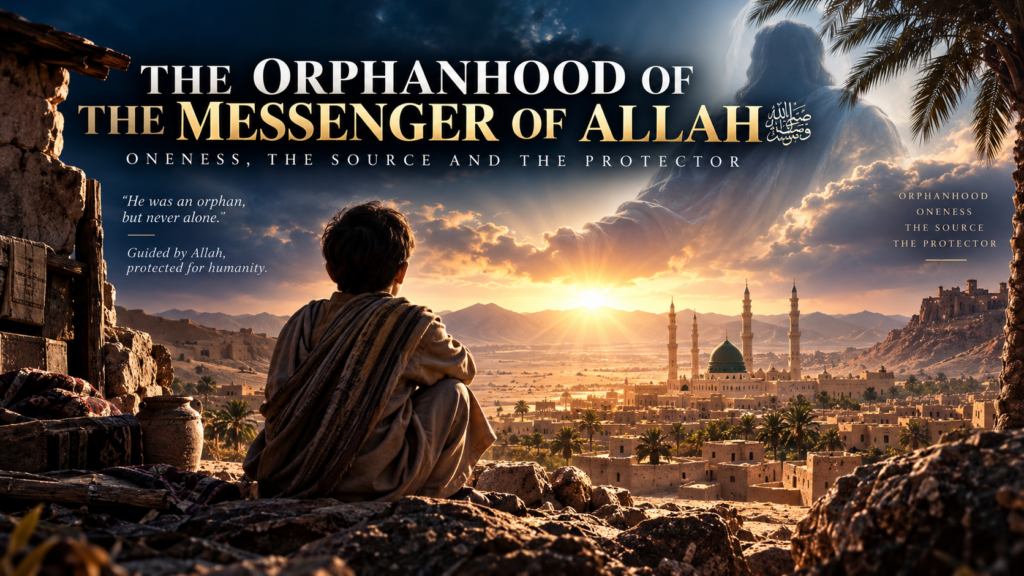
Every human being enters the stage of this world through a beginning:
ACTION!
ACTION = BIRTH.
It is not the entire universe that begins anew. Rather, an individual’s scene in this world begins when they are born.
Upon birth, human beings take on various roles:
child, father, mother, husband, wife, leader, follower.
All these are roles in the drama of worldly life.
Muhammad ﷺ also entered the human drama. He became a son, a husband, a father and a leader, and he is described as:
AN ORPHAN.
However, his role within the drama must be distinguished from his position as the bearer of the Message.
Muhammad ﷺ is:
the director who enters his own production, the principal actor, the bearer of Allah’s Message, and the Great Bearer.
Allah is not a thing, a material object, an unseen object or an additional character outside the screen.
Allah is the expression of Essence, Attributes and Actions, manifested through the entirety of the Message and the unfolding film of life.
Muhammad ﷺ carries that expression and bears Allah’s Message.
THE GREAT BEARER
YATIMAN — WHAT KIND OF ORPHAN?
Surah ad-Duha 93:6 states:
أَلَمْ يَجِدْكَ يَتِيمًا فَآوَىٰ
Word-by-word breakdown:
أَلَمْ — did He not
يَجِدْ — find
كَ — you
يَتِيمًا — an orphan / in a state of orphanhood
فَ — then / so
آوَىٰ — grant shelter / provide protection
Notice the sequence:
يَجِدْكَ
= found YOU
Then YOU are described as:
يَتِيمًا
= YATIMAN
The verse does not stop at the depiction of orphanhood. It immediately proceeds to:
فَآوَىٰ
FA indicates continuity, while ĀWĀ carries the meaning of providing shelter, protection and a place of safety.
Grammatically, يَتِيمًا describes كَ, while آوَىٰ has an implied subject. Therefore, we do not force yatīman to become the literal subject of āwā.
Nevertheless, the connection in meaning between the two remains important:
YATIMAN → followed immediately by the function of shelter and protection.
Therefore, the question is not merely “who is the orphan?”, but:
What kind of orphanhood is this, such that it is associated with shelter and protection?
FROM ORPHANHOOD TO ONENESS
The root ي ت م need not be restricted to the depiction of a child who has lost his father. Its range of meanings also carries the nuances of:
being alone, being separate, being singular, being without equal.
The Arabic language recognises the expression:
دُرَّةٌ يَتِيمَةٌ
meaning a singular, exceptional and incomparable pearl.
Therefore, the orphanhood of the Messenger of Allah ﷺ can be read on two levels.
At the level of the drama, he becomes a son, a husband, a father and a leader.
At the level of his position as the bearer of the Message, he does not derive that position from the role of a father, mother or the lineage of the drama.
That position is not inherited from another source and does not depend on worldly origins.
Therefore, the sequence is:
YATIM
→ NO DERIVED ORIGIN IN HIS POSITION
→ SINGULAR
→ ONE
In this sense, his orphanhood is not merely a depiction of deprivation, but an expression of the singularity of his position.
YATIM = ONE.
AL-IKHLAS AND THE CONCEPT OF SINGULARITY
Surah al-Ikhlas states:
قُلْ هُوَ اللَّهُ أَحَدٌ
“Say: Huwa Allah Ahad.”
اللَّهُ الصَّمَدُ
“Allah as-Samad.”
لَمْ يَلِدْ وَلَمْ يُولَدْ
“He neither begets nor is born.”
وَلَمْ يَكُن لَّهُ كُفُوًا أَحَدٌ
“And there is none comparable to Him.”
Grammatically, the third and fourth verses provide no clear indication that their subject changes to the Prophet ﷺ. Therefore, we do not forcibly transfer the subject of the verses.
However, in terms of their connection in meaning, these verses introduce concepts that align with the meaning of orphanhood as singularity:
Ahad
= one / singular
lam yalid
= does not beget
wa lam yūlad
= is not born
kufuwan ahad
= none comparable
All these converge within the same field of meaning:
singularity, the absence of a derived origin, the absence of an equal counterpart, and oneness.
Therefore, the logical connection is:
YATIM → SINGULAR → NO DERIVED ORIGIN → ONE
This connection does not mean that Surah al-Ikhlas is interpreted by changing its subject to the Prophet ﷺ. Rather, the concepts in these verses are used to explain the connection in meaning between orphanhood, singularity and oneness.
FROM ONENESS TO THE SOURCE
If someone still depends on another source to determine their position, they have not become the ultimate source of that position.
The true source does not depend on another source in order to be the source.
In this context, YATIM expresses singularity, while UMMĪ expresses the position of the source.
He is Ummī.
Ummī = the source.
The Ummah, in turn, consists of those who gather under that source.
Therefore, the connection in meaning is:
YATIM
→ SINGULAR
→ ONE
→ SOURCE
He does not require another source to establish him as the source in his position as the bearer of the Message.
“HE NEITHER BEGETS NOR IS BORN” IN THE POSITION OF THE SOURCE
Within the drama of worldly life, the Prophet ﷺ can fulfil the roles of both son and father. These are facts at the level of the story.
However, in his position as Director and Source, he does not derive that position from another source, nor does he produce another source as a continuation of his position.
Therefore, logically:
A CHARACTER CAN BEGET AND BE BORN.
THE TRUE SOURCE NEITHER BEGETS NOR IS BORN IN RELATION TO ITS POSITION.
This is where the connection with:
لَمْ يَلِدْ وَلَمْ يُولَدْ
becomes relevant as a connection in meaning, rather than a grammatical transfer of the subject.
FROM THE SOURCE TO THE PROTECTOR
Return to the sequence:
يَتِيمًا فَآوَىٰ
Orphanhood does not stop at the depiction of “an orphan as someone who needs protection”. The verse proceeds to:
آوَىٰ
= providing shelter and protection.
The connection in meaning is:
The singular YATIM is associated with the function of shelter and protection.
This function is connected to the position of the source, because it is the source that provides shelter for the Ummah.
If he is Ummī, then the Ummah gathers under its source.
Therefore, the complete framework is:
YATIM
→ ONE
→ SOURCE
→ PROTECTOR
Orphanhood here is no longer read as weakness, but as a singular position that provides shelter.
MUHAMMAD ﷺ — THE GREAT BEARER
Muhammad ﷺ carries Allah’s Message.
He bears:
Essence, Attributes, Actions
as the expression of the Message.
He does not carry a material thing or bear an unseen object. He bears the expression of Allah manifested through the Message and the journey of life.
That is why the Malay title:
Junjungan Besar Nabi Muhammad ﷺ
can be read in an active sense:
He is the Great Bearer.
What does he bear?
Allah’s Message.
THE GREAT BEARER
ﷺ — SAW
The prophets are commonly referred to with the expression:
عَلَيْهِ السَّلَامُ
Salam carries a range of meanings:
SAFETY → ASSURANCE.
The Prophet Muhammad ﷺ, on the other hand, is commonly referred to with:
صَلَّى اللَّهُ عَلَيْهِ وَسَلَّمَ
The connection is read as follows:
صَلَّى → bearing
اللَّهُ → Allah’s Message; the expression of Essence–Attributes–Actions, not a thing
عَلَيْهِ → upon him
وَسَلَّمَ → ASSURANCE / SAFETY
Therefore:
The Prophet ﷺ bears Allah’s Message upon himself, and that Message is under ASSURANCE / SAFETY.
He does not merely receive salam, but becomes the one upon whom Allah’s Message is borne.
SELAWAT UPON THE PROPHET
The Quran states:
إِنَّ اللَّهَ وَمَلَائِكَتَهُ يُصَلُّونَ عَلَى النَّبِيِّ
And:
صَلُّوا عَلَيْهِ وَسَلِّمُوا تَسْلِيمًا
Notice:
عَلَى النَّبِيِّ
= upon the Prophet
And:
عَلَيْهِ
= upon him
Muhammad ﷺ is the one upon whom Allah’s Message is borne.
That is why:
اللَّهُمَّ صَلِّ عَلَىٰ مُحَمَّدٍ
is read in relation to Muhammad ﷺ as:
Bearer — the Bearer of Allah’s Message.
Allah is not something carried like a material object.
Allah is the expression of Essence, Attributes and Actions, carried and manifested through the Message.
‘ALAYKA — YOU, THE SINGULAR ONE
In the Tahiyyat:
السَّلَامُ عَلَيْكَ أَيُّهَا النَّبِيُّ
Notice:
عَلَيْكَ
not:
عَلَيْكُمْ
KA = YOU, singular.
Singular.
One.
This expression aligns with the framework:
YATIM → singular
ONE → one
UMMĪ → source
‘ALAYKA → YOU, the singular one
Salam is addressed directly:
upon YOU, O Prophet.
One source.
One bearer.
One Great Bearer of Allah’s Message.
SOLAT — RETURNING TO THE SOURCE
The Ummah is a manifestation of the pattern of the source, not a physical clone.
That pattern is repeated through:
character, trustworthiness, attributes, actions.
Therefore, SOLAT is not a ritual movement detached from Muhammad ﷺ. SOLAT is the process of returning oneself to the pattern of the source.
Establishing SOLAT means:
establishing Muhammad ﷺ within oneself as the pattern of the Message.
Since Muhammad ﷺ bears Allah’s Message:
establishing the pattern of Muhammad means establishing Allah’s Message in one’s life.
ACTION = BIRTH
Every human being has their own ACTION.
ACTION = BIRTH.
Upon birth, a human being enters the scene of this world and receives:
a name, a body, a family, a role, a position, relationships.
All these are costumes and props in the scene of worldly life.
Muhammad ﷺ also entered through the ACTION of birth. He became a son, a husband, a father, a leader and an orphan.
However, all these belong to the level of the drama.
His position as Director, Bearer of the Message and Source does not originate from that drama.
CUT = TRANSITION TO ANOTHER REALM
When an individual’s scene in this world is complete:
CUT!
CUT does not mean destruction, nor does it mean that the entire film has ended.
CUT = the individual’s scene in this world is complete, and the human being moves on to the next realm.
Therefore:
ACTION = BIRTH
And:
CUT = TRANSITION TO ANOTHER REALM
The larger film continues. Other characters remain on the stage because their scenes have not yet ended.
CONCLUSION
ALLAH
= the expression of Essence, Attributes and Actions
= not a thing
MUHAMMAD ﷺ
= the director who enters his own production
= the principal actor
= the bearer of Allah’s Message
= the Great Bearer
YATIM
= not merely being without a father
= singular
= having no derived origin in his position
= ONE
AL-IKHLAS
= grammatically continues to describe Allah
= introduces the concepts of Ahad, neither begetting nor being born, and having no equal
= aligns with the meaning of orphanhood as singularity and having no derived origin
UMMĪ
= source
YATIMAN FA-ĀWĀ
= orphanhood associated with the function of shelter and protection
SAW
= Allah’s Message is borne upon him and remains under ASSURANCE / SAFETY
‘ALAYKA
= upon YOU, the singular one
SOLAT
= returning to the pattern of the source and establishing Allah’s Message within oneself
ACTION
= being born and entering the scene of this world
CUT
= completing the scene of this world and transitioning to another realm
Therefore, the entire argument converges into one framework:
YATIM → NO DERIVED ORIGIN → SINGULAR → ONE → SOURCE → PROTECTOR
And the Messenger of Allah ﷺ is:
THE GREAT BEARER — THE BEARER OF ALLAH’S MESSAGE, THE SINGULAR SOURCE IN HIS POSITION, AND THE SHELTER FOR THE UMMAH.