
ISLAM
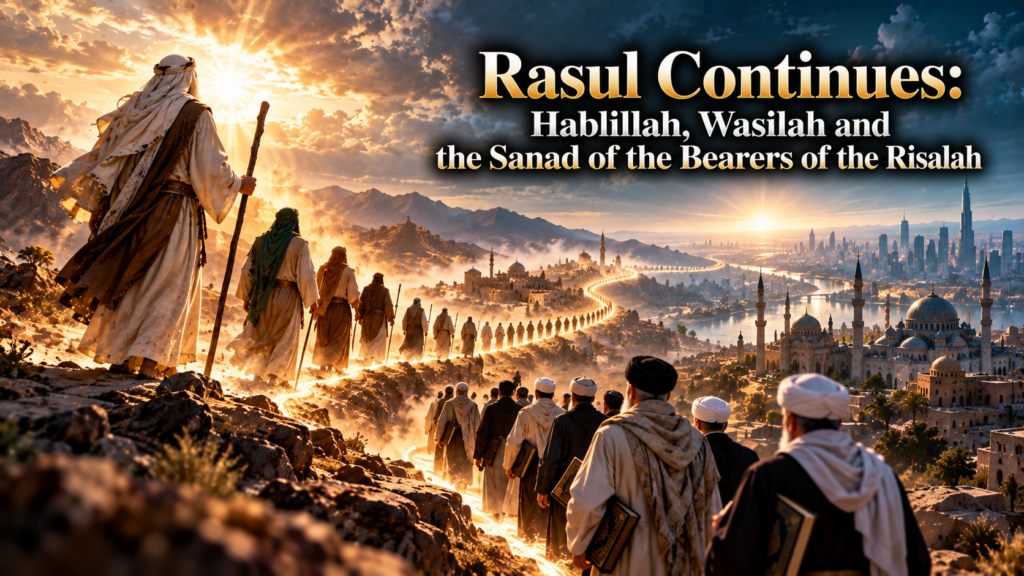
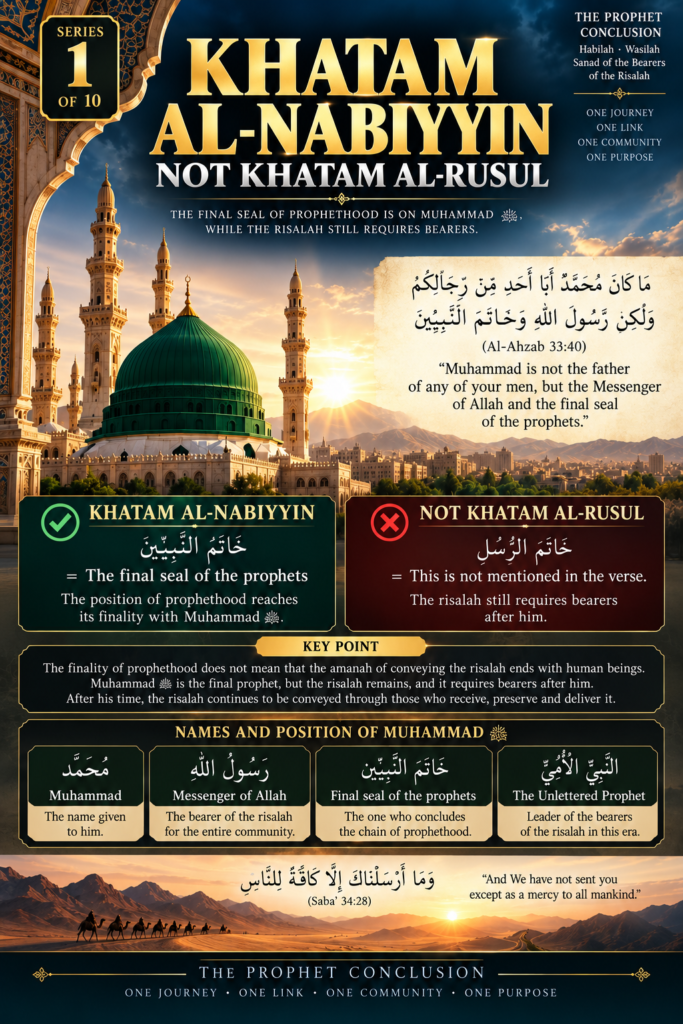
Muhammad ﷺ is al-Nabiyy al-Ummiyy, the original bearer of the Risalah for this Ummah. Prophethood reaches its completion with him, but the trust of carrying the Risalah continues through bearers who receive, preserve and convey it. :chatgpt-content-reference{index=”0″}
The Quran states:
مَّا كَانَ مُحَمَّدٌ أَبَا أَحَدٍ مِّن رِّجَالِكُمْ وَلَٰكِن رَّسُولَ اللَّهِ وَخَاتَمَ النَّبِيِّينَ
“Muhammad is not the father of any of your men, but he is the Messenger of Allah and the khatam of the Prophets.”
— Al-Ahzab 33:40
The wording is:
خَاتَمَ النَّبِيِّينَ
— khatam of the Prophets
not:
خَاتَمَ الرُّسُل
Therefore, what reaches its khatam is the position of prophethood with Muhammad ﷺ, while the Risalah still requires bearers. :chatgpt-content-reference{index=”1″}
⸻
EVERY UMMAH HAS A RASUL
The Quran states:
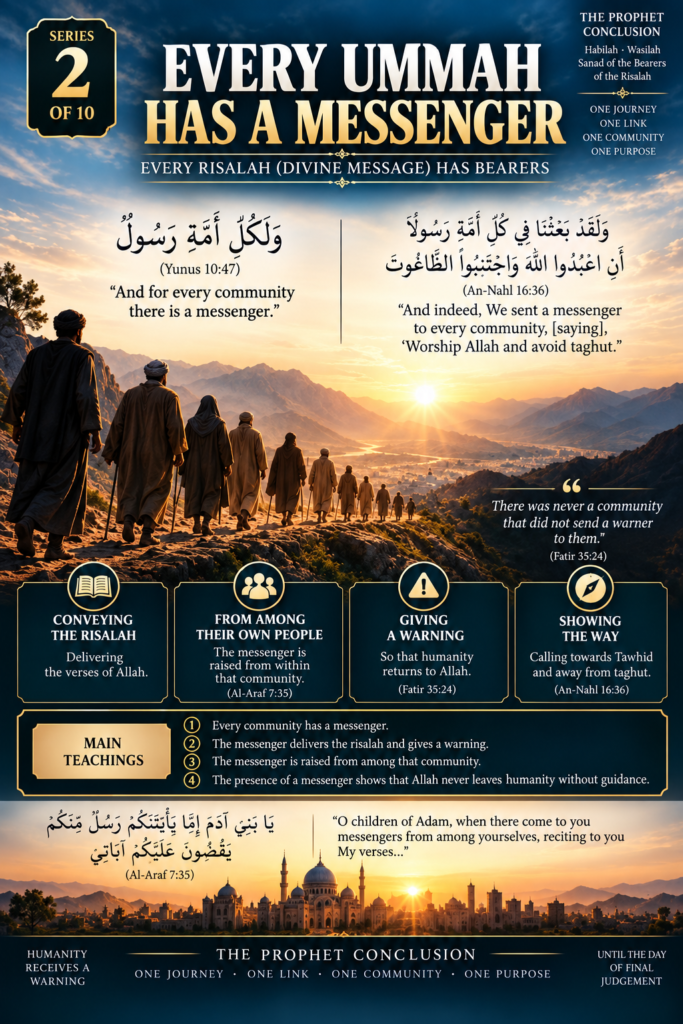
وَلِكُلِّ أُمَّةٍ رَّسُولٌ
“And for every Ummah there is a Rasul.”
— Yunus 10:47
And:
وَلَقَدْ بَعَثْنَا فِي كُلِّ أُمَّةٍ رَّسُولًا أَنِ اعْبُدُوا اللَّهَ وَاجْتَنِبُوا الطَّاغُوتَ
“And indeed, We raised among every Ummah a Rasul: ‘Worship Allah and avoid taghut.’”
— An-Nahl 16:36
This shows that the function of the Rasul is present alongside the Ummah.
The Quran also states:
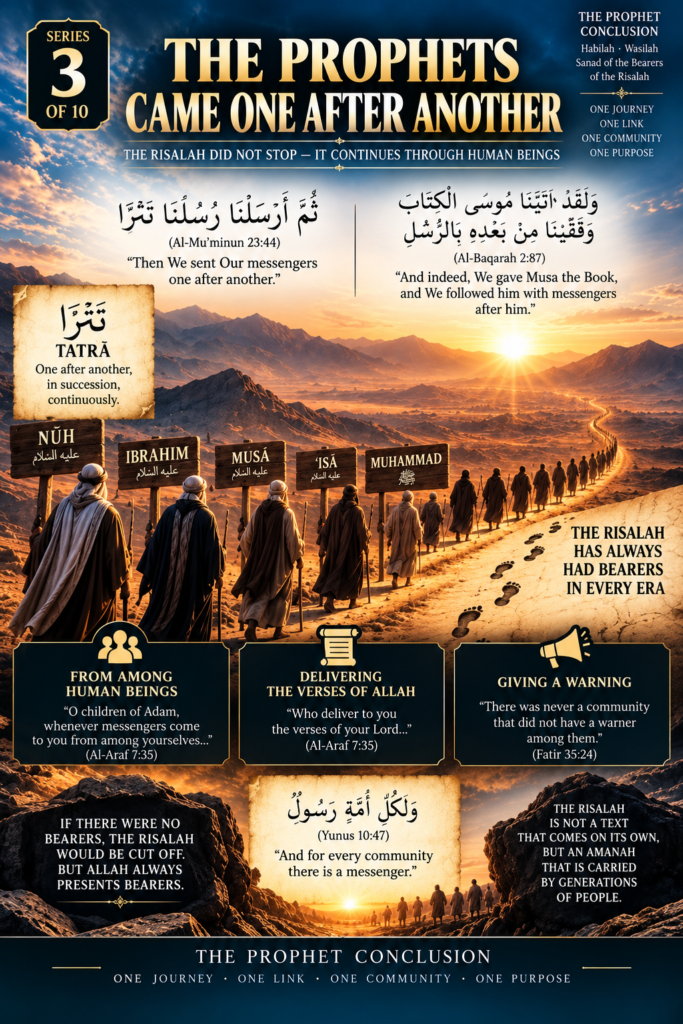
ثُمَّ أَرْسَلْنَا رُسُلَنَا تَتْرَا
“Then We sent Our Rusul in succession.”
— Al-Mu’minun 23:44
تَتْرَا — tatrā
= successively, continuously, one after another.
And:
وَلَقَدْ آتَيْنَا مُوسَى الْكِتَابَ وَقَفَّيْنَا مِن بَعْدِهِ بِالرُّسُلِ
“And indeed, We gave Musa the Book, and We followed him with Rusul.”
— Al-Baqarah 2:87
The important phrase is:
وَقَفَّيْنَا مِن بَعْدِهِ بِالرُّسُلِ
= We followed him with Rusul.
The structure is:
BEARER → BEARER → BEARER
The Risalah does not move by itself. It continues through human beings. :chatgpt-content-reference{index=”2″}
⸻
EVERY UMMAH HAS A WARNER
Fatir 35:24 states:
وَإِن مِّنْ أُمَّةٍ إِلَّا خَلَا فِيهَا نَذِيرٌ
“And there has been no Ummah except that a warner has passed among them.”
Al-A‘raf 7:35 also states:
يَا بَنِي آدَمَ إِمَّا يَأْتِيَنَّكُمْ رُسُلٌ مِّنكُمْ يَقُصُّونَ عَلَيْكُمْ آيَاتِي
“O children of Adam, when Rusul from among yourselves come to you, relating My verses to you…”
The important words are:
رُسُلٌ مِّنكُمْ
= Rusul from among yourselves
and:
يَقُصُّونَ عَلَيْكُمْ آيَاتِي
= relating My verses to you.
A Rasul is a bearer of the Risalah and a warner. :chatgpt-content-reference{index=”3″}
⸻
SANAD: THE RISALAH IS RECEIVED FROM HUMAN BEINGS
The Prophet ﷺ said:
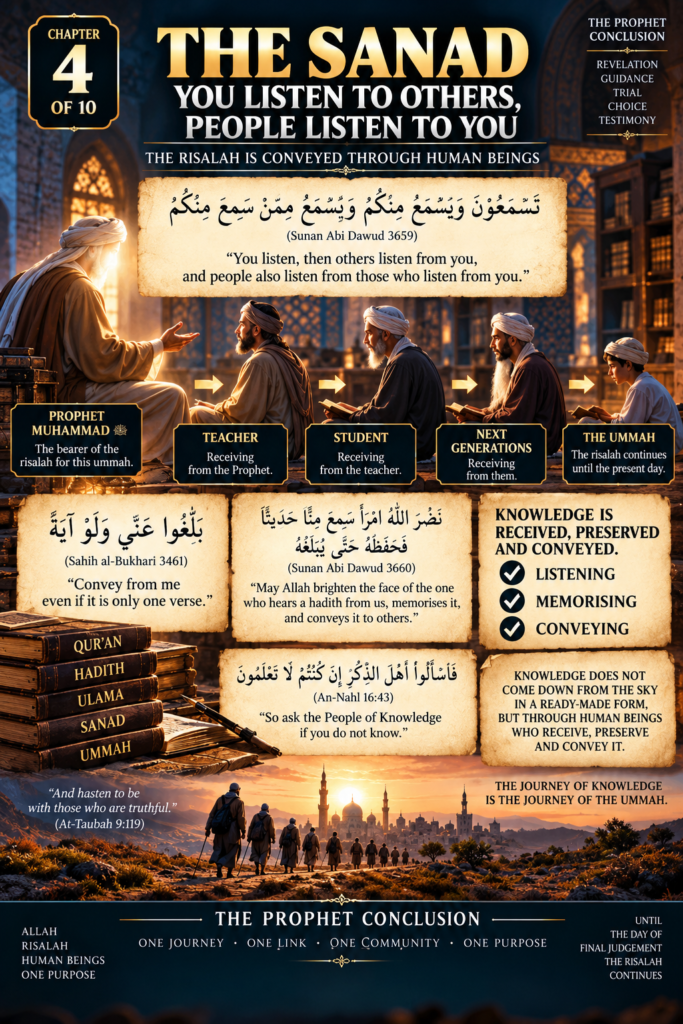
بَلِّغُوا عَنِّي وَلَوْ آيَةً
“Convey from me, even if it is one verse.”
— Sahih al-Bukhari 3461
Notice:
عَنِّي
= from me
بَلِّغُوا
= convey.
There is a source.
There is a recipient.
There is a subsequent conveyor.
Sunan Abi Dawud 3659 makes this even clearer:
تَسْمَعُونَ وَيُسْمَعُ مِنْكُمْ وَيُسْمَعُ مِمَّنْ سَمِعَ مِنْكُمْ
“You hear, then others hear from you, and others will hear from those who heard from you.”
— Sunan Abi Dawud 3659
This illustrates a continuous sanad:
THE PROPHET ﷺ
↓
YOU HEAR
↓
OTHERS HEAR FROM YOU
↓
THE NEXT PEOPLE HEAR FROM THOSE WHO HEARD FROM YOU
The following hadith reinforces this:
نَضَّرَ اللَّهُ امْرَأً سَمِعَ مِنَّا حَدِيثًا فَحَفِظَهُ حَتَّى يُبَلِّغَهُ
“May Allah brighten the one who hears a hadith from us, preserves it, and then conveys it.”
— Sunan Abi Dawud 3660
The structure is:
سَمِعَ مِنَّا — receives from us
↓
فَحَفِظَهُ — preserves it
↓
يُبَلِّغَهُ — conveys it
This is a living inheritance, not a text disconnected from its bearer. :chatgpt-content-reference{index=”4″}
⸻
HABLILLAH — THE BOND OF CONNECTION
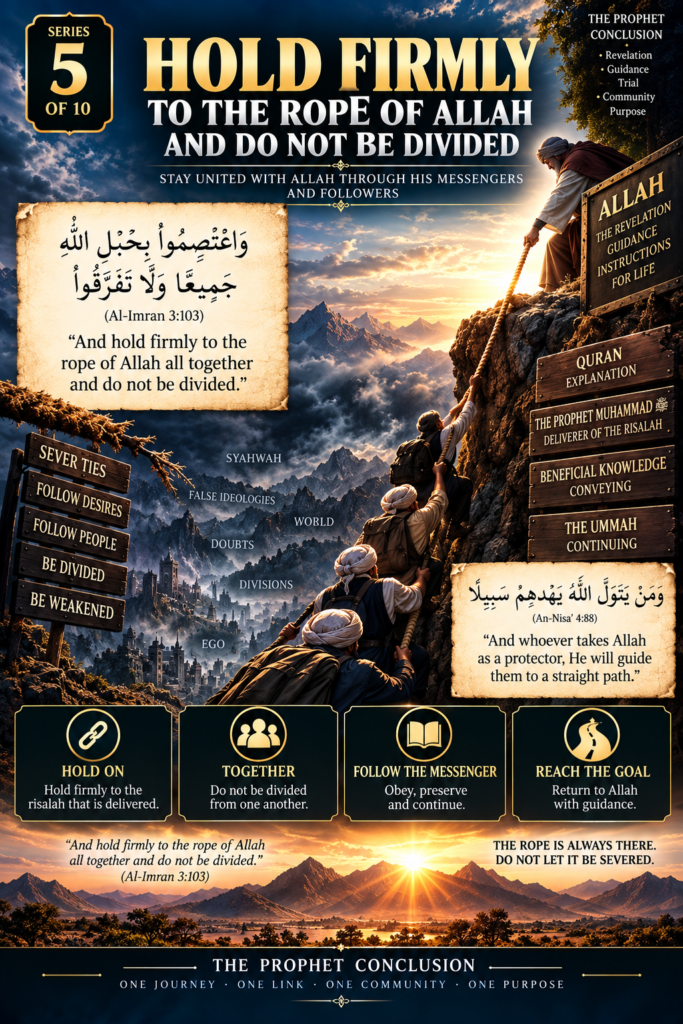
Ali ‘Imran 3:103 states:
وَاعْتَصِمُوا بِحَبْلِ اللَّهِ جَمِيعًا وَلَا تَفَرَّقُوا
“Hold firmly, all together, to Hablillah and do not become divided.”
حَبْل — ḥabl
= rope, bond, connection.
The wording of the verse is not:
دِين — dīn
Habl is not dīn.
A rope functions by connecting.
Within the structure of sanad:
حَبْلِ اللَّهِ
= the bond between the bearers of the Risalah that connects the recipient to the previous bearer until it returns to the original bearer of the Risalah.
Therefore:
وَلَا تَفَرَّقُوا
is not merely a prohibition against quarrelling.
It means:
DO NOT ALLOW THAT CONNECTION TO BE BROKEN.
The following verse states:
وَلَا تَكُونُوا كَالَّذِينَ تَفَرَّقُوا وَاخْتَلَفُوا مِن بَعْدِ مَا جَاءَهُمُ الْبَيِّنَاتُ
“And do not become like those who became divided and differed after clear proofs had come to them.”
— Ali ‘Imran 3:105
The connection must be preserved so that the trust does not become an inheritance without a source. :chatgpt-content-reference{index=”5″}
⸻
WASILAH — THE CONNECTING PATH TO REACH
Al-Ma’idah 5:35 states:
يَا أَيُّهَا الَّذِينَ آمَنُوا اتَّقُوا اللَّهَ وَابْتَغُوا إِلَيْهِ الْوَسِيلَةَ
“O you who believe, be mindful of Allah and seek the Wasilah towards Him.”
Al-Isra’ 17:57 states:
أُولَٰئِكَ الَّذِينَ يَدْعُونَ يَبْتَغُونَ إِلَىٰ رَبِّهِمُ الْوَسِيلَةَ أَيُّهُمْ أَقْرَبُ
“Those whom they call upon themselves seek the Wasilah towards their Lord, as to which of them is nearer.”
After الْوَسِيلَةَ comes:
أَيُّهُمْ أَقْرَبُ
= which of them is nearer.
Therefore:
HABL
= the rope that connects
WASILAH
= the path through which one reaches
SANAD
= the chain of human beings that preserves that connection.
Hadith also connects al-Wasilah with Muhammad ﷺ:
ثُمَّ سَلُوا اللَّهَ لِيَ الْوَسِيلَةَ
“Then ask Allah for al-Wasilah for me…”
— Sahih Muslim 384
Wasilah is not separated from the position of Muhammad ﷺ as the original bearer of the Risalah. :chatgpt-content-reference{index=”6″}
⸻
ULAMA AS THE INHERITORS OF THE PROPHETS — NOT EVERYONE WHO BEARS THE TITLE OF ULAMA
The hadith states:
وَإِنَّ الْعُلَمَاءَ وَرَثَةُ الْأَنْبِيَاءِ
“Indeed, the ulama are the inheritors of the Prophets.”
The hadith then explains:
وَإِنَّ الأَنْبِيَاءَ لَمْ يُوَرِّثُوا دِينَارًا وَلَا دِرْهَمًا وَرَّثُوا الْعِلْمَ
“The Prophets did not leave behind dinars or dirhams as inheritance; they left knowledge as inheritance.”
— Sunan Abi Dawud 3641
Here, the term must be understood:
ULAMA AS THE INHERITORS OF THE PROPHETS
It refers to a particular category.
For example:
a petroleum tanker truck
refers to a particular category of truck, not every truck.
Likewise:
ULAMA AS THE INHERITORS OF THE PROPHETS
does not mean every person who is given the title of ulama.
Not every religious graduate.
Not every PhD holder.
Not every preacher.
An inheritor must possess an inheritance.
And that inheritance must have a connection through which it was received.
The structure is:
THE PROPHET ﷺ
↓
TEACHER
↓
STUDENT
↓
THE NEXT TEACHER
↓
THE NEXT BEARER
That is the sanad of inheritance. :chatgpt-content-reference{index=”7″}
⸻
SEEK KNOWLEDGE FROM AHL AL-DHIKR
The Quran states:
فَاسْأَلُوا أَهْلَ الذِّكْرِ إِن كُنتُمْ لَا تَعْلَمُونَ
“So ask Ahl al-Dhikr if you do not know.”
— An-Nahl 16:43; Al-Anbiya’ 21:7
Notice the direction:
the one who does not know → asks the one who possesses dhikr/knowledge.
Knowledge is received through people, not merely through reading materials disconnected from their bearers.
The Quran also states:
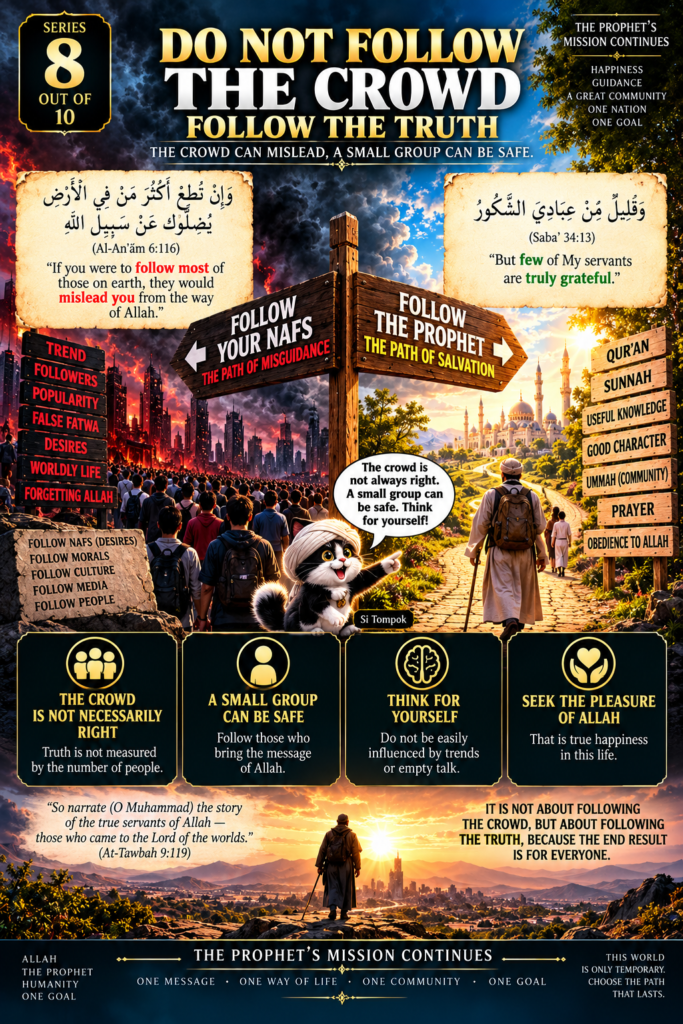
وَكُونُوا مَعَ الصَّادِقِينَ
“And be with those who are truthful.”
— At-Taubah 9:119
Not merely:
“read about truthful people.”
But:
مَعَ — with.
Human-to-human connection is part of the education of the Risalah. :chatgpt-content-reference{index=”8″}
⸻
LEARN → RETURN → WARN
At-Taubah 9:122 is extremely important:
فَلَوْلَا نَفَرَ مِن كُلِّ فِرْقَةٍ مِّنْهُمْ طَائِفَةٌ لِّيَتَفَقَّهُوا فِي الدِّينِ وَلِيُنذِرُوا قَوْمَهُمْ إِذَا رَجَعُوا إِلَيْهِمْ لَعَلَّهُمْ يَحْذَرُونَ
“Why does a group from each community not go forth to gain understanding of the dīn, then warn their people when they return to them, so that they may be cautious?”
The structure is:
GO AND LEARN
↓
UNDERSTAND
↓
RETURN
↓
WARN
This is very close to the function of a bearer of the Risalah.
Knowledge is received.
Then it is carried back.
Then it is conveyed. :chatgpt-content-reference{index=”9″}
⸻
THE BEARERS OF TRUTH CONTINUE UNTIL THE END
The Prophet ﷺ said:
لَا تَزَالُ طَائِفَةٌ مِنْ أُمَّتِي ظَاهِرِينَ عَلَى الْحَقِّ لَا يَضُرُّهُمْ مَنْ خَذَلَهُمْ حَتَّى يَأْتِيَ أَمْرُ اللَّهِ
“There will always remain a group from my Ummah manifest upon the truth; those who abandon them will not harm them until the command of Allah comes.”
— Sahih Muslim 1920
And:
لَنْ يَبْرَحَ هَذَا الدِّينُ قَائِمًا … حَتَّى تَقُومَ السَّاعَةُ
“This dīn will continue to stand … until Qiyāmah is established.”
— Sahih Muslim 1922
Therefore, the connection between the bearers of truth does not disappear along the way. :chatgpt-content-reference{index=”10″}
⸻
MUHAMMAD ﷺ — THE ORIGINAL BEARER OF THE RISALAH
Muhammad ﷺ is:
النَّبِيّ الأُمِّيّ
He is the original bearer of the Risalah.
From him:
بَلِّغُوا عَنِّي
— convey from me.
Then:
تَسْمَعُونَ
— you hear.
Then:
وَيُسْمَعُ مِنْكُمْ
— others hear from you.
Then:
وَيُسْمَعُ مِمَّنْ سَمِعَ مِنْكُمْ
— others hear from those who heard from you.
This is a living chain. :chatgpt-content-reference{index=”11″}
⸻
UMMATAN WASATHON — WITNESSES AT THE TRANSITION
Al-Baqarah 2:143 states:
وَكَذَٰلِكَ جَعَلْنَاكُمْ أُمَّةً وَسَطًا لِّتَكُونُوا شُهَدَاءَ عَلَى النَّاسِ وَيَكُونَ الرَّسُولُ عَلَيْكُمْ شَهِيدًا
“And thus We have made you a middle Ummah so that you may be witnesses over humanity, and the Rasul may be a witness over you.”
The structure is:
الرَّسُولُ
↓
أُمَّةً وَسَطًا
↓
شُهَدَاءَ عَلَى النَّاسِ
The Rasul is a witness over the middle Ummah.
The middle Ummah becomes a witness over humanity.
Ummatan Wasathon stands at the transition between the Worldly Realm and the Akhirah Realm.
Their task is to:
convey the Risalah of Tawhid,
give the final warning,
prepare the Ark of Salvation,
provide an opportunity to return,
and bear witness that humanity has been warned. :chatgpt-content-reference{index=”12″}
⸻
THE FINAL RASUL — THE PATTERN OF NUH عليه السلام
At the end of the transition, the bearer of the Risalah assumes a role following the pattern of Nuh عليه السلام.
Nuh gives warning:
قَالَ رَبِّ إِنِّي دَعَوْتُ قَوْمِي لَيْلًا وَنَهَارًا
“He said: My Lord, indeed I have called my people night and day.”
— Nuh 71:5
The warning is given repeatedly.
The Ark is prepared.
Human beings are given a choice.
Then comes the testimony that they had been informed.
Likewise, the function of the Rasul together with Ummatan Wasathon:
RASUL
→ carries the warning
UMMATAN WASATHON
→ conveys it and bears witness
HUMANITY
→ is given the choice to accept or reject. :chatgpt-content-reference{index=”13″}
⸻
HABLILLAH + WASILAH + SANAD
The complete structure is:
مُحَمَّد ﷺ — النَّبِيّ الأُمِّيّ
THE ORIGINAL BEARER OF THE RISALAH
↓
SANAD
the chain of reception
↓
حَبْلِ اللَّهِ — HABLILLAH
the bond of connection that must not be broken
↓
الْوَسِيلَة — WASILAH
the connecting path through which one reaches the original source
↓
ULAMA AS THE INHERITORS OF THE PROPHETS
those who receive the inheritance through that connection
↓
RASUL / BEARER OF THE RISALAH IN EVERY AGE
↓
أُمَّةً وَسَطًا — UMMATAN WASATHON
↓
شُهَدَاءَ عَلَى النَّاسِ — WITNESSES OVER HUMANITY :chatgpt-content-reference{index=”14″}
CONCLUSION
The Risalah is not inherited through a name.
It is not inherited through a certificate.
It is not inherited because someone has many followers.
It is inherited through continuous reception.
The Prophet ﷺ himself described it:
“You hear; others hear from you; and the next people hear from them.”
That is sanad.
Hablillah is the bond of connection.
Wasilah is the connecting path.
The ulama who are the inheritors of the Prophets are those who receive that inheritance through this connection.
Muhammad ﷺ is the original bearer of the Risalah.
And when humanity enters the final transition:
THE RASUL CARRIES THE WARNING.
UMMATAN WASATHON CONVEYS IT.
HUMANITY IS GIVEN THE OPPORTUNITY.
AND THE SANAD BEARS WITNESS THAT THE RISALAH WAS NEVER BROKEN.
Detecting your location…