


IMAN
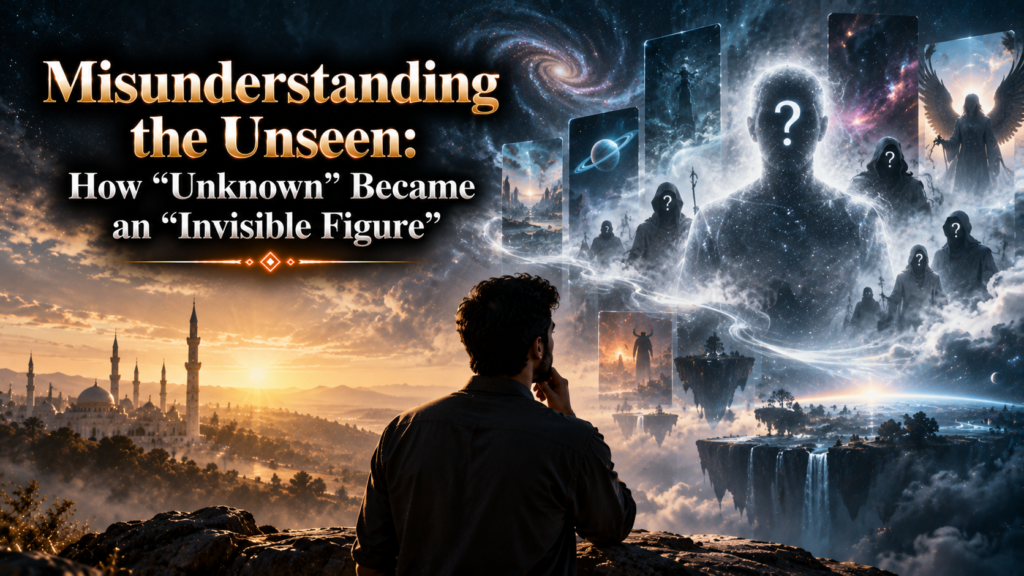
Many people read the word ghaib (the unseen), and their minds immediately form an image:
Something that cannot be seen.
Then, from “cannot be seen”, the mind takes another step:
Invisible.
And when someone says:
“Allah is unseen,”
the mind eventually constructs an image of Allah as a figure that exists but cannot be seen.
This is where a major misunderstanding begins.
Because when something is imagined as “existing but invisible”, it has already been placed within the category of a thing.
Yet the Quran gives a very clear warning:
لَيْسَ كَمِثْلِهِ شَيْءٌ
“There is nothing whatsoever like Him.”
— Ash-Shura 42:11
Notice the word:
شَيْءٌ
“A thing.”
If Allah is imagined as a figure, and that figure is distinguished from creation only because it is “invisible”, then the mind is still operating within the categories of things, forms and objects.
The only difference is that the object has been given the attribute:
Invisible.
That is the trap.
⸻
GHAIB DOES NOT MEAN INVISIBLE
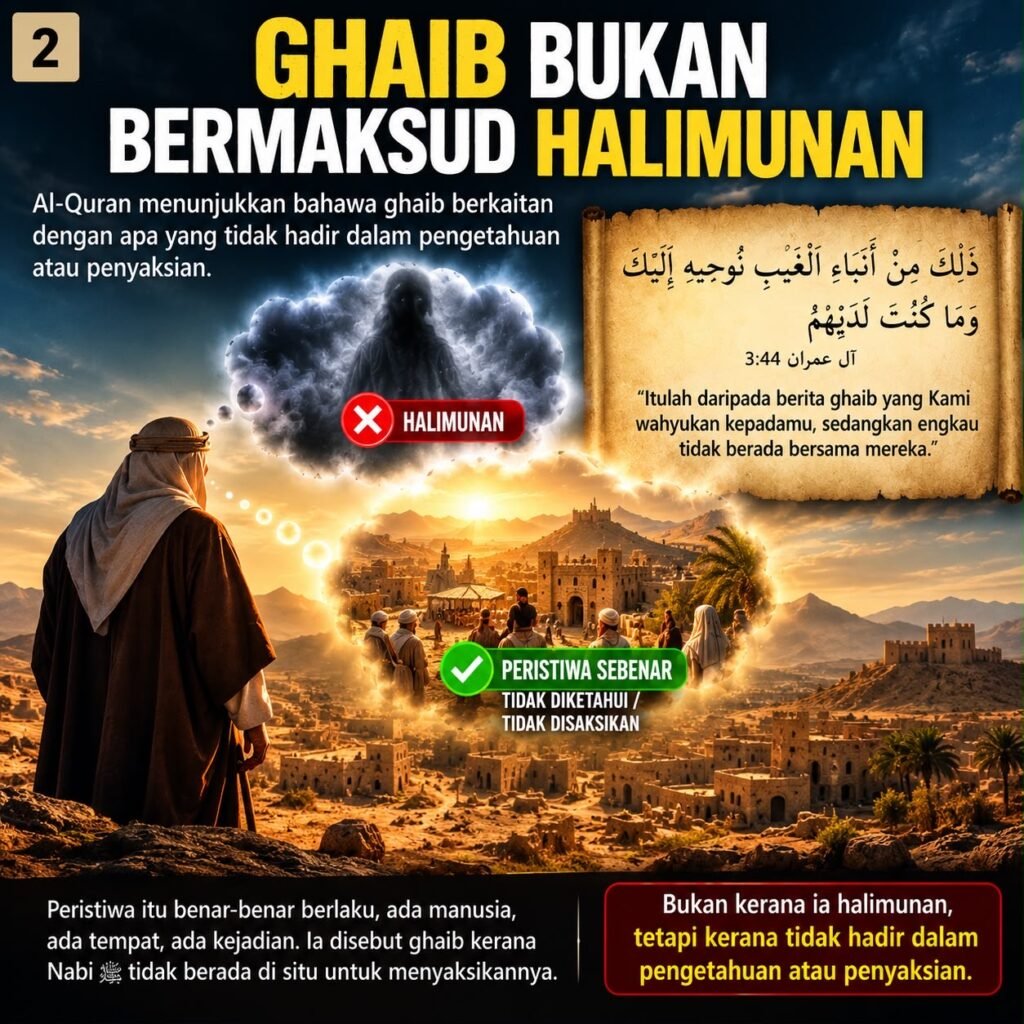
The Quran itself shows that ghaib relates to what is absent from knowledge or witnessing.
Consider Allah’s statement:
ذَٰلِكَ مِنْ أَنبَاءِ الْغَيْبِ نُوحِيهِ إِلَيْكَ وَمَا كُنتَ لَدَيْهِمْ
“That is among the accounts of the unseen which We reveal to you, while you were not present with them.”
— Ali ‘Imran 3:44
This verse is extremely important.
The events mentioned had actually taken place.
People were present.
The events unfolded.
But Prophet Muhammad ﷺ was not with them when those events occurred.
Therefore, they are described as:
أَنبَاءِ الْغَيْبِ
“Accounts of the unseen.”
Were the people involved in those events invisible?
No.
Was the location invisible?
No.
Did the events lack physical form?
No.
They were described as ghaib because the Prophet ﷺ was not there to witness them.
This verse alone is enough to challenge the assumption that:
GHAIB = INVISIBLE.
⸻
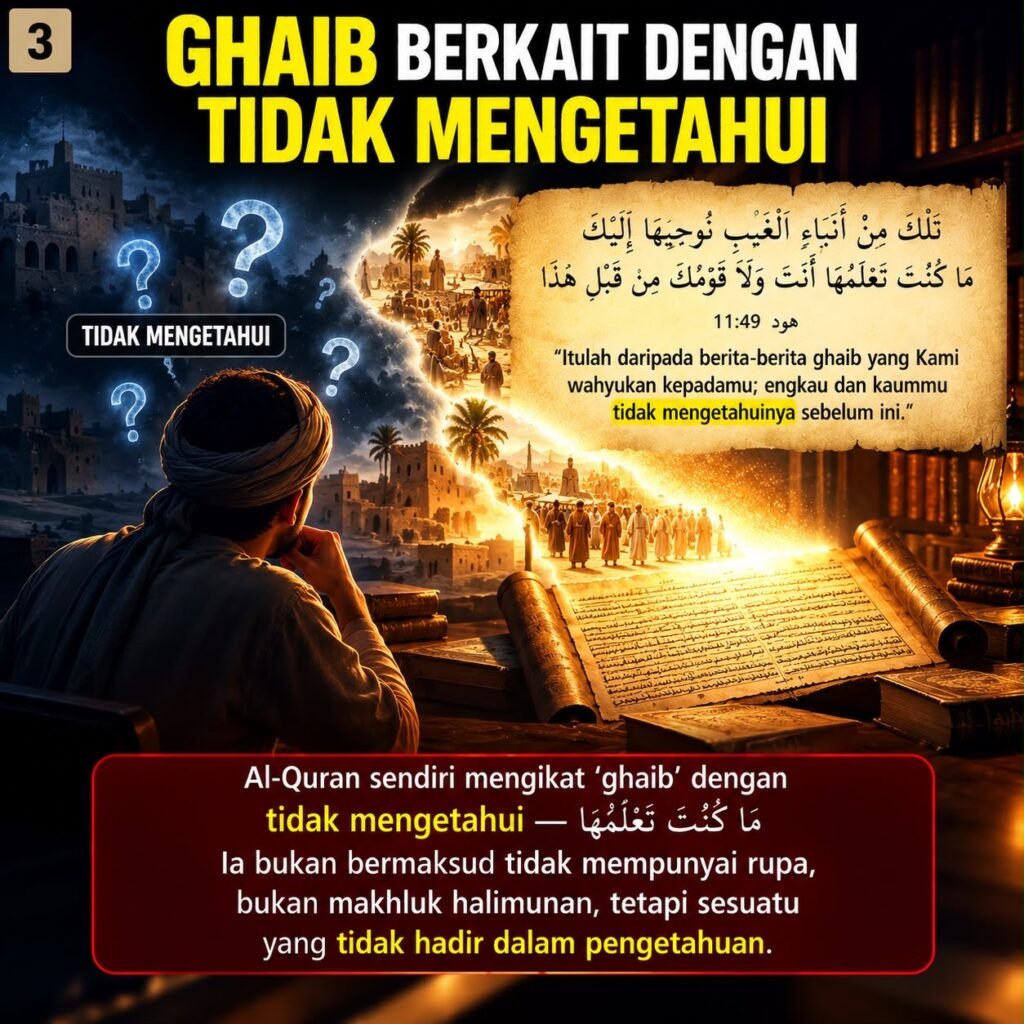
THE QURAN ITSELF CONNECTS GHAIB WITH KNOWLEDGE
Allah states:
تِلْكَ مِنْ أَنبَاءِ الْغَيْبِ نُوحِيهَا إِلَيْكَ مَا كُنتَ تَعْلَمُهَا أَنتَ وَلَا قَوْمُكَ مِن قَبْلِ هَذَا
“These are among the accounts of the unseen which We reveal to you. Neither you nor your people knew them before this.”
— Hud 11:49
Notice the phrase:
مَا كُنتَ تَعْلَمُهَا
“You did not know them.”
Here, the Quran itself provides a clue to the meaning.
Ghaib relates to:
NOT KNOWING.
Not:
Having no physical appearance.
Not:
An invisible creature.
Not:
A figure that cannot be seen.
But something absent from a person’s knowledge.
⸻
ANOTHER VERY CLEAR VERSE
Allah states:
ذَٰلِكَ مِنْ أَنبَاءِ الْغَيْبِ نُوحِيهِ إِلَيْكَ
“That is among the accounts of the unseen which We reveal to you.”
— Yusuf 12:102
The story of Prophet Yusuf عليه السلام is described as an account of the unseen for Prophet Muhammad ﷺ.
Why?
Because Prophet Muhammad ﷺ did not live during the time of Prophet Yusuf عليه السلام.
He did not stand inside the palace.
He did not witness Yusuf’s brothers.
He was not inside the prison.
He did not personally witness those events.
But when revelation explained them, what had previously been unknown became known.
Those events never changed from being “invisible” into being “visible”.
What changed was:
FROM UNKNOWN TO KNOWN.
⸻
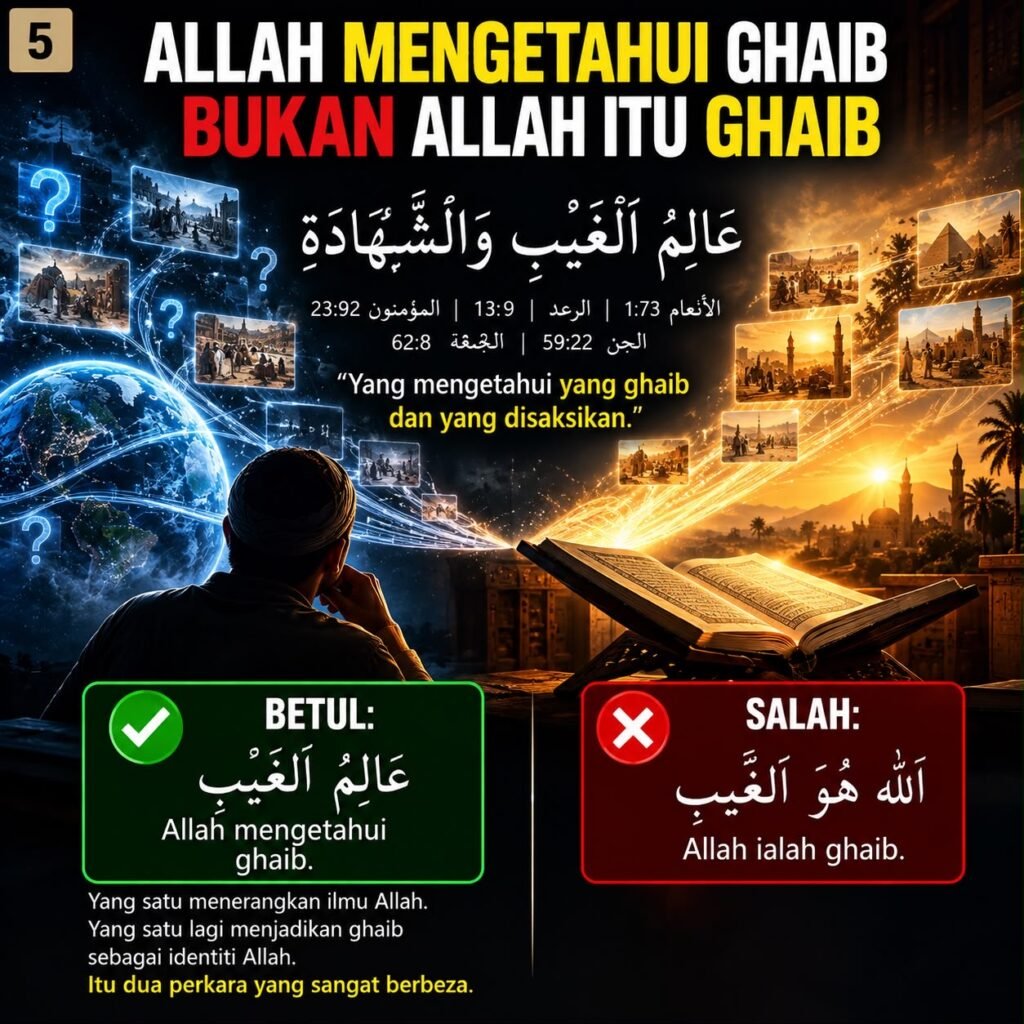
ALLAH KNOWS THE UNSEEN
This is an extremely important point.
The Quran repeatedly uses the expression:
عَالِمُ الْغَيْبِ وَالشَّهَادَةِ
“The Knower of the unseen and the witnessed.”
Among the references are:
— Al-An‘am 6:73 — Ar-Ra‘d 13:9 — Al-Mu’minun 23:92 — Al-Hashr 59:22 — Al-Jumu‘ah 62:8
Notice the structure of the expression.
The Quran says:
عَالِمُ الْغَيْبِ
“The Knower of the unseen.”
The Quran does not say:
الله هو الغيب
“Allah is the unseen.”
Those are two very different statements.
One describes knowledge.
The other turns ghaib into the identity of Allah.
Do not confuse the two.
⸻
“GHAIB” AND “SHAHADAH”
The Quran pairs two words:
الْغَيْبِ وَالشَّهَادَةِ
The unseen and the witnessed.
Shahadah relates to what is present within witnessing.
Ghaib relates to what is absent from witnessing.
Therefore, in many Quranic verses, the opposite of ghaib is not “coloured”, “physical” or “visible”.
The opposite used is:
الشَّهَادَة
WITNESSING.
This is where the misunderstanding must be corrected.
The issue is not the eyes.
The issue is:
WHETHER SOMETHING IS PRESENT OR ABSENT FROM KNOWLEDGE AND WITNESSING.
⸻
A SIMPLE EXAMPLE
A child is in Jakarta.
His father is in Makkah.
The father cannot see his child.
Does that make the child invisible?
No.
The child is simply absent from his father’s witnessing at that moment.
Then someone sends a video.
The father sees his child.
The child has not suddenly “come into existence”.
The child has not suddenly “emerged from an invisible realm”.
The only thing that has changed is:
INFORMATION AND WITNESSING.
That is how simple this distinction is.
⸻
HOW DOES THIS MISUNDERSTANDING BECOME DANGEROUS?
It begins with one word:
Ghaib.
Then the mind translates that word into:
Cannot be seen.
Then:
Invisible.
Then someone says:
Allah is unseen.
And an image forms in the mind:
There is “something” somewhere,
it cannot be seen,
its form is unknown,
but it is still imagined as a figure.
Eventually, the person claims that they do not imagine Allah.
Yet their mind has already constructed the category:
“Something that cannot be seen.”
That is still the category of a thing.
⸻
DO NOT TURN “GHAIB” INTO A PHYSICAL APPEARANCE
Ghaib is not an appearance.
Ghaib is not a form.
Ghaib is not a colour.
Ghaib is not a figure.
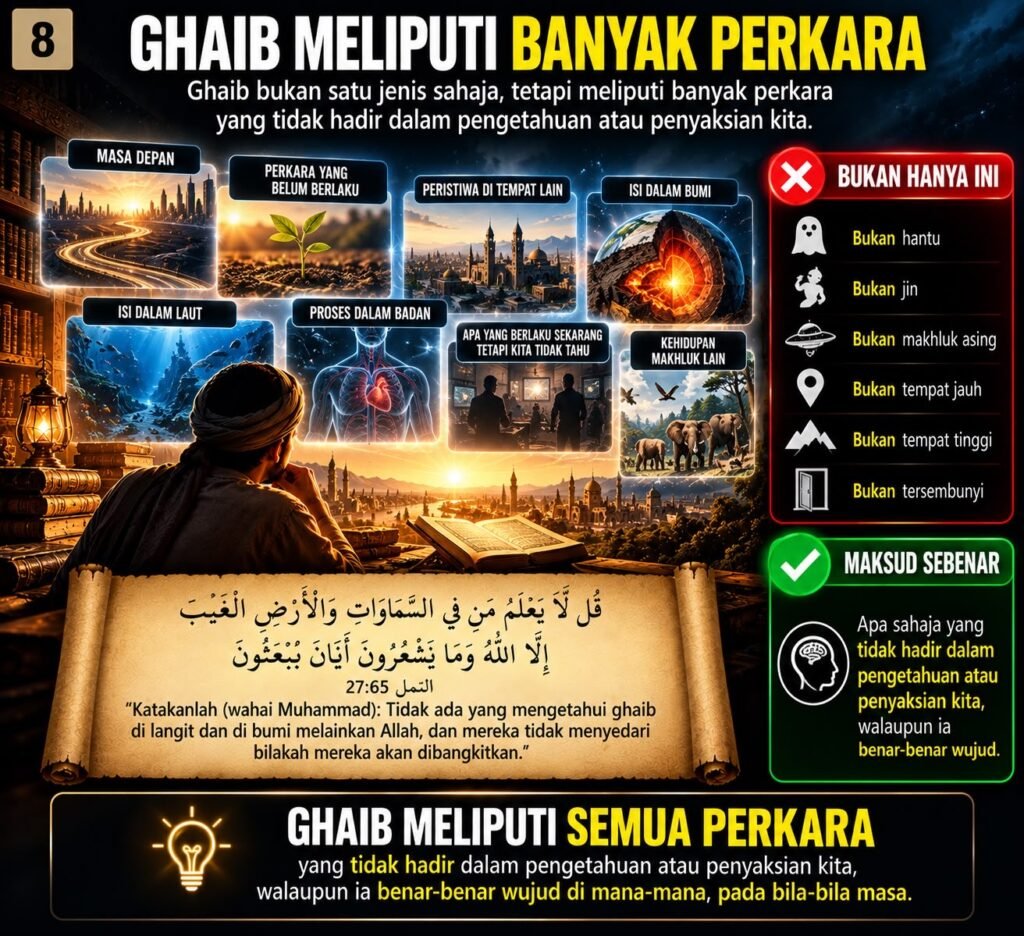
Ghaib is not a term for transparent creatures.
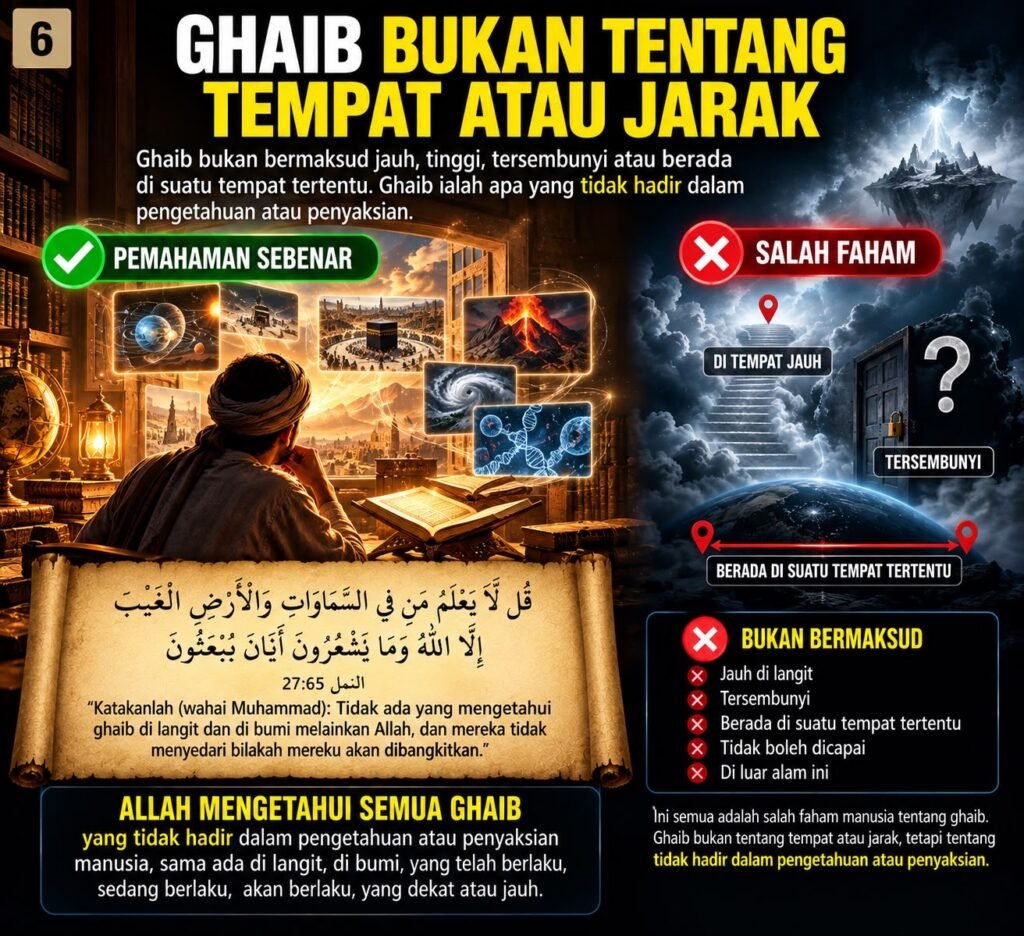
Ghaib describes the limits of human knowledge and witnessing.
That is why the Quran states:
وَعِندَهُ مَفَاتِحُ الْغَيْبِ لَا يَعْلَمُهَا إِلَّا هُوَ
“And with Him are the keys of the unseen; none knows them except Him.”
— Al-An‘am 6:59
Once again, this verse uses:
يَعْلَمُهَا
“Knows them.”
The question concerns knowledge.
⸻
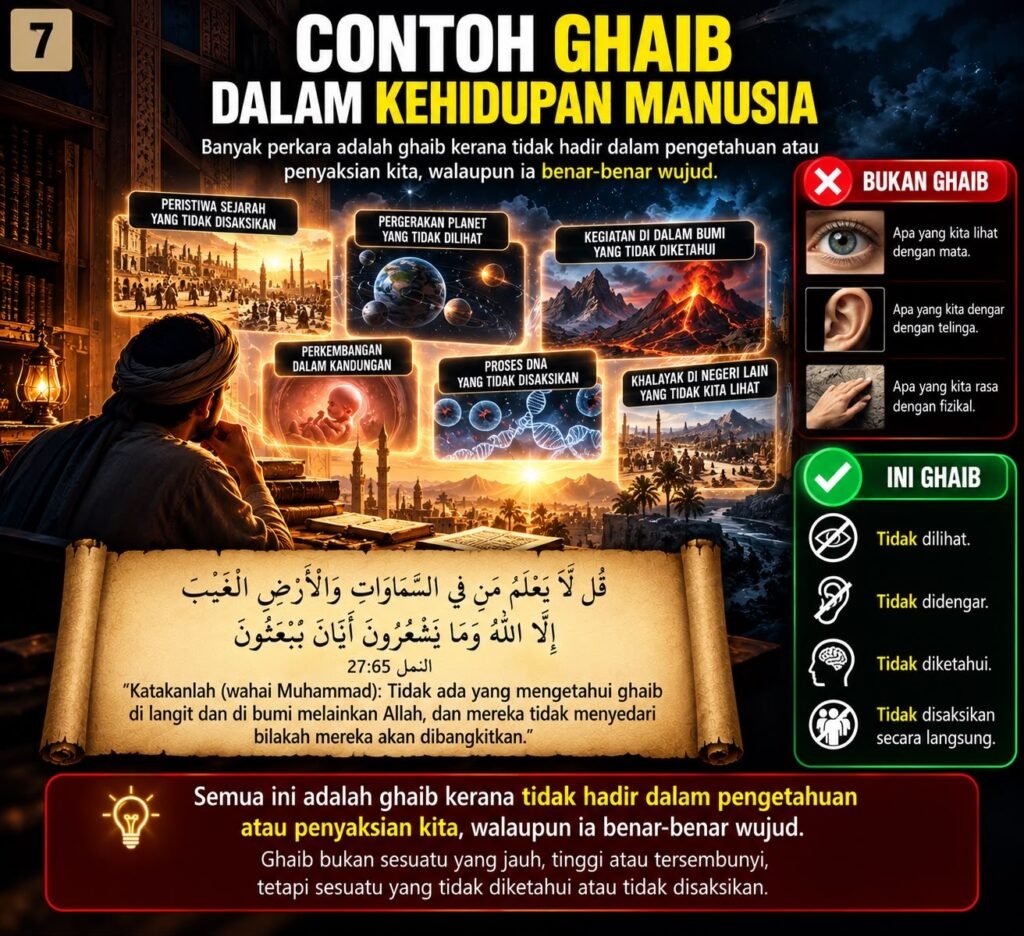
THE SAME APPLIES TO AN-NAML 27:65
قُل لَّا يَعْلَمُ مَن فِي السَّمَاوَاتِ وَالْأَرْضِ الْغَيْبَ إِلَّا اللَّهُ
“Say: None in the heavens and the earth knows the unseen except Allah.”
— An-Naml 27:65
Once again, the wording is:
لَا يَعْلَمُ
“Does not know.”
Not:
“Does not see.”
Not:
“Cannot see invisible creatures.”
But:
DOES NOT KNOW THE UNSEEN.
⸻
WHAT HAPPENS WHEN THE UNSEEN IS DISCLOSED?
Allah states:
عَالِمُ الْغَيْبِ فَلَا يُظْهِرُ عَلَىٰ غَيْبِهِ أَحَدًا إِلَّا مَنِ ارْتَضَىٰ مِن رَّسُولٍ
“The Knower of the unseen, and He does not disclose His unseen to anyone, except a Messenger whom He approves.”
— Al-Jinn 72:26–27
Notice:
يُظْهِرُ
“To reveal”, “to make manifest”, “to disclose”.
This means something previously unknown can be disclosed.
Once disclosed, it becomes known.
This again shows that the question of ghaib relates to:
ACCESS TO KNOWLEDGE.
⸻
THE GREATEST TRAP
The greatest trap is not in the word itself.
The trap occurs when human beings turn a word into an imagined figure.
A person reads:
Ghaib.
But their mind draws:
“An invisible figure.”
Then they call that figure:
“Allah.”
After that, they say:
“Allah does not resemble creation.”
But the structure of the imagination remains the same:
There is an object,
there is a figure,
there is something,
except that it cannot be seen.
This is where human beings must stop and return to the revealed text.
The Quran states:
لَيْسَ كَمِثْلِهِ شَيْءٌ
“There is nothing whatsoever like Him.”
— Ash-Shura 42:11
Do not first construct “something” in your mind and then say:
“But it is unlike anything else.”
The problem begins when Allah has already been placed within the category of a thing in the imagination.
⸻
GHAIB MUST NOT BECOME A HIDING PLACE FOR IMAGINATION
Some people reject statues.
They reject idols.
They reject human forms.
They reject images.
But after that, they construct an “unseen form” in their minds.
The only difference is:
A statue can be seen.
Their mental image cannot be seen.
If both are still imagined as figures, the problem remains unresolved.
Tawhid requires human beings to stop constructing Allah as an object of thought.
Allah is not a visible thing.
Allah is also not an invisible thing.
Do not place Allah within the category of things in the first place.
⸻
CONCLUSION
The word ghaib has long been simplified to mean:
Invisible.
From a small linguistic mistake, a major error in imagination emerges.
The Quran shows that:
Ghaib relates to what is absent from knowledge and witnessing.
That is why past history can be described as ghaib.
Events we did not witness can be ghaib.
The future can be ghaib.
Information not yet known can be ghaib.
But none of these necessarily means “invisible”.
Therefore, be careful when saying:
“Allah is unseen.”
Do not allow that statement to become, within your mind:
“Allah is an invisible figure.”
The Quran does not teach human beings to imagine Allah as an unseen figure.
The Quran states:
عَالِمُ الْغَيْبِ وَالشَّهَادَةِ
“The Knower of the unseen and the witnessed.”
And the Quran closes the door to imagination:
لَيْسَ كَمِثْلِهِ شَيْءٌ
“There is nothing whatsoever like Him.”
Therefore, the real problem is not that human beings cannot see Allah.
The real problem is that human beings still want to imagine Allah as something that can either be seen or not seen.
As long as “something” continues to be constructed in the mind, that imagined figure has not been released.
GHAIB DOES NOT MEAN INVISIBLE.
ALLAH KNOWS THE UNSEEN.
And do not use the word ghaib as a back door to construct an “invisible figure” and then call it Allah.
Detecting your location…