
MUKADDIMAH · M01
Islam Is Not an Inherited Religion: Faith After Reason
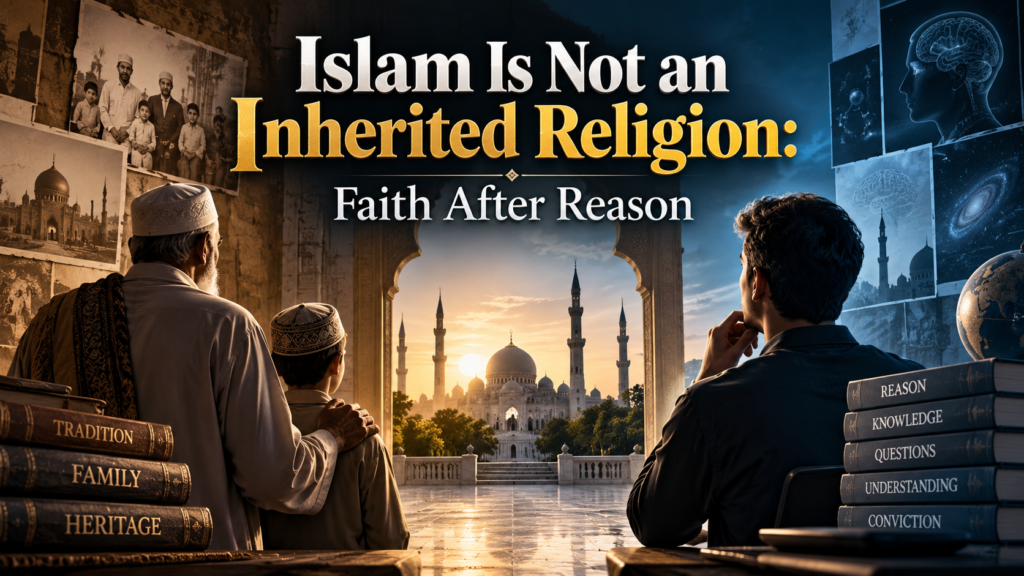
Many people first encounter religion through their families.
A child grows up surrounded by the name of a religion, its language, practices, customs and the way of thinking of the community around them.
Before the child is even capable of asking questions, they have already been told what they are expected to believe.
The question is not whether parents are wrong to teach religion to their children.
The deeper question is:
Does something automatically become faith simply because it has been inherited?
If someone is born into a Muslim family, does birth alone mean that they have recognised what they believe in?
If they repeat what they were taught as a child without ever understanding what those words mean, what distinguishes inheriting a religion from actually having faith?
SiHulk begins its Mukaddimah from this question because Islam should not be reduced to a tradition that requires people to silence their reason and accept something merely because previous generations accepted it.
The journey towards faith requires more than inheritance.
It requires consciousness.
It requires inquiry.
And it requires the use of:
Reason — akal.
Religion Cannot Be Forced into Becoming Faith
The Qur’an establishes an important principle:
لَا إِكْرَاهَ فِي الدِّينِ
“There is no compulsion in religion…”
— Al-Baqarah 2:256
The verse does not end with the statement that there is no compulsion.
It continues by declaring that right guidance has become distinct from error, followed by rejection of taghut and belief in Allah.
There is a significant movement here.
Something must be distinguished.
Something must be rejected.
And something must be affirmed.
Faith therefore cannot be reduced to an instruction:
“Just believe.”
Before believing, a person should seek to understand:
What am I believing?
Why do I believe it?
What am I rejecting?
And upon what basis am I affirming something as true?
Compulsion may produce outward conformity.
It may produce repetition.
It may even produce religious identity.
But none of those things automatically produces conscious faith.
Faith requires more than obedience to inherited expectation.
It requires an inward recognition of what is being accepted.
Reason Is Not the Enemy of Faith
Religious questioning is sometimes treated as though the more questions a person asks, the weaker their faith must be.
But questioning and rejection are not the same thing.
A sincere question may arise because a person wishes to understand.
They may want to know whether something they inherited is actually supported by revelation.
They may wish to distinguish between what the Qur’an says and what later generations have said about it.
They may want certainty rather than repetition.
The Qur’an itself warns:
وَلَا تَقْفُ مَا لَيْسَ لَكَ بِهِ عِلْمٌ
“Do not follow what you have no sure knowledge of.”
— Al-Isra’ 17:36
This raises an important question.
If human beings are warned against following something without knowledge, why should matters of faith be exempt from examination?
Why should a person be satisfied with:
“I believe because this is what I was taught since childhood”?
For SiHulk, reason is not a competitor to faith.
Reason is one of the paths towards faith.
Reason does not replace revelation.
It helps the human being receive, examine and understand what revelation communicates.
Being Born into a Religion Is Not the Same as Recognising It
The hadith of fitrah draws attention to the influence of family and environment upon religious identity.
Abu Hurairah reported that the Prophet Muhammad SAW taught that every child is born upon fitrah, after which the parents influence the religious formation of that child.
This illustrates something fundamental.
A child does not choose where they are born.
They do not choose their parents.
They do not choose the language first spoken to them.
They do not choose the first religious ideas they encounter.
They do not choose the community that initially defines what is normal for them.
The first religious identity a person receives is therefore usually given before it is examined.
This requires us to distinguish between:
an identity received through birth and environment
and
an understanding reached through conscious reasoning.
A person may carry the name “Muslim” from birth.
But understanding why they are Muslim still requires inquiry.
Understanding what they believe requires inquiry.
Understanding what they deny requires inquiry.
Understanding what they testify to requires inquiry.
Birth can give a person an identity.
Recognition requires a journey.
From Taqlid to Recognition
Imagine someone born in a place where every generation says that a particular road leads to a particular destination.
The person believes it because their father told them.
Their father believed it because their grandfather told him.
Their grandfather may have received the same information from someone before him.
Perhaps the information is correct.
But there remains a difference between someone who says:
“I believe this road leads there because my parents told me so.”
and someone who has actually travelled the road and recognised the destination.
The first has received information.
The second possesses recognition.
This distinction matters.
SiHulk does not argue that everything inherited is false.
Nor does inheritance itself prove that something is wrong.
The principle is simpler:
Something does not become true merely because it has been inherited.
Truth remains truth whether inherited or discovered.
But for the individual, truth still needs to be recognised as truth.
Otherwise, the person may only be repeating the conclusion of someone else.
This is where taqlid becomes an important question.
Following knowledge passed down by others can have value.
Human beings cannot personally rediscover everything.
But following something should not permanently remove the responsibility to understand.
Inheritance may be the beginning of a person’s religious journey.
It should not automatically be regarded as its completion.
Reason: Negation and Affirmation
Reason has a role greater than memorisation alone.
It must be able to:
Question → Examine → Compare → Distinguish → Negate → Affirm
These movements become especially important when we encounter the declaration:
لَا إِلٰهَ إِلَّا الله
Even before examining its deeper meaning, we can observe its structure.
لَا — negation
then
إِلَّا — exception
then
الله — affirmation
There is first a denial.
Then a distinction.
Then an affirmation.
This is not an empty sequence of sounds.
A conscious person must eventually ask:
What is being denied?
Why is it being denied?
What is being excluded from that denial?
And what is ultimately being affirmed?
A person cannot consciously negate and affirm if they do not understand what they are negating and affirming.
This is why reason matters.
The human being must not merely pronounce words.
They must seek to understand what those words demand.
Memorisation Is Not the Enemy — But Neither Is It the Destination
SiHulk does not reject memorisation.
Memorisation has an important place in learning.
People memorise the Qur’an.
They memorise prayers.
They memorise hadith.
They memorise terminology.
They memorise principles of law and theology.
They memorise the teachings of scholars.
The problem begins when:
memorisation takes the place of recognition.
Imagine someone who has memorised thousands of pages about the ocean without ever standing before it.
They know the chemical composition of water.
They know its depth.
They know the names of the world’s oceans.
They know how tides operate.
They can describe waves.
But possessing information about the ocean and standing before the ocean itself are not the same experience.
One is information.
The other introduces recognition.
The same distinction can arise in religion.
Knowing terminology about Allah does not necessarily mean recognising Allah.
Knowing the Sirah of Prophet Muhammad SAW does not necessarily mean recognising his station.
Knowing definitions of faith does not necessarily mean possessing faith.
Memorising the Shahadah does not necessarily mean becoming a conscious witness to what is being declared.
Knowledge is necessary.
Memorisation can support knowledge.
But knowledge should lead somewhere.
It should lead towards recognition.
Faith After Reason
When we say:
“Faith after reason,”
we are not saying that human reason becomes the absolute judge over revelation.
Human reason has limits.
Human beings can misunderstand.
They can begin with incorrect information.
They can reason from assumptions.
They can be influenced by culture, fear, pride, authority and personal desire.
Reason itself therefore requires discipline.
But recognising the limits of reason is different from abandoning reason.
Something as profound as faith should not rest entirely upon:
inheritance,
social pressure,
fear of questioning,
or
repetition without understanding.
Reason is used to seek.
Revelation guides.
Questions open the way.
Evidence is examined.
And recognition becomes the objective.
The approach therefore is not:
Believe first and never ask.
Instead:
Use reason. Examine. Question. Seek knowledge. Recognise what you believe.
Then belief is no longer merely something carried because others placed it upon you.
It begins to become something consciously held.
Inheritance, Authority and Truth
Human beings naturally depend upon authority.
A child depends upon parents.
A student depends upon teachers.
A community depends upon people with specialised knowledge.
There is nothing inherently wrong with this.
The difficulty begins when authority itself becomes the final evidence for truth.
A statement is not automatically true because a respected person said it.
A belief is not automatically true because many people hold it.
A tradition is not automatically true because it is old.
Likewise, something is not automatically false merely because it is new, unfamiliar or questioned.
The proper question remains:
What makes it true?
Authority can transmit knowledge.
Tradition can preserve knowledge.
Teachers can explain knowledge.
Books can record knowledge.
But eventually the seeker still carries responsibility for how they understand what has been received.
This is why sincere inquiry should not be feared.
A strong truth does not need ignorance in order to survive.
The Question Before Us
Rather than beginning with:
“What is your religion?”
there is another question worth asking first:
“Why do you believe what you believe?”
If the answer is:
“Because my parents taught me this,”
that explains how the belief reached you.
It does not yet explain why the belief is true.
If the answer is:
“Because everyone around me believes it,”
that tells us something about the community in which we live.
It still does not establish truth.
If the answer is:
“Because an authority told me so,”
we must still ask why that authority reached such a conclusion.
And if the answer is:
“I am not allowed to question it,”
another question immediately arises:
Why were human beings given reason if, in the most important matters of their existence, reason must never be used?
Faith should not fear sincere examination.
The purpose of questioning is not necessarily to destroy belief.
It may instead remove assumptions that have prevented belief from becoming conscious.
From Belief Towards Witnessing
A person can believe a report that they have never personally examined.
But witnessing carries a deeper implication.
Islam contains a declaration called:
Shahadah — Testimony.
The word itself raises a serious question.
What does it mean to be a witness?
A witness should know what they are testifying to.
A witness should understand what is being affirmed.
A witness should understand what is being denied.
A witness should not merely repeat sounds without seeking their meaning.
This is why the distinction between inheritance and recognition matters so much.
The journey cannot end with:
“I was told to believe.”
It must eventually confront:
“What do I know?”
“What do I recognise?”
“What am I denying?”
“What am I affirming?”
“And what am I actually bearing witness to?”
This is where inherited religion begins to face the demands of conscious faith.
Faith is not merely a name received at birth.
It is not merely a collection of phrases preserved by repetition.
It is not merely social belonging.
Faith requires recognition.
And recognition requires a human being who is willing to seek, examine, understand and bear responsibility for what they finally affirm.
References
1.Al-Qur’an, Surah Al-Baqarah, 2:256.
2.Al-Qur’an, Surah Al-Isra’, 17:36.
3.Imam Muslim, Sahih Muslim, Kitab al-Qadar, Hadith no. 2658b.
4.Ibn Kathir, Tafsir al-Qur’an al-‘Azim, commentary on Surah Al-Baqarah, 2:256.