
IMAN
Aqidah Begins with the Correct Categories
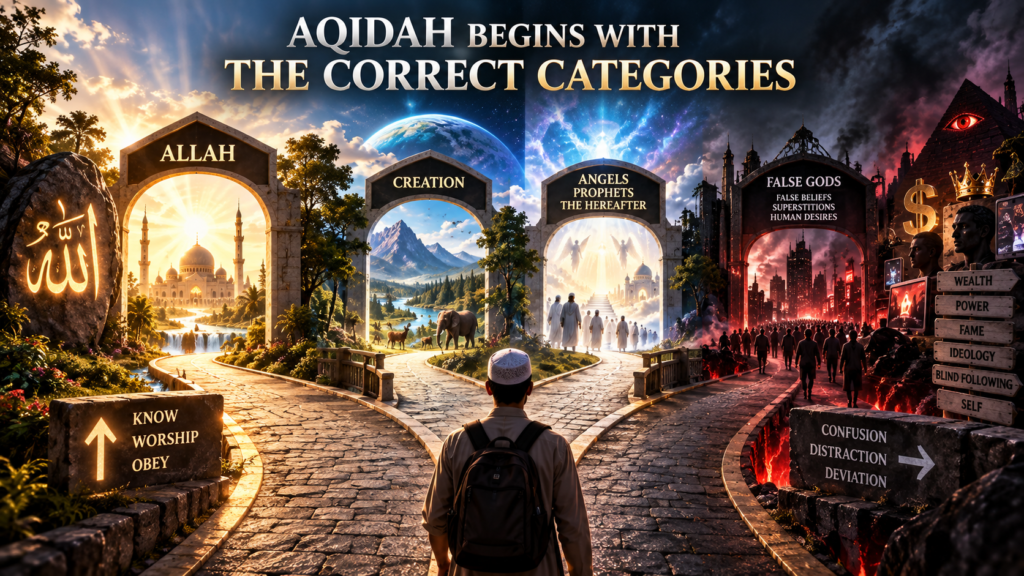
This entire discussion brings us to one very important reality:
Errors in aqidah sometimes do not begin with intention,
but with the wrong categories of thought.
Human beings want to know Allah.
That is good.
Human beings want to understand the verse:
لَيْسَ كَمِثْلِهِ شَيْءٌ
“He cannot be likened to anything.”
That is also good.
But when the mind begins its search with the assumption:
“Allah is something,”
the entire journey that follows can easily go astray.
From that single assumption arise various questions:
Where?
How?
Above or below?
Inside or outside?
Near or far?
Sometimes the problem is not that a person deliberately wants to go astray.
The problem is that the person is trying to understand Allah using categories normally used to understand things and space.
That is where the fundamental error begins.
⸻
AQIDAH CANNOT BE GIVEN A SCORE OF 70% OR 80%
In mathematics:
2 + 2 = 4.
If the answer is 3.8, we do not say:
“That is almost correct.”
The answer remains incorrect.
The same applies to the foundations of aqidah.
It is not a field of knowledge in which one can say:
“70% correct is sufficient.”
“80% is already excellent.”
Because one incorrect premise at the beginning can change the entire conclusion at the end.
If the foundation is:
“Allah is something,”
and one merely adds:
“…but He is not like His creation,”
then the issue of categorisation has still not been resolved.
That is why aqidah demands precision and consistency in its foundations.
Not empty assertions.
Not approximations.
Not because many people repeat the same thing.
But because every premise must be examined until it does not contradict the overall structure of understanding.
If one foundation is wrong, the entire structure can change.
⸻
THE CENTRAL PRINCIPLE THAT MUST BE UPHELD
Essence is not a thing.
Attributes are not things.
Actions are not things.
They are not objects.
They are not concrete in the way created beings are.
They are not forms that need to be imagined.
Within the framework of this argument, they are understood as statements and descriptions, not as things that exist as objects in themselves.
Therefore:
Essence — the reality towards which one is directed.
Attributes — descriptions of the Essence.
Af‘al / Actions — the manifestation of the Attributes through actions.
Thus, what is being sought is not an appearance.
Not a form.
Not an unseen object.
Rather, it is an understanding of:
Essence,
Attributes,
and Actions.
⸻
TWO SCHOOLS OF THOUGHT — BUT THEY MAY SHARE THE SAME FUNDAMENTAL PROBLEM
This is where two major tendencies arise, often coming into conflict with one another.
THE FIRST SCHOOL OF THOUGHT
One school understands Allah using the language of location:
“Allah is above the heavens.”
Some go further:
“Allah is outside the universe.”
The logical problem immediately arises when words such as:
above, below, inside, outside
are used as literal locations.
The Earth is spherical.
The sky is not a flat roof with one absolute direction of “above” for all humanity.
A person standing in Indonesia and a person standing on the physically opposite side of the Earth point in different directions when indicating “above.”
Therefore, when “above” is used as a literal spatial coordinate, new questions remain unresolved:
Above which direction?
From which point of reference?
Outside in which direction?
How far away?
What is the boundary between the universe and “outside the universe”?
The further these questions are pursued, the clearer it becomes that the mind is using the language of the location of things.
⸻
THE SECOND SCHOOL OF THOUGHT
The second school, on the other hand, emphasises:
Allah is not material.
Allah is not a physical body.
Allah is not confined to a location.
In words, the problem appears to have been resolved.
But that is not necessarily the case in the mental image a person retains.
Because someone may say:
“Allah is not a physical body,”
while still retaining the following image in their mind:
“There is an unseen entity named Allah.”
That entity may not be imagined as having hands or feet.
It may not be assigned a colour.
It may not be given any particular form.
But it is still conceived as “something that exists somewhere.”
If that is the case, the tongue has uttered the term “not a physical body,”
but the structure of thought is still turning Allah into an object.
The mouth negates physical form.
The mind continues to construct an object.
This is a far more subtle misunderstanding.
⸻
WHY DO BOTH SIDES CONTINUE TO ARGUE?
One side defends:
“Above.”
The other side defends:
“Not confined to a location.”
Each side presents scriptural evidence.
Each side presents books.
Each side cites prominent figures.
Each side is convinced that it is defending aqidah.
But why is the dispute so difficult to resolve?
Within the framework of the argument being developed here, the reason is that both sides may still be trapped within the same question:
“Where is this something called Allah?”
The first side answers:
“Above.”
The second side answers:
“Nowhere.”
But if the very first premise remains:
“Allah is something,”
they have not moved beyond the original problem.
They have merely provided two different answers to the same category of question.
That is why the debate can continue endlessly.
Not merely because they lack evidence.
But because an earlier question has not yet been resolved:
Should Allah be placed within the category of “something” whose location must then be sought?
If that fundamental question is not examined, human beings will continue asking:
Where?
Above or not?
Inside or outside?
Near or far?
Yet the actual problem may have begun before any of these questions arose.
⸻
RETURN TO THE FOUNDATIONAL VERSE
لَيْسَ كَمِثْلِهِ شَيْءٌ
In the interpretation used throughout this series:
“He cannot be likened to anything.”
Therefore, before asking:
“Where?”
first examine:
Why are we searching for a location?
Before asking:
“Above or not?”
first examine:
Has the mind already constructed an object that requires a direction?
Before arguing about:
“Inside the universe or outside the universe?”
first examine:
Are the categories of “inside” and “outside” themselves only appropriate for things that occupy space?
This is the correction that must take place at the most fundamental level.
⸻
IMAGINE THE CONSEQUENCES IF THIS FOUNDATION IS WRONG
Now imagine that this fundamental misunderstanding does not occur in just one person.
Instead, it is taught to:
children,
school students,
university students,
students of religious studies,
teachers,
preachers,
and generation after generation.
If the initial premise is never examined, an entire education system may repeat the same structure of thought for decades or centuries.
Students memorise.
They pass examinations.
Then they become teachers.
The teachers teach new students.
The new students memorise the same thing.
Eventually, what initially began as a mere error in the categories of thought can become the mainstream structure of thinking.
Not because everyone has malicious intentions.
But because something inherited and never examined eventually comes to be regarded as beyond question.
An individual error can be corrected.
A systemic error can be inherited as “knowledge.”
⸻
THE BOOKS STILL EXIST — BUT KNOWLEDGE CAN DISAPPEAR
The Messenger of Allah ﷺ explained that Allah does not take away knowledge by removing it directly from human beings. Rather, knowledge is taken away through the passing of the ulama.
When knowledgeable scholars are no longer present, people appoint ignorant leaders. They are asked questions and issue fatwas without knowledge, thereby going astray and leading others astray.
— Narrated by al-Bukhari and Muslim
Pay attention to this.
The Hadith does not describe knowledge disappearing because:
libraries are burned,
religious books are destroyed,
or written texts vanish.
Books may still fill the shelves.
Manuscripts may be preserved.
There may be millions of PDFs.
Universities may continue to grow.
Religious studies may become increasingly widespread.
Yet living understanding can continue to diminish.
Why?
Because:
books preserve texts.
But knowledgeable human beings carry understanding.
When the ulama who truly understand pass away, what disappears is not necessarily the written words.
What may disappear is:
the ability to read,
the ability to understand,
the ability to connect ideas,
the ability to examine logic,
the ability to awaken awareness,
and the ability to correct the structures of human thought.
That is why human beings can inherit thousands of books yet still lose something far more important:
the key to understanding them.
⸻
THIS IS WHERE ULAMA SU’ CAN FILL THE VACUUM
When the bearers of understanding become fewer, the vacuum can be filled by those who:
are eloquent,
are skilled at memorisation,
possess certificates,
hold positions,
have followers,
and have platforms.
But the measure of knowledge is not the number of books a person can cite.
The questions are:
Does that person bring understanding?
Does that person guide the mind?
Does that person dare to examine inherited premises?
Does that person open up meaning?
Or does that person merely repeat the same answers until the public regards repetition as proof?
This is where the distinction between:
someone who possesses information
and
someone who truly understands
becomes extremely significant.
⸻
WHY IS GUIDANCE IMPORTANT?
Because human beings can read the same verse yet develop two different structures of thought.
One person reads:
لَيْسَ كَمِثْلِهِ شَيْءٌ
and refrains from constructing a mental image.
Another person reads the same verse but still retains the idea of:
“something unseen, but unlike created beings.”
The same verse.
The same Book.
The same wording.
But what takes shape within the mind is not necessarily the same.
That is why a knowledgeable teacher does not merely check:
“Can you memorise it or not?”
The teacher examines:
What do you understand?
What do you imagine?
What are your premises?
And which categories is your mind using?
⸻
OVERALL SUMMARY
Do not begin with an imagined image.
Begin with the descriptions.
Do not search for an appearance when revelation provides descriptions.
Do not construct an unseen object and then give it the name Allah.
Do not assume that a tongue capable of saying “not a physical body” necessarily means that the mind has stopped turning Allah into an object.
And do not spend generations arguing about:
above or not,
inside or outside,
confined to a location or not confined to a location,
before resolving a much earlier question:
Why is Allah being placed within the category of things that require all these questions?
Seek to recognise through:
Essence,
Attributes,
and Actions.
Not through:
objects,
appearances,
locations,
and imagination.
⸻
CONCLUSION
لَيْسَ كَمِثْلِهِ شَيْءٌ
“He cannot be likened to anything.”
Aqidah is not an examination in which one can score:
70%,
80%,
or 90%,
and then consider that sufficient.
Its foundations must be precise.
Because one incorrect premise can be passed down through an entire education system and eventually appear true simply because it has been repeated for so long.
And when the ulama who carry understanding pass away, knowledge does not necessarily disappear because books are burned.
Books may remain.
Written texts may remain.
Institutions may remain.
But understanding can disappear.
Ultimately, human beings may possess thousands of answers,
yet continue arguing because the fundamental question has never been resolved.
Aqidah becomes corrupted when statements are turned into objects.
Aqidah becomes sound when the mind moves beyond the categories of things and is guided towards descriptions.