
IMAN
Aqaid 50: Attributes Are Not Things and Must Be Understood Together
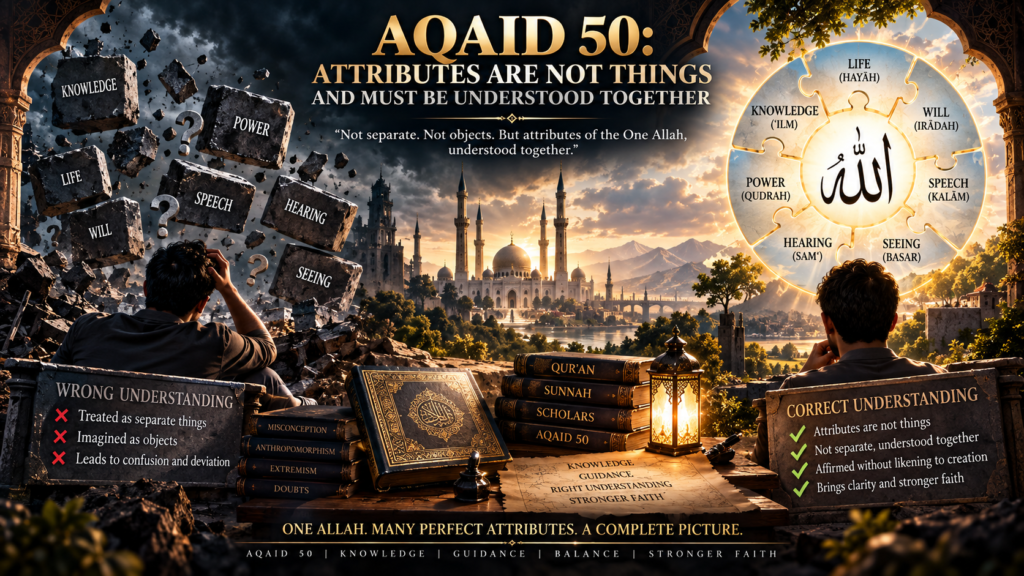
The first principle must be firmly established:
ATTRIBUTES ARE NOT THINGS.
An attribute is not a physical thing.
An attribute is not an object.
An attribute is not an entity that exists independently.
An attribute is merely a description of its bearer.
Once this fundamental principle is understood, the structure of Aqaid 50 can be viewed at a level beyond ordinary memorisation.
⸻
1. ATTRIBUTES ARE NOT TWO OBJECTS IN CONFLICT
When we mention:
Wujud ↔ ‘Adam
Zahir ↔ Batin
First ↔ Last
Siddiq ↔ Kizb
Amanah ↔ Khianah
do not imagine two objects.
Do not imagine two entities.
Do not imagine two “things” opposing one another.
Because:
ATTRIBUTES ARE NOT THINGS.
What exists are two descriptions that are paired together in relation to a single bearer of attributes.
The bearer of attributes is one.
Its attributes are many.
But an attribute never becomes an object separate from its bearer.
⸻
2. BEING PAIRED DOES NOT MEAN MUTUALLY NEGATING ONE ANOTHER
This is an important point.
We are not saying:
“Two attributes must fight against each other.”
No.
Nor are we merely saying:
“One attribute is understood because its opposite exists.”
That understanding is still too limited.
A more precise explanation is:
TWO DESCRIPTIONS WORK TOGETHER TO COMPLETE THE BEARER OF ATTRIBUTES.
A simple example is AI.
AI can be:
Responsive
and
Reactive.
Responsive and Reactive are not two objects.
They are two descriptions of a single system.
If it is only Responsive, the system merely waits for instructions.
If it is only Reactive, the system may respond to stimuli without necessarily providing a structured answer.
Functional completeness emerges when both work together.
Therefore:
Reactive detects.
Responsive answers.
One bearer.
Two descriptions.
One more complete function.
⸻
3. ZAHIR AND BATIN
Allah says:
هُوَ الْأَوَّلُ وَالْآخِرُ وَالظَّاهِرُ وَالْبَاطِنُ
“He is the First and the Last, the Manifest and the Hidden.”
This is very clear.
Zahir is not a thing.
Batin is not a thing.
Both are descriptions.
Their bearer is one.
Therefore, there is no problem with two descriptions that appear to be opposites being united within a single reality.
Why?
Because attributes are not objects.
Only when attributes are treated as objects does the mind begin to ask:
“How can two opposing objects exist together?”
That question arises because the categories were already misunderstood from the beginning.
⸻
4. FIRST AND LAST
Likewise:
First
and
Last.
Neither is a separate object.
Both are descriptions of a single reality.
Therefore:
First does not divide the bearer of attributes.
Last does not create a second bearer.
What changes is the perspective from which the description is made.
The bearer of attributes remains one.
⸻
5. WUJUD AND ‘ADAM
This is where the philosophy becomes deeper.
Aqaid 50 teaches:
Wujud — necessary.
‘Adam — impossible.
If understood merely through memorisation:
“Accept Wujud, discard ‘Adam.”
That is too superficial.
Because ‘Adam is not a thing either.
Wujud is not an object either.
Both are descriptions.
Therefore, the real discussion is not:
“Which object do we want to keep?”
Rather:
What do these two poles describe about the bearer of attributes?
This is where attributes must be understood together.
Not because the two attributes are two objects.
But because the two descriptions form a more complete field of explanation.
⸻
6. NECESSARY AND IMPOSSIBLE ATTRIBUTES ARE NOT TWO ENTITIES
Aqaid 50 is commonly structured as follows:
For Allah:
20 necessary attributes
20 impossible attributes
1 possible attribute
Total:
41
For the Messenger:
4 necessary attributes
4 impossible attributes
1 possible attribute
Total:
9
Overall total:
50
If we take only the necessary attributes and regard the impossible attributes as having no value in understanding, we are effectively cutting away half of the structure of knowledge.
Because an impossible attribute remains a description.
It describes a different pole.
It is not an object that must be “discarded” from the system.
⸻
7. THE BEARER OF ATTRIBUTES DETERMINES COMPLETENESS
An attribute is not complete as an object in itself, because an attribute is not an object in the first place.
Completeness is assessed in relation to the bearer of attributes.
For example:
Merciful.
That is one description.
The One Who Judges.
That is another description.
These two descriptions do not become two separate realities.
What determines completeness is the bearer of attributes who is capable of manifesting each attribute in its appropriate place.
Therefore, the principle is:
An attribute describes one aspect.
The bearer of attributes encompasses all aspects.
⸻
8. THE ATTRIBUTES OF THE MESSENGERS FOLLOW THE SAME PRINCIPLE
For the Messengers:
Siddiq ↔ Kizb
Amanah ↔ Khianah
Tabligh ↔ Kitman
Fatanah ↔ Baladah
Once again:
Siddiq is not an object.
Kizb is not an object.
Amanah is not an object.
Khianah is not an object.
All of these are descriptions.
What matters is the bearer of attributes.
The completeness of the bearer of the Message is assessed through how these attributes are brought together and manifested.
⸻
9. THE POSSIBLE ATTRIBUTE REVEALS THE SCOPE OF ACTION
Then there is the possible attribute.
The possible attribute is not a third object.
Nor is it a “thing” that connects two objects.
The possible attribute is a description of the scope of possibility.
For example, in af‘al:
giving ↔ withholding
giving life ↔ causing death
bestowing blessings ↔ inflicting punishment
The bearer of attributes is not confined to a single manifestation.
This is where the breadth of completeness becomes apparent.
⸻
10. THE GREATEST MISTAKE IS TURNING ATTRIBUTES INTO OBJECTS
If someone says:
“This is a necessary attribute.”
“This is an impossible attribute.”
“This one we accept.”
“That one we discard.”
without understanding that attributes are not things, then attributes have already been treated as objects.
Yet:
ATTRIBUTES ARE NOT THINGS.
They are merely descriptions.
When attributes are treated as things, the entire structure of knowledge begins to change.
Duality is regarded as two objects.
Opposites are regarded as enemies.
The impossible is regarded as something that must be eliminated.
Yet all of these are merely terms that describe the bearer of attributes from different perspectives.
⸻
11. A HIGHER LOGICAL FORMULA
Not:
two attributes = two objects
But:
two attributes = two descriptions
Not:
two poles = two realities
But:
two poles = two perspectives of explanation
Not:
accept the necessary, discard the impossible
But:
the necessary and the impossible are read together as a single structure of knowledge.
And everything returns to:
ONE BEARER OF ATTRIBUTES.
⸻
CONCLUSION
Aqaid 50 is not merely a list to be memorised.
It can be understood as a philosophical system that explains:
the bearer of attributes,
the descriptions of attributes,
the poles that are paired together,
and the scope of possibility within af‘al.
Its fundamental principle is very simple:
ATTRIBUTES ARE NOT THINGS.
Because attributes are not things:
Zahir and Batin do not become two objects.
First and Last do not become two separate realities.
Wujud and ‘Adam do not become two entities.
Siddiq and Kizb do not become two objects.
All of these are merely descriptions.
What is complete is the bearer of attributes who encompasses all these descriptions without being divided into multiple realities.
One bearer.
Multiple attributes.
Attributes are not things.
And attributes must be understood together.