
IMAN
Allah: The Title of the Film, Not a Thing
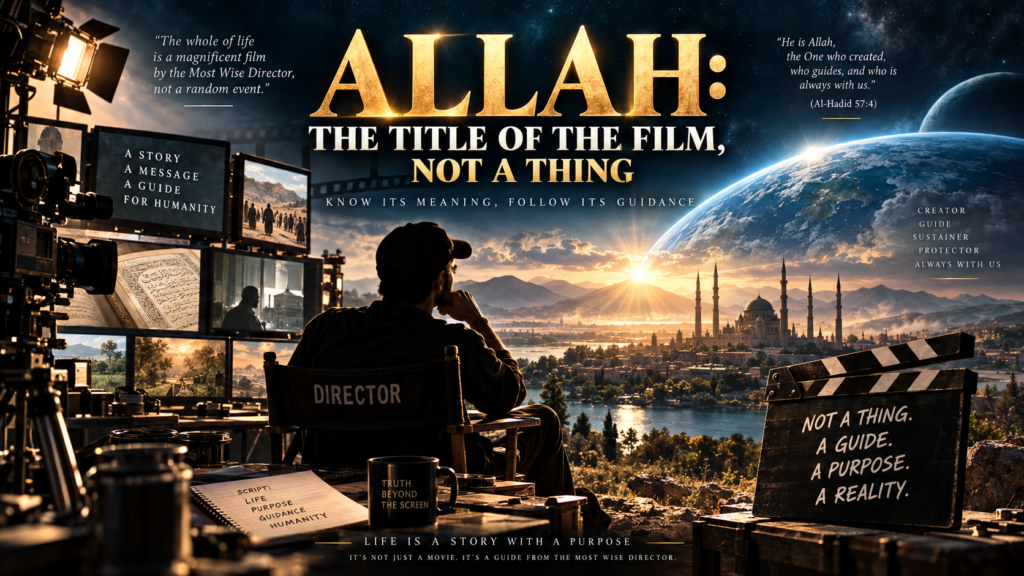
Imagine the entirety of life as an extraordinary film.
The film has a story, characters, attributes, actions, an order, a beginning and an ending. It also has a Director.
However, human confusion begins when people fail to distinguish between:
the title of the film, the film, the Director, the Master or Owner, the actors, and the acting.
Many take the title of the film — ALLAH — and imagine it as a thing.
Some even imagine it as an unseen Director existing as a separate entity.
Yet, within this framework:
ALLAH is the name given to the entirety of the film’s expression.
It is not a thing.
It is not an object.
It is not a physical body.
Rather, it is the name of the story that manifests:
Essence, Attributes, and Actions.
⸻
THE FILM IS AN EXPRESSION
A film can “speak”, but a film has no mouth.
A film can “be angry”, but a film has no body.
A film can “show love”, but a film is not a physical body that exists independently.
A film can “punish”, but what is seen is merely the story manifested through its scenes.
Therefore, when it is said:
“Allah speaks,”
within this analogy, it means:
the story is conveying an expression.
When it is said that Allah shows love, the story is manifesting love.
When it is said that Allah forgives, the story is manifesting forgiveness.
When it is said that Allah punishes, the story is manifesting punishment.
Attributes never become things.
Actions never become physical bodies.
The story never becomes the Director.
⸻
A PERFECT FILM MUST HAVE A METHOD
A truly perfect film cannot have only one side.
If everything is love, punishment has no meaning.
If everything is truth, falsehood has no meaning.
If everything is trustworthiness, betrayal has no meaning.
If everything is life, death has no meaning.
If everything is outward, the inward has no meaning.
Therefore, perfection must be expressed through pairs and differences.
Within this arrangement, the film is constructed through the 50 al-‘Aqa’id:
24 Jamal,
24 Jalal,
and
2 Harus.
Jamal reveals beauty and perfection.
Jalal reveals the opposing side, firmness and negation.
Harus opens the space for choice and possibility:
one for the Director,
and one for the actor.
The total is:
50.
Without pairs, the story does not move forward.
Without choice, there is no test.
Without possibility, acting has no meaning.
⸻
THE 99 ASMA’ WA SIFAT ARE THE THEMES OF THE FILM
A great film does not have only one theme.
It has various themes:
mercy, justice, knowledge, wisdom, forgiveness, power, preservation, recompense, subtlety, and greatness.
That is why this extraordinary film is known through the 99 Asma’ wa Sifat.
Not 99 things.
Not 99 entities.
Rather, they are 99 themes through which recognition becomes possible.
Ar-Rahman is the theme of mercy.
Al-Hakim is the theme of wisdom.
Al-‘Alim is the theme of knowledge.
Al-Ghafur is the theme of forgiveness.
Al-Qahhar is the theme of subjugation and power.
Names provide meaning.
Attributes provide expression.
Actions provide manifestation.
Yet names, attributes and actions all remain expressions.
They are not the Director.
⸻
WHEN THE FILM IS WRITTEN AS A BOOK, IT BECOMES A RECITATION
A film can be watched.
However, when the story of the film is written down and compiled into a book, it becomes a script.
When that script is read, it becomes:
الْقُرْآن
meaning the recitation.
The script explains the film.
The script provides guidance about the storyline.
The script helps human beings understand the meaning of every scene.
Yet this is where many people become stuck.
They read the script but do not understand the film.
They memorise the dialogue but do not recognise the meaning of the story.
They pronounce the name but do not understand who they are meant to recognise.
Eventually, they take the story to be a thing.
Yet the script is merely a recitation of the story.
And the story is merely an expression.
⸻
THE WORLD IS AN ACT THAT IS FAR TOO CONVINCING
The Quran describes the world as:
لَعِبٌ — play
لَهْوٌ — heedlessness
زِينَةٌ — adornment
All these have a structure closely resembling acting.
A game has roles.
Acting has characters.
A stage has decorations.
A film has costumes and props.
When all these become too convincing, the actor forgets that he is acting.
This is:
لَهْوٌ
meaning heedlessness.
Heedlessness does not arise merely because the world is enjoyable, but because the world is too convincing.
⸻
PROPS AND COSTUMES DECEIVE THE ACTOR
The body is a costume.
Wealth is a prop.
A house is a set.
A vehicle is a prop.
Rank is a role.
Beauty is the appearance of a costume.
Fame is the camera’s spotlight.
Followers are supporting actors.
The problem begins when human beings say:
“This is me.”
“This belongs to me.”
“This is my position.”
Yet all these are given only for a single scene.
The actor wearing a king’s costume eventually comes to believe that he truly is a king.
The actor given the prop of wealth begins to believe that he owns it absolutely.
The actor given a major role begins to look down upon actors with smaller roles.
Yet once filming ends:
the costumes are returned,
the props are left behind,
the set is dismantled,
and the roles come to an end.
⸻
DEATH IS “CUT”
Then comes a moment that cannot be negotiated.
CUT.
The scene stops.
The dialogue stops.
The movement stops.
The actor cannot ask:
“Give me one more scene.”
He cannot say:
“I have not finished enjoying this costume.”
Nor can he say:
“I have not collected enough props.”
CUT means that his scene has ended.
That is death.
At that moment, it finally becomes clear that everything he defended throughout the scene was merely part of the story.
Death is not the destruction of the entire film.
Death is the end of an actor’s scene.
The film continues.
⸻
THE FILM IS NOT THE DIRECTOR
This is where humanity’s greatest confusion lies.
People see the film and assume that the film is the Director.
They see attributes and assume that attributes exist as things in themselves.
They see actions and turn those actions into objects.
They take the title of the film and construct an unseen image according to their own assumptions.
Yet:
the film merely expresses.
The Director is the one who directs.
The film reveals.
The Director knows the meaning of the entire story.
The film has dialogue.
The Director knows why that dialogue was created.
The film has scenes.
The Director knows the entire journey.
Therefore, the film is not the Director.
The title of the film is not the Director either.
A title does not become an object merely because it has a name.
⸻
THE PURPOSE OF THE FILM IS FOR THE DIRECTOR TO BE RECOGNISED
This is the greatest purpose.
The film was not made so that human beings would worship the film.
The film was made so that, through the story, human beings could recognise who is behind it.
The Director wishes to be recognised through his work.
The way to recognise him is not by imagining his form, but by examining:
attributes, actions, arrangement, wisdom, the storyline, and the bearer of the film’s message.
The greater the work, the greater the opportunity to recognise the Director.
Yet the more extraordinary the film, the easier it becomes for human beings to become trapped within the film itself.
⸻
A GREAT DIRECTOR MUST BE THE BEST ACTOR
If the Director enters the film, then he must become the best actor.
Why?
Because he knows the story better than anyone else.
He knows the meaning of every scene better than anyone else.
He knows better than anyone else how each role must be performed.
He knows better than anyone else when to stop.
He also knows better than anyone else how the film’s message must be manifested.
Therefore, the Director who acts becomes the bearer of his film’s message.
Yet his greatness lies in one thing:
he must act so convincingly that he does not appear to be the Director.
If everyone immediately knows:
“That is the Director,”
then the acting is compromised.
The test is also compromised.
The other actors would submit merely because they know who is standing before them.
Therefore, the Director enters the story completely.
He eats.
He drinks.
He marries.
He walks.
He conducts business.
He leads.
He is hurt.
He grieves.
Eventually, his scene receives:
CUT.
The excellence of his own acting becomes a veil.
And therein lies the test of recognition.
⸻
“FOLLOW ME” — NOT “FOLLOW THE FILM”
This is where the verse from Surah Ali ‘Imran, 3:31, becomes extremely important:
قُلْ إِن كُنتُمْ تُحِبُّونَ اللَّهَ فَاتَّبِعُونِي
“If you love Allah, then follow me.”
Notice:
فَاتَّبِعُونِي
“Follow me.”
Not:
“Follow the film.”
This is important because the film contains various scenes.
There is love.
There is punishment.
There is war.
There is peace.
There is anger.
There is forgiveness.
If human beings merely imitate a single scene without understanding the entire story, they may go astray.
Yet the Director knows:
when a particular scene takes place,
why it takes place,
how that scene must be performed,
and what its purpose is.
Therefore, whoever loves the film should not stop at the film.
Follow the bearer of its message.
Muhammad ﷺ is the uswah hasanah — the exemplary model.
He did not merely read the script.
He brought the script to life.
⸻
SURAH AN-NAS: THE MASTER, KING AND ILAH OF HUMANITY
Surah An-Nas presents three positions:
قُلْ أَعُوذُ بِرَبِّ النَّاسِ
“The Master of humanity.”
مَلِكِ النَّاسِ
“The King of humanity.”
إِلَٰهِ النَّاسِ
“The Ilah of humanity.”
Then it mentions:
الَّذِي يُوَسْوِسُ فِي صُدُورِ النَّاسِ
“Who whispers into the breasts of humanity.”
Why are the breasts mentioned?
Because the test of recognition does not take place only on the external stage.
It also takes place within oneself.
That is where human beings begin to ask:
“Who is the Master?”
“Who is the Owner?”
“Who is the Director?”
“Who is the bearer of the Message?”
“Do I recognise the Director, or am I merely captivated by the film?”
“Am I following the example, or am I merely chasing props?”
This is the true arena of the test.
⸻
THE GREATEST CONFUSION
Many human beings fail not because there is no story.
They fail because they are too captivated by the story.
They mistake:
the title for the Director,
attributes for entities,
actions for things,
the script for the ultimate purpose,
props for possessions,
costumes for their true selves,
and a scene for the entirety of life.
Eventually, they never arrive at recognition.
They stop at the film.
Yet the film was made so that the Director could be recognised.
⸻
SUMMARY
ALLAH is the title of the film’s expression within this framework.
Essence, Attributes and Actions form the content of that expression.
The 50 al-‘Aqa’id constitute the method through which the story attains perfection.
The 99 Asma’ wa Sifat are the film’s major themes.
The Quran is the recitation of the story.
The world is the stage.
The body is a costume.
Wealth is a prop.
Rank is a role.
Life is a scene.
Death is CUT.
Muhammad ﷺ is the bearer of the Message and the exemplary model of acting.
The ultimate purpose is not for human beings to fall in love with the film.
Rather, through the film, human beings are expected to recognise:
the Director.
Do not confuse the title with the Director.
Do not confuse the story with the Owner of the story.
Do not confuse attributes with things.
Do not confuse props with your true self.
And do not wait until the moment of:
CUT
to realise that, all this time, we have merely been too absorbed in the costumes and the stage.