
MUKADDIMAH · M09
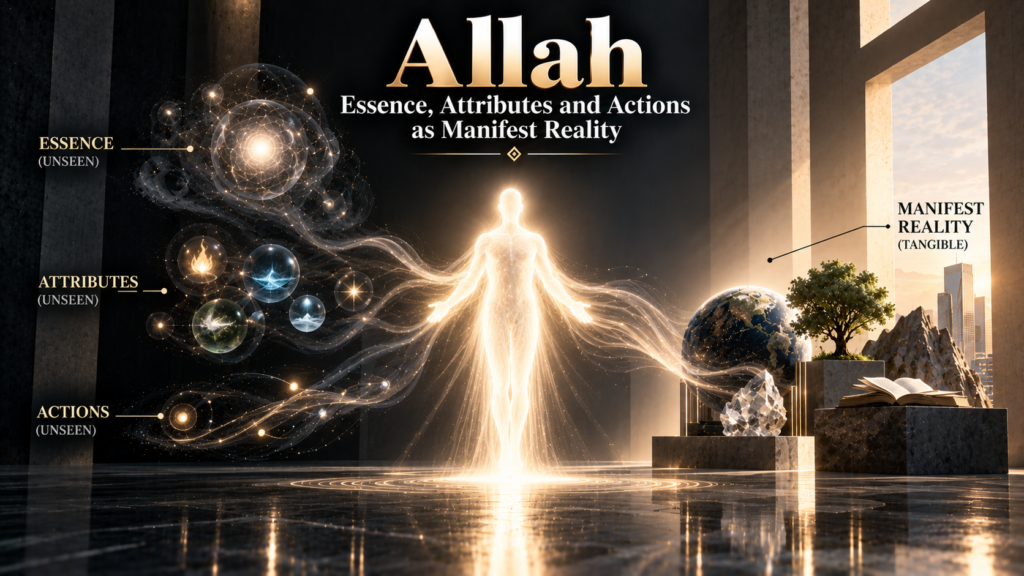
Allah: Essence, Attributes and Actions as Manifest Reality
When a person says:
Allah
what exactly do they mean?
The question may appear simple because the name is familiar.
A Muslim may have pronounced the name Allah since childhood. They hear it in prayer, read it in the Qur’an, encounter it in religious teaching and use it throughout their daily life.
But familiarity with a name does not necessarily mean recognition of what the name signifies.
If someone answers:
“Allah is an unseen being.”
another question immediately appears:
What exactly is meant by “being”?
If the mind imagines an invisible entity somewhere beyond the visible universe, then Allah may have been turned into a hidden object of imagination.
The object cannot be seen.
But conceptually, it remains a something.
For SiHulk, this is precisely where careful distinction becomes necessary.
Allah is not a thing among things.
Allah is not a visible object.
Nor should Allah simply be converted into an invisible object and placed somewhere beyond creation.
The Qur’an says:
لَيْسَ كَمِثْلِهِ شَيْءٌ
“There is nothing like unto Him.”
— Ash-Shura 42:11
Yet Islam also does not ask the human being to testify to a completely meaningless or absolutely unknowable word.
The Qur’an says:
فَاعْلَمْ أَنَّهُ لَا إِلَٰهَ إِلَّا الله
“So know that there is no ilah except Allah.”
— Muhammad 47:19
The instruction is:
Know.
This creates an important question:
If Allah is not an object that can be imagined, how is Allah to be known?
For SiHulk, an important framework for approaching this question is found through three familiar concepts:
Essence
Attributes
Actions
These correspond to the traditional terms:
Zat, Sifat and Perbuatan.
They are not three separate Allahs.
They are not three independent realities.
They are distinctions that help the human mind approach the question of how what cannot be reduced to an object becomes manifestly known.
What Is Meant by Manifest Reality?
The expression Manifest Reality is used here to translate the SiHulk concept of Kenyataan.
It does not simply mean a verbal “statement.”
It refers to:
that through which something becomes evident, disclosed, manifested or recognisable.
Consider an ordinary example.
You are standing outside a room.
You cannot see who is inside.
Then you hear a familiar voice.
A particular action follows.
Certain characteristics become evident.
Through what is disclosed, you begin to recognise who is present.
The voice is not the entirety of the person.
The action is not the entirety of the person.
The characteristics are not separate persons.
Yet through what becomes manifest, recognition becomes possible.
The analogy is necessarily limited when speaking about Allah.
But it establishes an important principle:
Recognition requires disclosure.
If absolutely nothing could ever be made known, then recognition would be impossible.
This is why SiHulk distinguishes between:
imagining Allah
and:
recognising Allah through what is made manifest.
Allah Is Not a “Something”
Human beings understand the physical world through things.
A mountain is something.
A tree is something.
A human body is something.
A planet is something.
An object may be large or small, visible or hidden, near or distant.
But it remains within the category of a thing.
Human imagination can extend this same structure into the unseen.
A person may say:
“Allah cannot be seen.”
Yet inside the imagination, Allah becomes:
an invisible something.
The physical form has disappeared.
The conceptual object remains.
It has simply been relocated from the visible world into an invisible one.
For SiHulk, this does not sufficiently solve the problem.
Calling an imagined object unseen does not stop it from being an imagined object.
This is why the Qur’anic statement:
“There is nothing like unto Him.”
must be taken seriously.
Allah cannot simply be placed inside the same conceptual category as created things and then distinguished by saying that Allah is infinitely greater.
An infinitely greater object remains conceptually an object.
An invisible entity can still be conceived as an entity within the imagination.
The problem therefore lies deeper than visibility.
The category itself must be examined.
Essence
The first concept is:
Essence
Traditionally expressed as Zat, Essence points towards the reality of Allah in Himself.
But immediately, a boundary must be recognised.
The Qur’an says:
وَلَا يُحِيطُونَ بِهِ عِلْمًا
“But they do not encompass Him in knowledge.”
— Taha 20:110
Human knowledge does not encompass Allah.
This means that speaking about Essence does not mean constructing a complete intellectual definition of Allah.
A definition normally places something within conceptual boundaries.
It tells us:
this is what the thing is,
and:
this is what it is not.
But Allah cannot be contained within a conceptual box created by the human mind.
Therefore, when SiHulk speaks of Essence, it does not mean:
“Imagine the substance or form of Allah.”
Nor does it mean:
“Construct a metaphysical object and call that object Allah.”
Essence instead reminds us that the Attributes and Actions through which recognition occurs are not independent realities floating without relation to what they disclose.
They point towards a reality that human knowledge does not encompass.
Essence establishes reality without turning that reality into an object of imagination.
Attributes
The second concept is:
Attributes
Traditionally expressed as Sifat, Attributes provide language through which Allah is made known.
The Qur’an describes Allah through names and attributes.
Allah is Knowing.
Merciful.
Powerful.
Living.
Hearing.
Seeing.
Wise.
The Qur’an says:
وَلِلَّهِ الْأَسْمَاءُ الْحُسْنَىٰ فَادْعُوهُ بِهَا
“To Allah belong the Most Beautiful Names, so call upon Him by them.”
— Al-A’raf 7:180
These names communicate something.
They are not meaningless sounds.
They guide understanding.
But the Attributes should not be imagined as separate pieces from which Allah is assembled.
Knowledge is not one part of Allah.
Mercy is not another part.
Power is not another.
Life is not another.
Allah is not a collection of components.
The distinctions exist within human language because human beings require language in order to learn and understand.
The Attributes therefore function as disclosure.
They make something known without exhausting the reality of what is known.
Actions
The third concept is:
Actions
Traditionally expressed as Perbuatan, Actions concern what is made evident through what Allah does.
The Qur’an repeatedly speaks of:
creation,
sustenance,
giving life,
causing death,
guidance,
forgiveness,
judgment,
ordering,
bringing forth,
and maintaining creation.
The Qur’an says:
الله خَالِقُ كُلِّ شَيْءٍ
“Allah is the Creator of all things.”
— Az-Zumar 39:62
It also says:
إِنَّ رَبَّكُمُ الله الَّذِي خَلَقَ السَّمَاوَاتِ وَالْأَرْضَ
“Indeed, your Lord is Allah, who created the heavens and the earth…”
— Al-A’raf 7:54
These are descriptions of action.
And actions matter because:
actions disclose.
When something acts, something becomes evident through the action.
The Qur’an therefore repeatedly directs human beings not merely towards abstract definitions, but towards what is happening around them.
Look at creation.
Look at life.
Look at death.
Look at the heavens.
Look at the earth.
Look at yourselves.
Reflect.
Consider.
Understand.
The visible world becomes filled with:
signs.
Actions Make Attributes Intelligible
Suppose someone tells you:
“This person is generous.”
You have received a description.
But how might generosity become recognisable?
Perhaps you observe the person giving.
The action makes the attribute evident.
If someone is described as merciful, mercy becomes intelligible through merciful action.
If someone is described as wise, wisdom may become evident through what proceeds from that wisdom.
If someone is described as knowledgeable, knowledge may become evident through what that knowledge produces.
Again, Allah cannot be reduced to human examples.
But the relationship helps us understand why:
Essence, Attributes and Actions
should not be treated as three disconnected theological subjects.
Actions disclose Attributes.
Attributes direct recognition towards the reality to which they belong.
The movement is towards Manifest Reality.
Creation Is Filled with Signs
The Qur’an repeatedly calls creation:
Ayat — signs.
Allah says:
إِنَّ فِي خَلْقِ السَّمَاوَاتِ وَالْأَرْضِ وَاخْتِلَافِ اللَّيْلِ وَالنَّهَارِ لَآيَاتٍ لِّأُولِي الْأَلْبَابِ
“Indeed, in the creation of the heavens and the earth and the alternation of night and day are signs for people of reason.”
— Ali ‘Imran 3:190
A sign is significant because it points beyond itself.
Smoke may indicate fire.
Footprints may indicate that someone passed through a place.
A written message points towards an author.
The sign is not identical to what it signifies.
But neither is it disconnected from it.
This distinction is crucial.
Creation is not Allah.
But creation can function as a sign through which something becomes known.
The Qur’an itself directs human beings towards creation for this purpose.
Signs in the Horizons and Within Ourselves
The Qur’an says:
سَنُرِيهِمْ آيَاتِنَا فِي الْآفَاقِ وَفِي أَنفُسِهِمْ حَتَّىٰ يَتَبَيَّنَ لَهُمْ أَنَّهُ الْحَقُّ
“We will show them Our signs in the horizons and within themselves until it becomes clear to them that it is the Truth.”
— Fussilat 41:53
The movement within this verse is important.
First:
signs are shown.
Then:
something becomes clear.
This is close to what SiHulk means by Manifest Reality.
Recognition is not produced merely by inventing an idea inside the mind.
Something is shown.
Something becomes evident.
The horizons disclose signs.
The human self contains signs.
Revelation presents signs.
The seeker observes, reasons and seeks recognition.
Manifest Reality Does Not Mean Objectification
A critical distinction must be maintained.
When SiHulk speaks about Manifest Reality, it does not mean that Allah becomes a physical object available for human inspection.
Nor does it mean that the Essence of Allah becomes contained within a created form.
Manifestation is not the same as objectification.
Something can become known through what it discloses without being reduced to the form through which that disclosure is recognised.
A person’s words may disclose knowledge.
But knowledge itself is not identical to the sound waves carrying those words.
An action may disclose compassion.
But compassion is not merely the physical movement involved in that action.
Likewise, signs disclose.
But the sign should not be confused with what it signifies.
Therefore, two errors must be avoided:
denying the significance of the signs
and:
mistaking the signs themselves for Allah.
Essence, Attributes and Actions Are Not Three Separate Realities
Language divides concepts so that human beings can study them.
We speak separately about:
Essence
Attributes
Actions
But analytical distinction should not automatically become separation in reality.
Consider an ordinary person.
There is the person.
There are characteristics associated with that person.
There are actions performed by that person.
We can discuss each separately.
But we have not necessarily created three people.
The analogy is limited and should not be extended into comparison with Allah.
Its purpose is simply to demonstrate one principle:
Conceptual distinction does not necessarily mean actual separation.
Therefore, Essence, Attributes and Actions should not be understood as three independent realities.
They form a framework for examining how recognition occurs.
The Action Is Not the Actor
Another distinction is equally important.
Suppose someone writes you a letter.
The letter contains language.
The language carries meaning.
The handwriting may reveal something about its writer.
But:
the letter is not the writer.
Yet through the letter, something about the writer may become known.
Similarly, an action is not necessarily identical to the actor.
But the action can disclose.
This is why the Qur’an repeatedly directs the human being towards observation.
The seeker is not simply commanded:
“Imagine Allah.”
Instead, human beings are repeatedly called to:
look,
reflect,
consider,
understand,
and:
recognise the signs.
This is a fundamentally different method.
Recognition proceeds from disclosure rather than unrestricted imagination.
Attributes Without Recognition Can Become Vocabulary
A person can memorise many Names and Attributes of Allah.
They may know Arabic terminology.
They may know translations.
They may answer examination questions.
They may reproduce theological definitions perfectly.
But memorisation does not automatically equal recognition.
A student may know:
Ar-Rahman — The Most Merciful.
But what has mercy actually come to mean within their understanding?
They may know:
Al-‘Alim — The All-Knowing.
But have they reflected upon what knowledge signifies?
They may know:
Al-Qadir — The Powerful.
But has the term moved beyond a memorised translation?
The words are valuable.
The Names are important.
The Attributes teach.
But:
the Name points.
the Attribute discloses.
the Action makes evident.
And the seeker must still recognise.
Actions Without Recognition Can Become Mere Mechanisms
There is also an opposite problem.
A person may observe the universe and see only mechanisms.
Rain falls.
Plants grow.
Stars move.
Human beings are born.
Human beings die.
Science may explain many of the processes involved.
Such explanations are valuable.
But explaining a mechanism does not necessarily exhaust the meaning of what is observed.
Knowing how rain forms does not answer every question concerning existence.
Understanding biological reproduction does not answer why existence itself exists.
Understanding physical laws does not explain why reality possesses an intelligible order at all.
The Qur’an therefore does not merely present creation as a mechanism.
It presents creation as:
signs.
The mechanism can be studied.
The sign must be recognised.
Knowledge Has Layers
Recognition therefore develops through layers.
A person may first know the word:
Allah.
Then they learn the Names and Attributes.
Then they observe the Actions and signs towards which revelation directs them.
Then they reflect upon what these disclose.
The movement can be expressed as:
Name → Attributes → Actions → Manifest Reality → Recognition
This should not be treated as a rigid formula.
It simply demonstrates that knowledge can deepen.
Knowing a name is not necessarily recognising what the name signifies.
Knowing an attribute is not necessarily recognising what that attribute discloses.
Seeing an event is not necessarily recognising it as a sign.
The seeker must consciously move from information towards recognition.
Revelation Is Necessary
Another question now appears.
Human beings can observe creation.
But how do they know what its signs mean?
A mountain can be observed.
Stars can be observed.
Life can be observed.
Death can be observed.
The human self can be examined.
But observation alone does not guarantee the correct interpretation.
Human beings can create competing explanations.
They can project their own assumptions onto what they see.
This is where:
Revelation
becomes essential.
Revelation communicates.
It identifies.
It explains.
It directs.
It tells the human being how to read the signs.
The seeker therefore does not simply look at creation and invent whatever religious meaning they prefer.
The signs and Revelation must be read together.
Reason examines.
Revelation guides.
Recognition develops through their proper relationship.
The Message Must Be Carried
A message does not communicate itself to humanity without transmission.
This brings us to the concept of:
Risalah — Message
and:
Rasul — the bearer of the Message.
The Qur’an identifies Prophet Muhammad SAW:
مُّحَمَّدٌ رَّسُولُ الله
“Muhammad is the Messenger of Allah.”
— Al-Fath 48:29
This declaration is much deeper than simply identifying Muhammad SAW as a historical personality.
The word:
Rasul
immediately raises the question of:
Risalah.
A messenger is recognised in relation to what he bears and conveys.
Therefore, if Allah is to be recognised through what is made known, the Risalah carried by Prophet Muhammad SAW becomes central to that recognition.
The witness must ask:
What is being carried?
What is being communicated?
What becomes known through the Risalah?
Muhammad SAW Is Not Merely a Historical Biography
A person may know a great deal about Prophet Muhammad SAW.
They may know his birthplace.
His family.
His migration.
His battles.
His companions.
His marriages.
The chronology of his life.
All of this forms part of the study of Sirah.
But the Shahadah does not merely testify:
“Muhammad was a historical person.”
It declares:
مُحَمَّدٌ رَّسُولُ الله
The testimony concerns his function and station as:
Rasulullah.
Therefore, biography alone does not complete the question.
The seeker must ask:
What does it mean that Muhammad SAW bears the Risalah of Allah?
This moves the discussion from historical information towards recognition.
The Risalah Carries Knowledge of Allah
If Allah is not to be invented by human imagination, then human beings require guidance concerning how Allah is to be understood.
This is one of the central functions of Revelation.
The Risalah tells humanity:
what to negate,
what to affirm,
what the signs mean,
what the Attributes disclose,
how the Actions are to be understood,
and how human beings should respond.
Therefore, Prophet Muhammad SAW cannot be separated from the question of recognition.
He bears the Risalah through which the name Allah, the Attributes, the Actions, the signs and their meanings are communicated to humanity.
The Rasul does not merely bring information about religious rules.
He bears a Risalah through which recognition becomes possible.
This is why the second testimony:
مُحَمَّدٌ رَسُولُ الله
cannot be treated as secondary to the first.
The two declarations are deeply connected within the act of witnessing.
Essence Cannot Be Separated from Attributes and Actions in Recognition
Three reductions must therefore be avoided.
Do not reduce Allah to:
an unknowable Essence about which nothing whatsoever can be recognised.
Do not reduce Allah to:
a list of Attributes memorised as theological vocabulary.
And do not reduce Allah to:
natural events detached from the reality towards which they point.
Instead, the relationship must be examined.
Essence reminds us that reality exceeds our conceptual definitions.
Attributes communicate.
Actions disclose.
Signs point.
Revelation explains.
The Messenger bears the Message.
And through this movement, the seeker approaches:
Manifest Reality and recognition.
Recognition Is Not Total Comprehension
At this point, an important boundary must be preserved.
To say that Allah must be recognised does not mean that the human being can comprehend Allah completely.
The Qur’an has already established:
“They do not encompass Him in knowledge.”
— Taha 20:110
Recognition and total comprehension are not identical.
We recognise many realities without comprehending everything about them.
A person can recognise the ocean without knowing every creature living within it.
A child recognises their mother without possessing complete knowledge of her biology, history, thoughts and experiences.
Recognition can therefore be real without being exhaustive.
This allows two principles to remain together:
Allah is to be known.
and:
Allah is not encompassed by human knowledge.
The first prevents faith from becoming testimony to an empty word.
The second prevents the human intellect from imagining that it can contain Allah within its own concepts.
From Imagination to Manifest Reality
The distinction can now be stated clearly.
Imagination constructs.
Manifest Reality discloses.
Imagination begins with the human mind and creates an image.
Manifest Reality begins with what becomes evident and asks the human being to recognise.
This is why SiHulk does not seek to create a more sophisticated picture of an invisible deity.
The objective is not to replace a simple hidden object with a philosophical hidden object.
The objective is to examine:
what has actually been made known.
What does the Qur’an disclose?
What do the Attributes disclose?
What do the Actions disclose?
What do the signs disclose?
What does the Risalah communicate?
And what is Prophet Muhammad SAW bearing when he is identified as Rasulullah?
This changes the entire direction of inquiry.
The question is no longer:
“What can I imagine Allah to be?”
It becomes:
“What has been made known?”
Allah Must Be Recognised Through What Is Made Known
The Qur’an does not leave the human being without signs.
It directs attention towards:
the heavens,
the earth,
life,
death,
the human self,
history,
Revelation,
and the Messenger.
It communicates Attributes.
It describes Actions.
It repeatedly commands reflection.
Therefore, saying that Allah is not a “something” does not mean saying that Allah is absent, meaningless or completely unknowable.
It means:
recognition must not be confused with objectification.
Allah is not made known by turning Allah into a thing.
Allah is approached through what is made manifest.
This is what SiHulk means by:
Manifest Reality.
From Theology Towards Recognition
Essence.
Attributes.
Actions.
These can remain academic terminology.
They can become chapters in textbooks.
They can become examination questions.
They can become definitions memorised by students.
But knowledge should not end there.
The deeper purpose is:
recognition.
What does Essence teach us about the limits of our concepts?
What do the Attributes disclose?
What do the Actions make evident?
Why does the Qur’an call creation signs?
What does Revelation explain?
What does the Risalah communicate?
And what is the significance of the one who bears that Risalah?
These questions move theology beyond classification.
They move it towards witnessing.
The Question Before Us
The question is no longer merely:
“Do you believe that Allah exists?”
A deeper question has emerged:
“How is Allah known?”
If the answer is:
“As an invisible something somewhere,”
then the problem of imagination remains.
If the answer is:
“Allah cannot be known in any sense whatsoever,”
then the meaning of knowledge and Shahadah becomes difficult to explain.
SiHulk therefore approaches the question through Manifest Reality.
The Essence is not encompassed.
But the Attributes communicate.
The Actions disclose.
The signs point.
Revelation explains.
The Messenger bears the Message.
And the witness is called to recognise.
The unseen does not become known because the human imagination invents a hidden object.
It becomes known through what is made manifest.
This is the movement from theological terminology towards recognition.
And when the witness says:
مُحَمَّدٌ رَسُولُ الله
the question becomes unavoidable:
What exactly is Prophet Muhammad SAW bearing when we testify that he is the Messenger of Allah?
References
1.Al-Qur’an, Surah Ash-Shura, 42:11.
2.Al-Qur’an, Surah Muhammad, 47:19.
3.Al-Qur’an, Surah Taha, 20:110.
4.Al-Qur’an, Surah Al-A’raf, 7:180.
5.Al-Qur’an, Surah Az-Zumar, 39:62.
6.Al-Qur’an, Surah Al-A’raf, 7:54.
7.Al-Qur’an, Surah Ali ‘Imran, 3:190.
8.Al-Qur’an, Surah Fussilat, 41:53.
9.Al-Qur’an, Surah Al-Fath, 48:29.