
QIAMAH
Al-Qiyāmah: When Human Beings Blame Themselves
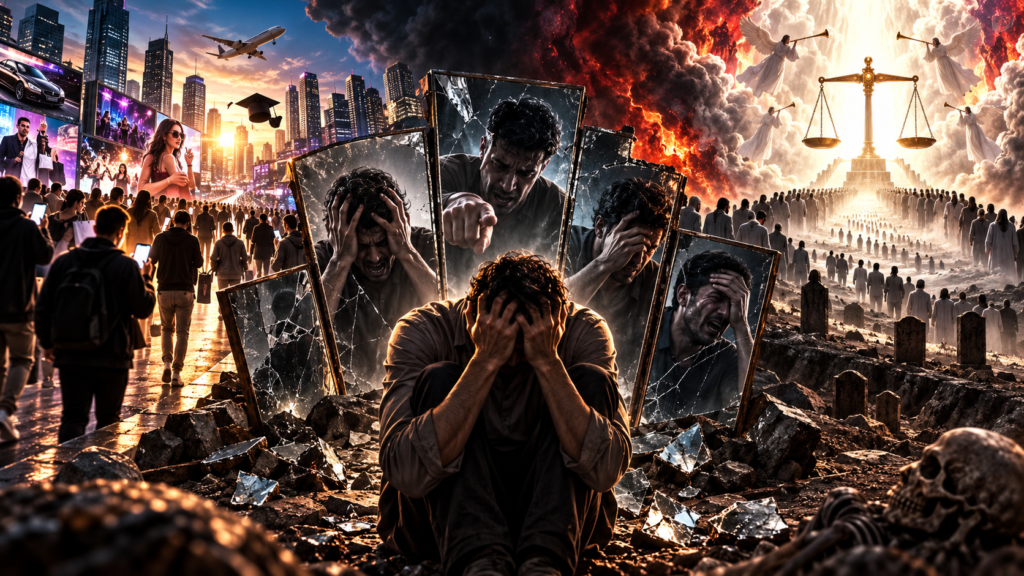
Allah says:
وَلَا أُقْسِمُ بِالنَّفْسِ اللَّوَّامَةِ
“And I swear by the soul that reproaches itself.”
— Surah al-Qiyāmah 75:2
The word اللَّوَّامَة — al-lawwāmah comes from the root ل و م, which carries the meanings of reproaching, admonishing, blaming and criticising.
But what is particularly important is this:
The soul reproaches itself.
It does not blame other people.
It does not blame the government.
It does not blame doctors.
It does not blame companies.
It does not blame technology.
It does not blame the tools.
Rather, it blames itself for the decisions it once made.
TECHNOLOGY DOES NOT CHOOSE
Technology has no will.
Technology has no intention.
Technology does not make decisions for human beings.
A knife can be used for cooking.
A knife can also cause injury.
Fire can provide warmth.
Fire can also burn.
Gene-editing technology can be used to treat certain diseases.
The same technology can also be misused.
Therefore, the real problem does not lie solely in technology.
The real question is:
Who uses it, how is it used, and who chooses to accept it?
DO NOT BLAME THOSE WHO PROVIDE IT
This brings us back to Surah al-Baqarah 2:249.
The river was provided.
The water was before them.
But human beings were the ones who chose whether to drink, refrain from drinking, or scoop up a handful first.
Therefore, once the consequences become apparent, human beings cannot simply shift the blame away from themselves.
A person may say:
“Someone told me to.”
“The government required it.”
“My employer made it compulsory.”
“The college asked for it.”
“I had to do it to enter the mall.”
“I had to do it to cross the border.”
“I had to do it to enter the mosque.”
All of these may be genuine forms of external pressure.
But pressure is not the same as a decision.
The decision still takes place within the individual.
THIS IS LAWWĀMAH
When human beings finally see the consequences of a decision, they begin to say to themselves:
“Why didn’t I examine it carefully?”
“Why didn’t I ask questions?”
“Why did I simply follow others?”
“Why was I afraid?”
“Why didn’t I use my reason?”
“Why did I surrender my choice to someone else?”
This is lawwāmah.
Anger towards oneself.
Self-reproach.
Regret for failing to exercise the power of choice that was already available.
HUMAN BEINGS ONLY SEE WHEN THE CONSEQUENCES HAVE ARRIVED
Allah says:
يُنَبَّأُ الْإِنسَانُ يَوْمَئِذٍ بِمَا قَدَّمَ وَأَخَّرَ
“On that Day, human beings will be informed of what they sent ahead and what they left behind.”
— Al-Qiyāmah 75:13
This verse is extremely important.
Human beings finally see:
what they did
and
what came of it.
These are the consequences.
What is done today produces effects tomorrow.
What is chosen today shapes one’s condition later.
THE INDIVIDUAL KNOWS
Then Allah says:
بَلِ الْإِنسَانُ عَلَىٰ نَفْسِهِ بَصِيرَةٌ
“Rather, human beings have clear insight into themselves.”
— Al-Qiyāmah 75:14
At this stage, a person no longer needs someone else to tell them.
Their own body gives them signals.
Their own awareness knows.
Their own experience becomes a witness.
They know what they once chose.
They know why they chose it.
They know what happened afterwards.
EXCUSES DO NOT CHANGE THE CONSEQUENCES
Then:
وَلَوْ أَلْقَىٰ مَعَاذِيرَهُ
“Even if they present their excuses.”
— Al-Qiyāmah 75:15
There may be many excuses.
The pressure may be intense.
The circumstances may be difficult.
But excuses do not change what has already happened to the individual.
If something has already been accepted, the body still bears its effects.
If a decision has already been made, its consequences will still follow.
This is why human beings reproach themselves.
Not because technology is evil.
Not because the river is at fault.
Not because the tool is to blame.
But because they feel:
“I was the one who failed to evaluate it.”
DO NOT BLAME THE TOOLS
CRISPR is not at fault.
mRNA has no intention.
A needle does not make decisions.
A machine does not choose.
Technology cannot be held responsible in the same way as human beings.
Human beings are the ones who possess reason.
Human beings are the ones who possess hands.
Human beings are the ones who have choices.
Human beings are the ones who accept.
And human beings are the ones who bear the consequences.
QIYĀMAH IS THE MOMENT OF AWAKENING
In this reflection on the Quran, Qiyāmah is not merely a story of destruction.
It is the moment when human beings awaken to awareness.
They awaken from heedlessness.
They awaken from blindly following others.
They awaken from fear.
They awaken from excuses.
Then they look at themselves.
And at that moment, they are no longer preoccupied with accusing others.
They see what is closest to them:
themselves.
CONCLUSION
The nafs lawwāmah is not a soul preoccupied with finding someone to blame.
It is the soul that finally says:
“I was the one who chose.”
Technology is merely a tool.
The river is merely a test.
Pressure is merely a circumstance.
But our hands remain our own.
Our reason remains our own.
Our choices remain our own.
And the consequences ultimately return to ourselves.
IT IS NOT SOMEONE ELSE’S FAULT.
IT IS NOT TECHNOLOGY’S FAULT.
WHAT IS REPROACHED IS THE SELF FOR FAILING TO EVALUATE BEFORE CHOOSING.