


IMAN
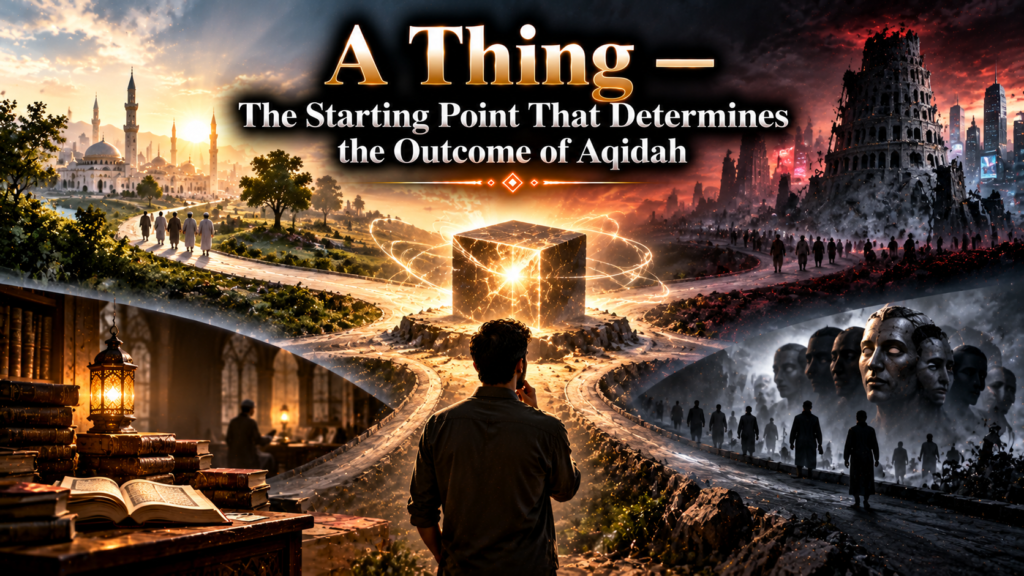
There are three positions:
## 1. MUJASSIMAH — DESCRIBING AND UNDERSTANDING ALLAH AS A “THING”
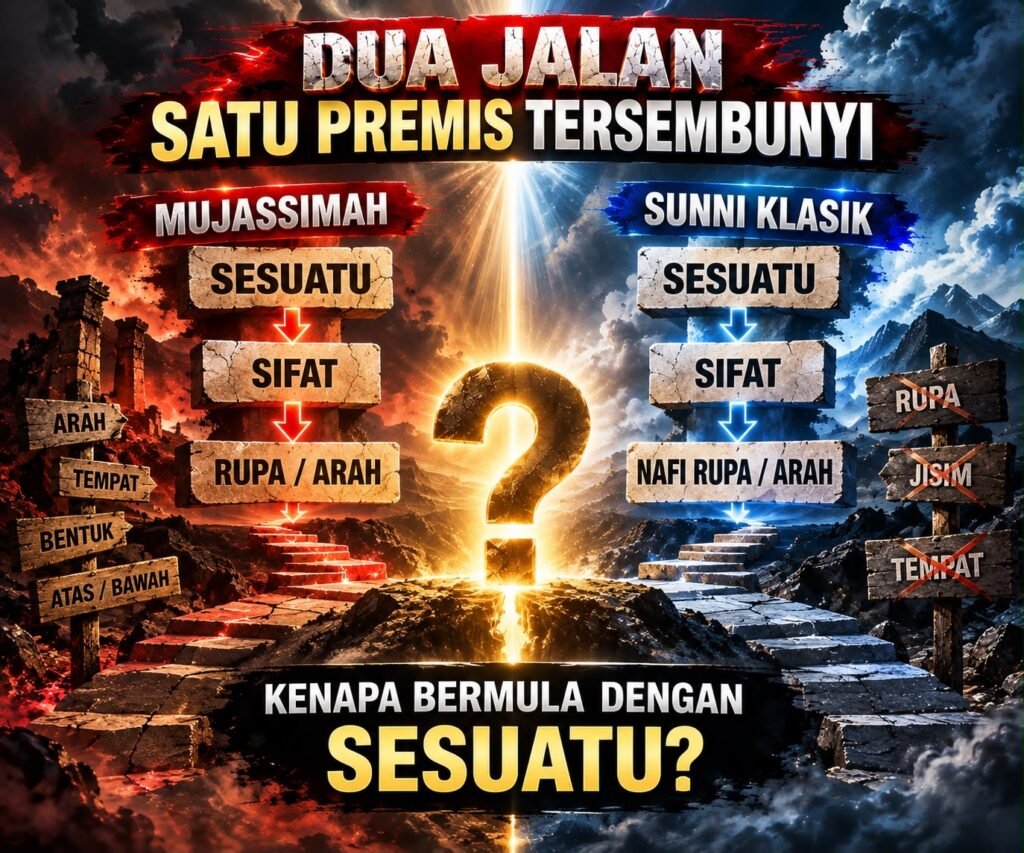
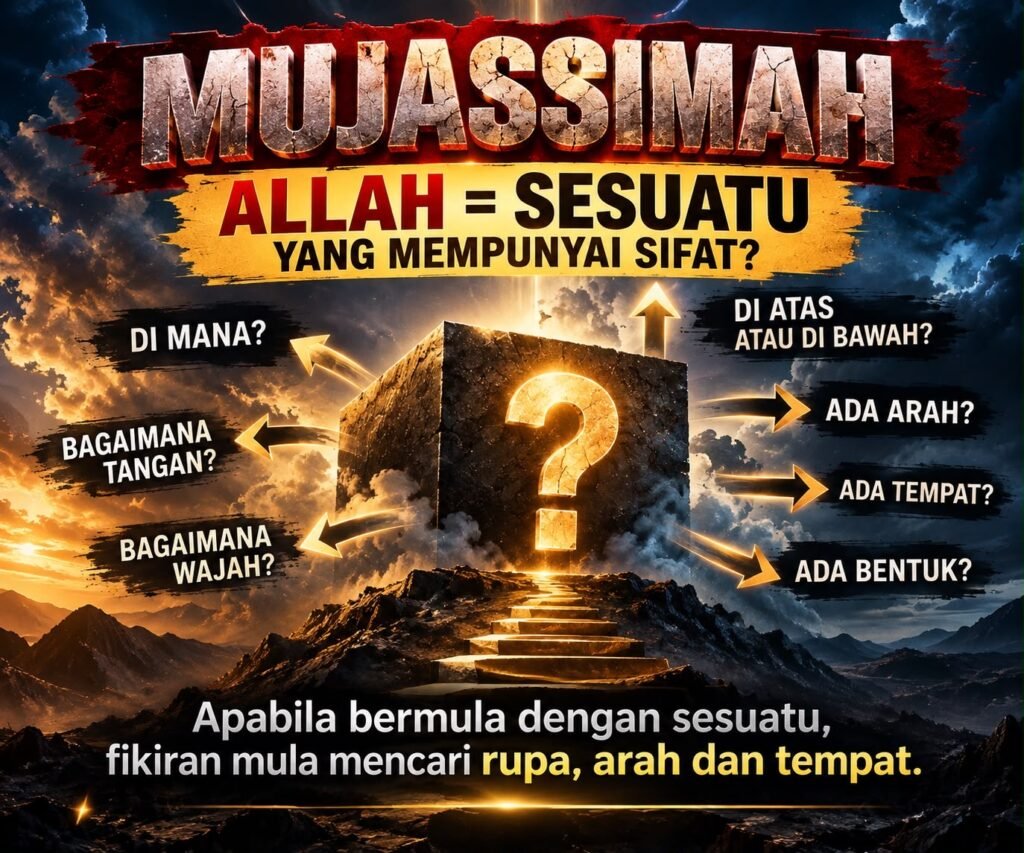
The Mujassimah begin with the premise:
Allah is a thing that possesses attributes.
Once there is a “thing” that possesses attributes, the mind begins asking:
Where is it?
Above or below?
Does it have a direction?
Does it occupy a place?
What is its hand like?
What is its face like?
How does it descend?
The Mujassimah describe Allah as a thing and understand Him as a thing.
Then that “thing” is assigned attributes, direction, position and an imagined form.
⸻
## 2. CLASSICAL SUNNIS — OPPOSING TAJSIM, YET STILL TRAPPED BY THE IDEA OF A “THING”
Classical Sunnis oppose the Mujassimah.
They affirm:
لَيْسَ كَمِثْلِهِ شَيْءٌ
“There is nothing whatsoever like Him.”
— Ash-Shura 42:11
They reject form.
They reject resemblance.
They reject corporeality.
They reject bodily parts resembling those of creation.
But an earlier question remains unresolved:
What is it that possesses those attributes?
When it is said:
Allah possesses attributes, but Allah’s attributes are unlike those of creation,
the structure of thought remains:
ALLAH → possesses → ATTRIBUTES
This still requires a possessor of attributes.
Therefore, even if the word “thing” is not explicitly mentioned, the structure of thought still requires something that possesses attributes.
This is a subtle but significant distinction:
MUJASSIMAH:
They describe Allah as a thing and understand Him as a thing.
CLASSICAL SUNNIS:
They oppose the imagined form of that “thing”, yet still begin with Allah as the possessor of attributes.
One openly operates within the category of a “thing”.
The other rejects the appearance, form and resemblance of that “thing” — but according to this critique, has not fully escaped that category.
⸻
## 3. THE PROPOSED APPROACH — CHALLENGING THE IDEA OF A “THING” AT ITS ROOT
The proposed approach does not ask:
“What does the thing that possesses those attributes look like?”
Nor does it stop at:
“That thing does not resemble creation.”
The proposed approach asks an earlier question:
WHO SAID ALLAH WAS A “THING” IN THE FIRST PLACE?
ALLAH IS NOT A THING THAT POSSESSES ATTRIBUTES.
Allah is the EXPLANATION.
Attributes explain.
Actions manifest attributes.
The combination of attributes gives meaning to the ESSENCE.
Therefore:
ACTIONS → ATTRIBUTES → ESSENCE → EXPLANATION OF ALLAH
Not:
A THING → possesses attributes → performs actions
This is where the difference becomes a complete reversal.
MUJASSIMAH:
“There is a thing, and that thing possesses attributes.”
CLASSICAL SUNNIS:
“There is a possessor of attributes, but the possessor and His attributes do not resemble creation.”
THE PROPOSED APPROACH:
“Why must a ‘thing’ be established as the possessor behind that explanation?”
⸻
## THE CONSEQUENCE: “ALLAH ABOVE THE ‘ARSH” BECOMES A CENTURIES-LONG DEBATE
When Allah is still understood as a thing, the word “above” continues to be interpreted through spatial relationships.
If there is something “above”, the mind begins asking:
What is beneath it?
How far away is it?
In which direction?
Where is its location?
Does the ‘Arsh support it?
Is it separate from the ‘Arsh?
Then people begin debating:
Is Allah above the ‘Arsh?
How is Allah above the ‘Arsh?
Does “above” indicate a direction or not?
Does Allah occupy a place or not?
How should Istiwa’ be understood?
According to the critique presented by the proposed approach, this debate has continued because both ALLAH and the ‘ARSH have been placed within spatial language.
Allah is treated as a thing.
The ‘Arsh is treated as an object or location.
Then “above” is interpreted as a physical position.
This produces the image:
A THING → IS ABOVE → ANOTHER THING
This is where the problem lies.
⸻
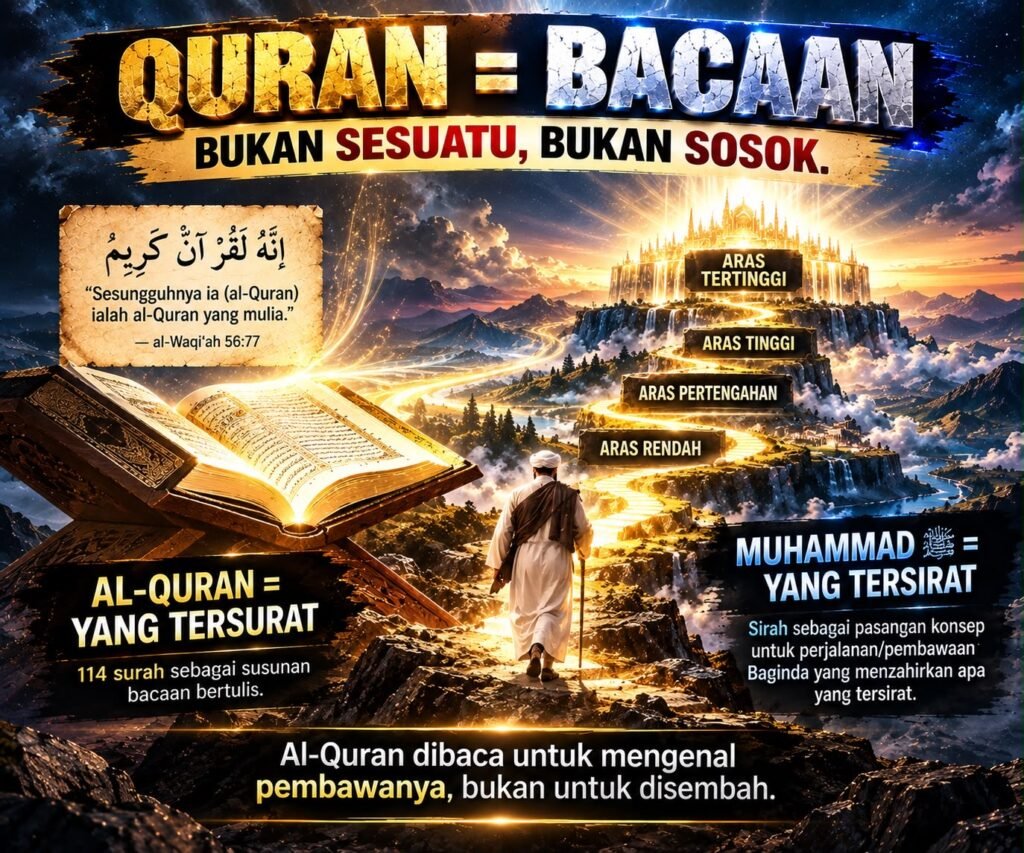
## ALLAH ABOVE THE ‘ARSH = ALLAH AT THE HIGHEST LEVEL
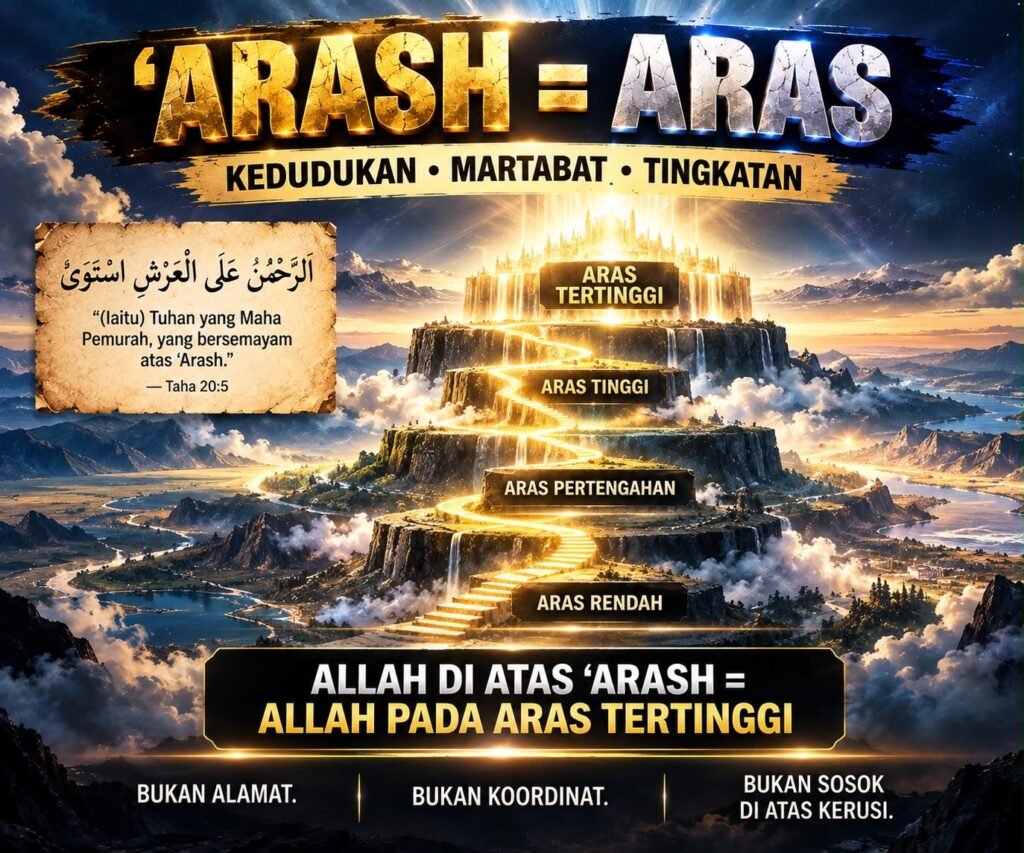
The proposed approach interprets ‘ARSH as ARAS:
position, rank, level or status.
Therefore, the expression “Allah above the ‘Arsh” does not need to produce the image of:
Allah as a figure positioned above an object.
Instead:
ALLAH ABOVE THE ‘ARSH
is understood as:
ALLAH AT THE HIGHEST LEVEL.
“Above” refers to elevation in rank, not spatial coordinates.
The ‘Arsh is a LEVEL, not a physical chair for a figure.
Therefore, the question changes completely.
Not:
“At what location is Allah?”
But:
“What is the HIGHEST LEVEL being explained by the word Allah?”
This is the important distinction:
A THING ABOVE ANOTHER THING
requires a location.
But:
AN EXPLANATION AT THE HIGHEST LEVEL
requires no body, direction or coordinates.
Therefore:
ALLAH → EXPLANATION
‘ARSH → LEVEL
ABOVE THE ‘ARSH → AT THE HIGHEST LEVEL
Once these three points are understood, the question:
“Where is Allah?”
is no longer the central question, because the text is explaining a LEVEL, not an address.
⸻
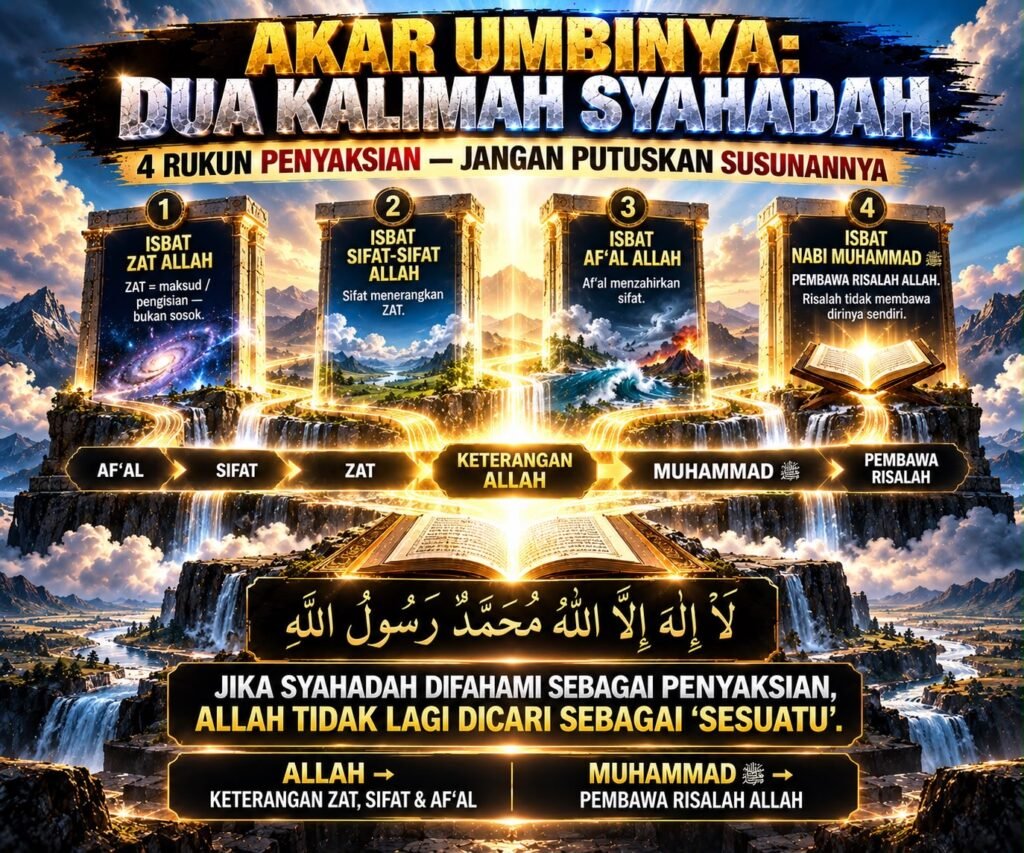
## THE ROOT OF THE PROBLEM RETURNS TO THE TWO DECLARATIONS OF SHAHADAH
Why has the question of a “thing” persisted for centuries?
According to the proposed approach, it is because the two declarations of Shahadah have been recited as words, while the structure of their WITNESSING has not been examined down to its essential pillars.
Shahadah has four matters that must be affirmed:
### 1. AFFIRMATION OF THE ESSENCE OF ALLAH
Not searching for a figure of Allah.
The ESSENCE is the meaning, substance, purpose and direction of the explanation, recognised through Attributes and Actions.
### 2. AFFIRMATION OF THE ATTRIBUTES OF ALLAH
Attributes are not accessories attached to some “Allah-object”.
Attributes are explanations that lead towards recognition of the ESSENCE.
### 3. AFFIRMATION OF THE ACTIONS OF ALLAH
Actions are deeds that manifest Attributes.
Through Actions, Attributes are recognised.
Through Attributes, the ESSENCE acquires meaning.
Therefore:
ACTIONS → ATTRIBUTES → ESSENCE → EXPLANATION OF ALLAH
### 4. AFFIRMATION OF PROPHET MUHAMMAD ﷺ AS THE BEARER OF ALLAH’S RISALAH
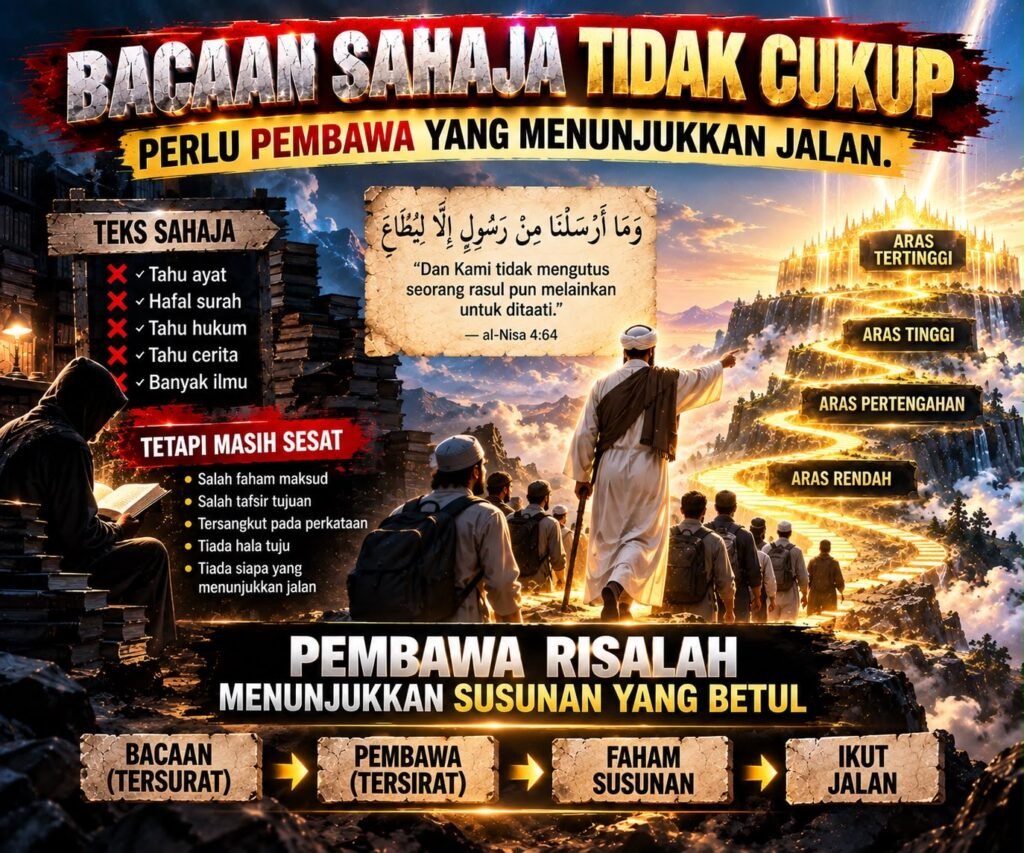
An explanation does not carry itself.
THE RISALAH MUST BE CARRIED.
Therefore, the two declarations of Shahadah:
لَا إِلٰهَ إِلَّا اللهُ مُحَمَّدٌ رَسُولُ اللهِ
require the witnessing of:
ESSENCE + ATTRIBUTES + ACTIONS + MUHAMMAD ﷺ AS THE BEARER OF THE RISALAH
⸻
## FROM SHAHADAH TO THE ‘ARSH
Now the chain of the problem becomes clear.
If the ESSENCE is misunderstood as a figure:
the idea of a THING emerges.
If ATTRIBUTES are understood as qualities possessed by a figure:
the idea of a POSSESSOR OF ATTRIBUTES emerges.
If the possessor of attributes is understood as a figure:
the question WHERE? emerges.
If the ‘Arsh is understood as an object or location:
the answer ABOVE THE ‘ARSH emerges.
Then people begin debating:
direction or no direction,
location or no location,
body or no body.
Meanwhile, the proposed approach rearranges the understanding from its roots:
ACTIONS → ATTRIBUTES → ESSENCE → ALLAH
And:
‘ARSH → LEVEL
Therefore:
ALLAH ABOVE THE ‘ARSH
= THE EXPLANATION OF ALLAH AT THE HIGHEST LEVEL.
Not:
a figure positioned above a chair.
⸻
## CONCLUSION
The problem of a “THING” does not begin with the ‘Arsh.
It begins with how ALLAH is defined.
And at a deeper level, it begins with how the two declarations of Shahadah are understood.
Its four pillars are:
1. AFFIRMATION OF THE ESSENCE OF ALLAH
2. AFFIRMATION OF THE ATTRIBUTES OF ALLAH
3. AFFIRMATION OF THE ACTIONS OF ALLAH
4. AFFIRMATION OF PROPHET MUHAMMAD ﷺ AS THE BEARER OF ALLAH’S RISALAH
If these four matters are properly arranged, then:
ALLAH is not a thing.
Allah is the explanation of the ESSENCE, ATTRIBUTES and ACTIONS.
And:
ALLAH ABOVE THE ‘ARSH
no longer requires searching for a location.
Because:
‘ARSH = LEVEL.
Therefore:
ALLAH ABOVE THE ‘ARSH
= ALLAH AT THE HIGHEST LEVEL.
In short:
MUJASSIMAH
Assign form, direction and location to a “thing”.
CLASSICAL SUNNIS
Deny the form, physical direction and resemblance of that “thing”, but according to this critique, still retain the structure of a possessor of attributes.
THE PROPOSED APPROACH
Challenges the very category of a “THING”.
It then restores the understanding:
ALLAH → EXPLANATION
‘ARSH → LEVEL
ABOVE → ELEVATION IN RANK
SHAHADAH → WITNESSING THE ESSENCE, ATTRIBUTES, ACTIONS AND MUHAMMAD ﷺ AS THE BEARER OF THE RISALAH.
Detecting your location…