
MUKADDIMAH · M21
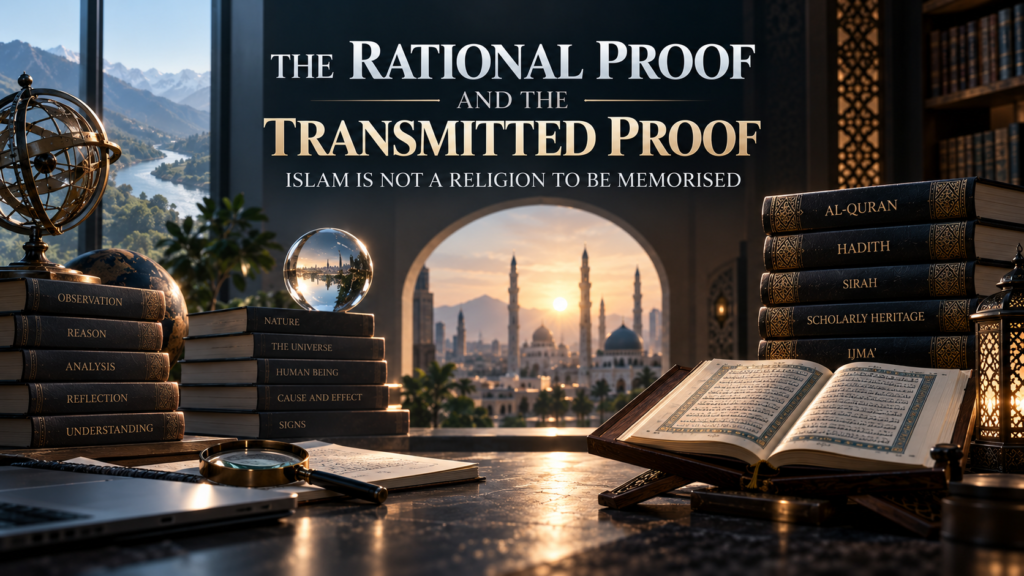
The question “Where is the proof?” can very easily be used as a weapon by those who are only strong in memorisation.
Whenever an argument is presented through sound thinking, examination and rational reasoning, the easiest response is:
“Where is the proof?”
As though proof in Islam consists only of quotations from the Quran or Hadith.
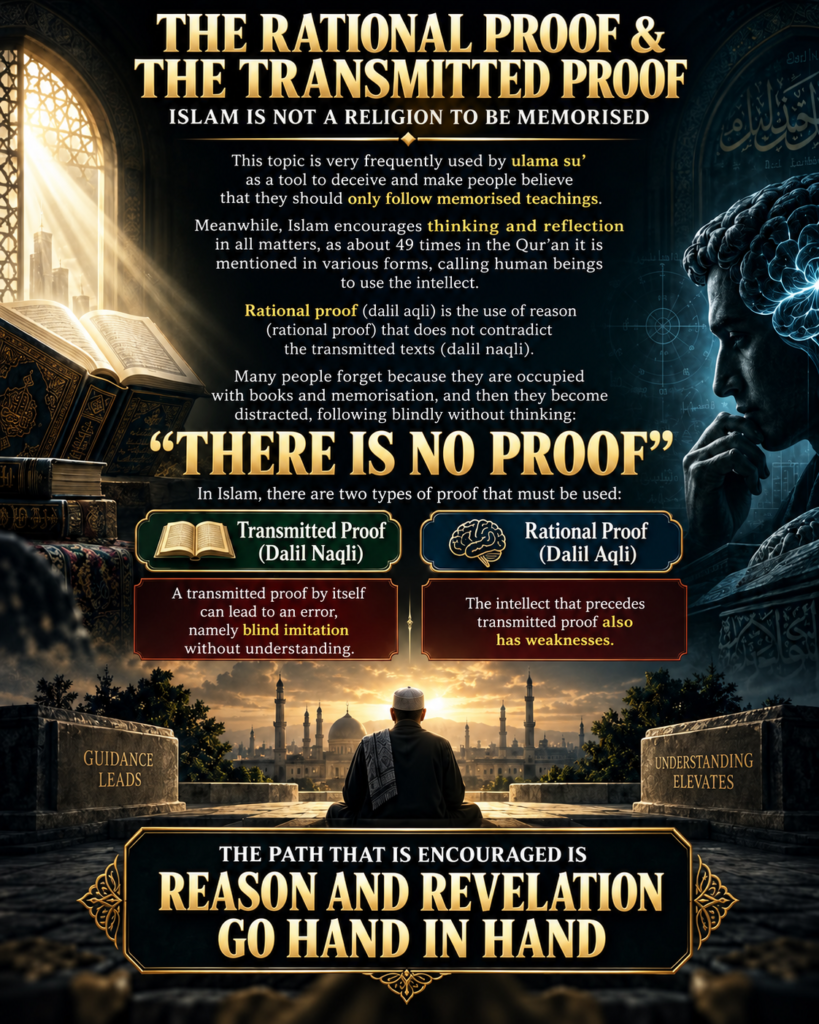
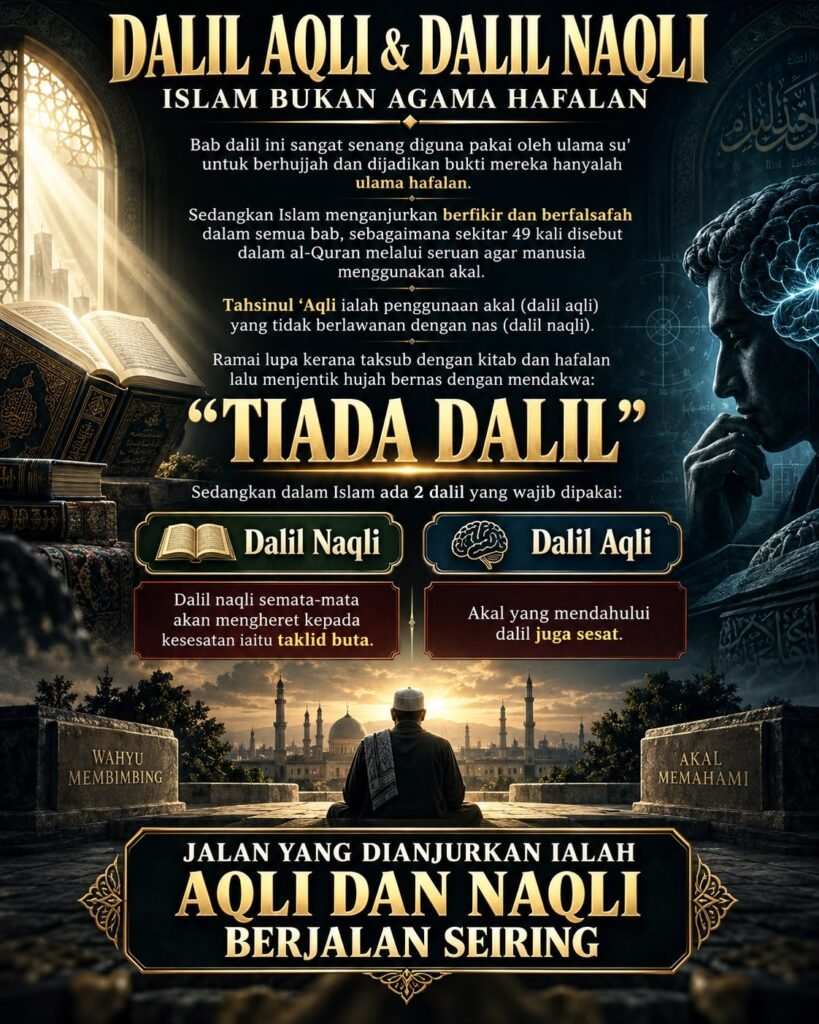
Yet within the Islamic intellectual tradition, arguments are not established through Transmitted Proof alone, but also through Rational Proof.
The Quran itself repeatedly calls upon human beings to use their intellect.
Expressions derived from the Arabic root ع ق ل, relating to the use of intellect, appear around 49 times in the Quran in various forms, such as:
أَفَلَا تَعْقِلُونَ
“Will you not use reason?”
لَعَلَّكُمْ تَعْقِلُونَ
“So that you may use reason.”
إِنْ كُنْتُمْ تَعْقِلُونَ
“If you use reason.”
Indeed, the Quran does not merely call upon human beings to use reason, but also to think, reflect, take lessons, observe and understand.
Therefore, Islam is not a religion that instructs human beings merely to:
MEMORISE — QUOTE — REPEAT.
Rather, it is a religion that requires human beings to:
THINK — UNDERSTAND — EVALUATE — TAKE LESSONS.
TRANSMITTED PROOF (DALIL NAQLI)
Transmitted Proof is evidence derived from revelation and transmitted sources such as:
the Quran and the Sunnah.
It serves as the foundation and measure that guides the use of reason.
RATIONAL PROOF (DALIL AQLI)
Rational Proof is an argument established through the sound use of reason.
Reason examines cause and effect.
Reason makes comparisons.
Reason understands implications.
Reason arranges premises.
Reason reaches conclusions.
As long as the conclusion does not contradict an authentic transmitted text, the use of reason is not an error.
This is what is often meant when reason is employed within the scope of consideration permitted by the Shariah.
However, reason is not given absolute freedom to override revelation.
Reason is used to understand the transmitted texts — not to erase them.
TWO MISGUIDED EXTREMES
FIRST: TRANSMITTED PROOF WITHOUT REASON
The texts are memorised.
The texts are quoted.
The texts are repeated.
But their meanings, purposes, relationships and wisdom are not examined.
Eventually, a person merely says:
“The book says this.”
“My teacher says this.”
“The earlier scholars said this.”
But when asked why and how, that person is unable to explain it.
This is a path that can lead to:
BLIND IMITATION.
Fanatical attachment to books and memorisation can cause a person to dismiss a sound argument merely by saying:
“There is no proof.”
Yet that argument may itself constitute a sound Rational Proof that does not contradict the Transmitted Proof at all.
SECOND: REASON PRECEDING THE TRANSMITTED TEXT
The other extreme is equally dangerous.
It occurs when a person makes their own reason the absolute judge and says:
“I think this transmitted text does not make sense.”
“My reason cannot accept it.”
“Therefore, this text must be rejected.”
At this point, reason has exceeded its proper limits.
This is no longer the use of reason to understand revelation.
This is:
REASON JUDGING REVELATION.
Therefore, both extremes must be avoided.
Transmitted Proof without reason can lead to blind imitation.
Reason that precedes or rejects the transmitted text can lead to intellectual misguidance.
ISLAM TEACHES THAT BOTH MUST GO HAND IN HAND
Islam does not suppress reason for the sake of transmitted revelation.
Nor does Islam discard transmitted revelation for the sake of reason.
Rather:
TRANSMITTED PROOF GUIDES REASON
and
REASON UNDERSTANDS TRANSMITTED PROOF.
Both go hand in hand.
This is why it is strange when someone becomes so fanatically attached to books that they regard every argument without an exact Quranic verse or Hadith quotation beside it as:
“THERE IS NO PROOF.”
Yet the very books they memorise were themselves produced through a process of:
TRANSMITTED TEXTS → REASON → LEGAL DEDUCTION → ARGUMENT → BOOK
The earlier scholars studied the transmitted texts.
They thought.
They compared.
They employed analogical reasoning.
They weighed different arguments.
They derived rulings.
Only then were books produced.
If earlier scholars used reason in producing their books, how can later generations claim that their task is merely to memorise those books?
This is what happens when knowledge changes from:
THINKING
into:
MEMORISING WHAT EARLIER GENERATIONS HAD ALREADY THOUGHT THROUGH.
Yet the Quran itself repeatedly challenges human beings:
أَفَلَا تَعْقِلُونَ
“Will you not use reason?”
Therefore, in Islam, proof is not limited to:
TRANSMITTED PROOF.
There is also:
RATIONAL PROOF.
However, both operate within a discipline.
Transmitted Proof without the use of reason can lead human beings towards blind imitation.
Rational Proof that precedes or contradicts the transmitted text can lead human beings towards intellectual misguidance.
The path that is encouraged is balance:
RATIONAL PROOF + TRANSMITTED PROOF
REASON AND REVELATION GO HAND IN HAND.
DO NOT SUPPRESS REASON FOR THE SAKE OF MEMORISATION.
AND DO NOT PLACE REASON ABOVE REVELATION.
The figure of approximately 49 occurrences refers to the commonly cited count of various verb forms derived from the Arabic root ع-ق-ل in the Quran, rather than simply counting the word “intellect” as a noun.
Detecting your location…