

MUKADDIMAH · M20

In Islamic Shariah, an act is not judged merely by its outward appearance.
The Shariah also determines:
what its cause is,
what its condition is,
what prevents it,
what its pillar is,
and ultimately:
VALID OR INVALID.
This discussion brings us to:
الْحُكْمُ الْوَضْعِي
THE LAW OF WADHA’I
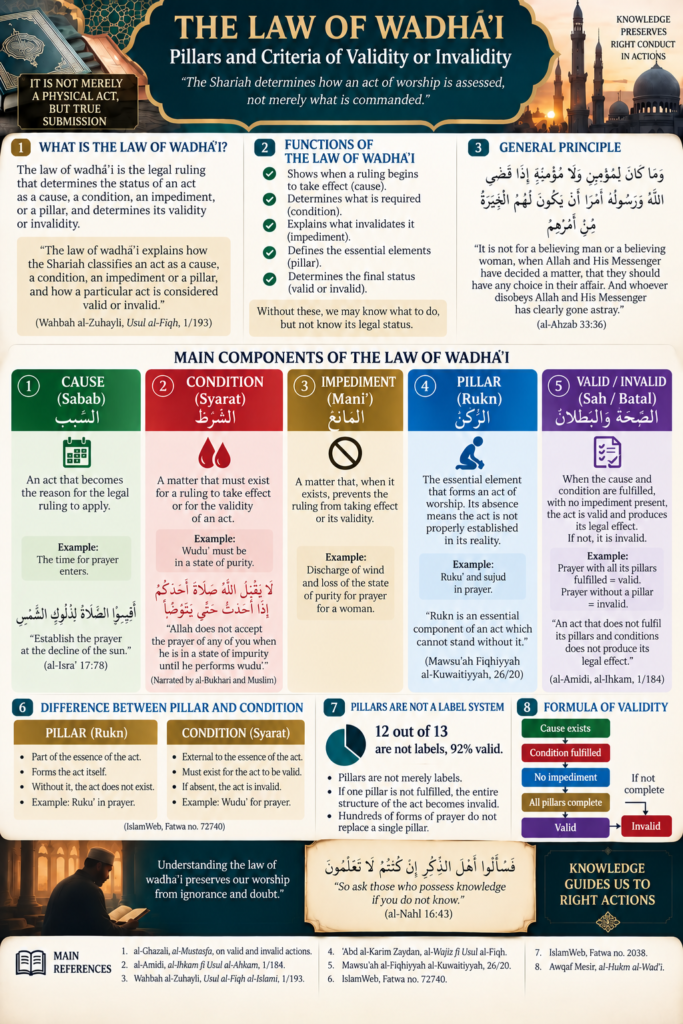
The Law of Wadha’i explains how the Shariah classifies something as a cause, a condition, an impediment or a pillar, and how an act is ultimately determined to be valid or invalid.
The Egyptian Ministry of Awqaf, referring to works on Usul al-Fiqh, defines the Law of Wadha’i as a ruling of Allah that makes something a cause for another matter, a condition for it, or an impediment to it. In broader classifications, some scholars of Usul also include validity and invalidity within the discussion of the Law of Wadha’i.
1. CAUSE (SABAB) — السَّبَب
A cause is something established by the Shariah as an indication that a particular legal ruling takes effect.
An example is the beginning of the time for prayer.
Allah says:
أَقِمِ الصَّلَاةَ لِدُلُوكِ الشَّمْسِ إِلَىٰ غَسَقِ اللَّيْلِ
“Establish the prayer at the decline of the sun.”
Surah al-Isra’ 17:78
In the works of Usul al-Fiqh, the decline of the sun is given as an example of a cause for the obligation of the Zuhr prayer.
In simple terms:
CAUSE EXISTS → THE RELATED RULING TAKES EFFECT.
The classical definition of a cause describes it as something whose existence is connected to the existence of a ruling, and whose absence is connected to the absence of that ruling, according to the determination of the Shariah.
2. CONDITION (SYARAT) — الشَّرْط
A condition is a matter that must exist for a ruling to take effect or for the validity of an act.
The clearest example is:
PURITY FOR PRAYER.
The Messenger of Allah ﷺ said:
لَا يَقْبَلُ اللَّهُ صَلَاةَ أَحَدِكُمْ إِذَا أَحْدَثَ حَتَّى يَتَوَضَّأَ
“Allah does not accept the prayer of any of you when he is in a state of impurity until he performs wudu.”
Narrated by al-Bukhari and Muslim.
Therefore, a person may:
stand,
bow,
prostrate,
recite,
and perform all the outward forms of prayer,
but if a required condition is not fulfilled, validity is not established.
In the terminology of Usul al-Fiqh:
a condition is something whose absence results in the absence of that which depends upon it.
3. IMPEDIMENT (MANI’) — الْمَانِع
An impediment is a matter that, when it exists, prevents a ruling from taking effect or prevents its legal consequence.
A cause may already exist,
but something may prevent the ruling from taking effect in the usual manner.
Scholars of Usul describe Mani’ as something whose existence prevents a particular ruling or cause from producing its effect.
Therefore, the law is not assessed merely by asking:
“Does the cause exist?”
It must also ask:
“Is there an impediment?”
4. PILLAR (RUKN) — الرُّكْن
This is a particularly important matter.
A pillar is an essential element that forms the act of worship itself.
The Kuwaiti Fiqh Encyclopedia defines a pillar as:
an internal element that forms the reality of something, without which that thing cannot properly exist in its reality.
Examples in prayer include:
Ruku’,
Sujud,
and other elements established as pillars.
A pillar is not an ornament of worship.
A pillar is not recommended.
A pillar is not optional.
When the Shariah establishes something as a pillar:
IT MUST BE FULFILLED.
5. PILLARS ARE DIRECTLY RELATED TO VALIDITY
Although scholars of Usul differ in how they formally classify the categories of the Law of Wadha’i, the relationship between pillars and validity is clear.
IslamWeb summarises that pillars and conditions are both necessary for the validity of an act when a person is capable of fulfilling them. The technical distinction concerns their respective positions within the structure of the act.
Therefore:
PILLAR NOT FULFILLED
↓
STRUCTURE OF WORSHIP INCOMPLETE
↓
VALIDITY IS NOT ESTABLISHED
unless the deficiency is corrected in a manner recognised by the Shariah.
6. PILLARS ARE NOT A LABEL SYSTEM
Pillars cannot be understood like an examination scoring system.
If an act of worship has several pillars, one cannot say:
“I have already performed almost all of them.”
For example, if an act has 13 pillars:
12 out of 13
does not mean:
92% VALID.
Because pillars are not marks.
A pillar is:
AN ESSENTIAL COMPONENT.
If one essential element that has truly been established as a pillar is missing, the validity of the entire structure is affected.
7. MANY OTHER ACTS CANNOT REPLACE A SINGLE PILLAR
If one pillar is omitted, performing many other acts does not replace that pillar.
Many recommended acts cannot replace one pillar.
Many acts of remembrance do not replace Ruku’.
Many additional recitations do not replace Sujud.
Why?
Because each matter has its own legal status.
Therefore:
ONE PILLAR CANNOT BE REPLACED BY A HUNDRED THINGS THAT ARE NOT PILLARS.
8. VALID (SAH) — الصِّحَّة
One of the important discussions within the Law of Wadha’i is:
الصِّحَّة
VALID.
Imam al-Ghazali discusses the term validity in acts of worship in al-Mustasfa. He explains that there are differences in terminology between the Mutakallimun and the Fuqaha, but both discuss the relationship between an act, its recognition by the Shariah and its legal effect.
In general Fiqh usage, an act of worship is considered valid when it fulfils what is required so that it produces a legal effect recognised by the Shariah.
Legal studies referring to al-Amidi, al-Subki and Ibn al-Humam likewise summarise that an act or transaction that fulfils its pillars and conditions is valid and produces its legal effect.
9. INVALID (BATAL) — الْبُطْلَان
The opposite of valid is:
الْبُطْلَان
INVALID.
If the required essential matters are not fulfilled, the legal effect that should arise from the act is not produced.
Therefore, the legal question is not:
“Has a person performed many things?”
Rather:
“Have the requirements for validity been fulfilled?”
Studies referring to classical works of Usul summarise that an act that does not fulfil its pillars and conditions does not produce the same legal effect as a valid act.
10. “I HAVE DONE IT” IS NOT THE SAME AS “IT IS VALID”
This is one of the major functions of the Law of Wadha’i.
A person may say:
“I have prayed.”
But the law still asks:
Were the conditions fulfilled?
Were all the pillars complete?
Was there any impediment?
Only then can the determination be made:
VALID
or:
INVALID.
Therefore, the mere existence of a physical act does not by itself answer the question of validity.
11. THE LAW OF WADHA’I DOES NOT LEAVE VALIDITY TO PERSONAL FEELINGS
Validity is not based on:
“I feel that it is enough.”
Nor:
“I feel that Allah accepts it.”
Nor:
“I have already tried.”
Validity has criteria established by the Shariah.
This is why the Fuqaha discuss in detail:
conditions,
pillars,
invalidating factors,
validity,
and:
invalidity.
If validity depended only upon personal feelings, this entire legal structure would not be necessary.
12. PILLARS ENSURE THAT WORSHIP IS NOT MERELY AN OUTWARD FORM
Two people may appear to be performing the same act.
But the legal ruling may differ because the structure of validity is not the same.
One fulfils what is required.
The other leaves out an essential element.
Therefore, outward appearance alone does not determine the ruling.
What determines it is:
WHAT THE SHARIAH HAS ESTABLISHED.
13. THE RELATIONSHIP BETWEEN CAUSE, CONDITION, IMPEDIMENT AND PILLAR
For easier understanding:
CAUSE
Triggers or indicates that a particular ruling takes effect.
↓
CONDITION
A matter that must exist for the ruling to take effect or for the validity of an act.
↓
IMPEDIMENT
A matter that prevents the ruling from taking effect or prevents its legal consequence.
↓
PILLAR
The essential element that forms the act itself.
↓
VALID / INVALID
The final determination of the act.
This provides a complete framework:
CAUSE → CONDITION → NO IMPEDIMENT → ALL PILLARS COMPLETE → VALID
14. THE EXAMPLE OF PRAYER
Take prayer as an example.
The beginning of the prayer time relates to the cause.
Purity relates to the condition.
Then, during prayer:
its pillars must be performed.
If something that has truly been established as a pillar is omitted and is not corrected in the manner determined by the Shariah:
THE PRAYER IS INVALID.
Therefore, a person cannot say:
“But I have already performed almost everything.”
Because the issue is not quantity.
The issue is:
THE PILLAR.
15. ONE MISSING PILLAR AFFECTS THE WHOLE
This is the nature of a pillar.
When something has truly been established as a pillar, it forms part of the reality of the act.
The Kuwaiti Fiqh Encyclopedia explains that a pillar is an internal component without which the act cannot stand.
Therefore:
THE ABSENCE OF A PILLAR IS NOT MERELY THE LOSS OF PERFECTION.
It affects:
VALIDITY.
16. A PILLAR MUST BE ESTABLISHED BY THE SHARIAH
However, one matter is extremely important.
We cannot arbitrarily label something as:
A PILLAR.
Because once something is given the status of a pillar, the consequence is significant:
its absence affects validity.
Therefore, the status of something as a pillar must have a basis in:
Islamic textual evidence,
the Sunnah,
or:
the recognised legal reasoning of qualified Fuqaha.
The term “pillar” is not a rhetorical label.
It is a legal term.
17. VALIDITY IS NOT BASED ON QUANTITY
Imagine an act that has:
10 pillars.
If only 9 are fulfilled:
the issue is not:
90% COMPLETE.
The issue is:
one essential component is missing.
Therefore, the formula:
“ALMOST ALL”
has no function in determining the validity of an act whose pillar is missing.
18. THE LAW OF WADHA’I IS A SYSTEM FOR DETERMINING LEGAL EFFECT
This is why the Law of Wadha’i is so important.
It explains:
when a ruling begins to take effect,
what is required,
what prevents it,
what forms the act,
and:
what its final legal effect is.
Without it, a person may know only that an act has taken place.
But they do not yet know:
WHAT IS THE LEGAL STATUS OF THAT ACT ACCORDING TO THE SHARIAH?
19. FORMULA OF VALIDITY
The Law of Wadha’i can be understood through the following sequence:
سَبَب
CAUSE
↓
شَرْط
CONDITION
↓
انْتِفَاءُ الْمَانِع
NO IMPEDIMENT
↓
رُكْن
ALL PILLARS COMPLETE
↓
صِحَّة
VALID
If a required element is not fulfilled:
↓
بُطْلَان
INVALID
20. A PILLAR IS THE DIVIDING LINE BETWEEN “ALMOST COMPLETE” AND “COMPLETE”
This is the simplest way to understand the matter.
Something that consists of pillars is complete only when its pillars are complete.
Therefore, the Law of Wadha’i does not ask:
“How much has already been done?”
Rather:
“Have all the matters that determine its validity been fulfilled?”
This is the difference between:
MANY
and:
VALID.
CONCLUSION
The Law of Wadha’i explains how the Shariah determines the relationship between:
CAUSE
CONDITION
IMPEDIMENT
PILLAR
and ultimately:
VALID OR INVALID.
Although scholars of Usul differ in how some of these terms are formally classified within the Law of Wadha’i, there is no reason to exclude pillars from the discussion of validity.
A pillar is an essential component of an act.
When something has truly been established as a pillar:
IT MUST BE FULFILLED FOR A VALID ACT TO BE ESTABLISHED.
One cannot:
perform some,
leave some,
and then say:
“It is almost complete.”
Because:
PILLARS ARE NOT MARKS.
PILLARS ARE NOT OPTIONAL.
PILLARS DETERMINE THE STRUCTURE OF THE ACT.
Therefore, the simplest formula is:
CAUSE
↓
CONDITION
↓
NO IMPEDIMENT
↓
ALL PILLARS COMPLETE
↓
VALID
and when a required essential element is not fulfilled:
INVALID.
REFERENCES
1. Abu Hamid al-Ghazali, al-Mustasfa min ‘Ilm al-Usul — discussion of validity, invalidity and fasad. Al-Ghazali records differences in terminology between the Fuqaha and Mutakallimun regarding the meaning of validity in worship.
2. Sayf al-Din al-Amidi, al-Ihkam fi Usul al-Ahkam, Vol. 1 — discussion of Islamic legal rulings, validity and invalidity. Al-Amidi’s classification is also referenced in studies discussing validity and invalidity within the Law of Wadha’i.
3. Wahbah al-Zuhayli, Usul al-Fiqh al-Islami, Vol. 1 — discussion of the Law of Wadha’i, cause, condition and impediment.
4. ‘Abd al-Karim Zaydan, al-Wajiz fi Usul al-Fiqh — discussion of the Law of Wadha’i and its relationship with cause, condition and impediment.
5. al-Mawsu‘ah al-Fiqhiyyah al-Kuwaitiyyah, Vol. 26, entry al-Shart — a pillar is described as an internal element that forms the reality of something, while a condition is required for its validity.
6. Egyptian Ministry of Awqaf, “al-Hukm al-Waḍ‘ī” — cause, condition and impediment as fundamental categories of the Law of Wadha’i; al-Amidi and some other scholars additionally include validity, invalidity, ‘azimah and rukhsah.
7. IslamWeb, “Aujuh al-Farq bayna al-Rukn wa al-Shart” — explains that pillars and conditions are both required for the validity of an act when a person is capable of fulfilling them.
8. IslamWeb, “Ta‘rif al-Shart wa al-Rukn wa al-Wajib” — explains a pillar as part of the reality of an act and purity as an example of a condition for the validity of prayer.
Detecting your location…