

MUKADDIMAH · M19

In Islam, human beings are not left to live without the guidance of law.
Allah determines what:
must be done,
must be avoided,
is encouraged,
is discouraged,
and
is left to individual choice.
This is the area discussed under:
الْحُكْمُ التَّكْلِيفِيّ
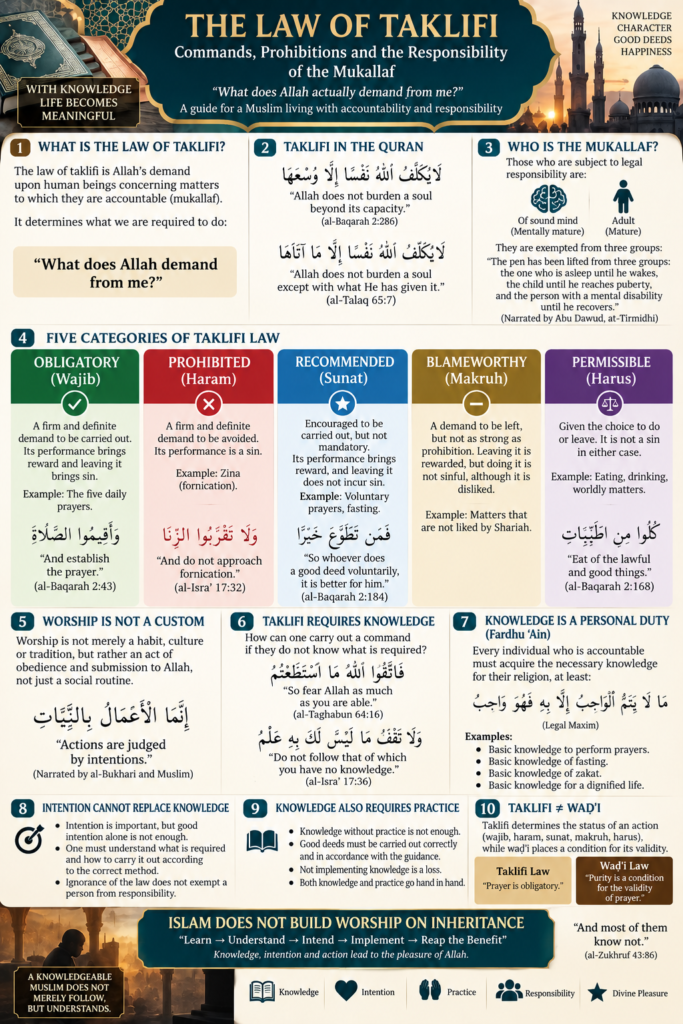
THE LAW OF TAKLIFI
The Law of Taklifi concerns Allah’s demands upon the actions of a Mukallaf.
It answers the question:
“What does Allah demand from me?”
Before discussing whether an act of worship is valid or invalid, a person must first know:
Is it Obligatory? Prohibited? Recommended? Blameworthy? Or Permissible?
1. WHAT IS TAKLIF?
The word Taklif originates from:
كَلَّفَ — يُكَلِّفُ
which carries the meaning of imposing a burden or assigning a responsibility.
Allah says:
لَا يُكَلِّفُ اللَّهُ نَفْسًا إِلَّا وُسْعَهَا
“Allah does not burden a soul beyond its capacity.”
Surah al-Baqarah 2:286
This verse shows that human beings receive Taklif, meaning legal responsibility.
Allah also says:
لَا يُكَلِّفُ اللَّهُ نَفْسًا إِلَّا مَا آتَاهَا
“Allah does not burden a soul except with what He has given it.”
Surah al-Talaq 65:7
Therefore, Taklif is not a command imposed without measure.
It remains within the capacity of the human being upon whom the responsibility is imposed.
2. WHO IS THE MUKALLAF?
A Mukallaf is a person who has fulfilled the qualifications required to bear legal responsibility.
Two very important foundations are:
OF SOUND MIND
and
ADULT (MATURE).
The Messenger of Allah ﷺ said:
رُفِعَ الْقَلَمُ عَنْ ثَلَاثَةٍ: عَنِ النَّائِمِ حَتَّى يَسْتَيْقِظَ، وَعَنِ الصَّبِيِّ حَتَّى يَحْتَلِمَ، وَعَنِ الْمَجْنُونِ حَتَّى يَعْقِلَ
“The pen has been lifted from three groups: the one who is asleep until he wakes, the child until he reaches puberty, and the person with a mental disability until he recovers.”
Narrated by Abu Dawud, al-Tirmidhi and others.
This hadith shows that Taklif is connected to:
awareness,
soundness of mind,
and
the capacity to bear responsibility.
3. WORSHIP IS NOT AN UNCONSCIOUS ACT
If Taklif is placed upon human beings who are of sound mind and conscious, then religion is not built upon random actions.
A person does not merely perform movements.
They know that they are performing an act of worship.
They know that Allah demands that action from them.
For this reason, the Messenger of Allah ﷺ said:
إِنَّمَا الْأَعْمَالُ بِالنِّيَّاتِ
“Actions are judged by intentions.”
Narrated by al-Bukhari and Muslim.
This hadith establishes intention as a major foundation of action.
The same outward action may carry different rulings depending upon its intention.
Therefore:
WORSHIP IS NOT A COINCIDENCE.
It is performed:
consciously,
intentionally,
and
as an act of obedience and submission to Allah.
4. THE FIVE CATEGORIES OF TAKLIFI LAW
Scholars of Usul al-Fiqh commonly divide Taklifi Law into five categories:
1. OBLIGATORY (WAJIB) — الواجب
A firm and definite demand to be carried out.
Its performance brings reward, and deliberately leaving it brings sin.
Example:
The five daily prayers.
Allah says:
وَأَقِيمُوا الصَّلَاةَ
“And establish the prayer.”
Surah al-Baqarah 2:43
2. PROHIBITED (HARAM) — الحرام
A firm and definite demand to be avoided.
Allah says:
وَلَا تَقْرَبُوا الزِّنَىٰ
“And do not approach fornication.”
Surah al-Isra’ 17:32
This prohibition indicates a firm demand to avoid the act.
3. RECOMMENDED (SUNAT) — المندوب
Something encouraged to be carried out, but not mandatory.
Its performance brings reward, and leaving it does not incur sin.
Examples include voluntary prayers, additional charity and various good deeds.
Allah says:
فَمَنْ تَطَوَّعَ خَيْرًا فَهُوَ خَيْرٌ لَهُ
“So whoever does a good deed voluntarily, it is better for him.”
Surah al-Baqarah 2:184
4. BLAMEWORTHY (MAKRUH) — المكروه
Something demanded to be left, but not as firmly as something prohibited.
Leaving it is rewarded, but doing it is not sinful in the same way as committing something prohibited.
5. PERMISSIBLE (HARUS) — المباح
Something for which a person is given the choice to do or leave.
Allah says:
كُلُوا مِنَ الطَّيِّبَاتِ
“Eat of the lawful and good things.”
A permissible act may become an act of worship when accompanied by a good intention.
5. TAKLIFI LAW ANSWERS: “WHAT MUST I DO?”
If a Muslim asks:
“Am I required to pray?”
That is a question of Taklifi Law.
The answer is:
OBLIGATORY.
If they ask:
“Is fornication permitted?”
The answer is:
PROHIBITED.
If they ask:
“Is additional charity obligatory?”
The answer is:
RECOMMENDED.
Therefore, Taklifi Law determines the status of an action.
6. TAKLIF REQUIRES KNOWLEDGE
How can a person carry out what is obligatory if they do not know what is required?
Allah says:
فَاعْلَمْ أَنَّهُ لَا إِلَٰهَ إِلَّا اللَّهُ
“So know that there is no ilah except Allah.”
Surah Muhammad 47:19
The command:
فَاعْلَمْ
“So know”
demonstrates the importance of knowledge before a person speaks about Tawhid.
Allah also says:
وَلَا تَقْفُ مَا لَيْسَ لَكَ بِهِ عِلْمٌ
“Do not follow that of which you have no knowledge.”
Surah al-Isra’ 17:36
Therefore, a Mukallaf is required not to practise religion on the basis of assumption or coincidence.
7. KNOWLEDGE IS A PERSONAL DUTY (FARDHU ‘AIN)
When an obligation has been imposed upon a person, they must acquire at least the knowledge necessary to fulfil that obligation.
A legal maxim states:
مَا لَا يَتِمُّ الْوَاجِبُ إِلَّا بِهِ فَهُوَ وَاجِبٌ
“Whatever is necessary for the completion of an obligation is itself obligatory.”
If prayer is obligatory, then the basic knowledge necessary to perform prayer also becomes obligatory according to what is required.
If Zakat is obligatory upon a person, they must know the basic rulings of Zakat relevant to their wealth.
If fasting during Ramadan is obligatory, they must know the basic matters that determine how the fast is performed.
Islam does not place a person in a situation of:
“Just do it. If it happens to be correct, perhaps it will be valid.”
Instead:
LEARN → UNDERSTAND → IMPLEMENT.
8. THE MESSENGER OF ALLAH ﷺ PRAISED THOSE WHO UNDERSTAND RELIGION
The Messenger of Allah ﷺ said:
مَنْ يُرِدِ اللَّهُ بِهِ خَيْرًا يُفَقِّهْهُ فِي الدِّينِ
“Whoever Allah intends good for, He gives them understanding of the religion.”
Narrated by al-Bukhari and Muslim.
The Prophet ﷺ did not merely say:
“Allah causes them to perform many actions.”
Rather:
يُفَقِّهْهُ
“He gives them understanding.”
Therefore:
PRACTICE + UNDERSTANDING
is closer to the nature of worship that is required than blindly following actions without knowledge.
9. INTENTION CANNOT REPLACE KNOWLEDGE
A person may have a good intention.
But good intention alone is not enough to automatically transform something incorrect into something correct.
For example:
“I intend to pray.”
That intention is important.
But the person still needs to understand what is required and how to perform the prayer according to the correct method.
Likewise:
“I intend to pay Zakat.”
They need to know:
whether Zakat has become obligatory,
the amount that must be paid,
to whom it may be given,
and
how Zakat is to be paid.
Therefore, ignorance of the law does not exempt a person from responsibility.
10. KNOWLEDGE ALSO REQUIRES PRACTICE
Conversely, knowledge without practice is not enough.
Allah condemns those who know but do not act.
Therefore, there is a relationship:
KNOWLEDGE → INTENTION → PRACTICE.
Knowledge without practice is not enough.
Practice without knowledge is vulnerable to error.
Intention without implementation does not fulfil an obligation.
Both knowledge and practice go hand in hand.
11. TAKLIFI LAW IS NOT THE LAW OF VALIDITY AND INVALIDITY
An important distinction must be made here.
Taklifi Law determines:
OBLIGATORY
PROHIBITED
RECOMMENDED
BLAMEWORTHY
PERMISSIBLE.
But the question:
“Is the act of worship valid?”
belongs to another discussion, namely:
WAD’I LAW.
For example:
Prayer is OBLIGATORY
→ Taklifi Law.
But:
Is the prayer that was performed VALID?
→ Wad’i Law.
This distinction is very important.
A person may know that prayer is obligatory, but if they do not fulfil what has been established for its validity, the obligation has not yet been validly fulfilled.
12. TAKLIFI LAW GIVES THE COMMAND; WAD’I LAW DETERMINES VALIDITY
The relationship can be summarised as follows:
TAKLIFI LAW
“Allah commands me.”
↓
KNOWLEDGE
“I need to know what is required.”
↓
INTENTION
“I intend to perform it as worship.”
↓
PRACTICE
“I carry out what is required.”
↓
WAD’I LAW
“Does my practice meet the conditions for its validity?”
13. PERSONAL DUTY (FARDHU ‘AIN) IS NOT BUILT UPON BLIND IMITATION
Fardhu ‘Ain means an obligation imposed upon every individual Mukallaf.
Therefore, that responsibility cannot be transferred to another person.
Others may teach.
A teacher may guide.
Scholars may explain.
But the Mukallaf themselves must:
know,
intend,
and
practise.
A person cannot say:
“My teacher knows, so that is enough.”
Or:
“I simply follow others without knowing what is being done.”
The Taklif rests upon that person.
14. “I PRAY” REQUIRES SELF-AWARENESS
A person who prays must be aware that they are praying.
A person who fasts must be aware that they are fasting.
A person who pays Zakat must know that what they are giving is Zakat.
Likewise, a person making the Shahadah says:
أَشْهَدُ
“I bear witness.”
All of this demonstrates that religion requires a person who is conscious of their own actions.
15. TAKLIF AND THE SHAHADAH
This relationship becomes even more important when discussing the Shahadah.
A person does not merely say:
لَا إِلَٰهَ إِلَّا اللَّهُ
but says:
أَشْهَدُ
“I bear witness.”
Allah also says:
إِلَّا مَنْ شَهِدَ بِالْحَقِّ وَهُمْ يَعْلَمُونَ
“Except those who bear witness to the truth while they know.”
Surah al-Zukhruf 43:86
Therefore, within the Shahadah there is a very clear element:
WITNESSING + KNOWLEDGE.
It is not merely a sound produced by the tongue.
16. TAKLIFI LAW EDUCATES HUMAN BEINGS TO BECOME RESPONSIBLE
Taklifi Law is not merely a list of:
Obligatory, Prohibited, Recommended, Blameworthy and Permissible.
It educates human beings to realise:
I am responsible for my actions.
Allah says:
كُلُّ نَفْسٍ بِمَا كَسَبَتْ رَهِينَةٌ
“Every soul is held accountable for what it has earned.”
Surah al-Muddaththir 74:38
Taklif makes a person responsible for:
what they know,
what they intend,
and
what they do.
17. WORSHIP IS NOT A MATTER OF CHANCE
From all the principles above, one matter becomes clear:
ISLAM DOES NOT BUILD WORSHIP UPON CHANCE.
A person does not worship in the following manner:
“I do not know what I am doing, but everything happened to be correct.”
Worship is performed as the action of a Mukallaf who:
is of sound mind,
is conscious,
knows the obligation,
intends,
and
practises it.
This is the nature of Taklif.
18. FROM TAKLIFI LAW TO WAD’I LAW
After Taklifi Law establishes:
“YOU MUST DO THIS,”
the next question is:
“HOW DO WE KNOW THAT IT HAS BEEN PERFORMED VALIDLY?”
This is where Wad’i Law takes its place.
Taklifi Law says:
“Pray.”
Wad’i Law determines:
“What are the requirements by which the prayer is considered valid?”
Taklifi Law says:
“Pay Zakat.”
Wad’i Law determines:
“What are the causes, conditions and structures that make Zakat valid?”
Therefore, the two cannot be separated.
CONCLUSION
Taklifi Law is Allah’s demand upon the Mukallaf.
It determines five main categories:
OBLIGATORY
PROHIBITED
RECOMMENDED
BLAMEWORTHY
PERMISSIBLE.
But behind all of these stands a human being who:
is of sound mind,
is conscious,
possesses knowledge,
intends,
and
is responsible.
Allah says:
لَا يُكَلِّفُ اللَّهُ نَفْسًا إِلَّا وُسْعَهَا
“Allah does not burden a soul beyond its capacity.”
Al-Baqarah 2:286
The Messenger of Allah ﷺ said:
إِنَّمَا الْأَعْمَالُ بِالنِّيَّاتِ
“Actions are judged by intentions.”
And the Prophet ﷺ also said:
مَنْ يُرِدِ اللَّهُ بِهِ خَيْرًا يُفَقِّهْهُ فِي الدِّينِ
“Whoever Allah intends good for, He gives them understanding of the religion.”
Therefore, religion is not:
COINCIDENCE.
It is not:
BLIND IMITATION WITHOUT KNOWLEDGE.
Rather:
KNOWLEDGE → AWARENESS → INTENTION → PRACTICE.
Only after that does Wad’i Law answer:
VALID OR INVALID?
ISLAMIC TEXTUAL SOURCES AND REFERENCES
1. The Quran, al-Baqarah 2:286 — Lā yukallifullāhu nafsan illā wus‘ahā.
2. The Quran, al-Talaq 65:7 — Allah does not burden a soul except with what He has given it.
3. The Quran, al-Baqarah 2:43 — the command to establish prayer.
4. The Quran, al-Isra’ 17:32 — the prohibition against approaching fornication.
5. The Quran, Muhammad 47:19 — Fa‘lam annahu lā ilāha illā Allāh.
6. The Quran, al-Isra’ 17:36 — the prohibition against following something without knowledge.
7. The Quran, al-Zukhruf 43:86 — shahida bil-haqqi wa hum ya‘lamūn.
8. The Quran, al-Muddaththir 74:38 — every soul is responsible for what it has earned.
9. Sahih al-Bukhari & Sahih Muslim — Innamal-a‘mālu bin-niyyāt.
10. Sahih al-Bukhari & Sahih Muslim — Man yuridillāhu bihi khayran yufaqqihhu fi al-dīn.
11. Sunan Abi Dawud — the hadith Rufi‘a al-qalamu ‘an thalāthah concerning the sleeping person, the child and the person without reason.
12. Imam al-Ghazali, al-Mustasfa min ‘Ilm al-Usul — discussion of Islamic law and Taklif.
13. Imam al-Amidi, al-Ihkam fi Usul al-Ahkam — discussion of Taklifi Law and the Mukallaf.
14. Ibn Qudamah, Rawdat al-Nazir — discussion of Islamic law, Taklif and the relationship between obligation and capacity.
Detecting your location…