
MUKADDIMAH · M07
La Ilaha: Negating God Before Recognising Allah
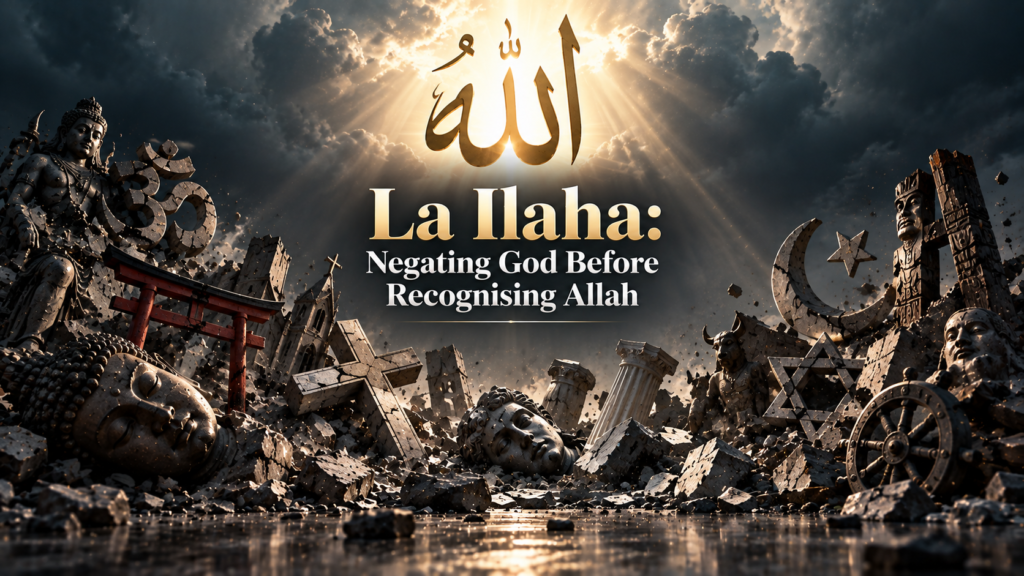
The declaration:
لَا إِلٰهَ إِلَّا الله
is usually encountered as a complete sentence.
Because it is recited as one continuous declaration, it is easy to move immediately towards the final word:
Allah.
But the Shahadah does not begin there.
It begins with:
لَا
No.
A negation comes before an affirmation.
This order deserves attention.
Before the witness is asked to affirm, something must first be denied.
Before recognition, there is distinction.
Before isbat, there is nafi.
This raises the central question:
What exactly is being negated in “La ilaha”?
In English, ilah is commonly translated as:
God.
If that translation is used, then La ilaha becomes:
There is no God.
This is not yet the whole Shahadah.
It is the negating movement of the Shahadah.
For SiHulk, this negation must be taken seriously.
The witness should not rush past it merely because they already know the words that follow.
Before asking what Allah means, we must first examine what we have been taught to imagine when we say:
God.
## La Begins with Negation
The Arabic particle:
لَا
performs a clear function.
It negates.
The declaration does not begin:
“There is Allah.”
It begins by removing something.
لَا إِلٰهَ
Whatever ilah signifies within the declaration is first subjected to negation.
This structure is important because a person may carry assumptions into the Shahadah without realising it.
If those assumptions are never examined, the person may pronounce the words of negation while continuing to preserve the very concept that the negation should have forced them to question.
The tongue says:
La.
But the imagination continues to hold onto an inherited image.
This is why nafi cannot be treated merely as grammar.
Negation must do something within the understanding of the witness.
## What Is Ilah?
The Qur’an uses the word ilah repeatedly.
For example:
وَإِلَٰهُكُمْ إِلَٰهٌ وَاحِدٌ
“And your ilah is one ilah…”
— Al-Baqarah 2:163
The Arabic word ilah is commonly rendered in English as god or deity.
Translation helps us approach a word.
But translation can also carry assumptions from the receiving language.
When a person hears the word God, they may imagine:
a supreme being,
a divine entity,
a creator somewhere beyond the world,
an unseen being,
or something existing invisibly above creation.
Whether consciously or unconsciously, the translated word can become filled with imagination.
The question therefore is not merely:
“What English word is normally used to translate ilah?”
The deeper question is:
“What concept have we placed behind that word?”
This distinction is essential.
A translated word is not automatically identical to everything the original term signifies.
And our imagination of a translated word is not automatically the reality to which revelation points.
## A Word and Its Concept Are Not the Same Thing
Consider a simple word:
King.
Different people may hear the same word but imagine very different things.
One imagines a medieval ruler.
Another imagines a constitutional monarch.
Another imagines absolute political authority.
Another thinks only of a ceremonial title.
The word is the same.
The concepts carried by different minds may not be.
The same problem can occur with religious language.
Two people may both say:
God.
But what exists in their understanding may be very different.
One may imagine an unseen object.
Another may imagine a supernatural being occupying some distant realm.
Another may think of an abstract philosophical cause.
Another may simply repeat the word without forming any clear understanding at all.
Therefore, before declaring that everyone means the same thing because everyone uses the same vocabulary, we must ask:
What does the word actually signify in the mind of the person using it?
This is particularly important when that word appears within the explanation of Shahadah.
## The Danger of Turning the Unseen into an Object
Human imagination naturally works with forms.
When we hear about something, the mind often tries to picture it.
If someone says:
mountain,
the mind may form an image.
If someone says:
house,
an image appears.
If someone says:
person,
the imagination may produce a human form.
But this habit creates a serious problem when applied carelessly to matters of faith.
A person may say:
“Allah cannot be seen.”
Then, without realising it, they imagine an invisible something.
The object has disappeared from sight, but it has not disappeared from imagination.
It has merely been moved into the unseen.
For SiHulk, this distinction is crucial.
Something does not cease to be an imagined object merely because we call it unseen.
If a person imagines a hidden entity somewhere beyond creation and then labels that imagined entity “Allah,” the question must be asked:
Is that recognition—or merely imagination?
The Shahadah begins with negation precisely because inherited assumptions must be capable of being challenged.
## The Qur’an Rejects Comparison
The Qur’an states:
لَيْسَ كَمِثْلِهِ شَيْءٌ
“There is nothing like unto Him.”
— Ash-Shura 42:11
This verse places a profound limit upon human comparison.
If nothing is like Him, then ordinary categories of created things cannot simply be enlarged and projected onto Allah.
A larger object is still an object.
An invisible object is still conceived as an object.
A distant being imagined through the categories of created existence is still being processed through those categories.
The Qur’an also says:
وَلَمْ يَكُن لَّهُ كُفُوًا أَحَدٌ
“And there is none comparable to Him.”
— Al-Ikhlas 112:4
These verses should make the witness cautious.
The question is not merely whether we avoid drawing an image of Allah.
The deeper question is whether our understanding itself has constructed an object and hidden it behind religious vocabulary.
## Negating the Hidden Idol
An idol does not necessarily begin with stone.
Before something is carved by the hand, it may already have been constructed by the imagination.
A physical idol is easy to recognise because it has shape.
A conceptual idol can be more difficult because it may hide behind words.
A person may reject statues while continuing to imagine a divine object somewhere beyond the universe.
They may insist that this object has no visible form.
They may call it unseen.
They may say it cannot be reached.
Yet internally, they still relate to it as a something.
For SiHulk, La ilaha demands that this possibility be confronted.
The hidden idol must also be subjected to negation.
The purpose is not to deny Allah.
It is to refuse to confuse Allah with something constructed by human imagination.
This distinction is fundamental.
Negating God is not the same as negating Allah.
Rather, within the SiHulk reading, the inherited concept of God must first be examined so that it is not automatically projected onto the word Allah.
## “God” and “Allah” Should Not Be Collapsed Without Examination
In everyday religious language, God and Allah are frequently treated as interchangeable.
For ordinary communication, this may appear natural.
But the Shahadah itself gives us reason to examine the relationship more carefully.
If ilah is translated as God, then the declaration begins:
La ilaha — There is no God.
Only after that negation comes:
illallah — except Allah.
The structure itself therefore distinguishes between what is negated and what is affirmed.
If we immediately define Allah simply as “God,” we risk collapsing the distinction before examining why the declaration was structured as negation followed by exception and affirmation.
For SiHulk, this requires careful reasoning.
We should not begin by assuming:
God = Allah
and then use that assumption to explain the Shahadah.
We should first allow the Shahadah to challenge the assumption.
What if the declaration is asking us to negate the very conceptual framework through which we have been imagining God?
That question must be examined before affirmation can be understood properly.
## One and “Satu Tak Terbilang”
The word one can carry different meanings.
When we say:
one chair,
the number one distinguishes that chair from two chairs.
When we say:
one person,
the person can be counted among other people.
This is numerical oneness.
But when speaking about Allah, SiHulk does not understand divine oneness as though Allah were simply one member of a category of possible divine objects.
Allah is not “one” in the same way that one object is one among many.
This is why the SiHulk expression:
satu tak terbilang
is important.
It points towards a oneness that should not be reduced to ordinary numerical counting.
The Qur’an declares:
قُلْ هُوَ الله أَحَدٌ
“Say: He is Allah, Ahad.”
— Al-Ikhlas 112:1
The word Ahad demands more careful thought than merely imagining the number 1.
If Allah were conceived simply as one object instead of several objects, the imagination would still be operating within the category of objects.
The number has changed.
The conceptual problem has not.
## Negation Clears the Ground
Imagine a glass filled with muddy water.
If someone continually pours clean water into it without addressing what is already inside, the result remains mixed.
Negation performs a clearing function.
It forces the seeker to examine what has already occupied their understanding.
What did I inherit?
What did I imagine?
What did translation cause me to assume?
What did culture teach me to picture?
What have I been calling Allah without ever examining whether that concept came from revelation or from imagination?
These questions are uncomfortable precisely because they challenge familiarity.
But familiarity is not evidence.
Something can feel obvious merely because we have repeated it for a long time.
La interrupts that comfort.
It says:
Negate first.
Do not rush to affirmation while carrying unexamined assumptions into it.
## Nafi Is Not Atheism
At this point, an important distinction must be made.
Negation in the Shahadah should not be confused with atheism.
Atheism commonly denies the existence of God or gods.
The Shahadah does not end with:
La ilaha.
It continues:
illallah.
Therefore, the negation is not the destination.
It performs a function within a larger testimony.
Nafi clears.
Isbat affirms.
If a person stops at negation, the declaration remains incomplete.
But if a person rushes into affirmation without understanding the negation, inherited assumptions may remain untouched.
The Shahadah contains both.
This balance matters.
## The Qur’an Shows Rejection Before Belief
Al-Baqarah 2:256 provides a striking sequence:
فَمَن يَكْفُرْ بِالطَّاغُوتِ وَيُؤْمِن بِالله
“Whoever rejects taghut and believes in Allah…”
— Al-Baqarah 2:256
Again:
rejection
comes alongside:
belief.
Something is refused.
Something is affirmed.
This does not mean that taghut and ilah are identical terms.
They are not.
But the pattern demonstrates that Qur’anic faith is not always described merely as adding belief.
There is also rejection of what falsely claims the place that should not belong to it.
This reinforces the intellectual movement of nafi and isbat.
Recognition sometimes requires removing a false object of recognition first.
## Inherited Images Must Be Examined
A child may be told:
“Allah is up there.”
The adult teaching the child may intend only a simple religious explanation.
But what does the child’s imagination construct?
Perhaps a powerful being somewhere above the clouds.
As the child grows older, the childish image may become more abstract.
The clouds disappear.
The physical form disappears.
The location becomes vague.
But the underlying concept may remain:
a hidden something somewhere.
Changing the sophistication of the language does not necessarily remove the original conceptual structure.
This is why adult faith requires adult examination.
The seeker must ask:
What exactly have I been imagining?
Where did that imagination come from?
Did revelation require me to imagine this?
Or did my mind create an object because it was uncomfortable with what it could not picture?
These questions are part of nafi.
## Allah Is Not Reached by Creating a Better Image
When one imagined concept is challenged, the solution is not simply to replace it with a more sophisticated imagined concept.
A crude image may become a philosophical image.
A physical object may become an invisible metaphysical object.
But if the underlying method remains:
“I must construct something in my mind and then call that Allah,”
the problem has not necessarily been solved.
The Qur’an says:
لَا تُدْرِكُهُ الْأَبْصَارُ وَهُوَ يُدْرِكُ الْأَبْصَارَ
“Vision does not encompass Him, while He encompasses all vision.”
— Al-An’am 6:103
Human perception has limits.
The answer to those limits is not to manufacture an invisible object and declare that the object is beyond sight.
The limitation itself should teach humility.
Recognition cannot simply mean successful imagination.
## The Witness Must Know What They Are Negating
The Shahadah now becomes more demanding.
When the witness says:
لَا إِلٰهَ
they should not treat those words merely as the opening sound before reaching Allah.
They should ask:
What am I refusing?
Am I refusing false objects of worship?
Am I refusing imagined divinity?
Am I refusing the idea that Allah is simply one divine object among possible divine objects?
Am I refusing inherited concepts that have never been examined?
Am I refusing to turn the unseen into a hidden idol?
These questions transform La ilaha from memorised language into intellectual and spiritual work.
Negation becomes conscious.
And only conscious negation prepares the ground for conscious affirmation.
## From God Towards the Question of Allah
The purpose of this discussion is not to create a linguistic argument over whether English speakers are allowed to use the word God.
The issue is deeper than vocabulary.
The issue is concept.
A person can use the word God while understanding it carefully.
Another can use the word Allah while carrying an entirely imagined concept.
Changing vocabulary alone therefore solves nothing.
The real question is:
What do we mean?
For SiHulk, La ilaha provides a method for confronting the inherited concept of God before simply assuming that the concept is identical to Allah.
The witness negates.
The witness clears.
The witness examines.
The witness refuses to turn imagination into certainty.
And then an even greater question emerges:
If Allah is not the “God” we have constructed within imagination, what does Allah actually signify?
That question cannot be answered merely by returning to the concept that has just been negated.
It requires a different examination.
For now, La ilaha leaves us at an important threshold.
Do not affirm before knowing what you have denied.
Do not call an imagined object Allah merely because it is invisible.
Do not assume that inherited vocabulary automatically equals recognition.
The Shahadah begins by demanding the courage to negate.
Because before the witness can recognise what is true, the witness must be prepared to release what has been falsely assumed to be true.
La ilaha is therefore not an empty denial.
It is the clearing of the ground upon which recognition can begin.
References
1. Al-Qur’an, Surah Al-Baqarah, 2:163.
2. Al-Qur’an, Surah Ash-Shura, 42:11.
3. Al-Qur’an, Surah Al-Ikhlas, 112:1–4.
4. Al-Qur’an, Surah Al-Baqarah, 2:256.
5. Al-Qur’an, Surah Al-An’am, 6:103.
6. Ibn Kathir, Tafsir al-Qur’an al-‘Azim, commentary on Surah Al-Ikhlas, 112:1–4.
7. Ibn Kathir, Tafsir al-Qur’an al-‘Azim, commentary on Surah Ash-Shura, 42:11.