
MUKADDIMAH · M06
The Reality of Shahadah: Witnessing, Negation and Affirmation
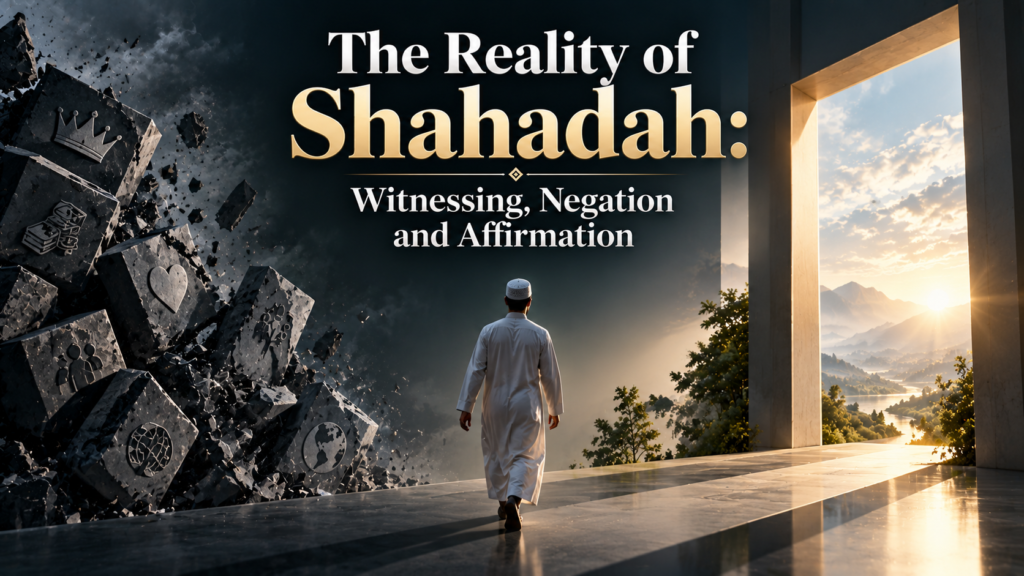
The Shahadah is among the most familiar declarations in Islam:
لَا إِلٰهَ إِلَّا الله مُحَمَّدٌ رَسُولُ الله
A Muslim may hear these words from childhood.
They may memorise them before understanding Arabic.
They may repeat them in prayer.
They may hear them in the adhan.
They may teach them to their children.
Because the words are so familiar, there is a danger that familiarity itself becomes a substitute for examination.
We know how to pronounce the Shahadah.
But do we know what it is asking us to witness?
This distinction matters.
Shahadah is not merely a sentence.
It is a testimony.
And testimony raises questions that ordinary repetition does not.
What does the witness know?
What is being denied?
What is being affirmed?
And upon what basis does the witness testify?
These questions bring us to the internal structure of the Shahadah itself.
Shahadah Means Bearing Witness
The Qur’an connects testimony with knowledge:
إِلَّا مَن شَهِدَ بِالْحَقِّ وَهُمْ يَعْلَمُونَ
“Except those who bear witness to the truth while they know.”
— Az-Zukhruf 43:86
The relationship is important:
Witnessing → Truth → Knowledge
A witness does not merely produce words.
A witness testifies concerning something.
And meaningful testimony requires some basis of knowledge.
Imagine someone appearing before a court.
They are asked:
“Did you witness what happened?”
They reply:
“No. I did not see it. I do not know what happened. I am only repeating what someone else told me.”
Such a person may be reporting information.
But their position is different from that of a witness.
This simple distinction helps us understand why the word Shahadah deserves serious attention.
To repeat is one thing. To bear witness is another.
The Qur’an Places Knowledge Beside Testimony
The relationship between knowledge and testimony appears elsewhere in the Qur’an:
شَهِدَ الله أَنَّهُ لَا إِلَٰهَ إِلَّا هُوَ وَالْمَلَائِكَةُ وَأُولُو الْعِلْمِ
“Allah bears witness that there is no ilah except Him, and so do the angels and those endowed with knowledge…”
— Ali ‘Imran 3:18
Notice who are mentioned:
Allah.
The angels.
And:
those endowed with knowledge.
Knowledge is not presented as something irrelevant to testimony.
It accompanies it.
This does not mean a person must know everything before they can speak about faith.
Human knowledge will always remain limited.
Rather, the principle is that testimony should possess conscious content.
The witness should seek to understand what the testimony means.
The Shahadah Has a Structure
Consider the first declaration:
لَا إِلٰهَ إِلَّا الله
These words are often pronounced as one continuous phrase.
But intellectually, the declaration contains a structure.
There is:
لَا — negation
followed by:
إِلَّا — exception
and then:
الله — affirmation
Something is first denied.
Then an exception is made.
Then something is affirmed.
This structure is fundamental.
The Shahadah does not begin merely with affirmation.
It begins with:
No.
Before the witness affirms, the witness negates.
This immediately produces two questions:
What exactly am I negating?
and
What exactly am I affirming?
If these questions have never been examined, the words may be familiar while their structure remains unexplored.
Negation Is Not Emptiness
Negation performs an important function.
It removes something.
Suppose a person is holding several assumptions to be true.
If one of those assumptions is false, adding another statement on top of it does not necessarily remove the false assumption.
It must first be confronted.
This is why negation can be intellectually important.
Before establishing what is true, a person may need to identify what is false.
Before recognising what something is, they may need to distinguish what it is not.
This movement can be expressed simply:
Nafi — negation
followed by:
Isbat — affirmation
The two belong together.
Negation without affirmation leaves emptiness.
Affirmation without negation may leave previous assumptions untouched.
The Shahadah contains both movements.
A Witness Must Distinguish
Suppose someone is shown two objects from a distance.
One is genuine.
The other is an imitation.
If the person cannot distinguish between them, how confidently can they testify which one is genuine?
The problem is not merely whether they have heard the correct answer.
The question is whether they can distinguish.
The same principle applies to ideas.
If truth and falsehood have never been distinguished, affirmation may become little more than inherited preference.
This is why the Qur’an repeatedly calls attention to distinction.
Al-Baqarah 2:256 states:
قَد تَّبَيَّنَ الرُّشْدُ مِنَ الْغَيِّ
“Right guidance has become distinct from error.”
The verse then speaks of rejecting taghut and believing in Allah.
Again, we encounter a movement:
Distinction → Rejection → Affirmation
This pattern is deeply relevant to Shahadah.
A conscious witness must eventually know what is being distinguished.
Repeating “La” Is Not Yet Negation
A person can pronounce:
لَا
without consciously denying anything.
The sound alone does not necessarily demonstrate understanding.
Imagine someone learning Arabic purely by imitation.
They repeat:
La ilaha illallah
perfectly.
But when asked:
“What does la do in this declaration?”
they have never considered the question.
The pronunciation is present.
But conscious negation has not necessarily occurred.
This distinction does not make pronunciation meaningless.
Words matter.
But the purpose of words is to carry meaning.
The tongue pronounces the negation.
Reason must seek to understand what is being negated.
The same applies to affirmation.
Pronouncing Allah does not by itself demonstrate that the person understands what they mean by Allah.
The word may have been inherited long before its meaning was examined.
Familiar Words Can Hide Unexamined Assumptions
Some words become so familiar that we stop asking what we mean by them.
Consider the word:
Allah
A Muslim may have heard this word thousands of times.
But if asked:
“What do you mean when you say Allah?”
the answer may reveal ideas collected from many different places.
Some may come from the Qur’an.
Some from hadith.
Some from teachers.
Some from translations.
Some from cultural imagination.
Some may come from childhood explanations.
Some may never have been consciously examined at all.
The same is true of:
ilah
and:
Rasulullah.
Familiarity with a word is not necessarily the same as understanding its meaning.
Therefore, before attempting deeper conclusions, the terms themselves must be examined.
Testimony Cannot Depend Only on Translation
Translation is useful.
It allows a person who does not understand Arabic to begin approaching the meaning of the Qur’an and religious terminology.
But translation is still an act of interpretation between languages.
One word in Arabic may not always correspond perfectly to one word in another language.
This becomes particularly important with foundational terms.
If ilah is translated into another language using a word that already carries cultural, philosophical or religious assumptions, those assumptions may quietly enter the reader’s understanding.
The reader may then believe they are examining the Arabic term when they are actually examining the assumptions attached to its translation.
This does not mean translation should be rejected.
It means:
Translation should open inquiry, not close it.
When a term is central to Shahadah, its meaning deserves careful examination.
Nafi Requires Knowing What Is Being Denied
Negation is meaningful only when its object is understood.
If someone tells you:
“Reject it.”
your natural question should be:
“Reject what?”
Without an object, rejection has no clear meaning.
The same principle applies to La ilaha.
If this is the negating movement of the Shahadah, then the witness must eventually investigate:
What is ilah?
What does the word mean in the Qur’anic context?
What assumptions have been attached to it?
What exactly is the Shahadah asking the witness to negate?
Until these questions are examined, a person may possess the wording of negation without understanding its object.
This is why nafi is not merely grammatical.
It is also an intellectual act of distinction.
Isbat Requires Knowing What Is Being Affirmed
The same principle applies to affirmation.
If someone tells you:
“Affirm this.”
you should know what this refers to.
The Shahadah does not stop at La ilaha.
It moves to:
إِلَّا الله
There is an affirmation involving Allah.
Therefore, another question becomes unavoidable:
What do we mean by Allah?
This question should not be treated as disrespectful.
If Allah stands at the centre of the testimony, seeking to understand what is meant by Allah is not a distraction from Shahadah.
It is part of taking Shahadah seriously.
A person cannot meaningfully say:
“I affirm”
while refusing to investigate what is being affirmed.
Muhammadur Rasulullah Is Also Testimony
The Shahadah does not end with:
لَا إِلٰهَ إِلَّا الله
It also contains testimony concerning Prophet Muhammad SAW:
مُحَمَّدٌ رَسُولُ الله
This declaration is often translated:
“Muhammad is the Messenger of Allah.”
Again, familiarity can hide important questions.
What is a rasul?
What is a risalah?
What does it mean to say that Muhammad SAW is Rasulullah?
What exactly did he carry?
What does the word Allah signify within this declaration?
If the words are testimony, these questions cannot permanently remain unexplored.
The witness should seek to understand not merely the name Muhammad, but what is being testified concerning him.
Knowing About Muhammad Is Not Necessarily Recognising His Station
A person may know many facts about Prophet Muhammad SAW.
They may know where he was born.
They may know the names of his family members.
They may know the battles associated with his Sirah.
They may know dates.
They may know narrations.
They may know his migration from Makkah to Madinah.
All of this can be valuable knowledge.
But historical information and recognition of Rasulullah are not necessarily identical.
The Shahadah does not merely say:
“Muhammad existed.”
It declares:
مُحَمَّدٌ رَسُولُ الله
The testimony concerns his station and function as Rasulullah.
Therefore, the witness must eventually move beyond biography alone and ask:
What am I recognising when I say Rasulullah?
Information Must Become Recognition
Consider a person who has studied a city for many years.
They know its streets.
They have seen photographs.
They know its history.
They can describe its buildings.
But they have never been there.
Their knowledge may be extensive.
Yet there remains a difference between:
information about a place
and:
recognition through encounter.
Religion contains a similar challenge.
A person can accumulate information about faith.
They can memorise theological definitions.
They can study religious history.
They can know thousands of rulings.
But Shahadah asks something more personal:
What do you bear witness to?
This is why knowledge should not remain merely external.
It should move towards recognition.
Shahadah Requires Intellectual Honesty
A person should not claim knowledge they do not possess.
The Qur’an says:
وَلَا تَقْفُ مَا لَيْسَ لَكَ بِهِ عِلْمٌ
“Do not follow what you have no sure knowledge of…”
— Al-Isra’ 17:36
This principle is particularly important in matters of testimony.
If something is unclear, say it is unclear.
If something requires investigation, investigate it.
If a conclusion comes from interpretation, identify it as interpretation.
If a statement comes directly from the Qur’an, distinguish it from the explanation built around it.
If a belief has merely been inherited, acknowledge that it was inherited before claiming that it has been independently understood.
This is not weakness.
It is intellectual honesty.
A sincere witness should prefer an honest question over a confident claim without knowledge.
Nafi Before Isbat
The structure of Shahadah now gives us an important method.
First: Nafi.
Examine what has been assumed.
Identify what is false.
Distinguish the object of negation.
Remove what should not be affirmed.
Then:
Isbat.
Identify what remains.
Understand what is being affirmed.
Recognise the basis upon which it is affirmed.
This process prevents affirmation from becoming merely another inherited slogan.
It demands consciousness.
A person does not simply say:
“This is true.”
They ask:
“What have I ruled out, and why?”
“What am I affirming, and why?”
The Shahadah therefore becomes not merely something pronounced, but something examined.
Witnessing Is Personal
Another person can teach us.
Another person can guide us.
Another person can provide evidence.
Another person can explain language.
Another person can share what they have understood.
But there remains a boundary.
No one can perform our recognition for us.
A teacher can point.
The student must look.
A guide can describe the road.
The traveller must travel.
A witness can tell another person what they witnessed.
But the listener does not automatically become a witness simply by hearing the report.
This is why Shahadah carries personal responsibility.
The declaration comes from the mouth of the individual.
Its meaning must therefore eventually confront the consciousness of that individual.
From Words to Witnessing
The Shahadah may begin for many people as words learned in childhood.
There is nothing unusual about that.
Human beings learn language through repetition.
They learn religious practices gradually.
Understanding develops over time.
But adulthood should not leave the Shahadah permanently at the level of childhood memorisation.
The journey should move:
Pronunciation → Meaning → Examination → Distinction → Negation → Affirmation → Recognition → Witnessing
At each stage, the same words become deeper.
The wording may not change.
The witness changes.
What was once repeated becomes examined.
What was once inherited becomes understood.
What was once merely information begins to become recognition.
The Question at the Centre of Shahadah
The central question is therefore not:
“Can you pronounce the Shahadah?”
Many people can.
The deeper question is:
“What are you bearing witness to when you pronounce it?”
When you say:
لَا إِلٰهَ
what are you denying?
When you say:
إِلَّا الله
what are you affirming?
When you say:
مُحَمَّدٌ رَسُولُ الله
what are you testifying concerning Muhammad SAW?
What is ilah?
What is Allah?
What is rasul?
What is risalah?
These questions cannot be answered merely by repeating the declaration again.
The declaration itself is what produces the questions.
For SiHulk, this is where Shahadah must be approached with seriousness.
A testimony should not merely pass through the tongue.
It should be understood by the witness.
Nafi without understanding is merely a word of denial.
Isbat without understanding is merely a word of affirmation.
But when a person distinguishes what is false, understands what is being affirmed and consciously bears testimony to what they recognise, Shahadah begins to reveal its deeper character:
not merely a declaration of religious identity, but an act of witnessing.
References
1.Al-Qur’an, Surah Az-Zukhruf, 43:86.
2.Al-Qur’an, Surah Ali ‘Imran, 3:18.
3.Al-Qur’an, Surah Al-Baqarah, 2:256.
4.Al-Qur’an, Surah Al-Isra’, 17:36.
5.Imam Muslim, Sahih Muslim, Kitab al-Iman, Hadith no. 26a.
6.Imam al-Bukhari, Sahih al-Bukhari, Kitab al-Iman, Hadith no. 8.