
MUKADDIMAH · M51
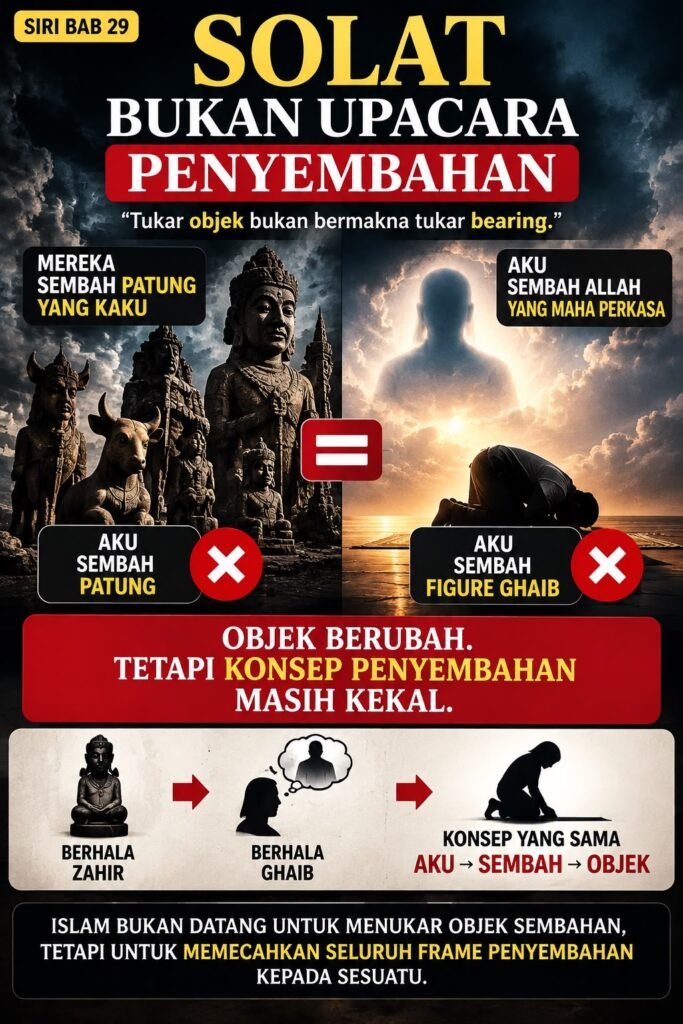
Many people describe the difference between non-Muslims and Muslims in this way:
“They worship lifeless statues.”
Then:
“I worship Allah the Almighty.”
At first glance, they appear different.
But examine the structure of their thinking:
I → WORSHIP → STATUE
is replaced with:
I → WORSHIP → UNSEEN FIGURE
The object changes.
But the concept of:
WORSHIPPING AN OBJECT
remains unchanged.
This chapter asks:
DID ISLAM COME TO REPLACE THE OBJECT OF WORSHIP?
Or did it come to dismantle the entire framework of worshipping something?
⸻
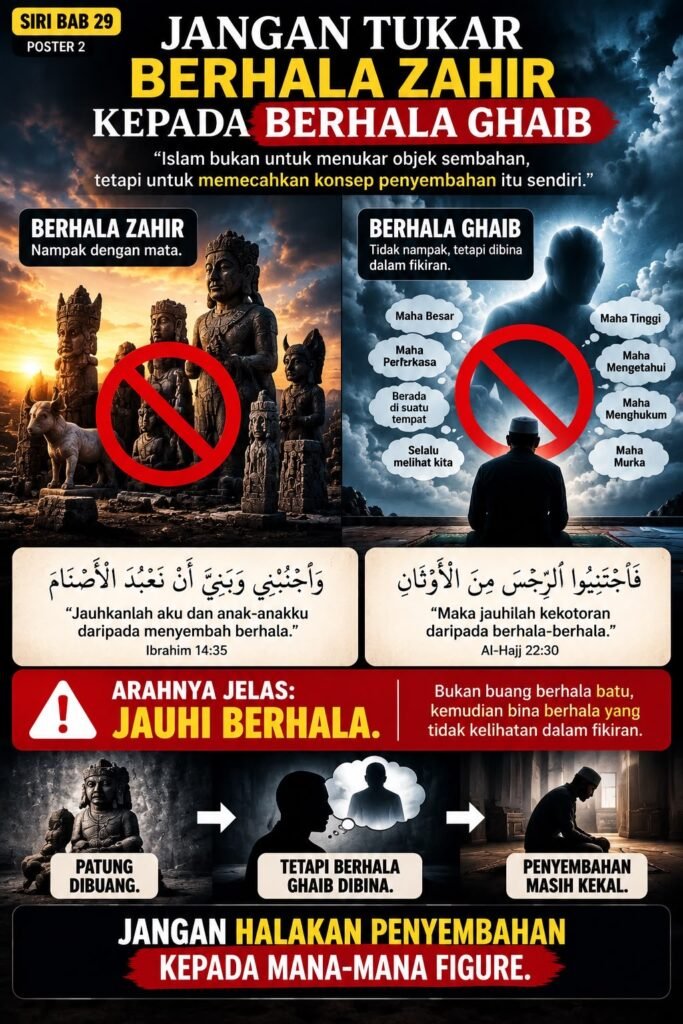
1. DO NOT REPLACE A VISIBLE IDOL WITH AN UNSEEN IDOL
The Quran states:
وَاجْنُبْنِي وَبَنِيَّ أَنْ نَعْبُدَ الْأَصْنَامَ
“Keep me and my children away from worshipping idols.”
— Ibrahim 14:35
And:
فَاجْتَنِبُوا الرِّجْسَ مِنَ الْأَوْثَانِ
“So avoid the impurity of idols.”
— Al-Hajj 22:30
The direction is clear:
AVOID IDOLS.
Not:
“Remove the stone idol, then construct an invisible idol.”
If the physical statue is removed but the mind continues to construct:
a great figure,
unseen,
powerful,
located somewhere,
watching over us,
and then names that image “Allah”—
the framework of idolatry has not truly been dismantled.
⸻
2. SALAH IS NOT A CEREMONY PERFORMED BEFORE AN UNSEEN FIGURE
If Salah is understood as:
“I stand five times a day to worship an unseen figure,”
then only the object of worship has changed.
The structure remains:
a worshipper
facing:
an object of worship.
Yet the previous chapters have established:
ALLAH IS NOT A THING.
Therefore, Salah must not be used to reconstruct something that has already been negated.
⸻
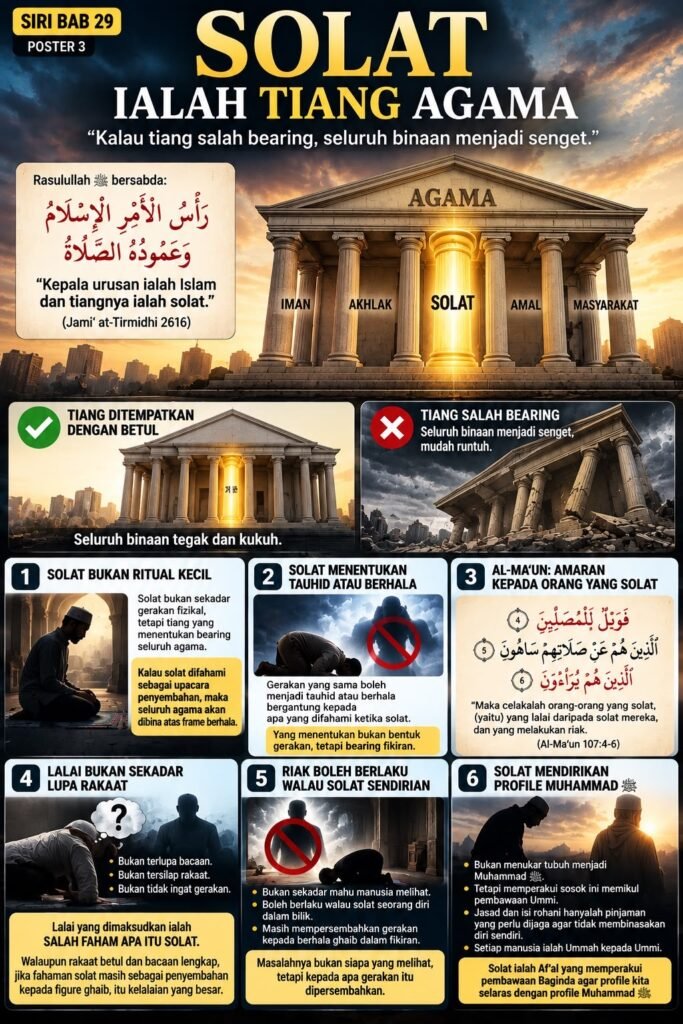
3. SALAH IS THE PILLAR OF RELIGION
A hadith states:
رَأْسُ الْأَمْرِ الْإِسْلَامُ وَعَمُودُهُ الصَّلَاةُ
“The foundation of the matter is Islam, and its pillar is Salah.”
— Jami‘ at-Tirmidhi 2616
Notice:
عَمُودُهُ الصَّلَاةُ
Salah is its pillar.
If a pillar is erected incorrectly, the entire structure becomes problematic.
That is why Salah is not a minor issue.
How someone understands Salah can determine the bearing of their entire Aqidah.
⸻
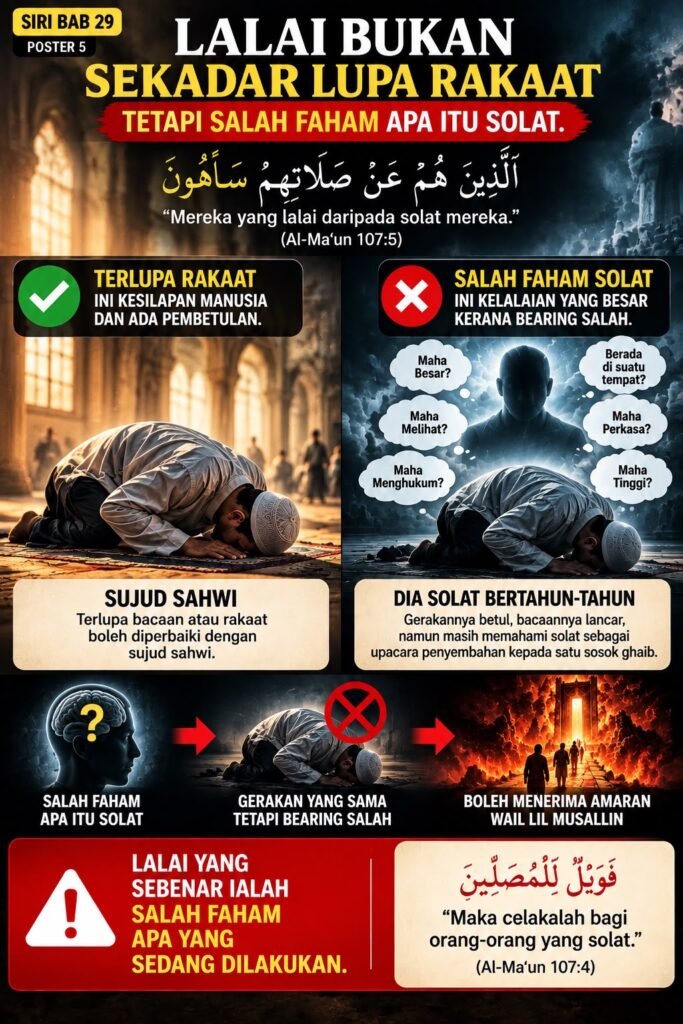
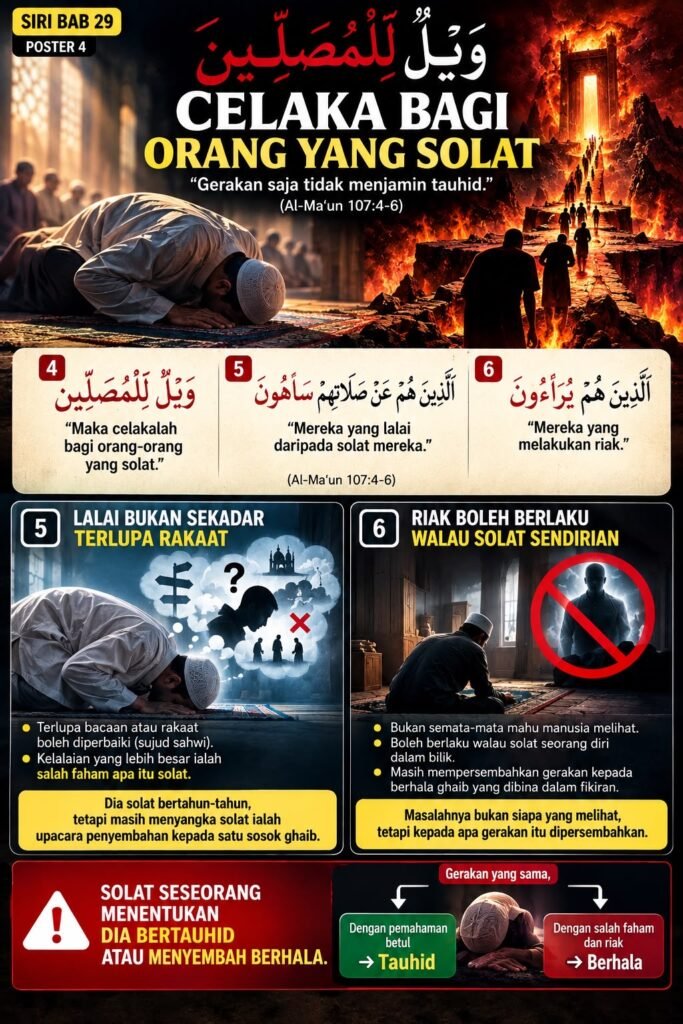
4. THAT IS WHY THE QURAN WARNS THOSE WHO PERFORM SALAH
Al-Ma‘un states:
فَوَيْلٌ لِّلْمُصَلِّينَ
“So woe to those who pray.”
— Al-Ma‘un 107:4
Then:
الَّذِينَ هُمْ عَن صَلَاتِهِمْ سَاهُونَ
“Those who are heedless of their Salah.”
— 107:5
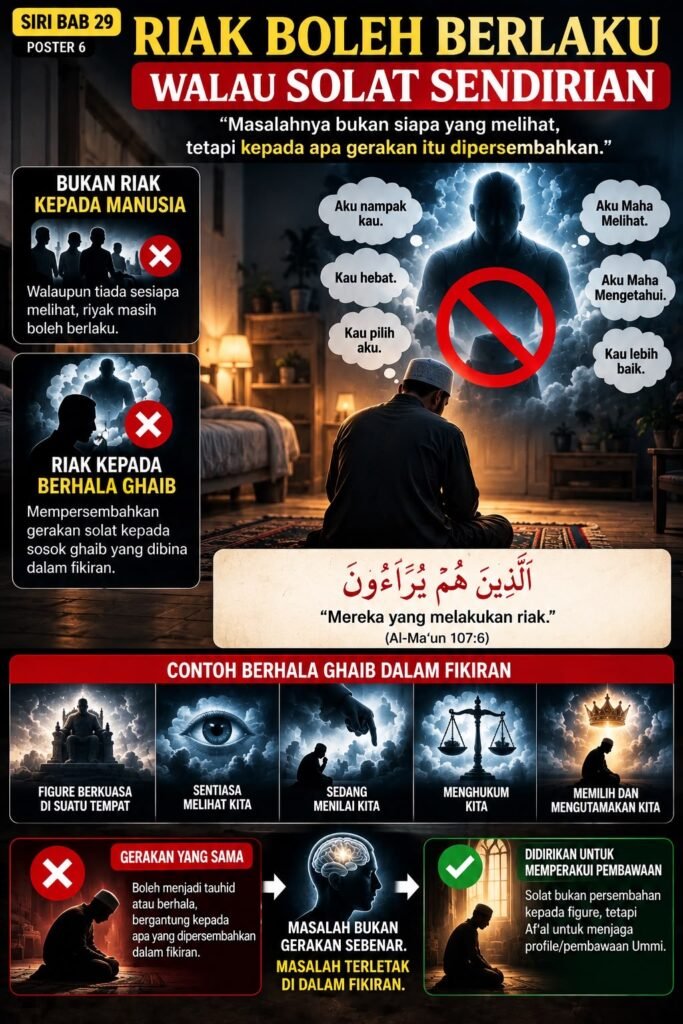
And:
الَّذِينَ هُمْ يُرَاءُونَ
“Those who show off.”
— 107:6
Notice something extremely important.
The warning is not directed at people who never perform the movements of Salah.
It is directed at:
الْمُصَلِّينَ
those who actually perform Salah.
Therefore, physical movements alone do not establish Tawhid.
⸻
5. “HEEDLESSNESS IN SALAH” IS NOT MERELY FORGETTING A RAK‘AH
Human beings can forget.
Forgetting the number of rak‘ahs has a correction through Sujud Sahwi.
Therefore, within the thesis of this chapter, the warning:
عَن صَلَاتِهِمْ سَاهُونَ
must not be reduced to:
forgetting a recitation,
making a mistake in the number of rak‘ahs,
losing concentration for a few seconds.
Such human mistakes do occur.
The greater issue is:
MISUNDERSTANDING WHAT SALAH ACTUALLY IS.
Someone performs Salah for years.
Yet continues to understand it as:
“A ceremony of worshipping an unseen figure.”
They do not forget the movements.
They have memorised the recitations.
They perform the correct number of rak‘ahs.
But the bearing of their Salah itself may be wrong.
That is a far greater form of heedlessness that must be examined.
⸻
6. RIYA’ IS NOT ONLY ABOUT SHOWING OFF TO OTHER PEOPLE
Riya’ is usually understood as:
“Performing Salah because you want other people to see.”
But what if someone performs Salah alone in a room?
No other human being is watching.
Yet in their mind, there is still the thought:
“I want to show an unseen figure that I am worshipping it.”
Within the thesis of this chapter, that too must be examined.
Because the structure:
I → PRESENT AN OFFERING → TO AN UNSEEN FIGURE
is still present.
Therefore, Riya’ is not merely a question of:
“Which human being is watching?”
But:
TO WHAT AM I PRESENTING THESE MOVEMENTS?
If an unseen idol still stands within the imagination, someone can be “showing off” even when no other human being is present in the room.
⸻
7. SALAH DETERMINES TAWHID OR IDOLATRY
This is why this chapter is so important.
The same movements:
standing,
bowing,
prostrating,
sitting,
giving salam,
can be performed by two people.
But the bearing of their understanding may be entirely different.
One understands Salah as:
an offering to an unseen object.
The other understands Salah as:
establishing a profile and carrying the Risalah.
Therefore, the difference is not merely in the physical movements.
The difference lies in:
WHAT IS ACTUALLY BEING ESTABLISHED?
That is why Salah can become the clearest means of examining:
TAWHID OR IDOLATRY.
⸻
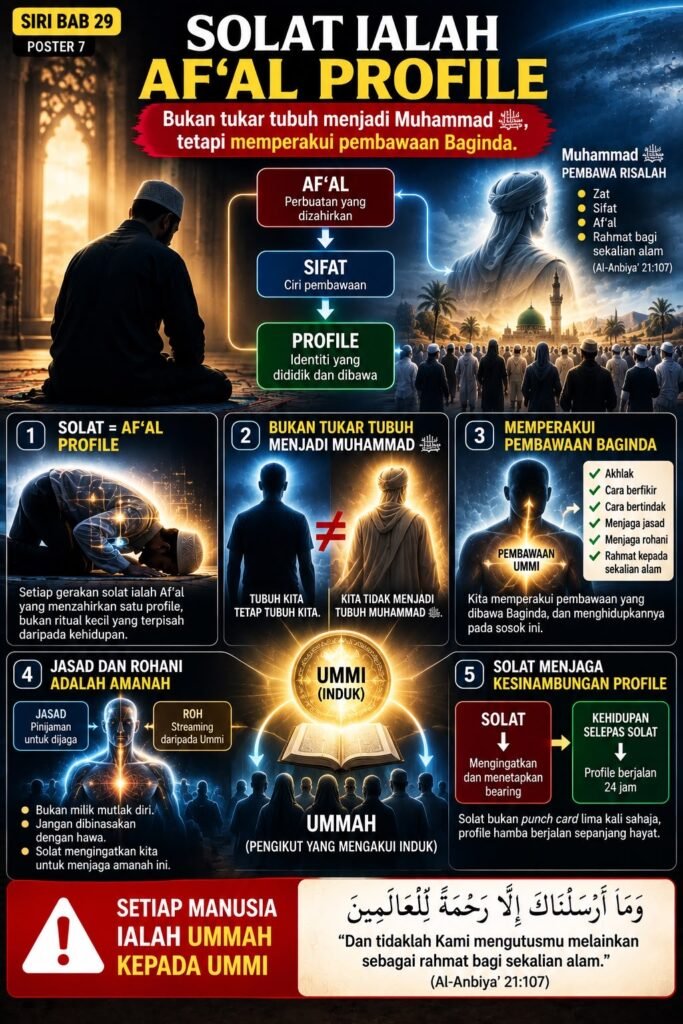
8. SALAH IS AF‘AL
Chapter 27 established the method:
AF‘AL → SIFAT → ZAT / PROFILE
Salah itself is:
AF‘AL.
It is an action.
Therefore, the question is:
Whose profile is being manifested through that action?
Within the thesis of this series, Salah does not end with bodily movements.
It is an action belonging to the profile and way of carrying the Risalah associated with Muhammad ﷺ as the bearer of Allah’s Risalah.
⸻
9. SALAH AND THE PROFILE OF MUHAMMAD ﷺ
This must be understood carefully.
We are not transforming our physical bodies into the figure of Muhammad ﷺ.
We do not become his physical body.
We do not change our biological identity into Prophet Muhammad ﷺ.
What is acknowledged is:
THIS PHYSICAL BODY BECOMES THE BEARER OF THE PROFILE / WAY OF LIFE INHERITED FROM THE UMMĪ.
In the terminology of this project:
Ummī = the original source.
Ummah = the followers who acknowledge that original source.
Therefore, every member of the Ummah acknowledges that their own way of life is not something to be constructed arbitrarily according to personal desires.
There is an original source of that way of life:
MUHAMMAD ﷺ.
⸻
10. NOT COPYING THE INDIVIDUAL — BUT PRESERVING WHAT HE CARRIED
This is not a process of:
“I want to become the physical figure of Muhammad.”
No.
The Prophet’s physical identity remains his own.
What must be preserved is the:
profile,
characteristics,
actions
that continue through the Ummah.
Therefore:
SALAH = AN ACTION THAT ACKNOWLEDGES THIS CONTINUITY.
It reminds the body:
“You do not exist to construct whatever profile you desire.”
⸻
11. THE PHYSICAL BODY AND SPIRITUAL CONTENT MUST BE RECOGNISED AS A TRUST
Chapter 28 raised the question:
Who truly owns the Ruh and the physical body?
Within the thesis of this project, Salah is, among other things, an action acknowledging that:
the physical body
and:
its spiritual content
are not possessions that can be shaped freely to the point of self-destruction.
They belong within the continuity of what the Ummī carries to the Ummah.
Therefore, Salah becomes an acknowledgement:
PROTECT THIS BODY.
PROTECT THIS PROFILE.
DO NOT DESTROY IT THROUGH PERSONAL DESIRES.
⸻
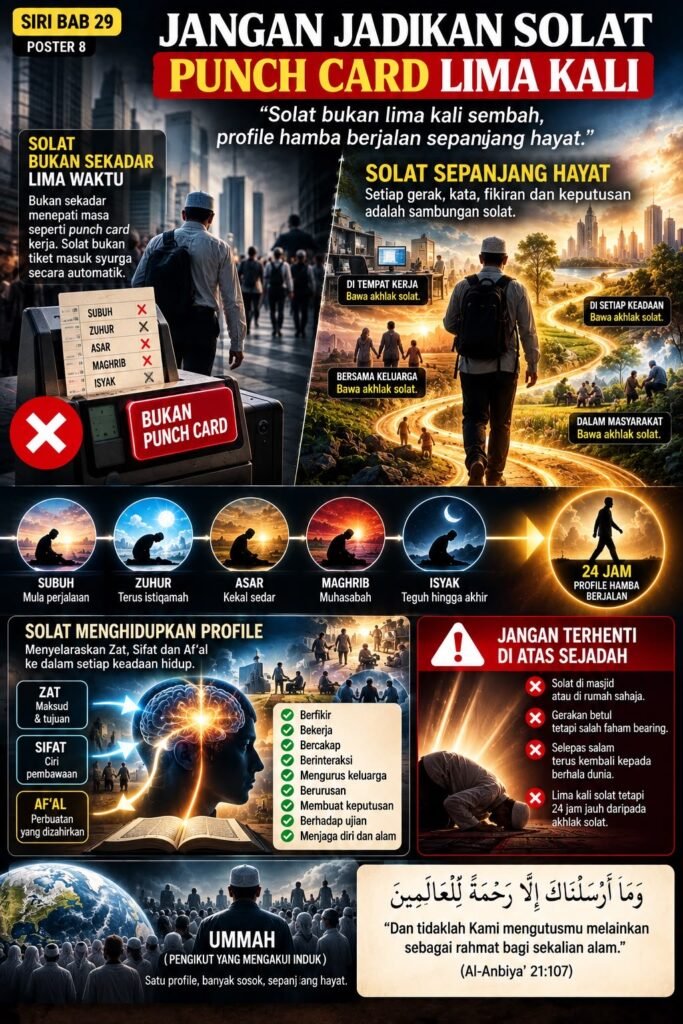
12. MUHAMMAD ﷺ — A MERCY TO ALL THE WORLDS
The Quran states:
وَمَا أَرْسَلْنَاكَ إِلَّا رَحْمَةً لِّلْعَالَمِينَ
“And We have not sent you except as a mercy to all the worlds.”
— Al-Anbiya’ 21:107
Therefore, what Muhammad ﷺ carried cannot be reduced to:
“A spokesperson who came to deliver a few ritual instructions.”
He became:
رَحْمَةً لِّلْعَالَمِينَ
a mercy to all the worlds.
Within the thesis of this series, the Ummah carries forward the continuation of that profile and way of life.
Therefore, Salah reminds the individual:
You are part of that mission of mercy.
⸻
13. DO NOT DESTROY YOURSELF
When the body and profile are regarded as absolute personal possessions:
“This is my body. I can do whatever I want with it.”
personal desires become the centre.
But when an individual understands themselves as a member of the Ummah following the Ummī, the body must be protected because it carries a responsibility.
Therefore, Salah is not a movement intended to “satisfy” an unseen figure.
It is a reminder to the individual:
DO NOT CORRUPT WHAT YOU HAVE BEEN ENTRUSTED TO CARRY.
⸻
14. SALAH IS NOT A PUNCH CARD FOR WORSHIP
If Salah is merely:
Fajr → worship
Dhuhr → worship
Asr → worship
Maghrib → worship
Isha → worship
and after the salam, the person returns to a profile governed by personal desires—
Salah has become a:
PUNCH CARD.
Yet a profile has no days off.
Servitude continues:
24 HOURS A DAY.
Therefore, what is practised during Salah must continue after the salam.
⸻
15. SALAH AS AN ACTION OF THE PROFILE
This is where the conclusion of this chapter becomes clear.
Salah is:
AN ACTION / AF‘AL
that manifests a profile.
Within this thesis:
THAT PROFILE IS ASSOCIATED WITH WHAT MUHAMMAD ﷺ CARRIED
as the original source for the Ummah.
It does not mean that our bodies become his body.
Rather, these very bodies must carry, preserve and manifest what has been inherited.
⸻
16. THE GREATER DISCUSSION OF SALAH HAS YET TO BEGIN
This chapter has not yet fully explained:
Qiyam,
Ruku‘,
Sujud,
Imam,
Saf,
Jama‘ah,
Salam,
direction,
times,
recitations.
These require a much more extensive article of their own.
Chapter 29 only seeks to remove one fundamental misunderstanding:
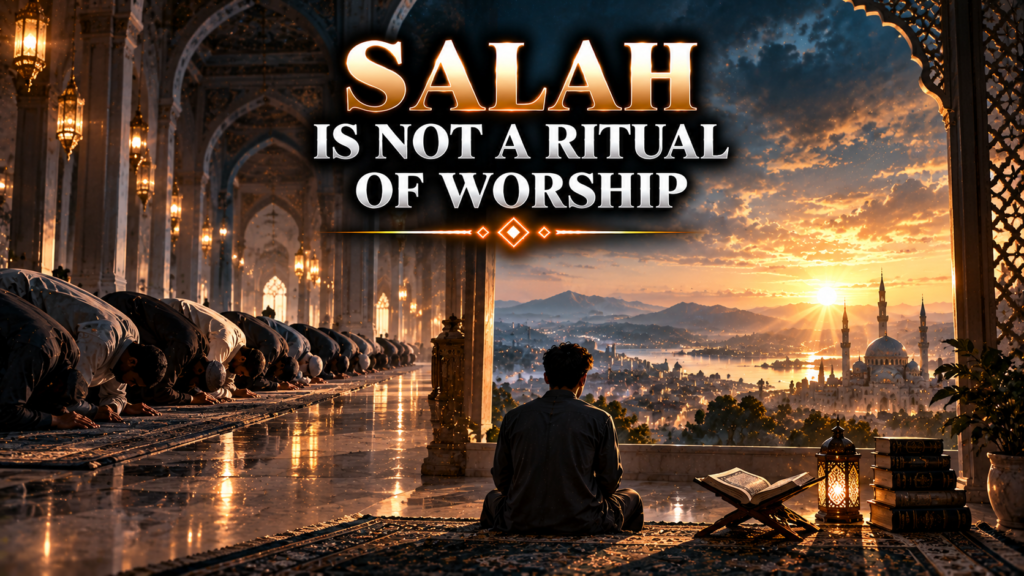
SALAH IS NOT A RITUAL OF WORSHIP.
If this bearing has not been corrected, all the other details will continue to be interpreted through the same frame.
⸻
THE OUTCOME
People say:
“They worship statues.”
Then:
“I worship Allah the Almighty.”
But if the underlying structure remains:
I → WORSHIP → OBJECT
then only the object has changed.
The Quran prohibits idols.
Therefore, do not replace:
a visible idol
with:
an unseen idol in the mind.
That is why the Quran can state:
فَوَيْلٌ لِّلْمُصَلِّينَ
WOE TO THOSE WHO PRAY.
Heedlessness does not necessarily mean forgetting a rak‘ah.
Forgetfulness can be corrected.
The greater heedlessness is:
MISUNDERSTANDING WHAT ONE IS ACTUALLY DOING.
Likewise, Riya’ does not necessarily mean wanting other people to see.
Someone can be alone yet still present their movements to an unseen idol constructed in their imagination.
Therefore, Salah truly becomes:
THE PILLAR OF RELIGION.
Because the bearing of Salah determines how the entire religion is constructed.
Within the thesis of this chapter:
SALAH IS AN ACTION OF THE PROFILE.
That profile and way of life are associated with Muhammad ﷺ as the Ummī and bearer of Allah’s Risalah.
Every member of the Ummah acknowledges that:
the physical body
and:
its spiritual content
are not unrestricted spaces for personal desires to shape however they please.
They must be protected so that the inherited mission of mercy is not destroyed.
NOT TRANSFORMING OUR BODIES INTO MUHAMMAD ﷺ.
BUT ACKNOWLEDGING THAT THESE VERY BODIES CARRY WHAT WAS INHERITED FROM THE UMMĪ.
And the greater discussion of Salah will explain how that acknowledgement is expressed through:
Qiyam, Ruku‘, Sujud, Saf, Imam, Salam and life after Salah.
⸻
CLOSING REFLECTION — “SAHAJA AKU”
This is suitable as the closing reflection for Chapter 29, but we must distinguish between the traditional wording and the meaning developed within this project.
Linguistically, the Malay phrase “sahaja aku” in the traditional declaration of intention does not, by itself, establish that “sahaja” means “not I”.
That is an Aqli or conceptual interpretation developed within this project.
Maintaining this distinction makes the argument clearer.
⸻
There is an expression deeply familiar to the Malay community when beginning Salah:
“Sahaja aku…”
This expression is commonly taught as part of the declaration of intention by earlier religious scholars and teachers.
But the word:
SAHAJA
can invite us to think more deeply.
Within the interpretation of this chapter, “sahaja aku” is understood as a reminder to the self:
SAHAJA AKU — AND NOT I.
Why?
Because the physical body standing there does not belong absolutely to itself.
It did not create its own body.
It did not create its Ruh.
It did not create its life.
It did not determine its own birth.
Nor can it guarantee that it will remain alive.
Therefore, when the body stands for Salah, it must not declare:
“This is me, I belong to myself, and I am presenting my worship to another figure.”
Instead, Salah becomes a discipline for dismantling that claim.
THIS BODY IS ONLY ON LOAN.
And what is on loan must be protected.
⸻
WHICH “I”?
This is the greater question.
When the mouth says:
“Sahaja aku…”
Who is this “I”?
Is it the body?
Is it personal desire?
Is it the name on an identity card?
Or is this physical body actually carrying something greater than itself?
Within the thesis of this series:
Ummī = the original source.
Ummah = the followers who acknowledge the original source.
Muhammad ﷺ is the bearer of the Risalah and a mercy to all the worlds:
وَمَا أَرْسَلْنَاكَ إِلَّا رَحْمَةً لِّلْعَالَمِينَ
— Al-Anbiya’ 21:107
Therefore, members of the Ummah do not construct their profiles however they please.
Salah becomes one of the actions that acknowledges:
THIS VERY BODY MUST PRESERVE WHAT WAS CARRIED BY THE UMMĪ.
Not that our bodies become the body of Muhammad ﷺ.
Not that our names become Muhammad.
But:
THE PROFILE / WAY OF LIFE HE CARRIED MUST BE BROUGHT TO LIFE THROUGH THIS VERY BODY.
That is why the body must not be destroyed.
The Ruh must not be neglected.
The profile must not be surrendered to personal desires.
⸻
SAHAJA AKU → NEGATING THE “I”
Therefore, conceptually, this chapter reads:
SAHAJA AKU
↓
I STAND
↓
BUT THIS BODY DOES NOT BELONG ABSOLUTELY TO ME
↓
NEGATE THE CLAIM OF SELF-OWNERSHIP
↓
ACKNOWLEDGE WHAT THE UMMĪ CARRIED
↓
PRESERVE THE PROFILE
This is the relationship between Salah and Tawhid.
Salah is not a ceremony of:
I → WORSHIP → UNSEEN FIGURE
Rather, it is a discipline that begins by questioning the “I” itself.
⸻
THE FINAL OUTCOME OF CHAPTER 29
Do not worship statues.
Do not construct unseen idols.
And do not turn the “I” into an idol either.
Because the physical body that says:
“Sahaja aku…”
is itself only on loan and must be protected.
Therefore, within the interpretation of this chapter:
“SAHAJA AKU”
ALSO TEACHES:
“NOT I.”
Not as a denial of the body’s existence.
But as a rejection of the claim:
“THIS BODY BELONGS ABSOLUTELY TO ME.”
Salah then becomes an action that preserves the profile so that what the Ummī carried continues to live through the Ummah.
SALAH IS NOT A RITUAL OF WORSHIP.
SALAH BEGINS BY NEGATING IDOLS — INCLUDING THE IDOL OF “I”.
Detecting your location…