





IMAN
A major mistake in understanding religion often occurs not because people do not read.
But because they begin reading in the wrong direction.
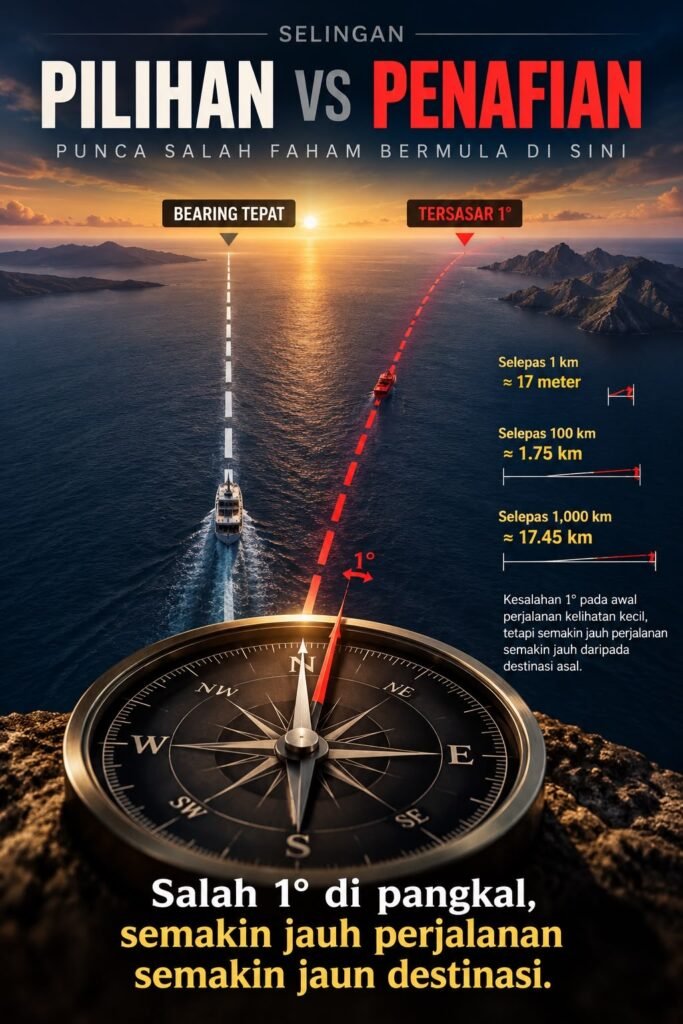
Like a compass.
If the bearing is even slightly incorrect at the starting point, a long journey can take someone far away from the intended destination.
The problem is not:
“How far have we travelled?”
The real question is:
WAS THE BEARING CORRECT WHEN WE BEGAN?
The same applies to understanding revealed texts.
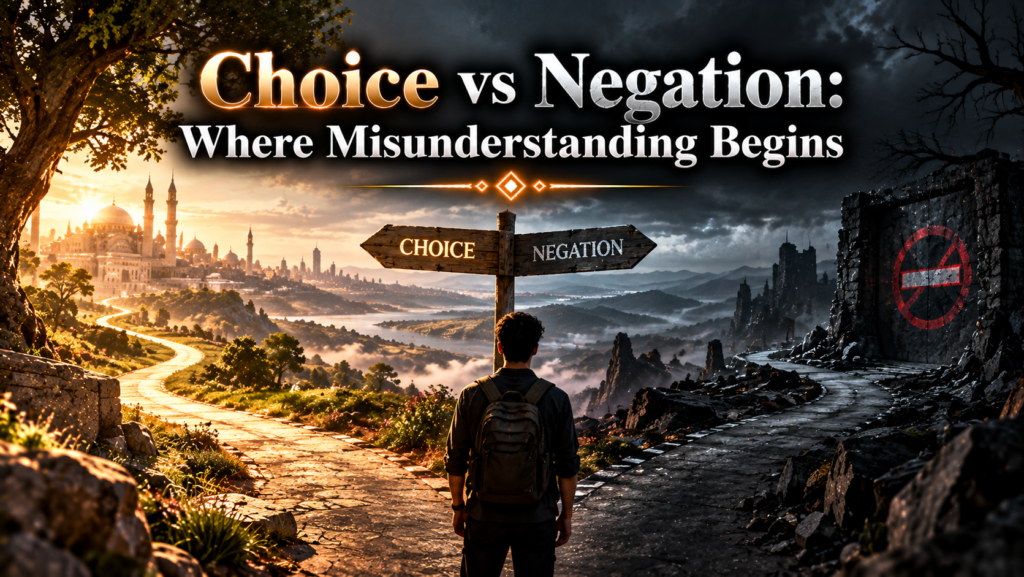
If NEGATION is interpreted as CHOICE, every subsequent interpretation moves in a different direction.
⸻
1. CHOICE AND NEGATION ARE NOT THE SAME
CHOICE means:
The original category is still accepted, but one option within it is selected.
NEGATION means:
The category itself is rejected.
A simple example:
If there are ten options and we choose one, we still accept the system of choices.
But if we say:
“This category does not apply,”
that is not choosing.
That is rejecting the entire category.
This is the fundamental difference that is often overlooked.
⸻
2. “GOD” — DO NOT CHOOSE, NEGATE
Many people read:
لَا إِلَٰهَ
as though it means:
“Choose the correct God from among many gods.”
That is still CHOICE.
Yet its opening structure is:
لَا
NEGATION.
Not:
The Hindu God is wrong, the Islamic God is right.
Not:
The Buddhist God is wrong, our God is true.
Not:
Their God is weak, our God is Almighty.
All of these remain within the category of God.
Yet:
لَا إِلَٰهَ
comes first to negate the category of ilah itself.
⸻
3. DO NOT REPLACE ONE GOD WITH ANOTHER GOD
When someone says:
“Our God is not the same as their God,”
they are still arranging:
God A
and
God B.
Relative relationships already exist.
Comparison already exists.
A category already exists.
Counting already exists.
That is still the process of CHOICE.
Yet NEGATION says:
Do not construct that category in the first place.
⸻
4. THE SAME APPLIES TO “SOMETHING”
The same mistake occurs when people say:
“Allah is something, but not like anything else.”
This is still CHOICE.
They reject a particular “thing”, but continue accepting the category:
SOMETHING.
Then they choose:
something unseen
rather than
something visible.
Or:
something without form
rather than
something with form.
But all of these are still:
SOMETHING.
Yet the direction established in the previous chapter was:
DO NOT CHOOSE A “THING” — NEGATE THE CATEGORY OF “THING”.
⸻
5. CHOICE PRESERVES THE BOX
When someone chooses, they remain inside the same box.
For example:
The GOD box contains:
God A
God B
God C
Our God
Then someone chooses:
“Our God.”
The box remains.
Or:
The SOMETHING box contains:
Something visible
Something unseen
Something large
Something without form
Then someone chooses:
“Something unseen.”
The box remains.
CHOICE DOES NOT BREAK THE BOX.
It merely selects something inside it.
⸻
6. NEGATION BREAKS THE BOX
NEGATION does something different.
It says:
The box itself must not be used.
Not:
Choose the correct contents.
But:
DISCARD THE ENTIRE FRAME.
That is an enormous methodological difference.
⸻
7. THAT IS WHY “LĀ” IS SO IMPORTANT
The Shahadah begins with:
لَا
Not:
اختر
Not:
“Choose.”
But:
LĀ — NEGATION.
This is not a minor detail.
The very first word determines the direction of the journey.
If LĀ is mentally transformed into:
“Choose the correct God,”
the bearing has already changed.
Even if someone subsequently reads thousands of books, that initial mistake continues to accompany them.
⸻
8. “OUR GOD IS ALMIGHTY” — DO NOT JUMP TO CONCLUSIONS
A statement such as:
“Our God is Almighty”
actually combines two different things.
Almighty describes an ATTRIBUTE.
But human beings immediately construct:
“Therefore, there must be an Almighty figure.”
This is where an attribute is transformed into a figure.
Yet:
ATTRIBUTE = EXPLANATION.
Do not rush to give a body to an explanation.
Do not assign it a location.
Do not assign it a direction.
Do not turn it into a figure.
⸻
9. RABB IS ALSO OFTEN CONFINED TO THE WORD “GOD”
The same applies to:
رَبّ — RABB
Many people immediately translate it as:
“God.”
Then all its meanings:
Lord,
owner,
organiser,
administrator,
sustainer,
are compressed into one word:
God.
Eventually, the mind once again constructs a figure.
This demonstrates how translation can change the direction of understanding.
⸻
10. THE RELIGION OF OUR ANCESTORS — WHY IS THIS REVEALED TEXT IMPORTANT?
The Quran repeatedly warns about people who merely inherit their understanding.
إِنَّا وَجَدْنَا آبَاءَنَا عَلَىٰ أُمَّةٍ وَإِنَّا عَلَىٰ آثَارِهِم مُّقْتَدُونَ
“Indeed, we found our forefathers following a particular way, and we are following in their footsteps.”
— Az-Zukhruf 43:23
And:
بَلْ نَتَّبِعُ مَا أَلْفَيْنَا عَلَيْهِ آبَاءَنَا
“Rather, we follow what we found our forefathers practising.”
— Al-Baqarah 2:170
Then the Quran challenges:
أَوَلَوْ كَانَ آبَاؤُهُمْ لَا يَعْقِلُونَ شَيْئًا وَلَا يَهْتَدُونَ
“Even if their forefathers understood nothing and were not guided?”
The problem is not merely following an old culture.
The problem is:
OLD CONCEPTS ARE INHERITED BEFORE THEY ARE EXAMINED.
Including concepts such as:
God.
Something.
Figures.
Places.
Directions.
⸻
11. WHAT WE ARE TAUGHT AS CHILDREN CAN BECOME OUR FIRST BOX
A child begins by recognising:
their mother,
their father,
their guardian,
those who provide for them.
Then the child is taught:
“God is the one we depend upon.”
The mind subsequently constructs another identity.
And when the child grows into adulthood, that identity is never re-examined.
It is simply given the name:
Allah.
This is where NEGATION becomes important.
Not to rename the figure.
But to:
DEMOLISH THE OLD FRAME.
⸻
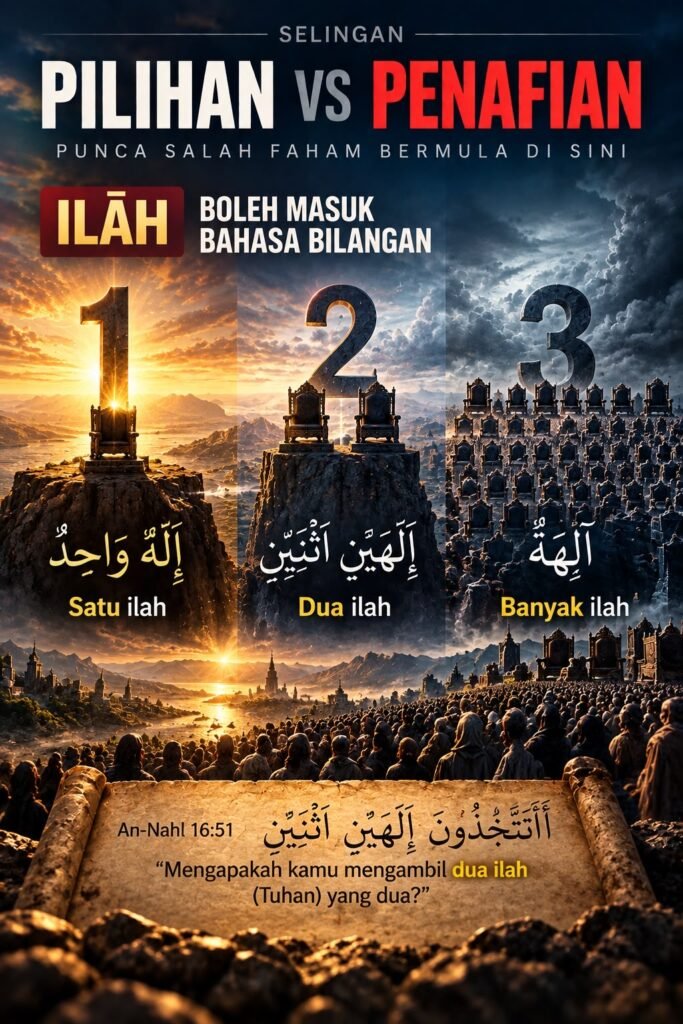
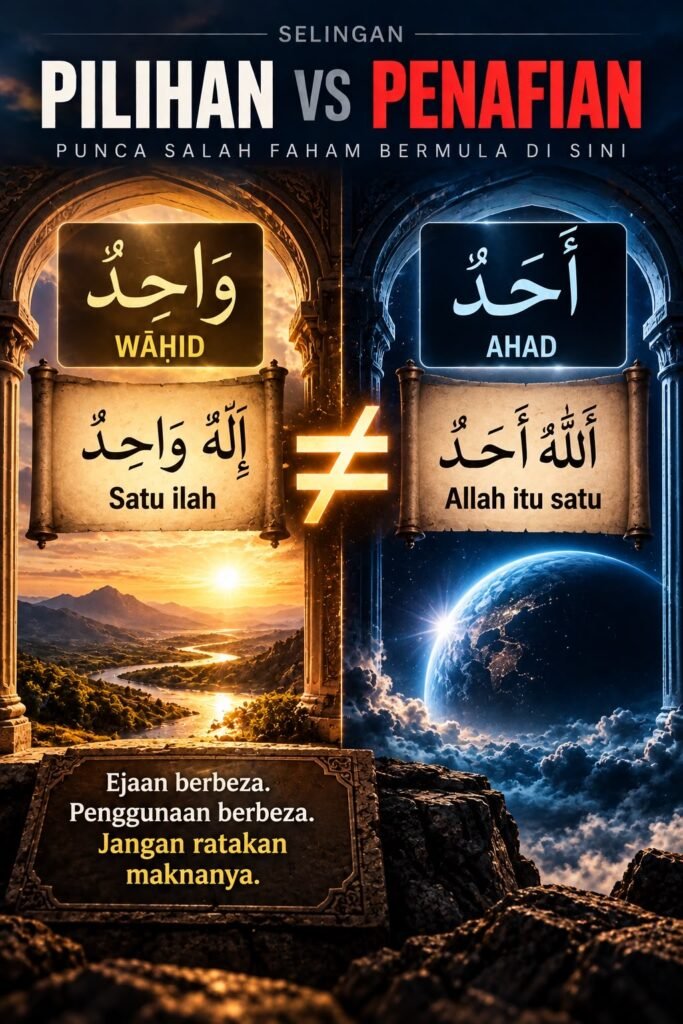
12. WĀḤID AND AHAD MUST NOT BE TREATED AS IDENTICAL
The Quran uses:
إِلَٰهٌ وَاحِدٌ
An ilah that is wāḥid — one.
Ilah can be described in terms of:
one,
two,
many.
There is:
إِلَٰهَيْنِ اثْنَيْنِ
“Two ilahs.”
— An-Nahl 16:51
And there is:
آلِهَة
Ilahs.
This shows that ilah belongs to a category that can be counted.
But Al-Ikhlas states:
اللَّهُ أَحَدٌ
Not:
الله واحد
In our interpretation:
WĀḤID still belongs to the language of numbers.
AHAD prevents Allah from being treated as an item within a numerical sequence.
Do not translate both terms in a way that erases their distinction.
⸻
13. AN ILĀH CAN BE ADOPTED, CREATED AND MULTIPLIED
The Quran itself demonstrates this:
أَرَأَيْتَ مَنِ اتَّخَذَ إِلَٰهَهُ هَوَاهُ
“Have you seen the one who takes his own desires as his ilah?”
— Al-Furqan 25:43
Therefore, an ilah is not necessarily an unseen figure.
Even personal desires can be adopted as an ilah.
This is extremely important.
It means that ilah refers to a position that is assigned, a centre of orientation, a point of dependence or an object of devotion.
Therefore, do not automatically equate:
ILĀH = ALLAH
And do not automatically equate:
ILĀH = GOD.
⸻
14. THE SOURCE OF MISUNDERSTANDING: CHOOSING WHERE NEGATION IS REQUIRED
The problem can now be summarised.
Human beings should:
NEGATE GOD
But instead they:
CHOOSE GOD.
Human beings should:
NEGATE “SOMETHING”
But instead they:
CHOOSE “SOMETHING”.
Human beings should:
DISCARD THE FRAME
But instead they:
CHOOSE A FRAME.
This is where the error in bearing begins.
⸻
15. ONE DEGREE OFF AT THE BEGINNING
Imagine a ship travelling with a bearing that is incorrect by only 1°.
At the beginning of the journey, the error appears insignificant.
But the further it travels, the further it deviates.
The same applies to religious understanding.
If we misread the very first word:
لَا
then the entire journey that follows carries the same mistake.
The problem is not:
how many books have been read.
Not:
how long a tradition has existed.
Not:
how many people follow it.
The question is:
WAS THE ORIGINAL BEARING CORRECT?
⸻
16. DO NOT CHOOSE — NEGATE
Therefore, the principle of this discussion is very simple:
GOD
Do not choose the correct God.
NEGATE GOD.
SOMETHING
Do not choose the correct thing.
NEGATE “SOMETHING”.
FIGURE
Do not choose the correct figure.
NEGATE FIGURE.
PLACE
Do not choose the correct place.
NEGATE PLACE.
⸻
17. NEGATION OPENS THE WAY FOR CORRECT AFFIRMATION
Negation is not the end.
Negation is the process of purification.
Only after all the old frames have collapsed can affirmation take place without reintroducing what has already been discarded.
That is the principle:
NEGATION → AFFIRMATION
But do not corrupt this process by turning it into:
NEGATION → CHOOSING THE OLD FRAME AGAIN.
⸻
THE OUTCOME
A major mistake in religion does not necessarily occur at the end.
Sometimes it occurs at the very first word.
If:
لَا
is interpreted as:
“Choose the correct one,”
then negation has been transformed into choice.
If:
Allah is not a thing
is interpreted as:
“Allah is something, just a different kind of thing,”
then negation has been transformed into choice.
That is the source of confusion.
CHOICE PRESERVES THE CATEGORY.
NEGATION REJECTS THE CATEGORY.
And that is why:
DO NOT CHOOSE.
NEGATE.
Correct the bearing at the beginning.
Only then can the rest of the journey remain on course.
Detecting your location…