
MUKADDIMAH · M43
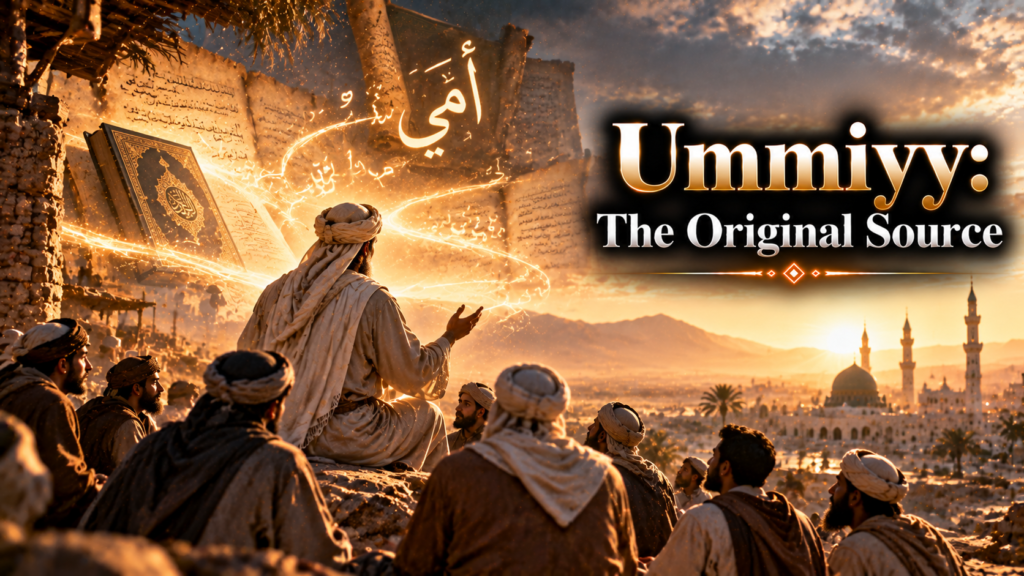
Chapter 21 — Ummiyy: The Original Source
After addressing the misunderstanding surrounding أُمِّيّ in Chapter 20, the real question now is:
If Ummiyy is not simply a label meaning “does not read and write”, what function does this word serve within the arrangement of the Risalah?
We begin with its linguistic family:
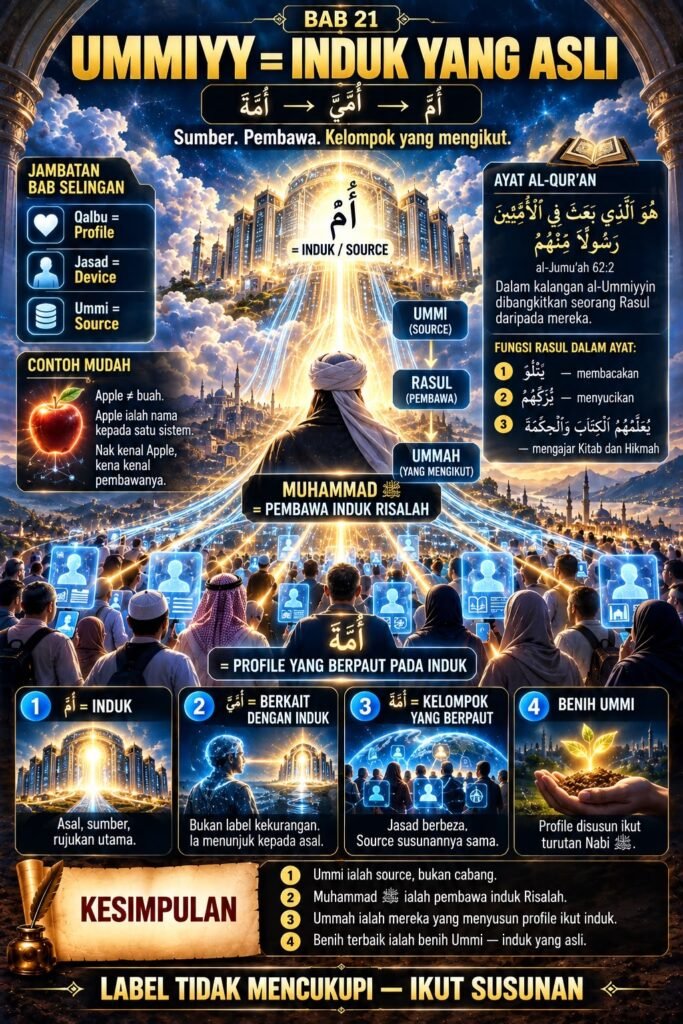
أُمّ — Umm
أُمِّيّ — Ummiyy
أُمَّة — Ummah
These words do not stand separately.
Within this chapter’s interpretation, they are understood through one fundamental idea:
ORIGINAL SOURCE
ORIGIN
SOURCE
REFERENCE PATTERN
From here, we can understand why Prophet Muhammad ﷺ is described as:
النَّبِيَّ الْأُمِّيَّ
⸻
1. أُمّ — UMM: THE ORIGINAL SOURCE
The simplest meaning of أُمّ is:
Mother.
But “mother” is not only a biological relationship.
It also carries the idea of:
origin,
original source,
starting point,
source of formation,
primary reference.
That is why Arabic uses the word أُمّ in expressions conveying the meaning of a centre or origin.
For example:
أُمُّ الْكِتَابِ
“Umm al-Kitab”
It does not mean a mother physically giving birth to a book.
It indicates:
the original source of the Book, its foundation, source or primary reference.
Therefore, when reading أُمّ, do not restrict its meaning to a biological mother.
It introduces the concept of:
SOURCE.
⸻
2. A SIMPLE ANALOGY: APPLE AS ESSENCE
Consider the Apple analogy.
When we say:
Apple
do not imagine the fruit.
“Apple” is a name representing a meaning.
It encompasses:
a system,
attributes,
technology,
products,
methods of operation,
design,
and the entire identity represented by that name.
Therefore, within our analogy:
APPLE = ESSENCE
Not an object that must be imagined in physical form.
But a name pointing towards an entire body of meaning.
To understand Apple, seeing one iPhone is not enough.
We need to understand:
who carries it,
what its system is,
what its attributes are,
and what it produces.
⸻
3. TO KNOW APPLE, YOU MUST KNOW ITS BEARER
Apple does not walk around introducing itself.
There is a bearer.
There is a founder.
There are people who explain the idea.
There are human beings who manifest the system to the world.
Therefore, there is one principle:
MEANING REQUIRES A BEARER.
A name alone is not enough.
A system must be carried.
An idea must be explained.
Its functions must be demonstrated.
The same applies to the Risalah.
The Risalah does not move independently.
It requires a bearer.
And that bearer is Muhammad ﷺ.
⸻
4. MUHAMMAD ﷺ IS THE ORIGINAL BEARER
Allah states:
هُوَ الَّذِي بَعَثَ فِي الْأُمِّيِّينَ رَسُولًا مِّنْهُمْ
“He is the One who raised among the Ummiyyin a Messenger from among themselves…”
— Al-Jumu‘ah 62:2
Notice:
فِي الْأُمِّيِّينَ
then:
رَسُولًا مِّنْهُمْ
The Messenger comes from among them.
He is not a stranger to that community.
Then the verse explains the Messenger’s functions:
يَتْلُو عَلَيْهِمْ آيَاتِهِ
recites His verses to them,
وَيُزَكِّيهِمْ
purifies them,
وَيُعَلِّمُهُمُ الْكِتَابَ
teaches them the Book,
وَالْحِكْمَةَ
and Wisdom.
Therefore, “Ummiyy” here appears alongside the functions of:
reciting,
purifying,
teaching,
shaping.
This is closer to the image of an original source of formation than to an image of deficiency.
⸻
5. THE UMMĪ IS NOT A PROFILE THAT COPIES ANOTHER PROFILE
The Interlude Chapter has explained:
PHYSICAL BODY = DEVICE
QALB = PROFILE
RUH = STREAMING DATA/CODE
LUH MAHFUZ = ANALOGY OF A PROFILE-STORAGE SERVER
UMMĪ = SOURCE / ORIGINAL SERVER
Now we apply that framework.
The Ummī does not obtain his profile from other human beings.
The Ummī does not imitate an external arrangement.
The Ummī is the original source.
Muhammad ﷺ was not shaped by earlier human scriptures until he became a copy of someone else.
He is the bearer of the original arrangement of the Risalah.
Therefore:
UMMĪ = THE ORIGINAL SOURCE THAT DOES NOT IMITATE AN EXTERNAL PROFILE.
⸻
6. THE HUMAN PROFILE IS BUILT THROUGH CHOICES
Human beings live like users of a device.
Everyone is given:
reason,
feelings,
desires,
memory,
the ability to choose.
But every human profile is different.
Why?
Because preferences differ.
What people like differs.
What they repeat differs.
What they prioritise differs.
What they defend differs.
Therefore:
A profile is not only what a person knows.
A profile is:
WHAT A PERSON REPEATEDLY CHOOSES.
⸻
7. THE UMMĪ BECOMES THE REFERENCE FOR ARRANGING THE PROFILE
Imagine all human beings receiving almost the same set of functions.
But the arrangement of priorities determines the outcome.
Consider building a house.
There are many steps:
level the ground,
lay the foundation,
lay the bricks,
install the roof,
fit the doors,
install electricity,
bring in the furniture.
Every step has its proper place.
But if the sequence is wrong, the house fails.
Imagine someone buying a bed first and lying on it before the foundation is completed.
The problem is not the bed.
The problem is the priority.
The same applies to human attributes.
Mercy is important.
Trustworthiness is important.
Patience is important.
Justice is important.
Firmness is important.
Anger also has its place.
But the arrangement determines the profile.
Therefore, the Messenger ﷺ teaches humanity:
WHAT COMES FIRST.
WHAT COMES NEXT.
WHAT BELONGS IN ITS PROPER PLACE.
⸻
8. THE 99 ATTRIBUTES: EVERYONE RECEIVES THEM, BUT THE ARRANGEMENT DIFFERS
Within this project’s interpretation, human beings can be understood as possessing the potential for 99 arrangements of attributes.
Everyone receives the materials.
But human beings arrange their own priorities.
One person prioritises mercy.
Another prioritises power.
One prioritises patience.
Another prioritises self-interest.
One prioritises trustworthiness.
Another prioritises anger.
The set may be the same.
But:
PROFILES DIFFER BECAUSE THEIR ARRANGEMENTS DIFFER.
The Ummī demonstrates the original arrangement.
Human beings choose whether to follow that arrangement.
⸻
9. THE UMMĪ DOES NOT FORCE
This is important.
A server does not force users to open a particular application.
The source provides the system.
But users choose.
The same applies to the Ummī.
The Ummī does not force human beings to become mechanical copies.
The Ummī demonstrates the correct arrangement.
Human beings are given a choice.
Because if human beings were forced, the profile would no longer be the result of their own choices.
Instead, human beings are given the opportunity to develop:
preferences,
priorities,
habits,
and ultimately, a profile.
⸻
10. THE UMMAH IS NOT ONLY A COMMUNITY LABEL
Now we come to:
أُمَّة — Ummah
Within this chapter, Ummah cannot be adequately understood as:
“Many people using the same religious name.”
It goes deeper than that.
The Ummah is a community united around:
one original source,
one direction,
one arrangement,
one pattern of conduct.
If people claim to belong to the Ummah but their profiles do not follow the original source, the name alone is not enough.
The Ummah must demonstrate its connection to the Ummī.
Like devices within one ecosystem:
different devices,
different sizes,
different appearances,
but the same source.
⸻
11. ALL DEVICES CAN BE DIFFERENT
Within the Apple ecosystem:
iPhones differ.
Macs differ.
iPads differ.
Watches differ.
But all can be connected to one system.
The same applies to human beings.
Physical bodies differ.
Ethnicities differ.
Languages differ.
Ages differ.
Locations differ.
But profiles can follow the same source.
Therefore, the unity of the Ummah does not arise because all physical bodies are identical.
The unity of the Ummah is:
THE SOURCE OF THEIR ARRANGEMENT IS THE SAME.
⸻
12. CLAIMING “I AM APPLE” MEANS TAKING WHAT BELONGS TO APPLE
An Apple user depends upon Apple continuously.
They use:
iCloud,
App Store,
updates,
security,
servers.
But they cannot say:
“I am Apple.”
They are only users.
Depending upon a system does not make someone the owner of that system.
The same applies to human beings.
Human beings receive.
Human beings depend.
Human beings use.
Human beings follow.
But they are not the source.
They are not the original source.
They are not the original owners of the system.
This preserves the distinction:
BEARER ≠ USER
ORIGINAL SOURCE ≠ THE PROFILE THAT FOLLOWS
⸻
13. THE QURAN IS THE WRITTEN SOURCE CODE
Within the technological analogy, the Quran can be understood as:
WRITTEN SOURCE CODE
It describes:
instructions,
arrangements,
boundaries,
functions,
and purposes.
But code must be executed for its meaning to be understood in lived experience.
Muhammad ﷺ is the bearer who demonstrates how that source code “runs”.
Mercy becomes action.
Trustworthiness becomes action.
Patience becomes action.
Justice becomes action.
Wisdom becomes action.
Therefore:
THE QURAN = WHAT IS EXPRESSED IN WRITING
MUHAMMAD ﷺ = THE BEARER WHO DEMONSTRATES WHAT IS IMPLICIT
⸻
14. MUHAMMAD ﷺ IS NOT A COPY OF AN EXTERNAL SCRIPTURE
Chapter 20 discussed how Al-‘Ankabut 29:48 states:
وَمَا كُنتَ تَتْلُو مِن قَبْلِهِ مِن كِتَابٍ وَلَا تَخُطُّهُ بِيَمِينِكَ
He did not read earlier scriptures or copy them with his right hand.
In Chapter 21, we consider the greater implication:
He was not formed by an external profile.
He did not become the bearer of the Risalah by copying earlier human systems.
He is the original bearer of the arrangement of the Risalah he carries.
⸻
15. THE ORIGINAL SOURCE DOES NOT SEEK ITS IDENTITY FROM ITS BRANCHES
A tree does not ask its branches:
“How should I become a tree?”
The branches receive from the original source.
The source does not obtain its identity from the device.
The device receives from the source.
Likewise, within this analogy:
The Ummī does not form himself by adopting the profiles of his followers.
Instead, the followers look to the Ummī as their reference.
⸻
16. THE QALB IS THE PROFILE THAT MUST BE ARRANGED
The Interlude Chapter established:
QALB = PROFILE
The profile receives:
information,
experiences,
choices,
desires.
Then it arranges them.
What is repeated becomes a preference.
Preferences become habits.
Habits become the profile.
Therefore, the task of human beings is not to create their own source.
Their task is:
TO ARRANGE THEIR PROFILE ACCORDING TO THE ORIGINAL SOURCE.
⸻
17. IF THE ARRANGEMENT IS WRONG, THE PROFILE IS WRONG
A simple example:
All the materials for a house may be correct.
The bricks are correct.
The cement is correct.
The steel is correct.
The timber is correct.
But if the construction sequence is wrong, the house will still be defective.
The same applies to attributes.
Mercy is good.
Firmness is good.
Anger has its place.
Forgiveness has its place.
Courage has its place.
But all must be applied at the appropriate time and in the appropriate circumstances.
This is Wisdom.
Wisdom is not simply possessing every attribute.
Wisdom means:
PLACING EVERYTHING IN ITS PROPER PLACE.
And the Messenger ﷺ teaches humanity that arrangement.
⸻
18. THAT IS WHY HE TEACHES WISDOM
Allah states:
وَيُعَلِّمُهُمُ الْكِتَابَ وَالْحِكْمَةَ
“And he teaches them the Book and Wisdom.”
— Al-Jumu‘ah 62:2
The Book provides instructions.
Wisdom determines their application.
When should one be patient?
When should one be firm?
When should one forgive?
When should one resist?
When should one remain silent?
When should one speak?
When should one give?
When should one refrain?
This is the arrangement of the profile.
⸻
19. THE UMMAH CONSISTS OF THOSE WHO FOLLOW THE ORIGINAL PATTERN
Therefore, the Ummah does not consist only of people who declare:
“I am Muslim.”
The Ummah consists of human beings who:
recognise the original source,
know the bearer,
follow the arrangement,
and form their profiles according to that pattern.
This does not mean all human beings become identical.
Devices may differ.
But their original system is the same.
⸻
20. ONE SOURCE, MANY PROFILES
Within a server:
one system can serve millions of users.
Each user has their own profile.
The same applies to the Ummī analogy.
One original source.
But human beings still have the freedom to arrange their profiles.
The source is the same.
But responses differ.
That is why human beings cannot blame the source for the profiles they have built themselves.
⸻
21. THE WORLD IS THE TIME FOR ARRANGING THE PROFILE
Human beings are not given this world as a permanent residence.
The world is the period for developing the profile.
Every choice is data.
Every deed is nourishment.
Every habit contributes to the arrangement.
Eventually, the profile matures.
And that mature profile becomes:
A SEED.
⸻
22. THE BEST SEED IS THE SEED OF THE UMMĪ
The best seed is the one that follows the original arrangement.
Not a seed that imitates random profiles.
Not a seed formed by personal desires.
Not a seed that arranges attributes chaotically.
But:
THE SEED OF THE UMMĪ — THE ORIGINAL SOURCE.
This means:
a profile arranged according to the original conduct demonstrated by the Messenger ﷺ.
⸻
23. THE WORLD = A FIELD FOR CULTIVATING SEEDS
Human beings live in this world like farmers.
They are given:
land,
time,
water,
seeds,
choices.
What is planted determines what will grow.
The same applies to the profile.
What is chosen today becomes tomorrow’s arrangement.
What is repeated becomes the final seed.
Therefore, the world is:
THE FIELD WHERE THE SEED IS FORMED.
⸻
24. THE SEED IS PLANTED IN THE AKHIRAH
Within this project’s framework, the Akhirah is the final realm.
The world is where the seed is prepared.
The Akhirah is where the result of that profile is planted.
That is why the profile developed in this world is so important.
Human beings do not carry their worldly devices.
They carry:
arrangements,
choices,
priorities,
and their profiles.
⸻
25. THIS IS NOT REINCARNATION
This must be clarified.
We are not saying that human beings are repeatedly born into this world.
We are not saying that the profile is tested in body after body without end.
No.
The journey occurs only once.
Human beings are given one opportunity to arrange their profiles.
Then the profile continues into the next stage.
Therefore:
ONE PROFILE
ONE JOURNEY
ONE OPPORTUNITY TO ARRANGE
Not reincarnation.
⸻
26. THREE WORDS — ONE CONTINUOUS CONNECTION
Now we return to the three words:
أُمّ
original source / origin
أُمِّيّ
connected to the original source / origin
أُمَّة
a community that follows one original source
Within this chapter’s interpretation, the sequence becomes:
UMM → UMMIYY → UMMAH
The original source.
The original bearer.
The community that follows the original source.
⸻
27. UMMIYY IS NOT A DEFICIENCY — IT POINTS TOWARDS THE ORIGIN
Chapter 20 rejected the simplistic equation:
أُمِّيّ = illiterate
Chapter 21 now offers a positive interpretation:
UMMIYY = A CONNECTION TO THE ORIGINAL SOURCE / ORIGIN
This corresponds with the position of the Messenger ﷺ, who:
recites verses,
purifies,
teaches the Book,
teaches Wisdom.
He is not an empty profile.
He is the bearer of the original pattern.
⸻
28. THE UMMĪ DOES NOT BECOME THE UMMĪ THROUGH HUMAN RECOGNITION
The original source does not become the original source because its followers vote for it.
The source does not become the source because devices agree.
The source is already the source.
The Ummī does not need human beings to give him his identity.
It is the followers who need to recognise him.
Therefore, human beings do not create truth.
They can only:
recognise,
accept,
reject,
or deviate.
⸻
29. MUHAMMAD ﷺ IS THE PATTERN TO BE WITNESSED
Human beings need a living example.
Texts provide instructions.
But the bearer demonstrates their implementation.
That is why Muhammad ﷺ becomes the pattern.
Not because human beings must imitate his physical appearance.
But because they must follow:
his arrangement,
his character,
his priorities,
his actions.
This is the meaning of following the original source:
FOLLOW THE ARRANGEMENT — NOT THE APPEARANCE.
⸻
30. CONCLUSION
This chapter can be summarised as follows:
أُمّ
= ORIGINAL SOURCE / SOURCE
أُمِّيّ
= CONNECTED TO THE ORIGINAL SOURCE / ORIGIN
أُمَّة
= A COMMUNITY CONNECTED TO ONE ORIGINAL SOURCE
MUHAMMAD ﷺ
= THE ORIGINAL BEARER OF THE RISALAH
THE QURAN
= WRITTEN SOURCE CODE
QALB
= PROFILE
PHYSICAL BODY
= DEVICE
RUH
= STREAMING DATA/CODE
LUH MAHFUZ
= ANALOGY OF A PROFILE-STORAGE SERVER
WORLD
= THE PLACE WHERE THE PROFILE IS DEVELOPED
SEED
= FINAL PROFILE
AKHIRAH
= THE FINAL REALM WHERE THE RESULTS OF THE PROFILE CONTINUE
Therefore, human beings should not only ask:
“Am I part of the Ummah?”
Ask:
“DOES MY PROFILE TRULY FOLLOW THE ORIGINAL SOURCE?”
Because a name is not enough.
A label is not enough.
The physical body is not enough.
What determines everything is:
THE ARRANGEMENT.
And that arrangement must return to:
UMMĪ — THE ORIGINAL SOURCE.
Muhammad ﷺ is the bearer of the Risalah who demonstrates that arrangement.
The Ummah consists of those who follow that arrangement.