
MUKADDIMAH · M42
Chapter 20 — Ummiyy: How Did “Does Not Read” Become “Illiterate”?
When Prophet Muhammad ﷺ is described as النَّبِيَّ الْأُمِّيَّ, the most common translation given is:
“THE ILLITERATE PROPHET.”
This translation has been used for so long that many people assume “illiterate” is the original meaning of the word أُمِّيّ.
But the question is:
Does the Quran itself state that Prophet Muhammad ﷺ WAS UNABLE TO READ AND WRITE?
Or have people taken a description and added a meaning that was never explicitly stated?
This is where we must return to the actual wording.
⸻
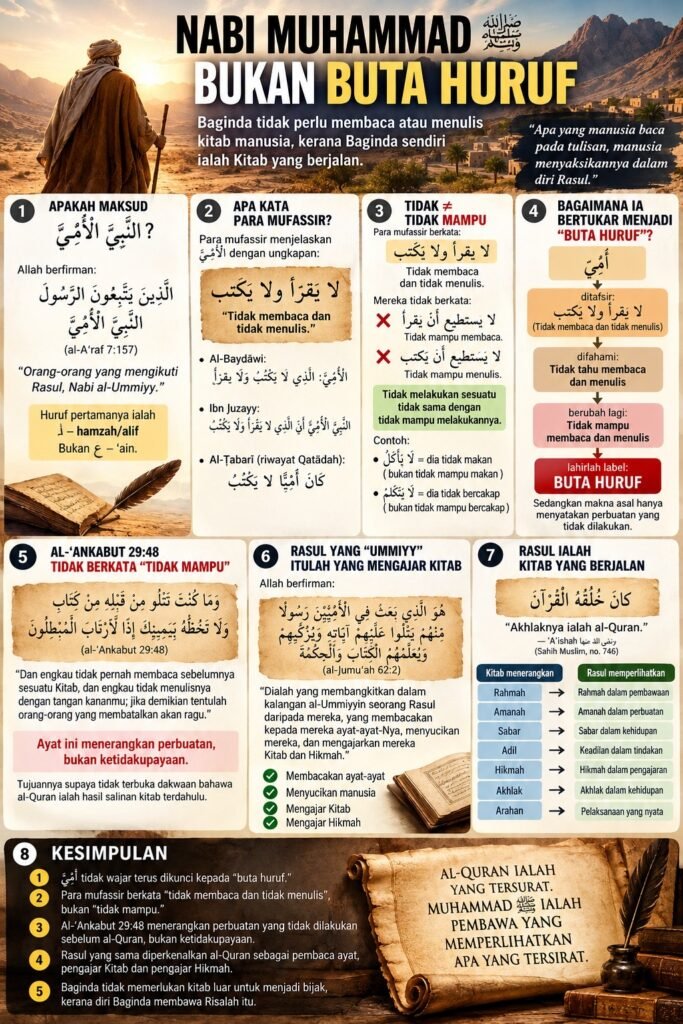
1. THE QURAN STATES: النَّبِيَّ الْأُمِّيَّ
Allah states:
الَّذِينَ يَتَّبِعُونَ الرَّسُولَ النَّبِيَّ الْأُمِّيَّ
“Those who follow the Messenger, the Ummiyy Prophet…”
— Al-A‘raf 7:157
The word used is:
الْأُمِّيّ
Its first letter is:
أ — HAMZAH/ALIF
Not:
ع — ‘AYN
It belongs to the linguistic family of:
أُمّ — UMM
أُمِّيّ — UMMIYY
أُمَّة — UMMAH
Therefore, before assigning the meaning “illiterate”, this word must be examined through its linguistic structure and its usage in the Quran.
⸻
2. WHAT DID THE QURANIC COMMENTATORS ACTUALLY SAY?
In many books of Tafsir, when commentators explain الأُمِّيّ, they use expressions such as:
لَا يَقْرَأُ وَلَا يَكْتُبُ
“Does not read and does not write.”
Al-Baydawi states:
الأُمِّيَّ: الَّذِي لَا يَكْتُبُ وَلَا يَقْرَأُ
“Al-Ummiyy is one who does not write and does not read.”
Ibn Juzayy states:
النَّبِيَّ الأُمِّيَّ أَيْ الَّذِي لَا يَقْرَأُ وَلَا يَكْتُبُ
“The Ummiyy Prophet, meaning one who does not read and does not write.”
In a narration transmitted by Al-Tabari from Qatadah, it is stated:
كَانَ أُمِّيًّا لَا يَكْتُبُ
“He was Ummiyy; he did not write.”
Notice something extremely important.
They said:
لَا يَقْرَأُ
does not read
and:
لَا يَكْتُبُ
does not write.
They did not say:
لَا يَسْتَطِيعُ أَنْ يَقْرَأَ
“Is unable to read.”
Nor did they say:
لَا يَسْتَطِيعُ أَنْ يَكْتُبَ
“Is unable to write.”
This is where a significant shift in meaning occurs.
⸻
3. “DOES NOT” IS NOT THE SAME AS “CANNOT”
Language must be read with discipline.
لَا يَأْكُلُ
means:
“He does not eat.”
It does not necessarily mean:
“He cannot eat.”
لَا يَتَكَلَّمُ
means:
“He does not speak.”
It does not necessarily mean:
“He is mute.”
Likewise:
لَا يَقْرَأُ
means:
“He does not read.”
It does not automatically mean:
“He cannot read.”
And:
لَا يَكْتُبُ
means:
“He does not write.”
It does not automatically mean:
“He does not know how to write or is incapable of writing.”
If the intended meaning is “unable”, Arabic has explicit expressions:
لَا يَسْتَطِيعُ
“Is unable.”
Or:
عَاجِزٌ عَنْ
“Incapable of…”
But such expressions were not used in the descriptions mentioned earlier.
⸻
4. THIS IS WHERE “DOES NOT READ” BECOMES “ILLITERATE”
The shift in meaning occurs in stages.
At the first stage:
أُمِّيّ
is interpreted as:
لَا يَقْرَأُ وَلَا يَكْتُبُ
“Does not read and does not write.”
Then it is understood as:
“Does not know how to read and write.”
After that, it changes further into:
“Is unable to read and write.”
Eventually, a label emerges:
“ILLITERATE.”
Yet “illiterate” carries the connotation of an inability or a lack of literacy skills.
This is what needs to be re-examined.
Because:
NOT DOING SOMETHING
is not the same as:
BEING UNABLE TO DO SOMETHING.
⸻
5. AL-‘ANKABUT 29:48 DOES NOT SAY “YOU WERE UNABLE”
Allah states:
وَمَا كُنتَ تَتْلُو مِن قَبْلِهِ مِن كِتَابٍ وَلَا تَخُطُّهُ بِيَمِينِكَ إِذًا لَّارْتَابَ الْمُبْطِلُونَ
“And you did not previously recite any Book, nor did you write it with your right hand; otherwise, those who seek to invalidate it would have doubted.”
— Al-‘Ankabut 29:48
This verse is extremely important.
Allah did not say:
وَمَا كُنتَ تَسْتَطِيعُ أَنْ تَتْلُو
“You were unable to read.”
Nor did Allah say:
وَمَا كُنتَ تَسْتَطِيعُ أَنْ تَكْتُبَ
“You were unable to write.”
Instead, the verse states:
وَمَا كُنتَ تَتْلُو
“You did not previously recite…”
and:
وَلَا تَخُطُّهُ بِيَمِينِكَ
“Nor did you write it with your right hand.”
This describes what he did or did not do before the Quran came.
It is not a declaration that his intellect or person lacked the ability.
⸻
6. WHY DID HE NOT READ EARLIER SCRIPTURES?
The verse itself provides the reason:
إِذًا لَّارْتَابَ الْمُبْطِلُونَ
“Otherwise, those who seek to invalidate it would have doubted.”
In other words, if Muhammad ﷺ had been known to obtain earlier scriptures, read them, copy them and then present the Quran, people could have claimed:
“This is only a copy.”
“This is the result of reading earlier scriptures.”
“This was taken from those who came before.”
Therefore, the fact that he did not construct the Risalah through reading and copying earlier scriptures becomes an argument for the originality of what he brought.
The issue is not:
HE WAS UNABLE TO READ.
What is being denied is:
HE DID NOT OBTAIN THIS RISALAH BY COPYING HUMAN SCRIPTURES.
⸻
7. THE MESSENGER DESCRIBED AS “UMMIYY” IS THE ONE WHO TEACHES THE BOOK
Now consider Al-Jumu‘ah 62:2.
Allah states:
هُوَ الَّذِي بَعَثَ فِي الْأُمِّيِّينَ رَسُولًا مِّنْهُمْ يَتْلُوا عَلَيْهِمْ آيَاتِهِ وَيُزَكِّيهِمْ وَيُعَلِّمُهُمُ الْكِتَابَ وَالْحِكْمَةَ
“He is the One who raised among the Ummiyyin a Messenger from among themselves, who recites His verses to them, purifies them and teaches them the Book and Wisdom…”
— Al-Jumu‘ah 62:2
Notice the sequence.
الْأُمِّيِّينَ
THE UMMIYYIN
then:
رَسُولًا مِّنْهُمْ
A MESSENGER FROM AMONG THEM
then that Messenger:
يَتْلُو عَلَيْهِمْ آيَاتِهِ
RECITES HIS VERSES TO THEM
وَيُزَكِّيهِمْ
PURIFIES THEM
وَيُعَلِّمُهُمُ الْكِتَابَ
TEACHES THEM THE BOOK
وَالْحِكْمَةَ
AND WISDOM.
Therefore, is it reasonable that a Messenger whom the Quran introduces as:
A RECITER OF VERSES,
ONE WHO PURIFIES HUMAN BEINGS,
A TEACHER OF THE BOOK,
and:
A TEACHER OF WISDOM
should then be portrayed as though he possessed an intellectual deficiency because of the label “illiterate”?
This is where the meaning must be re-examined.
⸻
8. THE MESSENGER TEACHES WISDOM
The supplication of Ibrahim عليه السلام:
رَبَّنَا وَابْعَثْ فِيهِمْ رَسُولًا مِّنْهُمْ يَتْلُوا عَلَيْهِمْ آيَاتِكَ وَيُعَلِّمُهُمُ الْكِتَابَ وَالْحِكْمَةَ وَيُزَكِّيهِمْ
“Our Lord, raise among them a Messenger from among themselves who recites Your verses to them, teaches them the Book and Wisdom, and purifies them.”
— Al-Baqarah 2:129
Then Allah states:
وَيُعَلِّمُكُمُ الْكِتَابَ وَالْحِكْمَةَ
“He teaches you the Book and Wisdom.”
— Al-Baqarah 2:151
And:
وَيُعَلِّمُهُمُ الْكِتَابَ وَالْحِكْمَةَ
“He teaches them the Book and Wisdom.”
— Ali ‘Imran 3:164
This is not the portrayal of a human being who lacks ability.
This is a TEACHER.
A teacher of the Book.
A teacher of Wisdom.
⸻
9. HE DID NOT NEED TO SEARCH THROUGH BOOKS TO BECOME WISE
Ordinary human beings seek knowledge through writing.
They open books.
They read.
They take notes.
They learn from other people.
But Muhammad ﷺ was not formed as a Messenger through reading earlier human scriptures.
The Risalah did not emerge from his efforts to copy human texts.
He received it, carried it, taught it and demonstrated it.
Therefore, the fact that he did not read earlier scriptures is not a deficiency.
It actually closes the door to the claim that the Quran was copied.
⸻
10. THE PERSON OF THE MESSENGER DEMONSTRATES WHAT THE BOOK DESCRIBES
When Aishah رضي الله عنها was asked about the character of the Messenger of Allah ﷺ, she replied:
كَانَ خُلُقُهُ الْقُرْآنَ
“His character was the Quran.”
— Sahih Muslim, no. 746
This statement carries tremendous significance.
The written Quran describes:
mercy,
trustworthiness,
patience,
justice,
truthfulness,
forgiveness,
firmness,
wisdom.
Then all these attributes can be witnessed in the conduct of the Messenger.
What others read in writing, human beings could witness through his person.
That is why we may describe him through an analogy:
THE MESSENGER IS A “WALKING BOOK.”
This does not mean his physical body becomes a Mushaf.
It means:
THE BOOK DESCRIBES.
THE MESSENGER DEMONSTRATES.
The Book mentions attributes.
The Messenger’s Actions manifest those attributes.
The Book mentions character.
The Messenger embodies that character.
The Book gives instructions.
The Messenger demonstrates how those instructions are carried out.
⸻
11. THE QURAN IS WHAT IS WRITTEN — THE MESSENGER CARRIES WHAT IS IMPLICIT
The Quran has an arrangement of recitation.
It is written.
It is read.
It is memorised.
But writing requires human beings to demonstrate its meaning.
Muhammad ﷺ is the bearer of that Risalah.
The Quran is what is expressed in writing.
The Messenger demonstrates its meaning through his conduct.
That is why he is not simply someone who reads a text and transfers words from pages to people.
He is the person who carries the Risalah within himself.
When human beings want to see mercy:
LOOK AT THE MESSENGER’S CONDUCT.
When they want to understand trustworthiness:
LOOK AT THE MESSENGER.
When they want to understand patience:
LOOK AT THE MESSENGER.
When they want to understand proper conduct:
LOOK AT THE MESSENGER.
When they want to understand Wisdom:
LOOK AT THE MESSENGER WHO TEACHES الْحِكْمَةَ.
⸻
12. READING WORDS IS NOT THE SAME AS CARRYING THEIR MEANING
Someone may read thousands of books without embodying the character described in them.
Someone may memorise thousands of lines without understanding their meaning.
Someone may possess academic qualifications without possessing wisdom.
In contrast, the Messenger ﷺ is the person who:
يَتْلُو
RECITES,
يُزَكِّي
PURIFIES,
يُعَلِّمُ
TEACHES,
and leads human beings towards understanding.
Therefore, the measure of the Messenger’s wisdom is not whether he possessed a record of education in reading and writing like ordinary people.
That measure comes from what he carried and taught.
⸻
13. MISUNDERSTANDING ARISES WHEN A DESCRIPTION IS TURNED INTO A DEFICIENCY
Originally, the expression used was:
لَا يَقْرَأُ وَلَا يَكْتُبُ
“Does not read and does not write.”
Then people formed an additional conclusion:
“Does not know how to read and write.”
Then:
“Is unable to read and write.”
Eventually:
“ILLITERATE.”
A description of an action became a judgement about ability.
This is what must be examined carefully.
Because the Quran itself describes the Messenger as:
مُعَلِّمًا
A TEACHER.
We cannot read a term in a way that diminishes the very function the Quran itself elevates.
⸻
14. UMMIYY SHOULD NOT AUTOMATICALLY BE CONFINED TO “ILLITERATE”
Before translating أُمِّيّ as “illiterate”, we must return to its linguistic family:
أُمّ
MOTHER / ORIGINAL SOURCE
أُمِّيّ
UMMIYY
أُمَّة
UMMAH
The Quran itself states:
فِي الْأُمِّيِّينَ رَسُولًا مِّنْهُمْ
“Among the Ummiyyin, a Messenger from among themselves.”
— Al-Jumu‘ah 62:2
Therefore, the next question is:
Is Ummiyy simply an educational label?
Or does it have a greater relationship with:
أُمّ — ORIGINAL SOURCE
and:
أُمَّة — A COMMUNITY ARISING FROM ONE ORIGINAL SOURCE?
This is what must be examined through language and Quranic usage.
⸻
15. THE MESSENGER WAS NOT EMPTY OF KNOWLEDGE BECAUSE HE DID NOT READ HUMAN SCRIPTURES
Instead, he was the one who filled human beings with knowledge.
He taught:
الْكِتَابَ
THE BOOK
and:
الْحِكْمَةَ
WISDOM.
He did not need to derive his identity from human scriptures.
His own person became the bearer of the Risalah.
That Risalah was present in his speech.
In his character.
In his attributes.
In his actions.
In his life journey.
That is why the Sirah of the Messenger cannot be separated from understanding the Quran.
Writing presents the description.
The Messenger demonstrates its living expression.
⸻
16. THE “WALKING BOOK”
The expression “Walking Book” can be a powerful analogy when properly understood.
It does not mean Muhammad ﷺ is paper.
It does not mean Muhammad ﷺ is a Mushaf.
It means:
WHAT IS EXPRESSED IN WRITING WITHIN THE BOOK IS DEMONSTRATED THROUGH THE MESSENGER’S CONDUCT.
Human beings read about:
MERCY.
The Messenger demonstrates mercy.
Human beings read about:
PATIENCE.
The Messenger lives with patience.
Human beings read about:
TRUSTWORTHINESS.
The Messenger carries that trust.
Human beings read about:
WISDOM.
The Messenger teaches Wisdom.
Therefore, he does not need to search for himself within the pages of a book.
He is the living bearer of that Risalah.
⸻
17. CONCLUSION
The question is not whether earlier scholars used the expression:
لَا يَقْرَأُ وَلَا يَكْتُبُ
Yes, that expression was indeed used.
The question is:
DO WE HAVE THE RIGHT TO ADD THE WORD “UNABLE” WHEN THEY SAID “DOES NOT”?
“Does not read” does not necessarily mean “cannot read”.
“Does not write” does not necessarily mean “cannot write”.
And Al-‘Ankabut 29:48 itself explains that he did not read or copy earlier scriptures.
Its purpose:
إِذًا لَّارْتَابَ الْمُبْطِلُونَ
so that the claim that the Risalah was copied from human sources would have no grounds.
Then the Quran introduces the same Messenger as someone who:
يَتْلُو عَلَيْهِمْ آيَاتِهِ
RECITES THE VERSES,
وَيُزَكِّيهِمْ
PURIFIES,
وَيُعَلِّمُهُمُ الْكِتَابَ
TEACHES THE BOOK,
and:
وَالْحِكْمَةَ
TEACHES WISDOM.
Therefore, one distinction must be restored to its proper place:
DOES NOT ≠ CANNOT
And:
أُمِّيّ ≠ AUTOMATICALLY “ILLITERATE”
Muhammad ﷺ was not shaped by human scriptures.
He carried the Book.
He did not copy Wisdom from human beings.
He taught Wisdom.
He did not require external scriptures to shape his conduct.
His own conduct demonstrated the meaning of the Risalah.
THE QURAN IS WHAT IS EXPRESSED IN WRITING.
MUHAMMAD ﷺ IS THE BEARER WHO DEMONSTRATES WHAT IS IMPLICIT.
Therefore, before repeating that أُمِّيّ = illiterate, we must ask:
Is that truly the meaning of the word?
Or is it simply the result of a chain of interpretations that eventually transformed:
“DOES NOT DO”
into:
“CANNOT DO”?
That is the question that reopens the meaning of النَّبِيَّ الْأُمِّيَّ.