
ISLAM

KEY: AN HEIR MUST INHERIT.
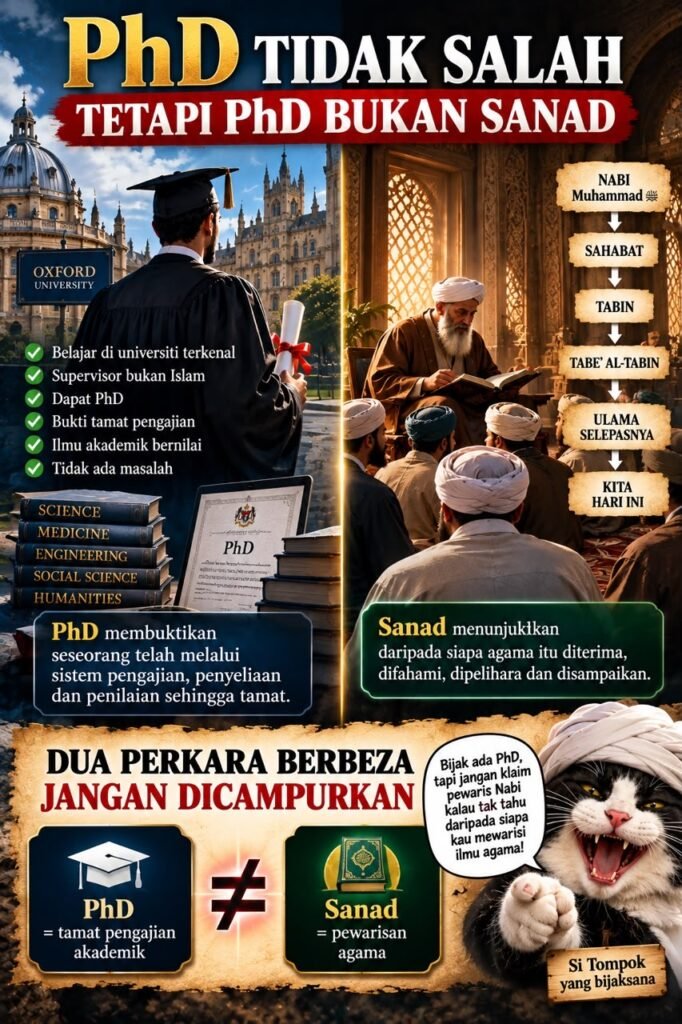
A person may pursue higher education.
They may hold a master’s degree, a PhD or a professorship.
They may study at Oxford, Cambridge or any other leading university in the world.
Their supervisor may even be a non-Muslim.
There is nothing wrong with academic knowledge.
A PhD demonstrates that someone has completed a programme of study, research, supervision and assessment according to the requirements of that institution.
But a PhD is not, by itself, a sanad of inherited knowledge from the Prophet ﷺ.
Do not confuse these two matters.
An academic qualification demonstrates the completion of academic studies.
A sanad shows from whom religious knowledge was received and to whom its chain ultimately returns.
⸻
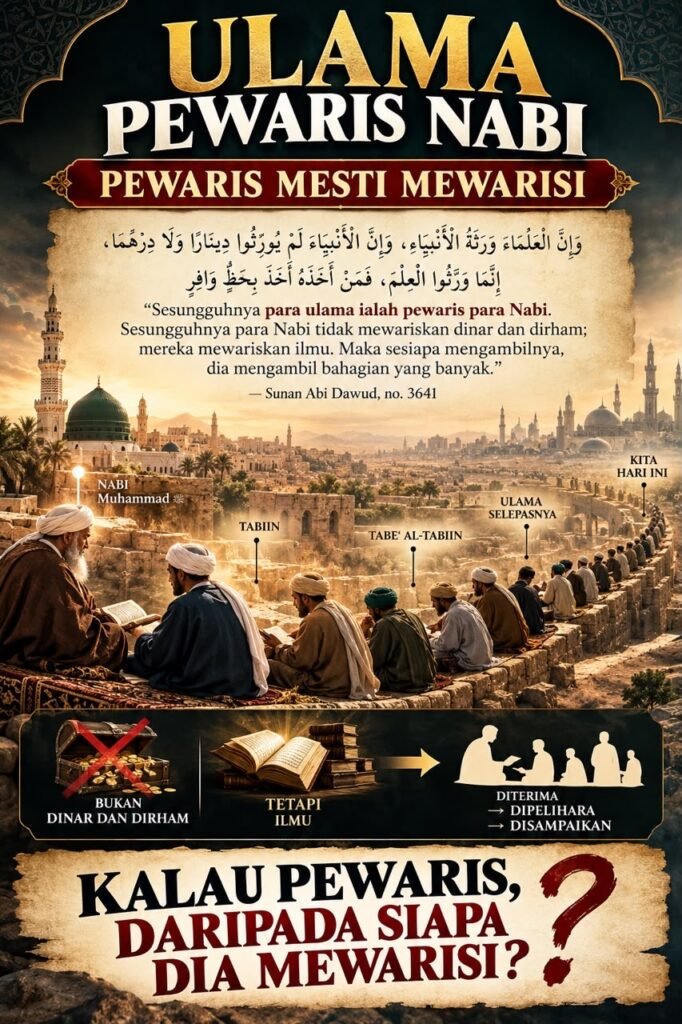
1. THE PROPHET ﷺ HIMSELF DESCRIBED THE ULAMA AS HEIRS
The Messenger of Allah ﷺ said:
وَإِنَّ الْعُلَمَاءَ وَرَثَةُ الْأَنْبِيَاءِ، وَإِنَّ الْأَنْبِيَاءَ لَمْ يُوَرِّثُوا دِينَارًا وَلَا دِرْهَمًا، وَرَّثُوا الْعِلْمَ، فَمَنْ أَخَذَهُ أَخَذَ بِحَظٍّ وَافِرٍ
“Indeed, the scholars are the heirs of the Prophets. The Prophets did not leave dinars or dirhams as an inheritance; they left knowledge. Whoever takes it has taken an abundant share.”
— Sunan Abi Dawud, no. 3641
Notice the word:
وَرَثَةُ — HEIRS
An heir does not create the inheritance.
An heir receives something that comes from those before him.
If there is nothing inherited, from whom does he become an heir?
⸻
2. THE QURAN ITSELF USES THE LANGUAGE OF INHERITANCE
Allah states:
ثُمَّ أَوْرَثْنَا الْكِتَابَ الَّذِينَ اصْطَفَيْنَا مِنْ عِبَادِنَا
“Then We caused those whom We chose from among Our servants to inherit the Book.”
— Fatir 35:32
The key word is:
أَوْرَثْنَا
“We caused to inherit.”
Therefore, the Book has a journey of inheritance.
It does not originate from the mind of someone who suddenly claims to understand religion.
The Quran also shows the journey of conveyance:
وَإِنَّهُ لَتَنزِيلُ رَبِّ الْعَالَمِينَ نَزَلَ بِهِ الرُّوحُ الْأَمِينُ عَلَىٰ قَلْبِكَ لِتَكُونَ مِنَ الْمُنذِرِينَ
“And indeed, it is truly a revelation from the Lord of all realms, brought down by al-Ruh al-Amin upon your qalb, so that you may be among those who warn.”
— Ash-Shu‘ara 26:192–194
There is reception.
There is bearing.
There is conveyance.
That is the pattern of inherited knowledge.
⸻
3. THE MESSENGER OF ALLAH ﷺ SHOWED A CHAIN FROM PERSON TO PERSON
The Messenger of Allah ﷺ said:
تَسْمَعُونَ وَيُسْمَعُ مِنْكُمْ وَيُسْمَعُ مِمَّنْ سَمِعَ مِنْكُمْ
“You will hear, then others will hear from you, and others will hear from those who heard from you.”
— Sunan Abi Dawud, no. 3659
Notice the sequence:
THE MESSENGER OF ALLAH ﷺ
↓
THOSE WHO RECEIVE
↓
THOSE WHO COME AFTER THEM
↓
THOSE WHO COME AFTER THOSE PEOPLE
This is the pattern of continuity.
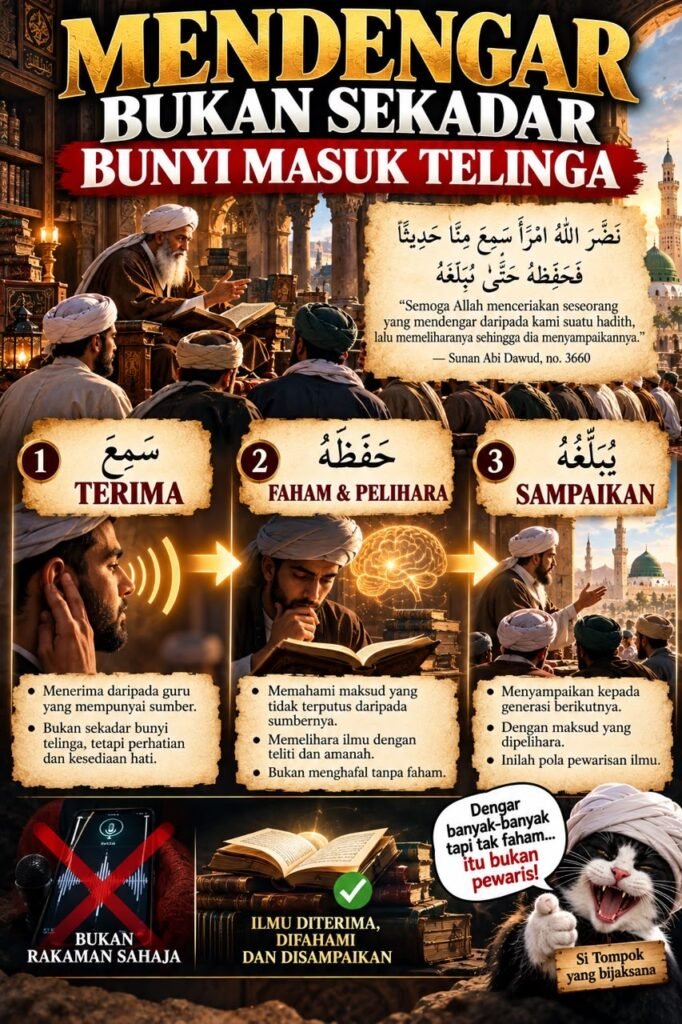
And “hearing” must not be confined to the recording of sounds entering the ears.
Someone may hear something a thousand times without understanding it at all.
Hearing that produces inheritance requires what is received to be understood, preserved and carried without its meaning becoming disconnected from its source.
The following Hadith explains this:
نَضَّرَ اللَّهُ امْرَأً سَمِعَ مِنَّا حَدِيثًا فَحَفِظَهُ حَتَّى يُبَلِّغَهُ
“May Allah brighten the face of a person who hears a Hadith from us, preserves it and then conveys it.”
— Sunan Abi Dawud, no. 3660
There are three stages:
سَمِعَ مِنَّا
RECEIVE FROM US
↓
فَحَفِظَهُ
PRESERVE IT
↓
يُبَلِّغَهُ
CONVEY IT
Therefore, inheritance is not only:
“I once heard it.”
Instead:
RECEIVE → UNDERSTAND/PRESERVE → CONVEY.
⸻
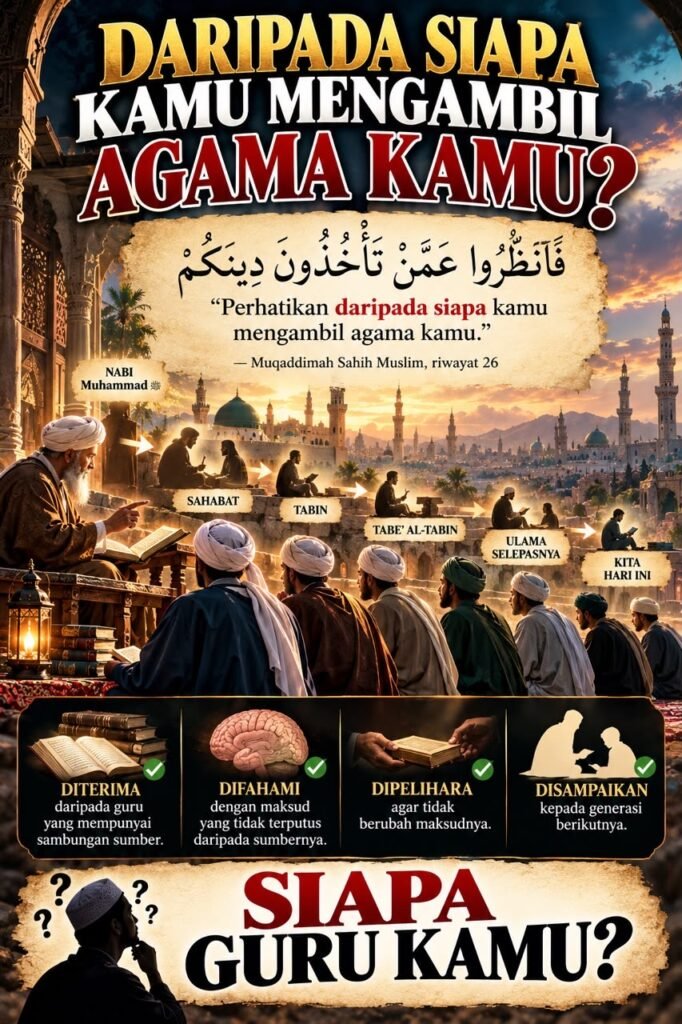
4. IBN SIRIN: LOOK AT WHOM YOU TAKE YOUR RELIGION FROM
Muhammad ibn Sirin said:
إِنَّ هَذَا الْعِلْمَ دِينٌ فَانْظُرُوا عَمَّنْ تَأْخُذُونَ دِينَكُمْ
“Indeed, this knowledge is religion. So consider carefully from whom you take your religion.”
— Introduction to Sahih Muslim, narration 26
This carries tremendous significance.
The question is not only:
“What qualifications do you have?”
Not only:
“How many books have you read?”
Not only:
“Which university did you attend?”
But:
عَمَّنْ تَأْخُذُونَ دِينَكُمْ
FROM WHOM DO YOU TAKE YOUR RELIGION?
Ibn Sirin also narrated that when fitnah occurred, people began saying:
سَمُّوا لَنَا رِجَالَكُمْ
“Name your men to us.”
— Introduction to Sahih Muslim, narration 27
This means that attention was given to the people who carried the knowledge and the sources from which they received it.
⸻
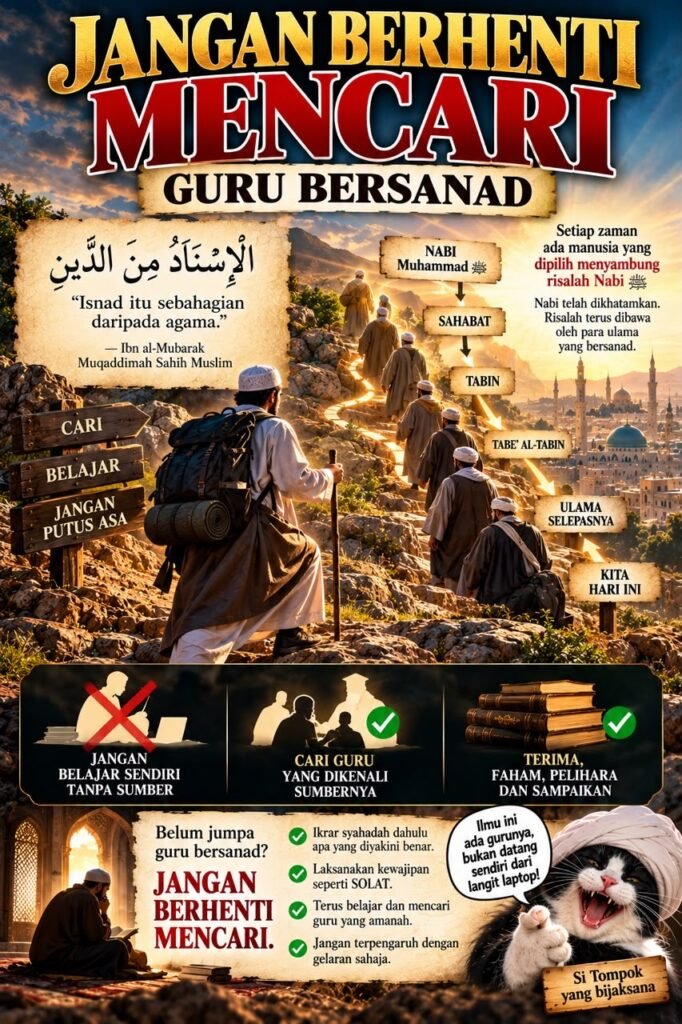
5. IBN AL-MUBARAK: SANAD IS PART OF RELIGION
‘Abd Allah ibn al-Mubarak said:
الْإِسْنَادُ مِنَ الدِّينِ، وَلَوْلَا الْإِسْنَادُ لَقَالَ مَنْ شَاءَ مَا شَاءَ
“Isnad is part of religion. Were it not for isnad, anyone could say whatever they wished.”
— Introduction to Sahih Muslim, narration 32
This is the problem when everyone can say:
“In my opinion, religion is like this.”
Then a second person says:
“According to my interpretation, it is like that.”
A third person says:
“I have a PhD, so I know better.”
Ibn al-Mubarak raises one question that challenges all these claims:
FROM WHOM?
⸻
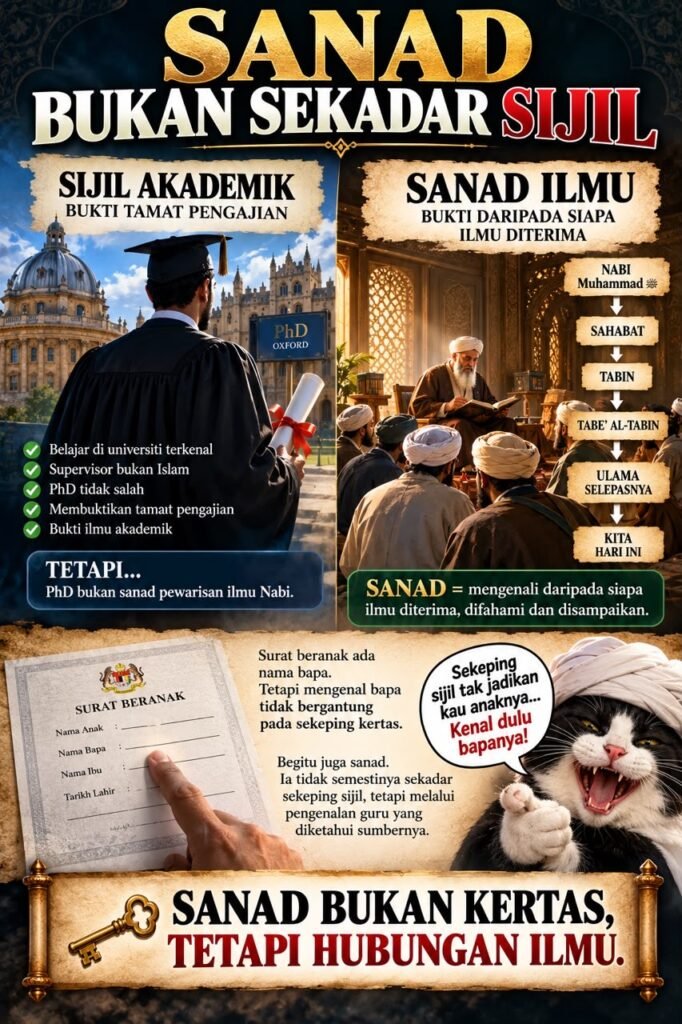
6. SANAD IS NOT NECESSARILY JUST A CERTIFICATE
Sanad must not be reduced to a stamped and signed piece of paper.
Consider a simple analogy.
A birth certificate contains the father’s name.
But someone does not truly know their father simply because they possess a birth certificate.
They know their father through a living relationship.
The same applies to sanad.
A document may serve as additional evidence, but the reality of a teacher-student relationship does not necessarily depend on a certificate.
Someone may be able to say:
“This is my teacher. I studied under him. My teacher studied under his teacher. I know the path through which I received my knowledge.”
Therefore, the question concerning sanad is not simply:
“WHERE IS YOUR CERTIFICATE?”
The question is:
WHO IS YOUR TEACHER?
And:
FROM WHOM DID YOUR TEACHER RECEIVE IT?
⸻
7. A PhD AND A SANAD ANSWER TWO DIFFERENT QUESTIONS
A Muslim may obtain a PhD under a non-Muslim supervisor.
There is no contradiction in that.
They may study medicine, physics, engineering, language, history, biology or even religion as an academic discipline.
The university certifies:
“This person has fulfilled our academic requirements.”
That has value.
But the certificate does not automatically declare:
“This person is an heir of the Prophet ﷺ through a chain of religious transmission.”
Therefore, do not belittle academic education.
And do not turn academic education into sanad.
ACADEMIC EDUCATION HAS ITS PLACE.
SANAD HAS ITS PLACE.
⸻
8. INHERITANCE REQUIRES CONTINUITY
Therefore, the more accurate conclusion is not:
“If someone does not have a sanad certificate, they are not an ulama.”
Instead:
If someone claims to carry the inheritance of the Prophet, we have the right to ask from whom that inheritance was received.
Because:
AN HEIR MUST INHERIT.
And inheritance requires someone who came before.
If every connection to those who came before is severed, and someone then constructs religion entirely from himself, the description “heir” becomes questionable.
⸻
9. EVERY AGE REQUIRES PEOPLE WHO CARRY THE RISALAH
This is where this series reaches an important conclusion.
Prophet Muhammad ﷺ is the Seal of the Prophets.
Prophethood does not continue after him ﷺ.
But the Risalah must continue to be carried.
The Risalah does not move by itself.
A book does not rise on its own and begin teaching humanity.
There must be people who receive, understand, preserve and convey it.
That is why the Hadith states:
تَسْمَعُونَ وَيُسْمَعُ مِنْكُمْ وَيُسْمَعُ مِمَّنْ سَمِعَ مِنْكُمْ
“You will hear, others will hear from you, and others will hear from those who heard from you.”
Therefore, every age has people who continue the chain.
Within the specific terminology of the Menongkah Arus series, people who continue and carry the Risalah in their own time may be described in terms of the function of messengership — conveying the Risalah, not becoming new Prophets and not claiming to receive a new religious law.
This is a conceptual conclusion of this series. It must not be attributed as the actual wording of Ibn Sirin or Ibn al-Mubarak, nor presented as a technical definition unanimously agreed upon by all classical scholars.
PROPHETHOOD HAS BEEN SEALED.
THE CONVEYANCE OF THE RISALAH MUST NOT BE SEVERED.
⸻
10. “HEARING” MEANS THAT UNDERSTANDING IS TRANSMITTED
Hadith should not be read as though human beings were merely recording devices.
سَمِعَ — HEARS
then
حَفِظَهُ — PRESERVES
then
بَلَّغَهُ — CONVEYS.
Therefore, someone who only memorises sounds without understanding what is being carried has not fulfilled the function of inheriting knowledge.
The purpose is for what came from previous generations to reach the next without losing its meaning.
That is why a human chain of sanad without understanding is also insufficient.
And understanding invented independently without a source loses its connection to inheritance.
What is sought is:
SANAD + UNDERSTANDING + TRUSTWORTHINESS IN CONVEYANCE.
⸻
11. RELIGION IS RECEIVED FROM PEOPLE WHOSE SOURCES ARE KNOWN
Ibn Sirin did not say:
“Take your religion from anyone, as long as their books are thick.”
He said:
فَانْظُرُوا عَمَّنْ تَأْخُذُونَ دِينَكُمْ
“Consider carefully from whom you take your religion.”
Therefore, someone seeking religious knowledge should look for a teacher whose sources of knowledge can be identified.
If you find a teacher who has that continuity, learn from them.
If you have not yet found one:
DO NOT STOP SEARCHING.
However, not having found a teacher with sanad must not become a reason to abandon the Shahadah, Salah or other religious obligations.
Hold firmly to what you already know while continuing to seek knowledge and trustworthy people.
⸻
12. CONCERNING THE DECLARATION OF SHAHADAH
Within the framework of this series, declaring the Shahadah before a bearer who has continuity through teachers is understood as a living connection of trust and witnessing:
one person receives from another,
then carries what has been received.
However, this must be distinguished from general Islamic jurisprudence.
According to the majority of Islamic jurists, the validity of someone’s entry into Islam does not require a particular teacher with sanad to witness their declaration.
Therefore, do not allow the search for sanad to lead someone to say:
“I have not found a teacher with sanad, so I do not want to declare the Shahadah.”
No.
Declare first what you believe to be true.
Learn.
Search.
Do not stop seeking the source.
When you find a bearer of knowledge whose continuity is known, learn from them and strengthen your witnessing and understanding.
⸻
13. SANAD IS NOT AN ORNAMENT OF NAMES
Some people possess long lists of teachers’ names but do not carry the understanding they inherited.
Sanad is not a chain of names to boast about.
Its purpose is to preserve:
what was received,
from whom it was received,
how it was understood,
and how it was conveyed.
That is why Ibn al-Mubarak said:
الْإِسْنَادُ مِنَ الدِّينِ
“Isnad is part of religion.”
Without that mechanism:
وَلَوْلَا الْإِسْنَادُ لَقَالَ مَنْ شَاءَ مَا شَاءَ
“Were it not for isnad, anyone could say whatever they wished.”
⸻
14. DO NOT BE DAZZLED BY TITLES
Dr.
Prof.
Mufti.
Sheikh.
Ustaz.
Preacher.
Oxford graduate.
Al-Azhar graduate.
Madinah graduate.
All of these may have their respective value.
But when someone says:
“I CARRY THE RELIGION OF THE PROPHET.”
our question remains the same:
FROM WHOM DID YOU RECEIVE IT?
Then:
FROM WHOM DID YOUR TEACHER RECEIVE IT?
And more importantly:
DOES WHAT YOU UNDERSTAND AND CARRY STILL PRESERVE THE MEANING THAT WAS INHERITED?
⸻
CONCLUSION
The Hadith states:
الْعُلَمَاءَ وَرَثَةُ الْأَنْبِيَاءِ
“The ulama are the heirs of the Prophets.”
Therefore, take the word “heirs” seriously.
AN HEIR MUST INHERIT.
AN INHERITANCE MUST BE RECEIVED.
WHAT IS RECEIVED MUST BE PRESERVED.
WHAT IS PRESERVED MUST BE UNDERSTOOD.
WHAT IS UNDERSTOOD MUST BE CONVEYED.
That is why the Messenger of Allah ﷺ described:
تَسْمَعُونَ
→ وَيُسْمَعُ مِنْكُمْ
→ وَيُسْمَعُ مِمَّنْ سَمِعَ مِنْكُمْ
You receive.
Others receive from you.
Those who come afterwards receive from them.
And Ibn Sirin provides the key:
فَانْظُرُوا عَمَّنْ تَأْخُذُونَ دِينَكُمْ
“CONSIDER CAREFULLY FROM WHOM YOU TAKE YOUR RELIGION.”
Therefore, do not stop at asking:
“What qualifications does this scholar have?”
Also ask:
“FROM WHOM DID THIS SCHOLAR INHERIT?”
Detecting your location…