
IMAN
The Patterns in the Sirah of the Prophets and Messengers Repeat — They Are Not Historical Archives
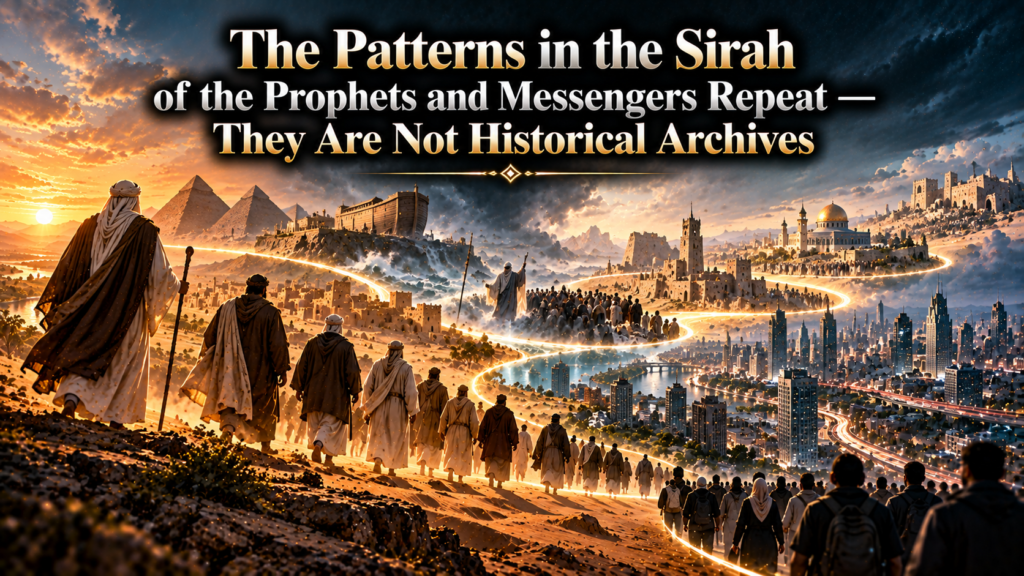
The fourth pillar of Iman is:
BELIEF IN THE MESSENGERS.
In the basic teachings of Islam, we are introduced to the names of the prophets and messengers, their sirah, their trials, their people, the opposition they faced, and how Allah saved them and those who believed alongside them.
The question is:
Why do we learn all of this?
Is it so that people can fluently recite the names of the 25 prophets and messengers?
Is it so that people can memorise that Nuh built the Ark, Ibrahim was thrown into the fire, Yusuf was cast into a well and imprisoned, Musa confronted Pharaoh, and Yunus was inside the belly of the fish?
If we stop there, religion becomes a historical archive.
Yet the Quran itself tells us that their stories have a far greater purpose.
⸻
THEIR STORIES ARE ‘IBRAH
Allah states:
لَقَدْ كَانَ فِي قَصَصِهِمْ عِبْرَةٌ لِّأُولِي الْأَلْبَابِ
“Indeed, in their stories there is an ‘ibrah for those of understanding.”
— Yusuf 12:111
The word used is:
عِبْرَة — ‘IBRAH
In Malay, we recognise the word:
IBARAT
An ibarat does not stop at the outward form.
An ibarat takes human beings from appearance to meaning.
From the story to its meaning.
From the form to the pattern.
From an event of the past to what must be recognised when that pattern appears again.
That is why the stories of the prophets should not be read merely as old stories that have already ended.
They are ibarat.
⸻
WHY DOES ALLAH REPEAT THE STORIES OF THE MESSENGERS?
Allah states:
وَكُلًّا نَّقُصُّ عَلَيْكَ مِنْ أَنْبَاءِ الرُّسُلِ مَا نُثَبِّتُ بِهِ فُؤَادَكَ وَجَاءَكَ فِي هَذِهِ الْحَقُّ وَمَوْعِظَةٌ وَذِكْرَىٰ لِلْمُؤْمِنِينَ
“And each of the accounts of the Messengers that We relate to you is to strengthen your fu’ad; and in this has come to you the truth, an instruction and a reminder for the believers.”
— Hud 11:120
Notice:
وَذِكْرَىٰ لِلْمُؤْمِنِينَ
A reminder for the believers.
Not only for the people who lived during the time of those prophets.
Therefore, their sirah remains alive because later generations of humanity will also encounter the same patterns of trials.
⸻
SUNNATULLAH DOES NOT CHANGE
Allah states:
سُنَّةَ اللَّهِ فِي الَّذِينَ خَلَوْا مِن قَبْلُ وَلَن تَجِدَ لِسُنَّةِ اللَّهِ تَبْدِيلًا
“The Sunnah of Allah concerning those who passed before; and you will never find any change in the Sunnah of Allah.”
— Al-Ahzab 33:62
This is the key.
What changes is:
the era,
language,
clothing,
technology,
location,
tools.
But human patterns and Sunnatullah continue.
Arrogance remains.
Rejection remains.
Betrayal remains.
Warnings continue to come.
There are still groups who accept.
There are still groups who reject.
Therefore, the sirah of the prophets is a map of human patterns.
⸻
LATER GENERATIONS WILL ALSO BE TESTED
Allah states:
أَحَسِبَ النَّاسُ أَن يُتْرَكُوا أَن يَقُولُوا آمَنَّا وَهُمْ لَا يُفْتَنُونَ وَلَقَدْ فَتَنَّا الَّذِينَ مِن قَبْلِهِمْ
“Do people think that they will be left to say, ‘We believe,’ without being tested? We certainly tested those before them.”
— Al-‘Ankabut 29:2–3
This verse directly connects:
those before were tested
and
those who come later will also be tested.
Therefore, human beings do not merely read about the trials of the prophets.
Human beings themselves will pass through those patterns of trials.
The difference is:
some recognise them,
and some do not.
⸻
THE PATTERN OF NUH عليه السلام — A VERY CLEAR IBARAT
Among the strongest examples of a sirah that can be read as an ibarat is the sirah of Nuh عليه السلام.
Allah states:
إِنَّا أَرْسَلْنَا نُوحًا إِلَىٰ قَوْمِهِ أَنْ أَنذِرْ قَوْمَكَ مِن قَبْلِ أَن يَأْتِيَهُمْ عَذَابٌ أَلِيمٌ
“Indeed, We sent Nuh to his people: Warn your people before a painful punishment comes upon them.”
— Nuh 71:1
Nuh came as a warner.
His call was:
أَنِ اعْبُدُوا اللَّهَ وَاتَّقُوهُ وَأَطِيعُونِ
“Worship Allah, be mindful of Him and obey me.”
— Nuh 71:3
The pattern is clear:
TAWHID → REMINDER → WARNING → REJECTION
Then his people ridiculed him:
كَذَّبَتْ قَبْلَهُمْ قَوْمُ نُوحٍ فَكَذَّبُوا عَبْدَنَا وَقَالُوا مَجْنُونٌ وَازْدُجِرَ
“Before them, the people of Nuh denied; they denied Our servant and said, ‘He is mad,’ and he was driven away.”
— Al-Qamar 54:9
Therefore, the pattern of Nuh is:
a warner
→ calls towards Tawhid
→ gives warning
→ is rejected
→ is ridiculed
→ is accused of madness
→ only a few accept.
Allah states:
وَمَا آمَنَ مَعَهُ إِلَّا قَلِيلٌ
“And none believed with him except a few.”
— Hud 11:40
This is the pattern.
⸻
THE ARK: OUTWARD FORM AND IBARAT
Literally, the Ark of Nuh was a vessel.
Allah states:
وَاصْنَعِ الْفُلْكَ بِأَعْيُنِنَا وَوَحْيِنَا
“And build the Ark under Our watch and according to Our revelation.”
— Hud 11:37
But when read as an ‘ibrah, the Ark carries a broader meaning as a vessel of salvation.
Within an ibarat reading:
THE ARK = a vessel for people who accept the warning.
In the time of Nuh, its outward form was a ship.
In another age, the pattern of salvation may appear as:
a group of people who share the same understanding, accept the warning, hold firmly to Tawhid, and move together in one direction.
This is an ibarat reading, not a claim that the word fulk literally means “group”.
But that is the function of ‘ibrah:
to see the meaning beyond the form.
⸻
TEXTUALISTS WILL REJECT IT BECAUSE THEY ARE WAITING FOR THE SAME THING
This is where the problem of the prison of text appears.
A textualist will ask:
“Where does the verse say that Nuh is a pattern?”
“Where does the verse say that the Ark is a group?”
“Where does the verse say that the story will repeat?”
The problem is that they demand the conclusion to be written word-for-word in the verse.
Yet the Quran itself provides three keys:
‘IBRAH
— Yusuf 12:111
SUNNATULLAH
— Al-Ahzab 33:62
THE TESTS OF THOSE BEFORE AND THOSE WHO COME LATER
— Al-‘Ankabut 29:2–3
Therefore, the argument is not:
“the text says Ark = group.”
The argument is:
the text commands human beings to take ‘ibrah and recognise recurring patterns within the Sunnah.
If people merely wait for the same wooden ship, the same staff, the same fire, the same well, or Pharaoh wearing the same Egyptian clothing — they are waiting for the outer skin of history.
Yet its ibarat may already be right before their eyes.
⸻
ULUL ALBAB — THOSE WHO GRASP THE IBARAT
Allah states:
لِّأُولِي الْأَلْبَابِ
“For those of understanding.”
— Yusuf 12:111
Linguistically, albab comes from lubb, meaning the inner core, clear reason and deep understanding.
Within the analogy of this chapter:
many stand at the doorway of the text,
while ulul albab enter until they reach its core.
They do not merely read the story.
They recognise the pattern.
They do not merely know the names of the prophets.
They know what is happening when the ibarat appears in their own time.
⸻
PROPHETHOOD ENDS — THE RISALAH CONTINUES
Allah states:
مَّا كَانَ مُحَمَّدٌ أَبَا أَحَدٍ مِّن رِّجَالِكُمْ وَلَٰكِن رَّسُولَ اللَّهِ وَخَاتَمَ النَّبِيِّينَ
“Muhammad is not the father of any man among you, but he is the Messenger of Allah and the Seal of the Prophets.”
— Al-Ahzab 33:40
Therefore, prophethood was sealed with Prophet Muhammad ﷺ.
But the Risalah did not die.
Knowledge was not cut off.
The teaching did not end.
Allah states:
وَاعْتَصِمُوا بِحَبْلِ اللَّهِ جَمِيعًا وَلَا تَفَرَّقُوا
“And hold firmly, all together, to the rope of Allah, and do not become divided.”
— Ali ‘Imran 3:103
حَبْلِ اللَّهِ — HABLILLAH
Within the reading of this chapter, Hablillah is the continuity of the Risalah and knowledge.
Prophet Muhammad ﷺ is Khatam al-Nabiyyin.
After him, his Risalah continues to be carried, taught and inherited by those who maintain the continuity of knowledge.
The Prophet ﷺ said:
إِنَّ الْعُلَمَاءَ وَرَثَةُ الْأَنْبِيَاءِ
“Indeed, the ulama are the inheritors of the Prophets.”
— Abu Dawud 3641; Al-Tirmidhi 2682
Therefore:
PROPHETHOOD ENDS.
THE RISALAH CONTINUES TO BE CARRIED.
HABLILLAH IS NOT SEVERED.
If the term “rasul throughout the ages” is used within this discussion, its meaning must be clear:
those who continue and carry the Risalah of Muhammad ﷺ,
not new prophets and not bearers of a new Shariah.
⸻
SANAD IS NOT A CERTIFICATE
It is this continuity of knowledge that makes sanad important.
Sanad is not decoration.
Sanad is not a title.
Sanad is not merely a certificate.
Sanad is:
who received from whom,
who was guided by whom,
and how that knowledge was transmitted through a continuous chain.
Without sanad and guidance, people can easily make themselves the teacher of the text.
They read.
They feel.
Then they say:
“This is what it means.”
Eventually, their own feelings become the interpretation.
That is where people can become trapped.
⸻
GHURABA — THE FEW AND THE STRANGERS
The Prophet ﷺ said:
بَدَأَ الْإِسْلَامُ غَرِيبًا وَسَيَعُودُ كَمَا بَدَأَ غَرِيبًا فَطُوبَى لِلْغُرَبَاءِ
“Islam began as something strange and will return to being strange as it began. So glad tidings to the ghuraba.”
— Sahih Muslim 145
The sirah of Nuh gives us this picture:
وَمَا آمَنَ مَعَهُ إِلَّا قَلِيلٌ
“And none believed with him except a few.”
— Hud 11:40
Therefore, those who grasp the ‘ibrah and remain firmly attached to the Risalah may appear:
strange,
few,
unpopular,
ridiculed,
opposed.
But being few is not automatically proof of being right.
The measure remains the text and the truth.
The point is:
truth is not necessarily followed by the majority.
⸻
THE FOURTH PILLAR OF IMAN IS NOT AN EXERCISE IN MEMORISATION
So return to the original question.
Why believe in the Messengers?
Why are their names known?
Why are their stories mentioned?
Why are their journeys told?
The answer is not so that we become memorizers of an archive.
It is so that when the pattern appears, we recognise it.
Nuh teaches the pattern of warning and rejection.
Ibrahim teaches the pattern of confronting false beliefs.
Yusuf teaches the pattern of temptation, patience, imprisonment and deliverance.
Musa teaches the pattern of confronting the power of Pharaoh.
Ayyub teaches the pattern of prolonged trials.
Yunus teaches the pattern of emerging from constriction.
The prophets and messengers are a map of human ibarat.
⸻
ALL HUMAN BEINGS PASS THROUGH PATTERNS — BUT NOT EVERYONE RECOGNISES THEM
This is the central point of this chapter.
Human beings will pass through:
trials,
rejection,
fear,
loss,
betrayal,
separation,
deliverance,
warnings,
and decisions.
But many do not realise that they are living through a chapter already explained by the Quran.
They say:
“This is merely a problem of our time.”
“This is merely politics.”
“This is merely illness.”
“This is merely conflict.”
“This is merely coincidence.”
Whereas the ulul albab ask:
“What pattern is repeating?”
⸻
CONCLUSION
The stories of the prophets and messengers are not historical archives.
They are:
‘IBRAH.
IBARAT.
SUNNATULLAH.
A MAP OF HUMAN TRIALS.
What changes is the face of the age.
What remains is the pattern.
What changes are the tools.
What remains is human nature.
What changes is the form of the Ark.
What remains is the principle of salvation together with those who accept the warning.
Therefore, do not only ask:
“What happened to Nuh in the past?”
Also ask:
“Is the pattern of Nuh happening now?”
Do not only ask:
“What happened to Musa and Pharaoh in the past?”
Ask:
“Is the pattern of Musa and Pharaoh repeating in another form?”
This is the difference between:
READING HISTORY
and
RECOGNISING THE IBARAT.
And this is why the Quran states:
لَقَدْ كَانَ فِي قَصَصِهِمْ عِبْرَةٌ لِّأُولِي الْأَلْبَابِ
“Indeed, in their stories there is an ‘ibrah for those of understanding.”
— Yusuf 12:111
THE STORIES OF THE PROPHETS DID NOT DIE IN THE PAST.
THEIR PATTERNS CONTINUE.
THOSE WHO ARE GIVEN GUIDANCE WILL RECOGNISE THEM.