
IHSAN
The Quran Came to Be Understood — Not to Imprison Reason Within Letters
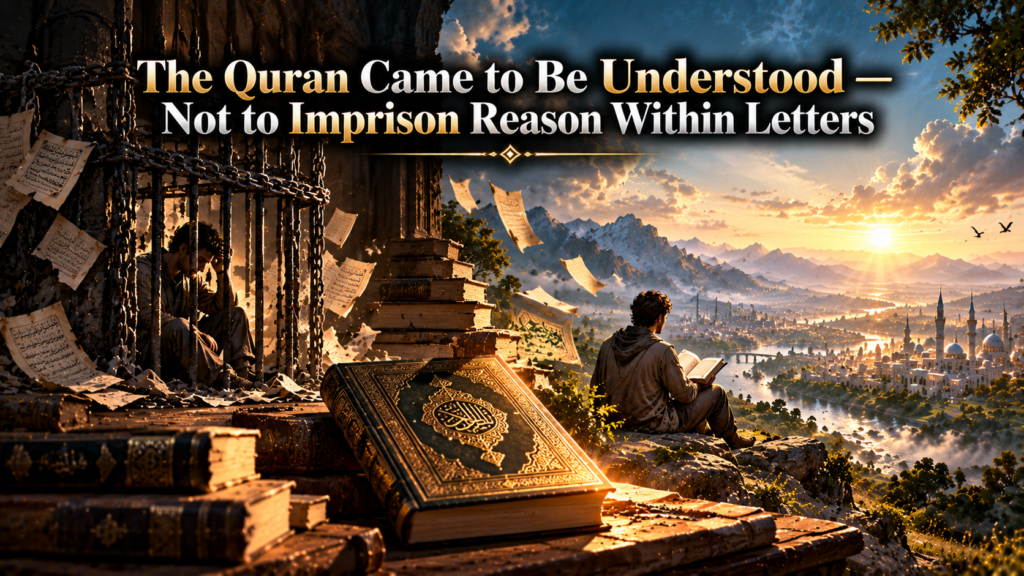
The Quran came as guidance.
But guidance does not benefit a person merely because its letters are read or its verses memorised. It needs to be understood.
Allah Himself teaches human beings to look at their food:
فَلْيَنظُرِ ٱلْإِنسَٰنُ إِلَىٰ طَعَامِهِۦ
“Then let the human being look at his food.”
— ‘Abasa 80:24
Physical food gives strength to the body.
Knowledge, meanwhile, can be likened to inward nourishment that brings illumination to the qalb.
And food teaches us one important thing:
it is not simply swallowed whole.
THE SKIN POINTS TO THE CONTENT WITHIN
A fruit has a skin.
The skin is important because it protects and indicates what is inside.
But the purpose of eating fruit is not to stop at the skin.
The skin is peeled.
The content within is taken.
The same applies to text.
Letters and words are bearers of meaning.
The text must be preserved because it serves as a sign pointing towards what is to be understood.
But if human beings stop only at the letters, they are merely holding the outer skin of knowledge.
Therefore, the process is:
NEGATION — peel away the skin.
AFFIRMATION — take what is within.
This does not mean discarding the text.
Rather, it means using the text to reach the meaning it carries.
28 TEETH — 28 LETTERS
Once the content within has been obtained, food needs to be chewed.
This is where the analogy between 28 teeth and 28 letters becomes very interesting.
The Arabic alphabet is commonly counted as having 28 letters.
A human being also has 28 teeth when the four wisdom teeth are not counted.
We are not claiming that this numerical relationship is a revealed text or an established religious principle.
But as a sign for reflection, it is very powerful:
28 letters form the reading.
28 teeth chew food.
Physical food is not simply swallowed whole.
Knowledge should likewise not simply be “swallowed” through memorisation without being processed.
Teeth chew food.
Reason chews knowledge.
To chew knowledge means to:
observe,
question,
connect,
distinguish,
evaluate,
and ultimately understand.
Allah states:
أَفَلَا يَتَدَبَّرُونَ ٱلْقُرْءَانَ أَمْ عَلَىٰ قُلُوبٍ أَقْفَالُهَآ
“Do they not deeply reflect upon the Quran, or are there locks upon their qalbs?”
— Muhammad 47:24
This verse does not stop at the tongue.
It leads directly to the qalb.
UNDERSTANDING IS THE DIGESTION OF KNOWLEDGE
Food that has been chewed will be digested.
Once digested, its benefits are absorbed by the body.
Knowledge works in the same way.
Reading is the beginning.
Memorisation is a tool.
But the ultimate purpose is understanding.
Allah states:
أَفَلَمْ يَسِيرُوا۟ فِى ٱلْأَرْضِ فَتَكُونَ لَهُمْ قُلُوبٌ يَعْقِلُونَ بِهَآ
“Have they not travelled through the earth so that they may have qalbs with which they understand…”
— Al-Hajj 22:46
Notice:
قُلُوبٌ يَعْقِلُونَ بِهَا
qalbs with which they understand.
Therefore, when knowledge becomes Nūr, do not imagine a lamp physically glowing inside the chest.
Nūr is the state in which something that was once unclear becomes clear.
What was once merely sound becomes meaning.
What was once merely memorisation becomes understanding.
WHEN IT IS NOT CHEWED, IT GETS STUCK
Food swallowed without being chewed can become stuck in the throat.
The Prophet ﷺ used a very severe image concerning a particular group:
يَقْرَءُونَ الْقُرْآنَ لَا يُجَاوِزُ حَنَاجِرَهُمْ
“They recite the Quran, but it does not go beyond their throats.”
— Narrated by Al-Bukhari and Muslim concerning the Khawarij
This hadith has a specific context.
But the image it uses is very clear:
Recitation can remain on the tongue and in the throat without reaching true understanding.
Therefore, reading a great deal does not necessarily mean understanding a great deal.
Extensive memorisation also does not necessarily mean that knowledge has reached the qalb.
WHY DOES THE MESSENGER EXPLAIN?
If the text alone were sufficient without explanation, why was the Messenger ﷺ commanded to explain it?
Allah states:
وَأَنزَلْنَا إِلَيْكَ ٱلذِّكْرَ لِتُبَيِّنَ لِلنَّاسِ مَا نُزِّلَ إِلَيْهِمْ وَلَعَلَّهُمْ يَتَفَكَّرُونَ
“And We sent down to you the Reminder so that you may explain to humanity what has been sent down to them, and so that they may think.”
— An-Nahl 16:44
The sequence is clear:
REVELATION → EXPLANATION → THINKING
Allah also states:
يَتْلُوا۟ عَلَيْهِمْ ءَايَٰتِهِۦ وَيُزَكِّيهِمْ وَيُعَلِّمُهُمُ ٱلْكِتَٰبَ وَٱلْحِكْمَةَ
“He recites His verses to them, purifies them, and teaches them the Book and Wisdom.”
— Al-Jumu‘ah 62:2
There is a difference between:
يَتْلُوا — recites
and
يُعَلِّمُهُم — teaches them.
If reading were already the same as understanding, there would be no need to mention teaching separately.
DO NOT MAKE YOURSELF THE TEACHER OF THE TEXT
The danger begins when someone reads without the guidance of those who are truly knowledgeable, and then makes himself the teacher of what he reads.
He reads.
Then his own feelings determine the meaning.
His own inclinations select the interpretation.
Eventually, he assumes that whatever he feels within himself is the religion.
Allah warns:
أَفَرَءَيْتَ مَنِ ٱتَّخَذَ إِلَٰهَهُۥ هَوَىٰهُ
“Have you seen the one who takes his own desire as his Ilah?”
— Al-Jathiyah 45:23
That is why understanding the texts requires the guidance of knowledge.
SANAD IS NOT A CERTIFICATE
Sanad is not a certificate.
Sanad is not a title.
Sanad is a continuous chain through which knowledge is received.
A person receives from a teacher.
The teacher receives from his teacher.
In this way, knowledge is carried and preserved through a connected chain.
The Prophet ﷺ said:
إِنَّ الْعُلَمَاءَ وَرَثَةُ الْأَنْبِيَاءِ
“Indeed, the ulama are the inheritors of the Prophets.”
— Sunan Abi Dawud 3641; Jami‘ at-Tirmidhi 2682
The inheritance of the Prophets is knowledge, not status.
Therefore, tadabbur does not mean that a person is free to interpret according to his own feelings.
Tadabbur requires a key.
And that key is guided knowledge.
EVERY TEXT HAS A KEY
No verse stands isolated from the Quran as a whole.
To understand, human beings need to examine:
language,
the relationship between verses,
the explanations of the Prophet ﷺ,
principles,
and the meanings indicated by the words.
That is why a conclusion does not have to be written word-for-word in a single verse in order to be true.
For example:
لَيْسَ كَمِثْلِهِۦ شَىْءٌ
“There is nothing whatsoever like Him.”
— Ash-Shura 42:11
If someone accepts only what is written literally, he will immediately ask:
“Where is the verse that says exactly that, word-for-word?”
But understanding means recognising what the text indicates, not merely searching for a verse that repeats our conclusion word-for-word.
MEMORISING MULTIPLICATION TABLES IS NOT UNDERSTANDING MULTIPLICATION
Imagine a student memorising the multiplication tables up to:
12 × 12 = 144
Then he is asked:
15 × 15 = ?
The answer is:
225
But 15 × 15 is not found in the multiplication tables he memorised.
Does that make 225 wrong?
No.
Someone who understands MULTIPLICATION can arrive at the answer even if that particular example was never memorised.
But someone who only memorises may say:
“It’s not in my multiplication table!”
This is the difference:
MEMORISING MULTIPLICATION TABLES ≠ UNDERSTANDING MULTIPLICATION
Likewise:
MEMORISING THE TEXT ≠ UNDERSTANDING THE TEXT
But understanding the method does not mean being free to give whatever answer one wishes.
15 × 15 still cannot be answered as 900 merely because someone wants to “go beyond memorisation”.
The same applies to the Quran.
Escaping the prison of letters does not mean escaping the discipline of the text.
THE QURAN COMMANDS HUMAN BEINGS TO THINK
Allah states:
كِتَٰبٌ أَنزَلْنَٰهُ إِلَيْكَ مُبَٰرَكٌ لِّيَدَّبَّرُوٓا۟ ءَايَٰتِهِۦ وَلِيَتَذَكَّرَ أُو۟لُوا۟ ٱلْأَلْبَٰبِ
“A blessed Book that We have sent down to you so that they may deeply reflect upon its verses and so that those of understanding may take heed.”
— Sad 38:29
Therefore, the journey of knowledge is:
LETTERS → READ → GUIDANCE → THINK → UNDERSTAND → QALB
Not:
LETTERS → MEMORISE → REPEAT → REJECT EVERYTHING THAT IS NOT WRITTEN WORD-FOR-WORD
DO NOT BUILD A PRISON OUT OF LETTERS
Letters are extremely important.
The text is extremely important.
Memorisation is also important.
But all of these are the path, not the destination.
Physical food has a skin.
Knowledge has text.
Food is chewed with the teeth.
Knowledge is chewed with reason.
Food is digested and then benefits the body.
Knowledge is understood and then becomes illumination for the qalb.
And when the text is merely swallowed without being chewed through thought, human beings may end up with knowledge that remains only on the tongue and in the throat.
THE QURAN CAME TO BE UNDERSTOOD — NOT TO IMPRISON REASON WITHIN LETTERS.