

MUKADDIMAH · M25
What is an attribute?
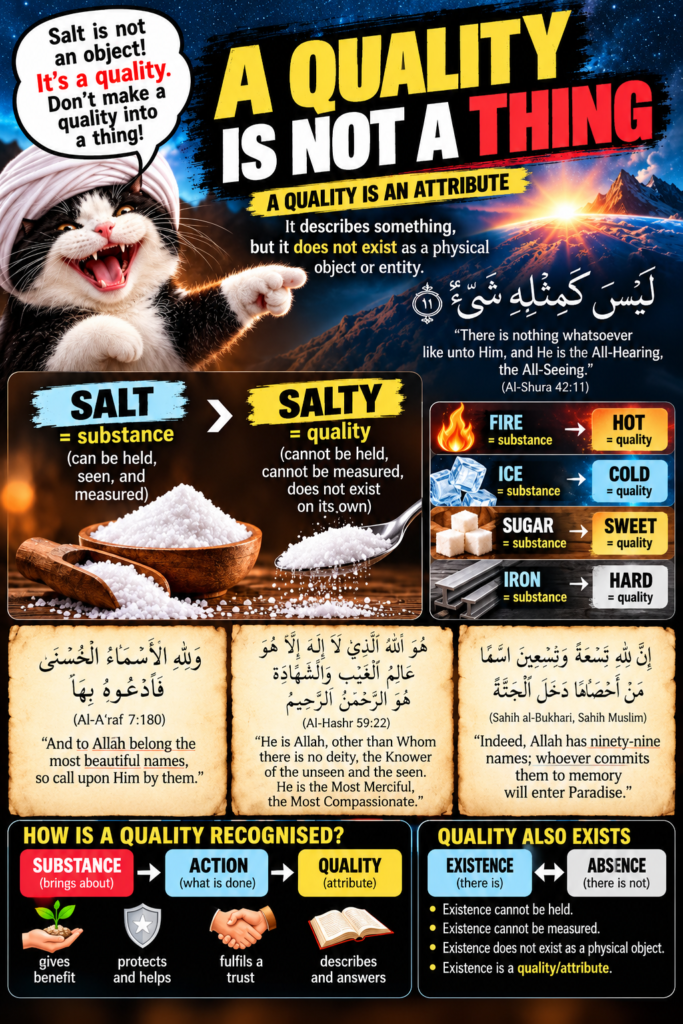
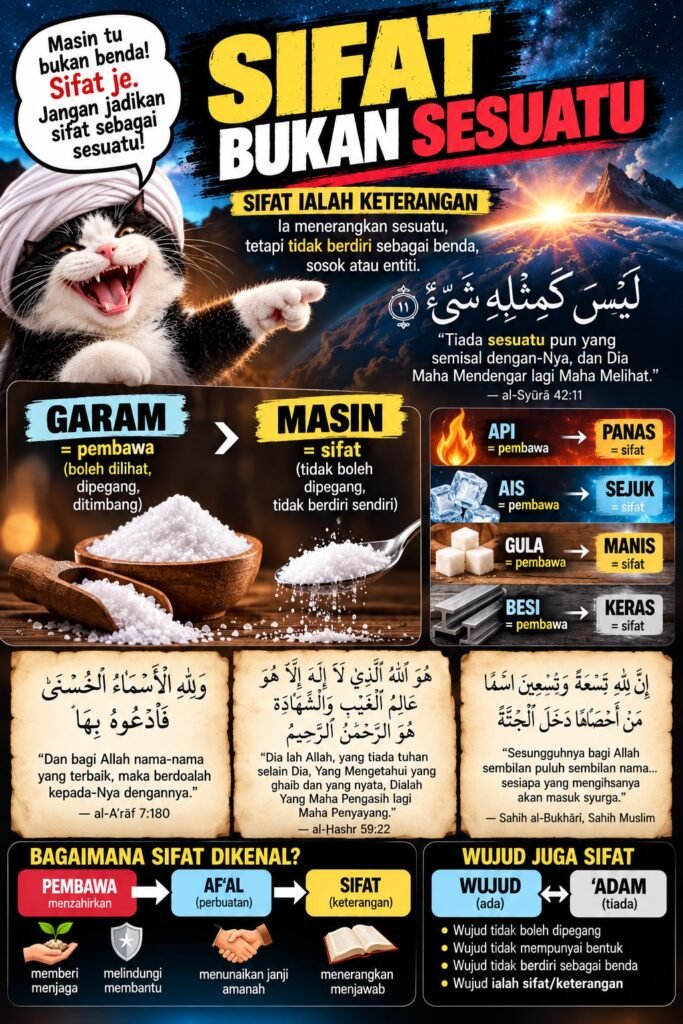
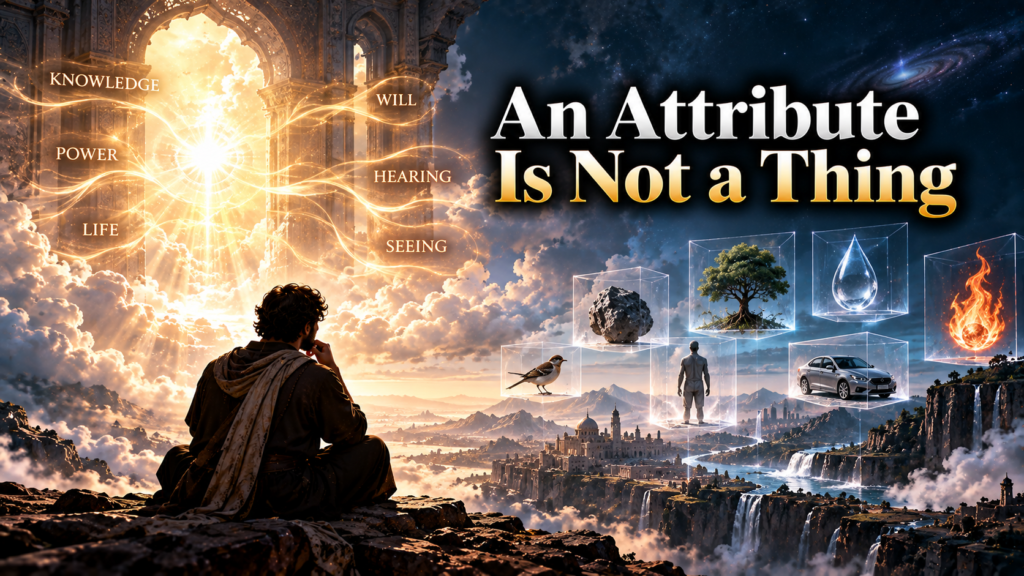
An attribute is a description.
It describes something, but the attribute itself does not stand as an object, figure or entity.
Take the simplest example:
SALT — SALTINESS
Salt can be seen.
Salt can be touched.
Salt can be weighed.
But:
saltiness cannot be held.
Saltiness cannot be placed on a table.
Saltiness does not stand independently as an object.
Saltiness is only recognised through its bearer.
Therefore:
SALT = bearer
SALTINESS = attribute
⸻
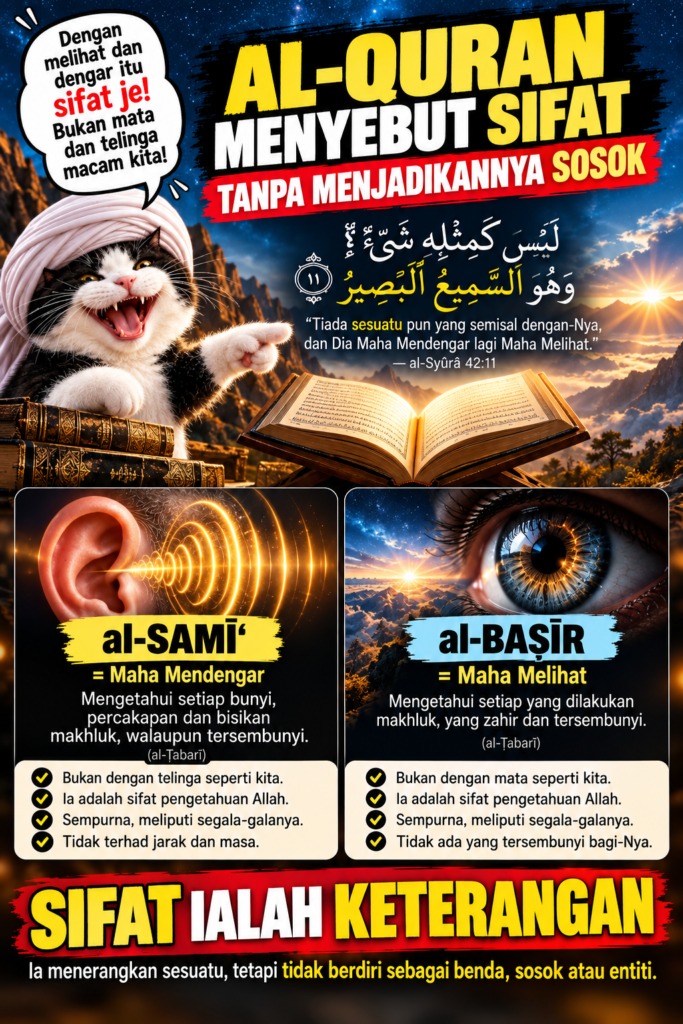
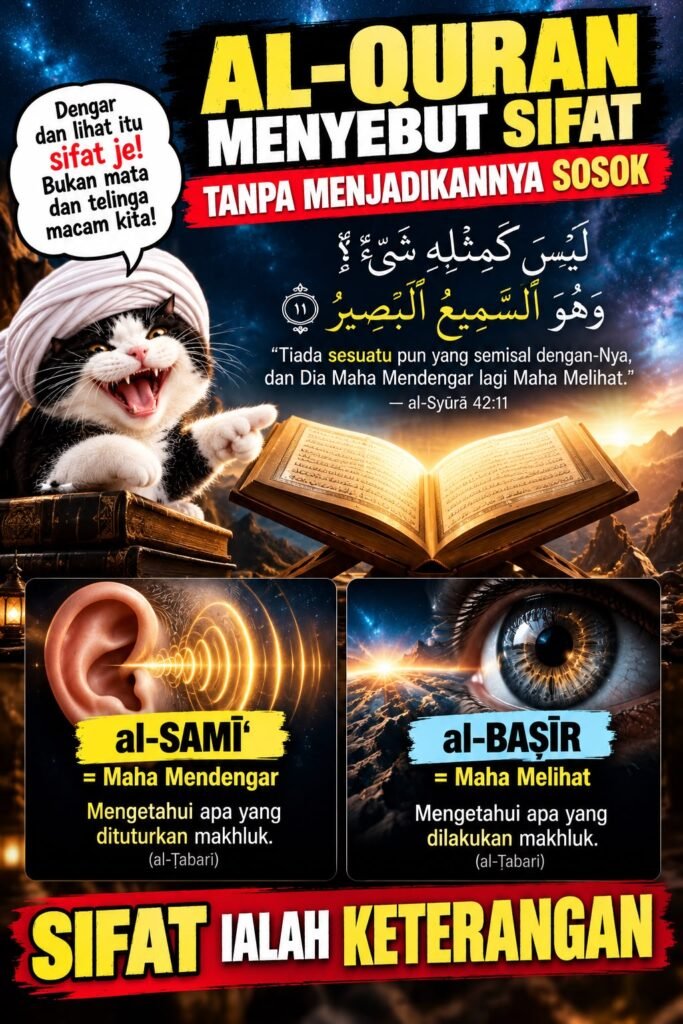
THE QURAN MENTIONS ATTRIBUTES WITHOUT TURNING THEM INTO FIGURES
Allah states:
لَيْسَ كَمِثْلِهِ شَيْءٌ ۖ وَهُوَ السَّمِيعُ الْبَصِيرُ
“There is nothing whatsoever like Him, and He is the All-Hearing, the All-Seeing.”
— Ash-Shura 42:11
Notice the structure.
The verse first negates any likeness to a thing:
لَيْسَ كَمِثْلِهِ شَيْءٌ
Then it immediately states:
السَّمِيعُ — All-Hearing
الْبَصِيرُ — All-Seeing
Al-Tabari explains that Allah hears what His creation says and sees what they do; nothing is hidden from His knowledge.
Here, attributes are mentioned as descriptions, not as figures.
⸻
THE NAMES OF ALLAH CARRY DESCRIPTIONS
Allah states:
وَلِلَّهِ الْأَسْمَاءُ الْحُسْنَىٰ فَادْعُوهُ بِهَا
“And to Allah belong the most beautiful names, so call upon Him by them.”
— Al-A‘raf 7:180
A sahih hadith states:
إِنَّ لِلَّهِ تِسْعَةً وَتِسْعِينَ اسْمًا…
“Indeed, Allah has ninety-nine names…”
Names such as:
al-Raḥmān
al-Raḥīm
al-‘Alīm
al-Samī‘
al-Baṣīr
carry the meanings of attributes.
A name does not need to be turned into an object.
⸻
THE QURAN PRESENTS ATTRIBUTES AS DESCRIPTIONS
Allah states:
هُوَ اللَّهُ الَّذِي لَا إِلَٰهَ إِلَّا هُوَ عَالِمُ الْغَيْبِ وَالشَّهَادَةِ هُوَ الرَّحْمَٰنُ الرَّحِيمُ
— Al-Hashr 59:22
Notice:
عَالِمُ الْغَيْبِ وَالشَّهَادَةِ
= Knower of the unseen and the seen
الرَّحْمَٰنُ الرَّحِيمُ
= the Most Compassionate and the Most Merciful
Al-Tabari explains these names as descriptions relating to knowledge and mercy.
Therefore, when we speak of:
Knowing
Compassionate
Merciful
we are reading attributes.
⸻
RATIONAL PROOF: AN ATTRIBUTE DOES NOT STAND INDEPENDENTLY
Take the example:
FIRE — HEAT
What is seen is the fire.
What is felt is the heat.
Heat does not walk around by itself.
Heat does not have a body.
Heat is recognised through its bearer.
Likewise:
SUGAR — SWEETNESS
ICE — COLDNESS
IRON — HARDNESS
Therefore:
An attribute does not stand independently as a thing.
It is recognised through its bearer and its effects.
⸻
HOW IS AN ATTRIBUTE RECOGNISED?
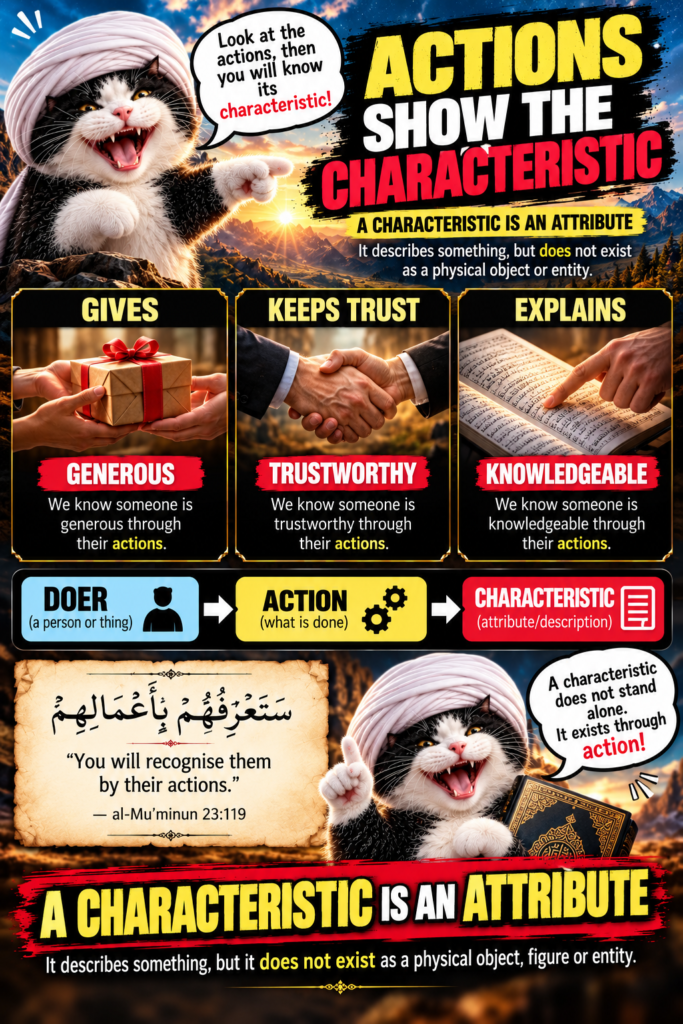
Through Af‘al.
We recognise someone as:
compassionate
because we see that person:
care, give, help, protect.
We recognise someone as:
trustworthy
because that person:
fulfils responsibilities, safeguards what is entrusted, does not betray.
We recognise someone as:
knowledgeable
because that person:
explains, answers, organises, solves.
Therefore:
AF‘AL → DEMONSTRATES ATTRIBUTES
Without Af‘al, an attribute cannot be clearly witnessed.
⸻
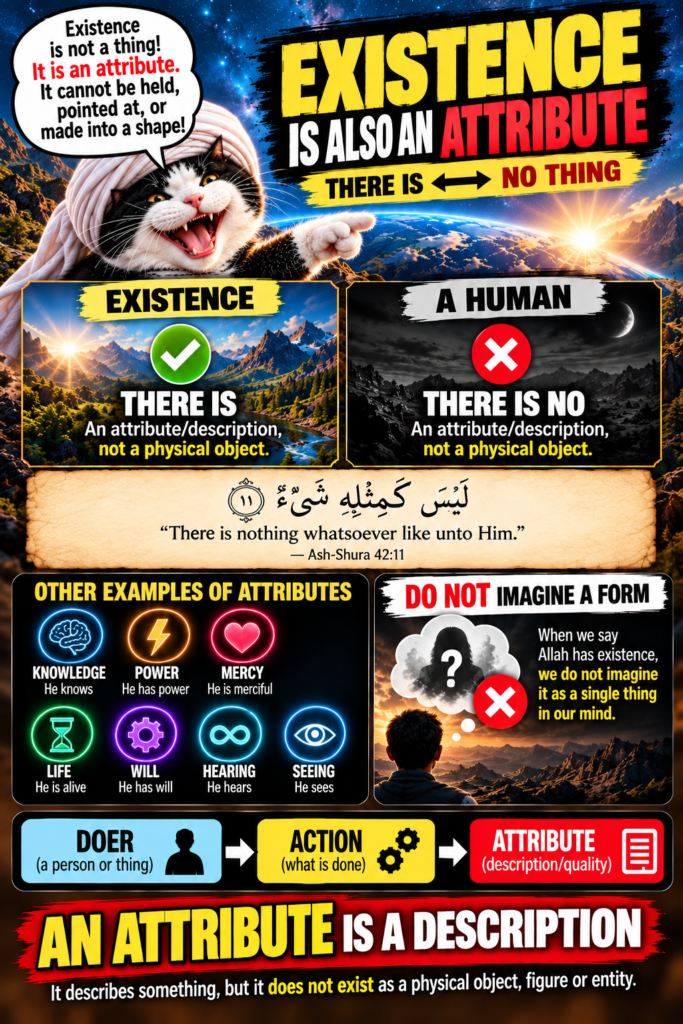
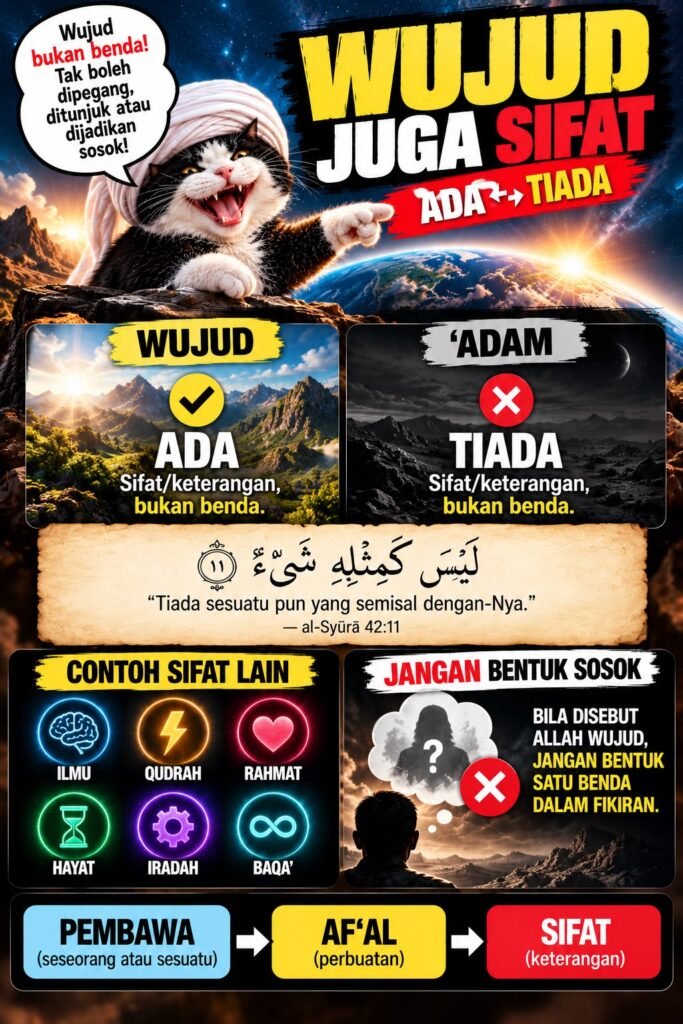
WUJUD IS ALSO AN ATTRIBUTE
In Aqaid 50, among the earliest attributes is:
WUJUD
and its opposite:
‘ADAM
existence ↔️ non-existence
Ask using reason:
Is “wujud” an object?
No.
Can “existence” be held?
No.
Can “wujud” be pointed to as a figure?
No.
Therefore:
Wujud is an attribute/description.
Likewise:
Qidam
Baqa’
Ilmu
Qudrah
Iradah
Hayat
all of them are attributes.
And an attribute is not a thing.
⸻
WHEN WE SAY “ALLAH EXISTS”
Do not immediately form an unseen figure in the mind.
Because Wujud is an attribute.
If an attribute is turned into a figure, then a description has been turned into a thing.
Yet Ash-Shura 42:11 has already established the boundary:
لَيْسَ كَمِثْلِهِ شَيْءٌ
and then states:
وَهُوَ السَّمِيعُ الْبَصِيرُ
Attributes are mentioned without turning Allah into an object or figure.
⸻
THE ENTIRE UNIVERSE MANIFESTS ATTRIBUTES
The entire universe carries characteristics.
There are things that are:
strong,
weak,
living,
dead,
moving,
still,
giving,
receiving,
causing growth,
causing death.
All of these are recognised through Af‘al.
Thus, human beings read attributes through what takes place within the universe.
An attribute does not need to become another created being.
An attribute is a description manifested through actions.
⸻
THE INNER AND THE OUTWARD
Attributes can be recognised from two aspects:
INNER
= data, order, internal characteristics
OUTWARD
= form, structure, effects and functions
The inner is recognised through the outward.
Take the human being as an example:
DNA carries developmental information.
That information cannot be seen with the naked eye.
But its effects are manifested through:
the form of the body,
the structure of organs,
cellular functions,
physical characteristics.
Therefore:
the inner is recognised through the outward.
The same applies to attributes.
⸻
BEARER → AF‘AL → ATTRIBUTES
This is the path of recognition:
BEARER
→ manifests AF‘AL
→ Af‘al reveals ATTRIBUTES
For example:
salt
→ comes into contact with the tongue
→ saltiness is recognised
fire
→ produces heat
→ heat is recognised
a human being
→ gives and cares
→ compassion is recognised
Therefore:
An attribute does not stand independently as a thing.
An attribute is recognised through its bearer and its Af‘al.
⸻
CONCLUSION
The Quran mentions attributes such as:
Hearing
Seeing
Knowing
Compassionate
Merciful
Hadith also mentions the names of Allah.
Early classical tafsir such as al-Tabari explains them as descriptions relating to knowledge, mercy, hearing and seeing.
Rational proof points towards the same principle:
saltiness is not an object
heat is not a figure
trustworthiness is not an entity
wujud is not an object
Therefore:
ATTRIBUTE = DESCRIPTION
It is not an object.
It is not a figure.
It is not an entity.
It does not stand independently.
It is recognised through:
BEARER → AF‘AL → ATTRIBUTE
DO NOT TURN AN ATTRIBUTE INTO A THING.
Detecting your location…