
MUKADDIMAH · M22
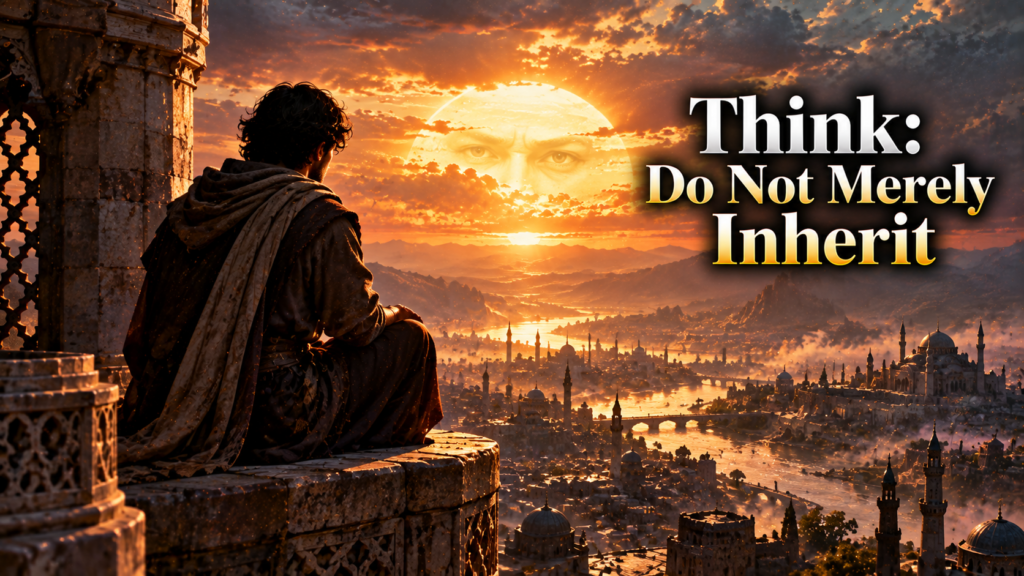
Chapter 1.1 — Think: Do Not Merely Inherit
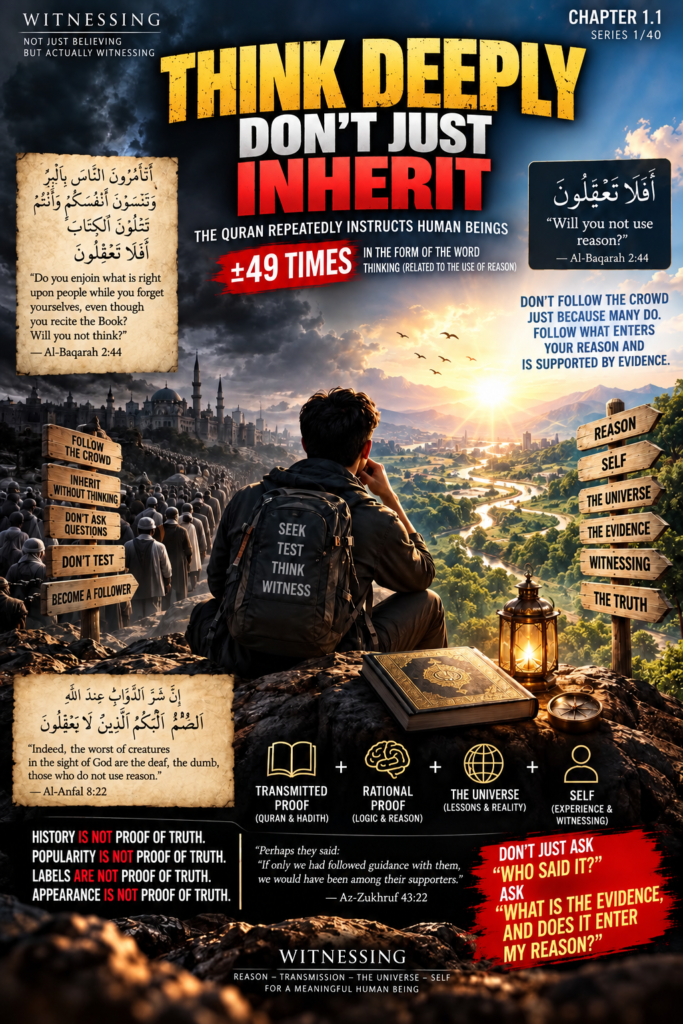
The Quran does not educate human beings to become followers who merely memorise.
It repeatedly challenges humanity:
أَفَلَا تَعْقِلُونَ
“Will you not use reason?”
The root ع ق ل, relating to the use of reason, appears repeatedly in the Quran, commonly counted at around 49 occurrences in verbal forms. This itself raises a major question:
If religion only needs to be inherited and memorised, why are human beings repeatedly told to use reason?
REASON IS NOT THE ENEMY OF RELIGION
Among the clearest admonitions is:
أَتَأْمُرُونَ النَّاسَ بِالْبِرِّ وَتَنسَوْنَ أَنفُسَكُمْ وَأَنتُمْ تَتْلُونَ الْكِتَابَ ۚ أَفَلَا تَعْقِلُونَ
“Do you command people to do good while forgetting yourselves, even though you recite the Book? Will you not use reason?”
— Al-Baqarah 2:44
Notice the sequence.
They recite the Book.
Yet they are still admonished:
أَفَلَا تَعْقِلُونَ
This shows that merely reading the text is not enough.
A person can:
read,
memorise,
teach,
hold certificates,
have followers,
yet still fail to use reason regarding what they read.
THE GREATEST DANGER: FOLLOWING WITHOUT EXAMINING
The Quran also describes people who merely follow what they have inherited:
بَلْ قَالُوا إِنَّا وَجَدْنَا آبَاءَنَا عَلَىٰ أُمَّةٍ وَإِنَّا عَلَىٰ آثَارِهِم مُّهْتَدُونَ
“Rather, they say, ‘Indeed, we found our forefathers upon a certain way, and we are guided by following in their footsteps.’”
— Az-Zukhruf 43:22
This is a great trap.
Something can be inherited for hundreds of years until people no longer ask:
Is this really what it means?
Is the translation correct?
Is the root word correct?
Is it consistent with the Quran as a whole?
Old does not prove true.
Many people believing something does not prove it true.
A certificate does not prove it true.
A title does not prove it true.
What is true must be tested.
EVEN RELIGIOUS PEOPLE CAN FAIL TO USE REASON
The Quran gives a very severe description:
إِنَّ شَرَّ الدَّوَابِّ عِندَ اللَّهِ الصُّمُّ الْبُكْمُ الَّذِينَ لَا يَعْقِلُونَ
“Indeed, the worst of moving creatures in the sight of Allah are the deaf and dumb who do not use reason.”
— Al-Anfal 8:22
The problem is not merely the absence of text.
The problem is that the text is present, but reason is not functioning.
That is why people can hold the Book yet still go astray when inherited interpretations are accepted without examination.
WHEN KNOWLEDGE BECOMES INHERITANCE WITHOUT WITNESSING
This is where we begin to understand how religion can become distorted from within.
A person can be taught by a system.
Then receive a certificate.
Then be given a title.
Then teach the next generation.
The next generation then repeats the same thing.
Eventually, an interpretation is considered true not because it has been tested, but because:
“Everyone before us said the same thing.”
This is the starting point from which an ulama su’ may emerge without even realising that he has become an ulama su’.
He does not necessarily intend to deceive.
He may sincerely defend what he has learned.
But if the foundation he inherited has gone astray, he will also pass that distortion on to others.
This makes the danger far subtler:
a person who believes he is defending religion may actually be defending an inherited error.
REASON + NAQLI
Using reason does not mean abandoning the revealed texts.
Rather:
Dalil Naqli provides the evidence.
Dalil Aqli tests our understanding of that evidence.
If an interpretation of one verse causes it to conflict with another verse, then that interpretation must be examined.
If a translation conflicts with the root word, examine it.
If a belief requires us to shut down the very logic that the Quran itself commands us to use, examine it.
Our method is:
LETTERS → ROOT WORD → ṢARF → NAHU → CROSS-REFERENCING TEXTS → REASON → NATURE → SELF
Not:
“The ulama of the past said so, therefore do not ask questions.”
THIS IS THE GATEWAY TO WITNESSING
This series does not ask people to believe something merely because it is new.
Nor does it ask people to reject something merely because it is old.
We will test it.
If the old reading is correct, it will withstand examination.
If the new reading is wrong, it must be abandoned.
But if a distortion has been inherited until it is regarded as religion itself, courage is required to uncover it.
That is why the journey of Witnessing must begin with one instruction:
USE REASON.
Do not be afraid to ask questions.
Do not be afraid to examine.
Do not be afraid to go against the current when the texts, language and reason point towards something different.
Because people who do not think are easily turned into followers.
And followers who are unaware can help defend the very distortion they mistake for truth.
THE PUNCHLINE
DO NOT ASK: “WHO SAID IT?”
ASK: “WHAT IS THE EVIDENCE — AND DOES IT MAKE SENSE?”
Detecting your location…