
QIAMAH
Al-Qāri‘ah — The Calamity That Humanity Does Not Realise
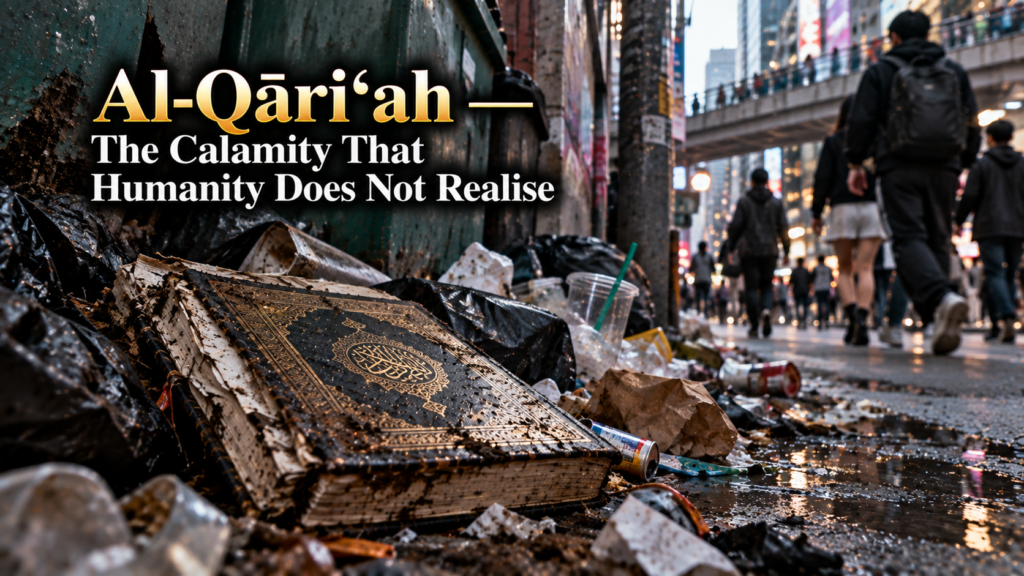
Surah Al-Qāri‘ah does not merely describe a devastating event.
It begins with a name.
الْقَارِعَةُ
“Al-Qāri‘ah.”
Then it immediately asks:
مَا الْقَارِعَةُ
“What is Al-Qāri‘ah?”
And once again:
وَمَا أَدْرَاكَ مَا الْقَارِعَةُ
“And what will make you know what Al-Qāri‘ah is?”
Why is the question repeated?
Because it is something immense, yet human beings do not truly realise it.
They read about Qiyāmah.
They hear about Qiyāmah.
They speak about its signs.
Yet they still imagine Qiyāmah as something distant, something that has not yet begun, and something they merely need to wait for.
But Al-Qāri‘ah presents an image of the state in which human beings finally come face to face with something they had never truly understood.
HUMANITY BECOMES DIRECTIONLESS
Allah continues:
يَوْمَ يَكُونُ النَّاسُ كَالْفَرَاشِ الْمَبْثُوثِ
“On the Day when people will be like scattered moths.”
— Al-Qāri‘ah 101:4
Consider the image of الْفَرَاشِ الْمَبْثُوثِ.
Moths flying about do not move in an orderly direction.
They scatter.
They circle around.
They come and go.
They do not know where to go.
This is the image of human beings when something they never expected finally happens.
They search for a way.
They search for answers.
They search for someone who can save them.
But they themselves do not know which direction to take.
All this time, human beings felt that life was under control.
When Al-Qāri‘ah comes, that confidence collapses.
What remains is humanity scattered in confusion.
MOUNTAINS LIKE SCATTERED WOOL
Then:
وَتَكُونُ الْجِبَالُ كَالْعِهْنِ الْمَنْفُوشِ
“And the mountains will be like scattered wool.”
— Al-Qāri‘ah 101:5
The Quran chooses a very powerful image:
الْعِهْنِ الْمَنْفُوشِ
Wool that has been loosened, pulled apart and scattered.
In the natural world, this image can be observed through mountains releasing ash, dust and smoke into the atmosphere.
Mountains that had always appeared solid and still suddenly become sources of material scattered into the air.
Volcanic ash rises.
Dust spreads.
Smoke fills the sky.
What is heavy upon the earth becomes like something light and dispersed.
However, a distinction must be made:
The verse literally describes the mountains as becoming like scattered wool. Connecting this imagery with eruptions, ash and smoke is a reading of the natural imagery, not a replacement of the wording of the verse itself.
THEN COMES THE WEIGHING
After describing humanity and the mountains, the surah immediately turns its attention towards the human being.
فَأَمَّا مَنْ ثَقُلَتْ مَوَازِينُهُ
“Then as for the one whose scales are heavy.”
— Al-Qāri‘ah 101:6
Then:
فَهُوَ فِي عِيشَةٍ رَاضِيَةٍ
“They will be in a pleasant life.”
— Al-Qāri‘ah 101:7
Why are some people at peace?
One reading that can be developed is that they do not encounter Al-Qāri‘ah as something completely unknown.
They had received the warning.
They observed the signs.
They understood that human beings are not merely commanded to read the text, but also to observe what is happening in the natural world and within themselves.
They prepared before something happened.
Therefore, when others panic, they are better prepared.
Not because they are immune to the event.
But because the event does not catch them in a state of complete ignorance.
The heaviness of their scales represents what has been accumulated before the moment of determination arrives:
knowledge,
awareness,
warnings,
deeds,
and preparation.
THOSE WHOSE SCALES ARE LIGHT
Then comes the opposite group:
وَأَمَّا مَنْ خَفَّتْ مَوَازِينُهُ
“And as for the one whose scales are light.”
— Al-Qāri‘ah 101:8
They are unprepared.
They did not expect it.
They may have heard the warnings but regarded them as something distant.
They may have read the verses but never connected them with life.
They may have been waiting for something extraordinary, to the point that they failed to notice the changes already taking place little by little.
When reality is finally unveiled, only then do they realise that they do not have sufficient provisions.
Then it is said:
فَأُمُّهُ هَاوِيَةٌ
“Then ummuhu is Hāwiyah.”
— Al-Qāri‘ah 101:9
The word هَاوِيَةٌ — Hāwiyah carries the imagery of falling, an abyss and destruction.
It portrays a tremendous fall.
Not merely a small shock.
Not merely a momentary fear.
But a state in which everything they had confidently believed collapses.
They thought something would never happen.
It happens.
They thought there was still time.
The time has arrived.
They thought there would be an easy way out.
They discover that they themselves are unprepared.
THE BURNING FIRE
Then the Quran closes the surah with:
وَمَا أَدْرَاكَ مَا هِيَهْ
“And what will make you know what it is?”
نَارٌ حَامِيَةٌ
“A fiercely burning fire.”
— Al-Qāri‘ah 101:10–11
The text explicitly mentions نَارٌ — fire.
Therefore, the wording of fire cannot be removed.
However, “fire” also opens a space for reflection as an image of suffering that burns the human being from within.
The fire of regret.
The fire of anger towards oneself.
The fire of realising that the signs had already been there.
The fire of realising that the warning had already arrived.
The fire of realising that previous choices were made without sufficient thought.
The fire of finally understanding that many things once regarded as insignificant actually carried immense consequences.
This is where Al-Qāri‘ah becomes profoundly heavy.
The calamity is not merely what happens outside the human being.
The greater calamity is when human beings finally understand what is happening — but that understanding comes only after their choices have already been made.
AL-QĀRI‘AH IS NOT MERELY A STORY ABOUT THE FUTURE
This surah can be read as a warning against living merely in a state of waiting.
Because those who only wait may fail to recognise the signs already appearing before their eyes.
Al-Qāri‘ah begins with a question.
As though human beings are being compelled to think:
Do you truly know what it is that you are waiting for?
Then humanity is portrayed as scattered.
The mountains change.
The scales are opened.
Some are at peace.
Some fall into Hāwiyah.
And finally, a fiercely burning fire is mentioned.
The sequence is not random.
It takes the human being from:
NOT KNOWING → SEEING → BEING WEIGHED → FACING THE CONSEQUENCES
CONCLUSION
Surah Al-Qāri‘ah is not merely a surah about fear.
It is a surah about awareness before it is too late.
Those who know beforehand are not the same as those who only come to know after the event.
Those who prepare are not the same as those who are taken by surprise.
Those who understand the warning are not the same as those who merely read but pay no attention.
That is why Al-Qāri‘ah is questioned repeatedly.
Because human beings may know its name,
yet still not know what it means for themselves.
AL-QĀRI‘AH IS NOT ONLY A CALAMITY OUTSIDE THE SELF.
THE GREATEST CALAMITY IS WHEN HUMAN BEINGS FINALLY UNDERSTAND ONLY AFTER EVERYTHING HAS ALREADY HAPPENED.