
QIAMAH
Surah Al-Qāri‘ah: Do Not Misunderstand Qiyāmah
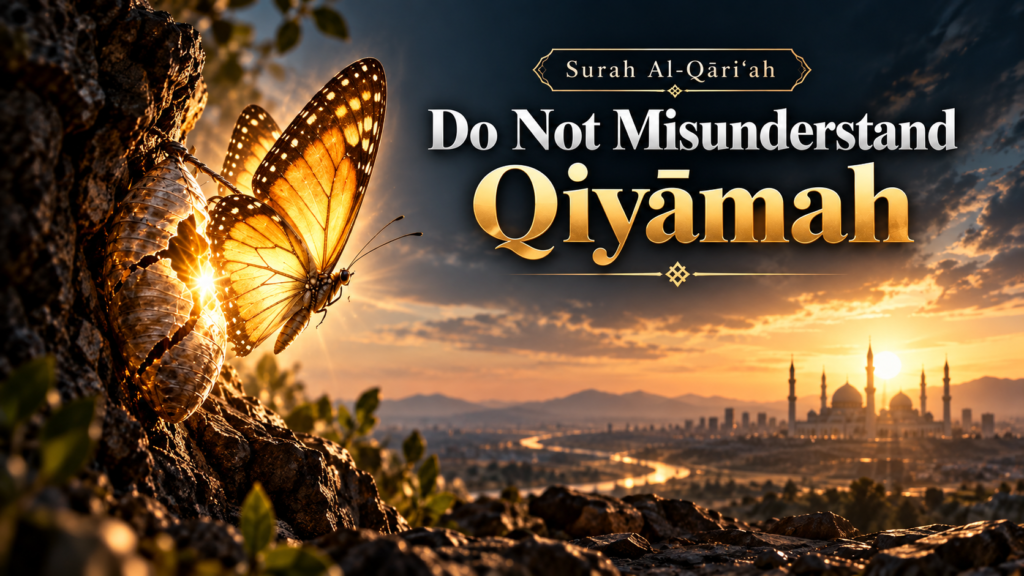
Qiyāmah is not destruction.
Qiyāmah is:
RISING.
Consider the Arabic word:
قِيَام — QIYĀM
meaning to stand / rise / stand upright
and:
قِيَامَة — QIYĀMAH
Both originate from the same root letters:
ق — و — م
QAF — WAW — MIM
From this root come the meanings of:
getting up,
standing,
standing upright,
rising.
Therefore, when we speak of:
يَوْمُ الْقِيَامَةِ
YAUM AL-QIYĀMAH
its fundamental focus is:
THE DAY OF RESURRECTION
THE DAY OF STANDING
THE DAY OF RISING
Not “the day of destruction”.
This is extremely important because misunderstanding the word Qiyāmah — قِيَامَة from the beginning will cause the entire understanding that follows to go astray.
Surah Al-Qāri‘ah then explains how this resurrection becomes a tremendous shock to human beings who have misunderstood it all along.
⸻
VERSE 1 — THE GREAT SHOCK
الْقَارِعَةُ
Within this framework:
AL-QĀRI‘AH = THE GREAT SHOCK
A shock occurs only when:
what was assumed does not match what actually happens.
If something has been anticipated accurately, there is no shock.
Therefore, Al-Qāri‘ah is the moment when:
ASSUMPTIONS SHATTER.
REALITY IS REVEALED.
⸻
VERSES 2 AND 3 — WHAT IS THIS SHOCK?
مَا الْقَارِعَةُ
وَمَا أَدْرَاكَ مَا الْقَارِعَةُ
Human beings do not yet truly know how the reality of resurrection will unfold.
If everything were already known precisely, it would no longer be a shock.
The question is:
WHAT DO HUMAN BEINGS ASSUME, AND WHAT ACTUALLY HAPPENS?
⸻
VERSE 4 — HUMAN BEINGS LIKE MOTHS
يَوْمَ يَكُونُ النَّاسُ كَالْفَرَاشِ الْمَبْثُوثِ
Why moths?
Because a moth:
EMERGES FROM ITS COCOON.
It leaves one state and emerges in a new state.
This is the illustration of:
قِيَامَة — QIYĀMAH
RISING.
Human beings emerge from their former state and rise into a new state.
It does not mean that human beings fly like drones.
⸻
VERSE 5 — THE MOUNTAINS SCATTERED
وَتَكُونُ الْجِبَالُ كَالْعِهْنِ الْمَنفُوشِ
What is mentioned is:
الْجِبَالُ
THE MOUNTAINS.
Not the earth.
Within this framework, the mountains break apart, erupt, and their material is scattered widely like fluffed wool.
This describes widespread volcanic eruptions.
⸻
VERSE 6 — WEIGHTY JUDGEMENT
فَأَمَّا مَن ثَقُلَتْ مَوَازِينُهُ
The weight is not measured in kilograms.
What carries weight is:
THE JUDGEMENT OF REASON.
The person has thought.
The person has weighed the matter.
The person has attained certainty that:
قِيَامَة = RISING.
Therefore, when Qiyāmah actually occurs, that reality aligns with the person’s judgement.
⸻
VERSE 7 — CONTENTMENT
فَهُوَ فِي عِيشَةٍ رَّاضِيَةٍ
The person is content because:
what happens matches what they had already come to believe with certainty.
Their judgement carries weight.
Their conviction is firm.
Reality confirms their understanding.
⸻
VERSE 8 — LIGHTWEIGHT JUDGEMENT
وَأَمَّا مَنْ خَفَّتْ مَوَازِينُهُ
What is light is:
THE JUDGEMENT OF REASON.
The person has misunderstood.
The person has not attained certainty.
The person accepted an imagined picture without resolving their understanding.
Therefore, when Qiyāmah occurs:
THEIR ASSUMPTIONS SHATTER.
This is where:
الْقَارِعَةُ
THE GREAT SHOCK
occurs.
⸻
VERSE 9 — DEPENDENCE ON THE “I”, THAT IS, HAWA
فَأُمُّهُ هَاوِيَةٌ
Within this framework:
HĀWIYAH → HAWA → EGO
The person remains dependent on:
“I”.
Yet the “I” has no independent existence.
It can exist only by depending on its source.
For example:
HEAT AND FIRE.
Heat comes from fire.
Heat cannot claim:
“I exist independently.”
Because without fire, where would the heat come from?
Heat depends on its source.
The same applies to the hawa of the ego.
A human being says:
“I exist.”
Yet their physical body is received.
Their spirit is received.
Their strength is received.
Their attributes are received.
Everything that allows the “I” to emerge is borrowed.
When what has been borrowed is taken back, the “I” loses the source upon which it depends.
What remains is:
MEMORY.
But that memory still wants to cling to:
“I”.
Like heat that wants to remain even after the fire is gone.
This is where the ego falls.
⸻
VERSE 10 — FINALLY KNOWING THE REALITY
وَمَا أَدْرَاكَ مَا هِيَهْ
When reality is revealed, only then does the person realise:
The “I” they have defended all along has never existed independently.
It depends.
It receives.
It exists through something else.
It is not the source.
⸻
VERSE 11 — THE HEAT OF ANGER AND REGRET
نَارٌ حَامِيَةٌ
When human beings come to know the true reality, there arises:
HEAT.
The heat of anger.
The heat of frustration.
The heat of disappointment.
The heat of regret.
Anger towards themselves because they were once given reason but refused to resolve their own judgement.
Only then do they realise:
“Why did I misunderstand?”
“Why did I defend the ‘I’?”
“Why did I fail to understand when I still had the opportunity?”
That is:
THE FIRE OF ANGER TOWARDS ONESELF.
⸻
THE SEQUENCE OF SURAH AL-QĀRI‘AH
قِيَام — QIYĀM
Standing / rising.
قِيَامَة — QIYĀMAH
Resurrection.
الْقَارِعَةُ — AL-QĀRI‘AH
The great shock when reality does not match what was assumed.
Verse 4
Human beings rise like moths emerging from their cocoons.
Verse 5
The mountains are scattered.
Verse 6
Weighty judgement of reason.
Verse 7
Contentment because the judgement was correct.
Verse 8
Lightweight judgement and misunderstanding.
Verse 9
Dependence on the hawa of the ego.
Verse 10
Reality is finally known.
Verse 11
The heat of anger, frustration and regret towards oneself.
⸻
CONCLUSION
Before imagining Qiyāmah, first look at the word itself:
قِيَامَة
And look at its root:
ق — و — م
QAF — WAW — MIM
A root that gives rise to:
قِيَام
STANDING
RISING
Therefore, do not turn resurrection into a story of destruction.
Qiyāmah is rising.
And Al-Qāri‘ah is the great shock when human beings rise and discover that:
REALITY DOES NOT MATCH THEIR ASSUMPTIONS.
Those whose judgement carries weight will be content.
Those whose judgement is light will be shocked.
Those who still depend on the “I” will come to know that the ego is merely like:
HEAT THAT DEPENDS ON FIRE.
When its source is gone, it has nothing upon which to stand.
And when that reality is finally known:
THE SELF BURNS WITH ANGER, FRUSTRATION AND REGRET.
DO NOT WAIT UNTIL قِيَامَة TO UNDERSTAND قِيَام.